

When to Hire Data Protection Specialists for a High-Risk Project
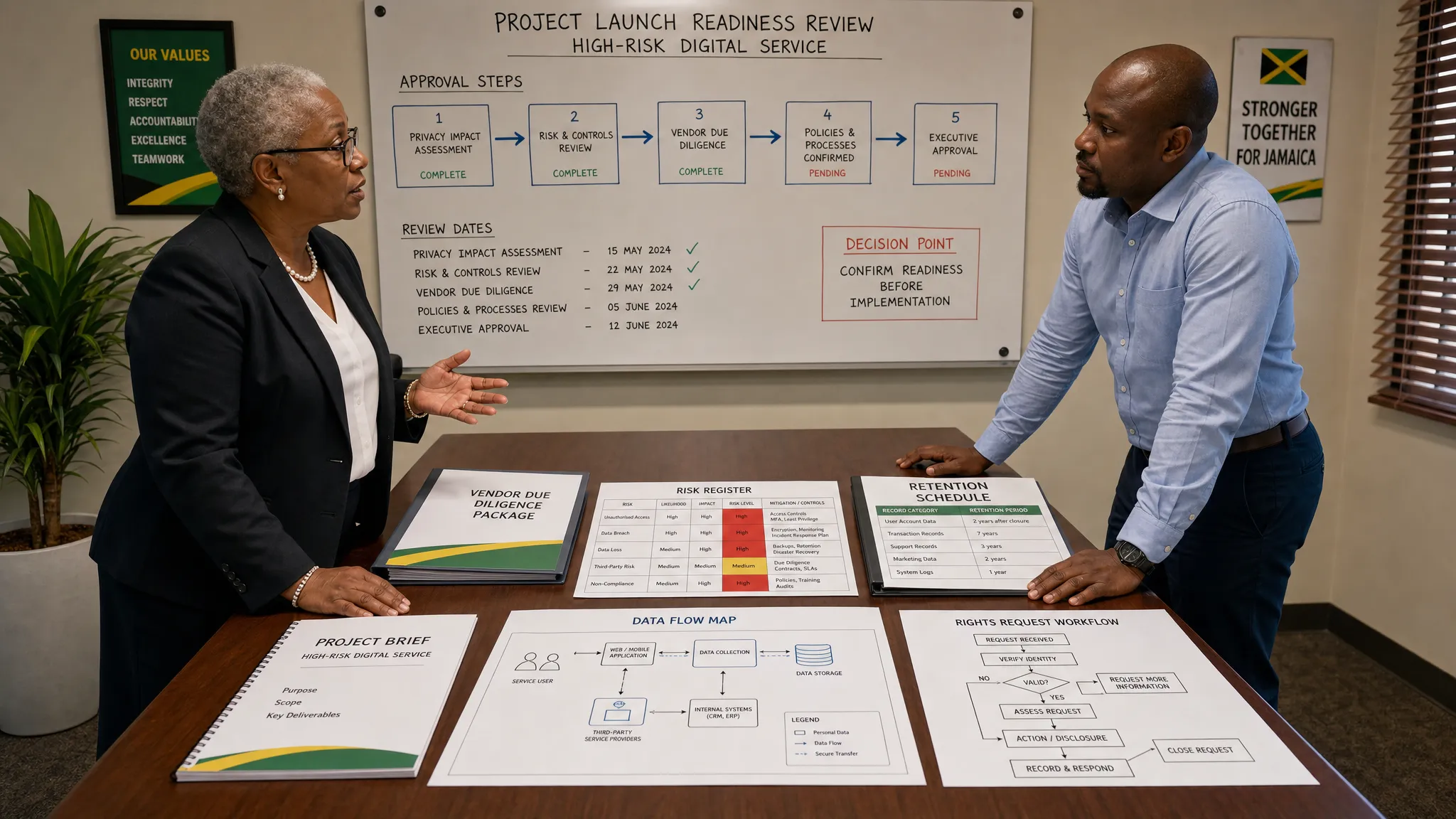
Some projects are too sensitive to treat privacy as a final legal check. A cloud migration, new customer onboarding platform, patient portal, employee monitoring tool, digital wallet, AML workflow, AI pilot, or analytics programme can change how personal data is collected, shared, profiled, retained, and secured.
For Jamaican organisations, these decisions must be viewed through the lens of the Data Protection Act, 2020, wider governance duties, cyber security expectations, and sector-specific obligations. By the time a project is ready to launch, privacy problems may already be built into contracts, system architecture, workflows, and customer communications.
That is where data protection specialists add the most value. They help leaders identify risk early, translate legal duties into workable controls, and create evidence that the organisation considered privacy before decisions became expensive to reverse.
What makes a project high-risk?
A project is high-risk when it could significantly affect individuals, expose sensitive or confidential information, create new security vulnerabilities, or make it difficult for the organisation to demonstrate lawful and accountable data handling.
High risk is not only about the size of the dataset. A small pilot can be risky if it uses sensitive health records, biometric data, employee surveillance, children’s information, location tracking, financial information, or identity documents. A large project can also be risky if it centralises data across departments, introduces complex vendors, or transfers data outside Jamaica.
For official updates on Jamaica’s data protection regime, organisations should monitor the Office of the Information Commissioner. International guidance, such as the UK ICO’s material on data protection impact assessments, can also be useful as a practical benchmark, while local legal and compliance requirements must remain the priority.
Project signal | Examples | Why specialist support helps |
Sensitive or high-impact data | Health records, biometric data, identity documents, financial data, employee disciplinary files | Specialists help assess necessity, access controls, notices, retention, and safeguards. |
New technology or automation | AI screening, profiling, facial recognition, automated eligibility decisions | Specialists review fairness, transparency, explainability, risk, and human oversight. |
Large-scale data consolidation | CRM replacement, HR system integration, national customer database | Specialists map data flows and prevent overcollection, excessive access, and unclear ownership. |
New vendor or cloud service | SaaS platforms, outsourced call centres, offshore hosting, managed IT services | Specialists assess processor obligations, contracts, transfers, security, and audit rights. |
Cross-border sharing | Regional processing, overseas support teams, global cloud infrastructure | Specialists evaluate transfer risk, contractual safeguards, and governance controls. |
Regulatory overlap | AML/KYC, healthcare, education, financial services, employment monitoring | Specialists align privacy obligations with sector rules and operational realities. |
Public trust or reputational sensitivity | Customer portals, complaint systems, public-facing digital services | Specialists help ensure privacy notices, consent choices, and complaint handling are credible. |
If several of these signals apply, the project should not proceed on ordinary procurement, IT, or legal review alone.
The best time to hire a data protection specialist
The best time to involve a specialist is before the organisation commits to the design, vendor, budget, or launch date. Early support allows privacy requirements to be built into the project rather than added after the fact.
A specialist does not need to slow the project down. In many cases, early privacy review prevents delay because it identifies the issues that would otherwise appear during contract negotiation, user testing, security review, customer complaints, or regulator scrutiny.
Project phase | What can go wrong without specialist input | What the specialist should do |
Idea and business case | The project is approved without understanding personal data risk. | Run a privacy triage and flag whether a deeper assessment is needed. |
Vendor selection | The selected supplier cannot meet privacy, security, or data residency expectations. | Add privacy requirements to the RFP, review vendor responses, and assess contract gaps. |
Process design | Teams collect more data than necessary or reuse data for unclear purposes. | Test necessity, purpose limitation, lawful basis, and data minimisation. |
Build and configuration | Access rights, logging, deletion, and reporting are not configured properly. | Work with IT and operations to embed privacy and security controls. |
Testing and pre-launch | Notices, consent journeys, retention rules, and rights request processes are incomplete. | Validate customer-facing materials, staff procedures, and evidence records. |
Post-launch | Risks are only discovered after complaints, incidents, or audit findings. | Review live controls, remediate gaps, and establish monitoring. |
If the project is already underway, it is still worth bringing in support. The specialist can prioritise the most material risks, identify quick fixes, and document what has been assessed. However, the later they join, the more likely the organisation will face rework.
Red flags that mean you should not wait
Some situations call for immediate specialist involvement, even if the project team believes it has privacy under control.
You should hire or engage data protection specialists when the project team cannot clearly answer questions such as what personal data will be collected, why each category is needed, who will access it, where it will be stored, how long it will be kept, which vendors will handle it, and how individuals can exercise their rights.
Another warning sign is when privacy is reduced to a single document. A privacy notice is important, but it is not the full compliance programme. The organisation also needs data flow records, decision logs, vendor due diligence, access controls, retention rules, incident procedures, training, and evidence that those controls are operating.
Projects involving AML and KYC are a good example. Organisations may be legally required to collect identity and verification information, but that does not remove the need to limit access, define retention, secure documents, manage vendors, and explain the processing clearly. Privacy and anti-money laundering compliance should work together, not compete.
What a data protection specialist should deliver
A useful specialist is not there to simply say yes or no. Their role is to help the project meet business goals while reducing legal, operational, cyber, and reputational exposure.
At a minimum, specialist support for a high-risk project should include:
Project privacy triage to decide whether a full assessment is needed.
Data mapping that shows what information is collected, used, shared, stored, and deleted.
Review of lawful basis, purpose, transparency, data minimisation, and retention.
Vendor and processor due diligence, including contract and transfer considerations.
Alignment with cyber security controls such as access management, encryption, logging, backups, and incident response.
Practical procedures for rights requests, complaints, breach escalation, and staff handling.
Training or briefing for the teams that will operate the process.
An evidence pack that management can rely on for audits, board reporting, or regulator engagement.
For a deeper view of assessment methods, see PLMC’s guide to data protection risk assessment scope, steps, and evidence. If the project depends heavily on technical safeguards, it is also worth reviewing the cyber data protection controls that reduce real risk.
Workstream | Evidence the project should keep |
Data mapping | Data inventory, system map, vendor list, access matrix |
Legal and privacy analysis | Lawful basis record, purpose assessment, privacy notice review, decision log |
Risk assessment | Risk register, mitigation plan, residual risk approval, review dates |
Vendor governance | Due diligence checklist, contract clauses, transfer assessment, service owner sign-off |
Security alignment | Access control evidence, encryption settings, logging approach, backup and recovery evidence |
Operational readiness | Staff procedure, rights request workflow, breach escalation steps, retention schedule |
Training | Attendance records, role-based materials, scenario exercises, follow-up actions |
Good evidence matters because compliance is not only about having policies. It is about proving that decisions were made thoughtfully and controls were implemented.
How much specialist support does the project need?
Not every high-risk project requires a full-time external adviser. The right engagement model depends on the project’s complexity, internal capability, timeline, and risk appetite.
Support model | Best fit | Watch-outs |
Short advisory review | A defined project with a capable internal privacy or compliance lead | May not be enough if data flows, vendors, or security controls are unclear. |
Project-embedded specialist | Complex implementation, new technology, multiple departments, or tight deadlines | Requires clear decision rights so recommendations are acted on. |
Independent assurance review | Pre-launch validation, board concern, audit preparation, or remediation after a finding | Works best when the project team has already gathered evidence. |
Ongoing privacy programme support | Several projects, limited internal resources, or a need to mature governance | Should be tied to a roadmap, metrics, and management ownership. |

Many organisations choose a hybrid model. Internal teams keep ownership of the project, while the specialist provides structured review, templates, challenge, and practical guidance at key decision points.
How to choose the right specialist for a high-risk project
The right specialist should understand both data protection compliance and project delivery. High-risk work is rarely solved by legal knowledge alone. It requires the ability to work with IT, procurement, HR, operations, marketing, finance, risk, and senior leadership.
Look for experience in Jamaica’s Data Protection Act, 2020, local business practices, sector-specific obligations, and practical governance. If your project involves vendors, cloud hosting, cyber security, AML compliance, or international data flows, ask for evidence that the specialist has handled those issues before.
A good specialist should be able to explain risk in business language. They should not overwhelm the project with theory, nor should they promise that a template will solve everything. They should help the organisation make defensible decisions, assign ownership, and produce documents that people can actually use.
Useful questions to ask before hiring include:
What high-risk projects have you supported that are similar to ours?
How do you decide whether a full privacy impact assessment is needed?
What evidence will we have at the end of the engagement?
How will you work with IT security, legal, compliance, procurement, and business owners?
Can you help us turn findings into controls, procedures, and training?
How will you distinguish urgent risks from lower-priority improvements?
PLMC’s guide on what to expect from privacy protection services in Jamaica can help you compare providers and scope an engagement properly.
How to prepare before you bring in support
You do not need to have everything perfect before speaking with a specialist. In fact, incomplete information is often the reason to seek help. Still, gathering a few core materials will make the first review more productive.
Before the first meeting, try to collect the project brief, business objectives, system or vendor names, types of personal data involved, expected users, customer or employee groups affected, countries where data may be accessed, draft contracts, existing privacy notices, relevant policies, and any known concerns from IT, legal, compliance, or operations.
The specialist can then identify missing information and help the project team build a realistic assessment plan. For organisations with multiple departments involved, it is also helpful to appoint a single project owner who can coordinate responses and escalate decisions.
This is where governance becomes important. A specialist can recommend controls, but management must approve risk decisions, assign resources, and ensure business units follow through. For a broader operating model, see PLMC’s article on data protection governance, roles, RACI, and reporting.
Common mistakes to avoid
The first mistake is waiting until go-live. At that point, contracts may be signed, system settings may be fixed, staff may be trained incorrectly, and the public notice may not match the real process.
The second mistake is treating cyber security review as a complete privacy review. Security is essential, but privacy also asks whether the organisation should collect the data, whether the purpose is clear, whether individuals are properly informed, whether retention is justified, and whether people can exercise their rights.
The third mistake is relying completely on a vendor’s compliance statement. A vendor may have strong global controls, but the organisation still needs to understand how the service will be configured, what data will be processed, where it will go, who can access it, and what happens at termination.
The fourth mistake is failing to train the people who will operate the process. A well-designed system can still create risk if staff overshare information, ignore identity verification, keep records too long, or fail to report incidents. Role-based training is especially important for high-risk projects. PLMC’s guide to data protection training courses by role explains how to tailor learning to different teams.
Frequently Asked Questions
Do we need data protection specialists for every new project? No. Low-risk projects may only need a light privacy check by an internal compliance or legal lead. Specialist support becomes more important when the project involves sensitive data, new technology, large-scale processing, vendors, cross-border access, or significant impact on individuals.
Should we hire a specialist before or after selecting a vendor? Before vendor selection is usually best. That allows privacy and security requirements to be included in the procurement process and contract discussions. If the vendor has already been chosen, a specialist can still review configuration, contract gaps, data flows, and launch readiness.
Is a data protection impact assessment always required for a high-risk project? The formality and depth of the assessment will depend on the project and the organisation’s obligations. However, high-risk processing should be assessed and documented in a structured way so the organisation can show how risks were identified, mitigated, and approved.
Can our IT security team handle the review alone? IT security is essential, but it should not be the only reviewer. Security focuses on protecting systems and data from compromise. Data protection also covers lawful use, fairness, transparency, minimisation, retention, rights handling, vendor governance, and accountability.
What if the project is already live? Bring in support as soon as possible. A specialist can perform a post-launch review, prioritise urgent fixes, update notices and procedures, strengthen controls, and create a remediation plan with evidence of progress.
Build privacy into the project before risk becomes rework
High-risk projects can deliver major business value, but only if privacy, security, governance, and compliance are considered from the start. The earlier you involve data protection specialists, the easier it is to design controls that work, avoid costly rework, and demonstrate accountability under Jamaica’s Data Protection Act, 2020.
Privacy & Legal Management Consultants Ltd. supports organisations in Jamaica with data protection implementation, corporate governance, AML compliance, cyber security, GRC integration, training, risk assessment tools, and practical compliance guidance.
If your organisation is planning a sensitive project, modernising systems, selecting a vendor, or preparing for launch, contact PLMC to discuss the right level of support before privacy risk becomes a project blocker.