

Privacy Statements: What Your Website Needs in 2026

If your website collects names through a contact form, tracks visitors with analytics, or embeds third party tools (payments, chat widgets, marketing pixels), you are processing personal data. In 2026, that reality comes with higher expectations from customers, regulators, and business partners. A clear, accurate privacy statement is no longer a “nice to have”, it is a core compliance document and a trust signal.
This guide explains what privacy statements should include in 2026, with a practical lens for Jamaican organisations aligning with the Data Protection Act.
What a “privacy statement” needs to do (beyond legal compliance)
A privacy statement (also called a privacy notice) should help a real person quickly understand:
What data you collect (and what you do not collect)
Why you collect it (your purposes)
Who you share it with (including vendors)
How long you keep it
What rights people have and how to use them
How to contact you for privacy questions
In practice, it also needs to stand up to scrutiny: if your statement says you do not share data, but your site loads ad tracking pixels, your organisation is exposed.
Privacy statement vs cookie banner vs Terms and Conditions
Many websites mix these up. They are related, but not interchangeable.
Document | What it covers | Who needs it | Where it’s usually shown |
Privacy statement | Personal data processing disclosures and rights | Any site collecting or tracking personal data | Footer link, forms, sign up flows |
Cookie notice (or cookie section) | Tracking technologies, cookies, similar identifiers, and choices | Sites using analytics, marketing tags, embedded tools | Banner and/or dedicated page |
Terms and Conditions | Contractual terms, site rules, disclaimers | Most business sites, especially e-commerce | Checkout, footer |
A cookie banner alone does not replace a privacy statement. And Terms and Conditions rarely satisfy transparency requirements for personal data.
What Jamaican websites should cover under the Data Protection Act
PLMC’s broader compliance content focuses on governance, rights handling, vendor management, and operational controls. If you need the big picture, see:
For your website privacy statement specifically, the core principle is transparency: individuals should not have to guess what happens to their personal data when they interact with your site.
A strong statement in 2026 is usually built around the sections below.
The 2026 privacy statement checklist (website specific)
1) Who you are (controller identity) and how to contact you
Make it easy to identify the organisation responsible for the site.
Include:
Registered business name (and trading name if different)
Business address (or at minimum, country and parish plus a contact channel)
A privacy contact email or form
Your data protection lead or officer (if appointed), or the team responsible
Why it matters: rights requests and complaints often fail because people cannot find a contact.
2) What personal data you collect (by interaction)
Avoid generic statements like “we may collect information”. Instead, map to real website touchpoints.
Examples of categories to document:
Contact forms: name, email, phone number, message content
Accounts or portals: username, password (stored hashed), activity logs
Bookings or enquiries: service details, appointment preferences
Payments: you should usually avoid collecting full card details directly unless you are PCI-ready. Most sites use a payment processor and receive confirmation tokens.
Technical data: IP address, device/browser info, timestamps, pages visited (often via analytics)
If you collect sensitive data (for example health information, ID numbers, or anything that could be considered highly sensitive in context), get legal advice on how you describe it and how you handle it. Do not bury it inside a broad “other information” paragraph.
3) Why you use the data (purposes) and your lawful basis
Your privacy statement should connect each collection activity to a legitimate purpose.
Common website purposes include:
Responding to enquiries
Providing requested services
Creating and managing user accounts
Improving site performance and user experience
Preventing fraud and securing systems
Marketing (where applicable)
Where appropriate, also document the lawful basis you rely on (for example, performance of a contract, legitimate interests, consent). If you are not sure which basis applies to each activity, that is a signal to step back and do a quick processing review.
4) Cookies, analytics, pixels, and “similar technologies”
In 2026, this is where many privacy statements fail in real life.
If you use any of the following, disclose them clearly:
Analytics tools
Advertising pixels and retargeting tags
Embedded video players
Social media plugins
Fraud prevention and bot detection tools
At a minimum, your privacy statement should:
Explain what tracking technologies are used and why
Link to your cookie notice (or a cookie section)
Explain how users can manage preferences (for example via a consent banner and browser controls)
For generally recognised guidance on writing clear privacy notices, many organisations benchmark against the UK ICO privacy notice guidance because it is practical and user-focused.

5) Who you share personal data with (and why)
List categories of recipients and, where helpful, examples.
Common website sharing scenarios:
Hosting providers and cloud platforms
Email delivery and CRM tools
Payment processors
Website analytics providers
IT and cybersecurity service providers
Keep it accurate. If your site uses multiple plugins that pass data to third parties, do not say “we do not share data”.
A practical approach is to describe:
Recipient category (for example “website hosting providers”)
Purpose (for example “to host and secure our website”)
What data is involved at a high level
6) Cross-border transfers (especially cloud services)
Many Jamaican organisations use cloud services hosted outside Jamaica. If personal data is transferred or accessed internationally, your privacy statement should say so in plain language.
Good disclosure looks like:
Which types of vendors are involved (for example hosting, analytics, email)
That transfers may occur to other countries
The safeguards you rely on (described generally if you cannot list details publicly)
This aligns with the real compliance work described in PLMC’s practical resources on vendor governance and cross-border considerations, such as Data Protection Basics: What Jamaican Firms Must Know.
7) Retention: how long you keep website data
Retention is often ignored, but it is a key accountability signal.
You do not need to publish a full retention schedule, but you should communicate:
The criteria you use (for example “for as long as necessary to respond to your request, then archived for X period for audit and legal purposes”)
Different retention logic for different sources (contact form vs customer account)
If you cannot defend your retention periods internally, fix that first, then update the statement.
8) Individual rights and how to submit a request
Your statement should explain what people can ask for (access, correction, deletion where applicable, objection, etc.) and how they can do it.
Include:
The request channel (email, form, postal address)
What you will do to verify identity
Expected timelines (keep these realistic and aligned with your internal process)
If your rights handling process is still being formalised, prioritise that. A privacy statement is not just a website page, it is a commitment you must operationalise.
9) Security: what you do to protect data (without oversharing)
You should provide reassurance, but avoid publishing a technical blueprint.
Appropriate statements reference controls like:
Access controls and least privilege
Encryption in transit (HTTPS/TLS)
Monitoring and incident response procedures
Vendor due diligence
If your website does not consistently enforce HTTPS, fix that immediately before revising your privacy statement.
10) Children and student users (where relevant)
If your site is likely to be used by minors (schools, youth programmes, certain community services), add a clear section on:
Whether you knowingly collect children’s data
What parental or guardian involvement is required
What happens if a child submits data unintentionally
11) Marketing communications (email, SMS, WhatsApp)
If you send marketing messages, your privacy statement should match your actual practice.
Be clear on:
What users are signing up for
How they can opt out
Whether you use third party marketing platforms
12) Versioning: “effective date” and change notifications
In 2026, privacy statements are living documents. Include:
An effective date
How you will notify users of material changes (for example prominent notice on the site, or email for account holders)
Avoid fake precision like “we review monthly” unless you truly do.
A practical build process that avoids “privacy theatre”
The fastest way to produce a privacy statement is to copy a template. The fastest way to get into trouble is also to copy a template.
A better 90-minute process for most Jamaican SMEs and mid-sized organisations:
Step 1: Inventory your website data flows
Open your website in a private browser window and note every interaction that collects or emits data:
Forms
Newsletter sign-up
Booking widgets
Embedded maps or videos
Analytics and marketing tags
Live chat
If you have access to your tag manager, list every active tag and what it does.
Step 2: Match each flow to purpose, legal basis, recipients, and retention
This is the heart of the statement. A simple internal worksheet is enough.
Website element | Data involved | Purpose | Shared with | Retention trigger |
Contact form | Name, email, message | Respond to enquiries | Email/CRM provider | Closed enquiry + defined archive period |
Analytics | Device and usage data | Improve site performance | Analytics provider | Per tool settings + periodic deletion |
Payment link | Transaction reference | Take payment | Payment processor | Financial recordkeeping needs |
Only include items you are confident are true for your site.
Step 3: Draft for clarity, then legal accuracy
A good privacy statement reads like clear business communication, not like a law textbook.
Practical drafting tips:
Use headings that match user questions (“What we collect”, “Who we share with”, “Your rights”)
Keep paragraphs short
Avoid vague language (“may”, “might”, “sometimes”) unless it reflects reality
Step 4: Publish where users expect to find it
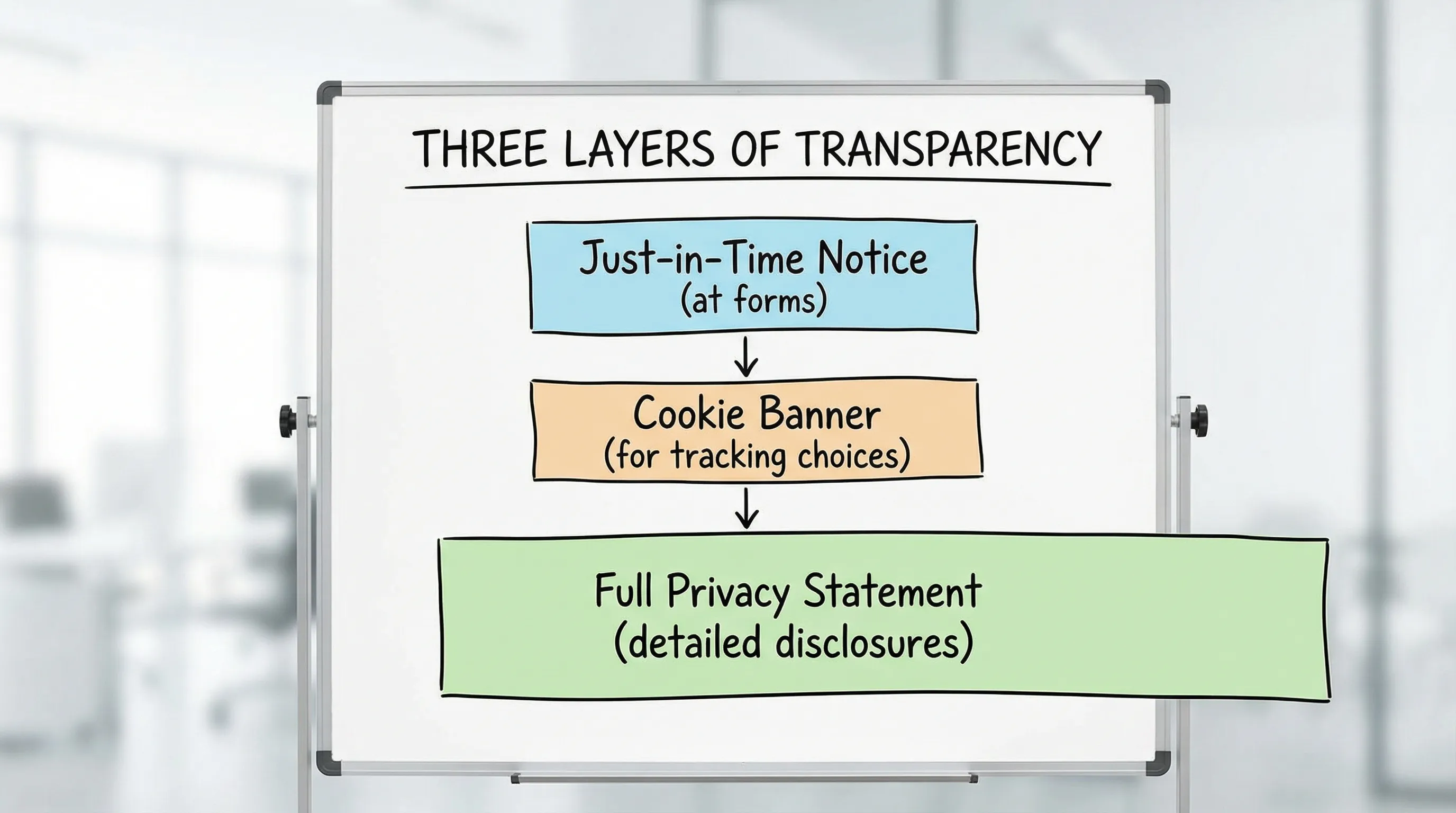
At minimum, place a footer link labelled “Privacy Statement” on every page.
Also link it:
Next to forms (“By submitting this form…”) with a short just-in-time notice
In account registration flows
In your cookie banner or cookie settings panel
Common mistakes we see on websites (and how to fix them)
“We do not share your information” while using third party tools
If your site uses third party analytics, embedded maps, marketing pixels, or cloud forms, you are almost certainly sharing some data. Fix by describing recipient categories honestly.
A privacy statement that does not match operations
If your statement promises deletion on request but you have no internal process to action it, that is a governance gap. Align your statement with your rights handling capability, then build the capability.
Forgetting vendor and plugin sprawl
Modern sites can load dozens of scripts. Review your plugins, tag manager, and embeds at least quarterly.
No retention logic
Saying “we keep data as long as necessary” is not enough unless you explain what “necessary” means in your context.
When to review your privacy statement in 2026
Review when any of these change:
You add a new form, booking tool, chat widget, or marketing pixel
You change your CRM, email platform, host, or analytics provider
You expand services or start processing new types of personal data
You begin using AI tools that collect or analyse user inputs
As a baseline, many organisations schedule a review at least annually, plus after major website releases.
How PLMC can help
If you want confidence that your published privacy statement matches your real data processing, it helps to treat it as part of your compliance programme, not a website copy exercise.
PLMC supports Jamaican organisations with data protection implementation, training, and broader Governance, Risk, and Compliance integration. If you are building or refreshing your transparency documentation as part of a wider readiness push, you may also find these resources useful:
For organisations that want a guided review, PLMC offers consultations and can help you validate what your website collects, what your vendors receive, and what your privacy statement should say in 2026.