

Privacy and Data Protection: A Practical Checklist

Data privacy failures rarely start with “hackers” and “malware”. More often, they start with everyday gaps, an outdated spreadsheet of customer data, a staff member unsure what to say when a client asks for a copy of their information, or a vendor contract that never mentioned security.
For organisations in Jamaica, privacy and data protection is no longer a “nice to have”. It is a governance and risk issue that touches customer trust, regulatory exposure, cyber security, and business continuity. This practical checklist is designed to help you identify what “good” looks like, document evidence, and prioritise fixes.
How to use this checklist (so it actually helps)
Start by treating this as a working document, not a one-time exercise.
Assign an owner for each section (HR, IT, Operations, Legal, etc.).
Collect evidence as you go (policies, screenshots, logs, contracts).
Flag any item you cannot evidence today, those are your action items.
If you are aligning to Jamaica’s legal framework, read the Data Protection Act itself and any guidance from the regulator. A public starting point is the Jamaica Data Protection Act (DPA) and the Office of the Information Commissioner (OIC) website.
Quick readiness snapshot (what most organisations miss)
Use this table to run a fast internal check. If you cannot confidently answer “Yes”, treat it as a priority gap.
Area | “Yes” looks like | Typical gap to fix first |
Accountability | A named privacy lead, with authority and reporting lines | Nobody “owns” privacy decisions |
Data inventory | You can list the personal data you hold, where it lives, and why | Shadow files, scattered drives, unknown systems |
Notices | Clear privacy notices for customers and staff | Notices are generic, incomplete, or missing |
Rights requests | A documented process to respond within legal timelines | Requests handled ad hoc, no tracking |
Security | Risk-based controls, access management, logging, backups | Shared accounts, weak access controls, poor monitoring |
Vendors | Contracts address security and confidentiality | Vendors are onboarded without due diligence |
Breaches | An incident response plan and a tested workflow | No playbook, no clear reporting chain |
1) Governance and accountability
Privacy compliance starts with governance. Without clear responsibility, decisions get delayed or delegated to whoever shouts loudest.
Checklist
Appoint a responsible role for privacy and data protection (even if not full-time), with defined authority.
Create or update core policies, including:
Data protection and privacy policy
Information security policy
Data retention and disposal policy
Acceptable use and remote work policy
Maintain a record of key decisions (why you collect data, how long you keep it, who can access it).
Train staff by role (front desk, HR, finance, IT, field teams) and document attendance.
Practical tip: Keep governance lightweight. A short monthly privacy checkpoint meeting, with actions and owners, is often better than a “big annual review” that never happens.
2) Map your personal data (inventory and data flows)
You cannot protect what you cannot see. A data inventory is the foundation for notices, security, retention, and responding to rights requests.
Checklist
List your systems and repositories that store personal data (HR system, CRM, email, shared drives, paper files, mobile devices).
Document the data types you process (IDs, contact details, payroll info, health information, CCTV footage, call recordings).
Record the purpose for each processing activity (why you collect it and how you use it).
Identify where data flows (collection points, internal sharing, vendors, cloud services, cross-border access).
Classify data by sensitivity (for example, general personal data vs sensitive categories requiring higher safeguards).
Evidence to gather
What to document | Example evidence |
Data inventory | Spreadsheet or GRC tool export |
Data flow map | Diagram, even if simple |
System owners | List of application owners and administrators |
3) Lawful, fair, and minimised processing
Many organisations collect “just in case” data. That is risky. A strong privacy posture uses purpose limitation and minimisation as default controls.
Checklist
Collect only what you need for a defined purpose, and stop collecting “nice to have” fields.
Align collection forms (paper and online) to the purpose stated.
Confirm fairness and expectations, especially when using surveillance, monitoring tools, or analytics.
Set retention periods by category and implement disposal processes (including backups where feasible).
If your retention policy says “keep for 7 years”, verify that your systems can actually enforce it. Policies that cannot be implemented create audit risk.
4) Transparency: privacy notices that match reality
Privacy notices should not be copied from another website. They must reflect your actual processing activities, especially sharing and retention.
Checklist
Publish a customer-facing privacy notice (website, forms, reception area as needed).
Provide an employee privacy notice covering HR processing, monitoring, and staff data sharing.
Explain key points in plain language, including:
What you collect
Why you collect it
Who you share it with (vendors and partners)
How long you keep it
How people can contact you and exercise their rights
Keep version control so you can prove what notice applied at a given time.
5) Individual rights: build a repeatable request process
People will ask questions: “What do you have on me?”, “Fix this”, “Stop using my information”, or “Delete it”. The risk is not the request, the risk is inconsistent handling.
Checklist
Create an intake channel (email address or web form) for privacy requests.
Verify identity before releasing personal data.
Track requests in a simple register (date received, request type, assigned owner, outcome).
Meet statutory timelines and document reasons if you cannot.
Train frontline staff so requests are not ignored or mishandled.
Practical tip: Most delays come from searching across multiple inboxes, drives, and systems. Your data inventory directly improves response time.
6) Security controls that support privacy
Privacy and security overlap, but they are not identical. Strong data protection needs security controls that are risk-based and consistently applied.
Checklist
Access control
Use unique accounts, least privilege, and timely user removal
Implement MFA where possible
Device and endpoint protections
Encrypt laptops and removable media
Secure mobile access (screen locks, remote wipe capability)
Logging and monitoring
Keep logs for critical systems
Review alerts and unusual access patterns
Backups and recovery
Maintain backups and test restoration
Physical security
Secure file rooms, visitor controls, and workstation screens
For internationally recognised security guidance, the NIST Cybersecurity Framework is a useful reference point, even for smaller organisations.
7) Vendor and third-party management
If a vendor touches personal data, your risk travels with them. A contract without security and confidentiality terms is a common, avoidable gap.
Checklist
Maintain a vendor list showing which vendors process personal data.
Perform due diligence proportionate to risk (especially for cloud services, payroll, HR, call centres, and IT support).
Use written agreements that address:
Confidentiality
Security requirements
Subcontracting rules
Breach notification expectations
Data return or destruction on termination
Reassess high-risk vendors annually or after major changes.
8) Cross-border access and international operations
Even if your organisation is Jamaican, your personal data may be accessed or stored abroad through cloud platforms, support teams, or group companies.
Checklist
Identify cross-border data flows (cloud hosting region, overseas support access, parent company reporting).
Assess risks (legal environment, vendor security posture, access controls, encryption).
Document safeguards (contract clauses, technical controls, restricted access, audit rights where applicable).
Align business expansion plans with privacy planning early.
If your organisation is exploring international growth, such as setting up operations or investing abroad, treat data protection as part of your market-entry checklist. For example, teams looking for structured, end-to-end support for UAE business or property ventures may find it helpful to consult a specialist like Dubai Invest alongside their legal, tax, and compliance advisors, because cross-border expansion often introduces new data handling and documentation requirements.
9) Breach readiness (because “when” beats “if”)
A privacy breach is not only a cyber incident. It can be a misdirected email, a lost laptop, an exposed file link, or unauthorised staff access.
Checklist
Create an incident response plan that includes privacy steps (containment, assessment, communications, documentation).
Define roles (incident lead, IT, communications, legal/compliance, senior management).
Maintain a breach log to track what happened and corrective actions.
Run tabletop exercises at least annually for realistic scenarios.
Establish notification decision-making aligned to the legal framework and regulator expectations.
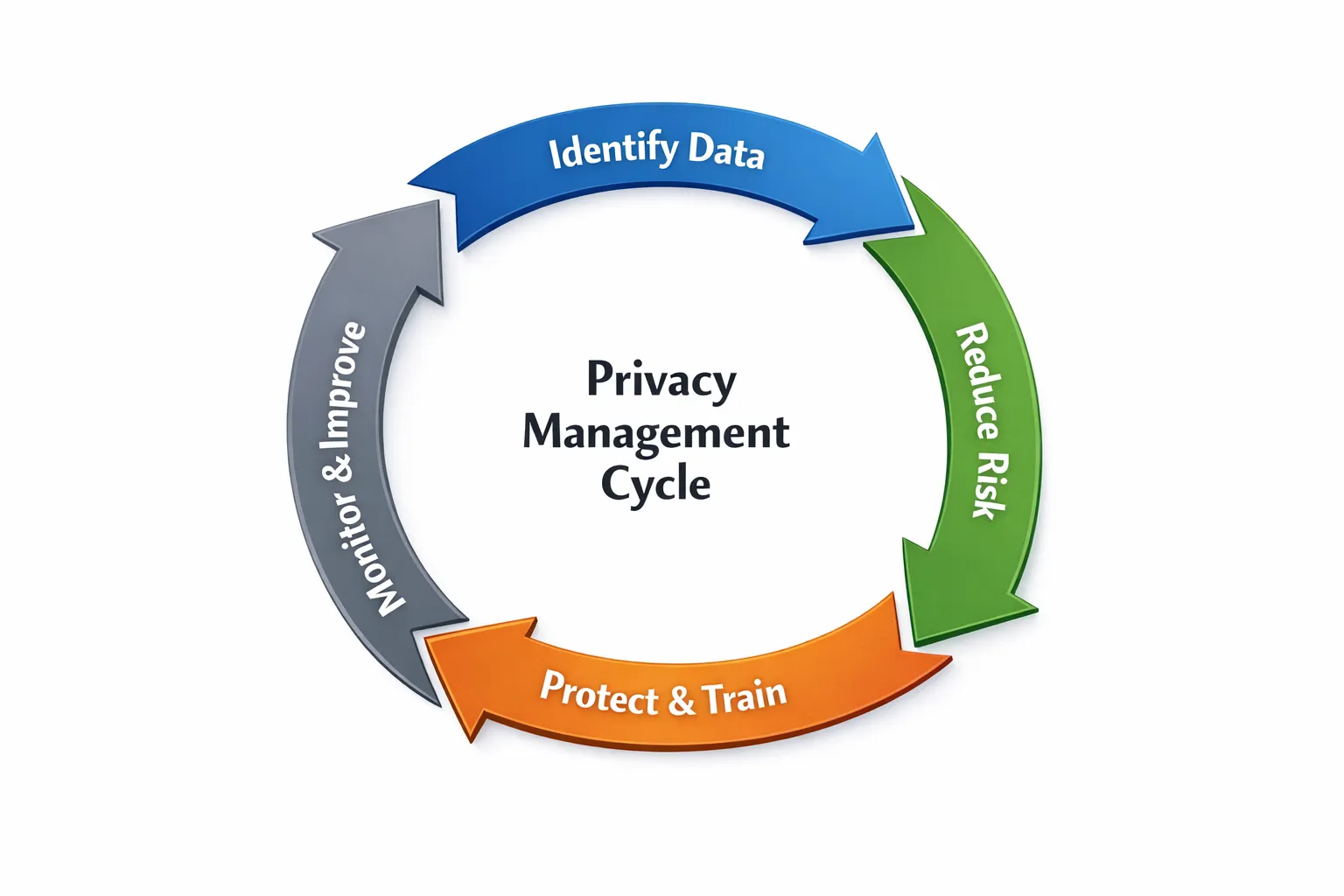
10) Risk assessments and continuous improvement
A privacy programme is a living system. Regulators and customers expect you to improve controls as your processing changes.
Checklist
Perform periodic privacy risk assessments, especially when introducing new systems, surveillance, or sensitive data processing.
Review policies and notices on a defined schedule, and after major operational changes.
Audit key controls (access reviews, vendor checks, retention, staff training completion).
Measure performance using simple metrics (number of requests received, time to close, incidents logged, training coverage).
A simple “evidence pack” to keep on file
If you ever need to demonstrate compliance, having documentation ready reduces stress and improves response quality.
Document | Why it matters |
Data inventory and data flow summary | Proves you understand what you process and where it goes |
Privacy notices (current and historical versions) | Demonstrates transparency at the time of collection |
Rights request register | Shows consistent handling and accountability |
Incident response plan and breach log | Demonstrates preparedness and continuous improvement |
Vendor list and key agreements | Shows third-party governance |
Training records and materials | Demonstrates awareness and role-based education |
Frequently Asked Questions
Is privacy and data protection only an IT issue? No. IT secures systems, but privacy also includes governance, lawful collection, staff behaviour, vendor contracts, retention, and how you respond to individual requests.
What is the first thing we should do if we have no privacy programme today? Assign ownership, then build a data inventory. Once you know what data you have, you can prioritise notices, retention, vendor contracts, and security controls with much less guesswork.
Do we need a privacy notice even if we only collect employee data? Yes. Employees are data subjects too, and HR processing often includes sensitive information. A clear internal notice sets expectations and reduces disputes.
How do we handle a request for access or correction of personal data? Use a documented workflow: verify identity, locate data using your inventory, apply internal approvals, respond within statutory timelines, and log the outcome.
What counts as a data breach? Any incident that compromises confidentiality, integrity, or availability of personal data. That includes lost devices, unauthorised access, and accidental disclosure (like emailing a spreadsheet to the wrong recipient).
How often should we review vendors who handle personal data? Review high-risk vendors at least annually and whenever there is a major change (new system, new subcontractor, security incident, or scope expansion).
Need help turning this checklist into a working compliance programme?
Privacy & Legal Management Consultants Ltd. (PLMC) supports Jamaican organisations with practical data protection implementation, privacy awareness training, and compliance-oriented risk assessments.
If you want help prioritising gaps, building documentation, or training staff, consider booking a consultation through Privacy & Legal Management Consultants Ltd..