
Data Privacy in Jamaica: Key Principles and Rights

Data privacy is no longer “nice to have” in Jamaica. With the Data Protection Act, 2020 in force, organizations are expected to handle personal information more transparently, more securely, and with clearer accountability. For individuals, it also means stronger rights to understand and influence what happens to their data.
This guide breaks down the key data privacy principles and the core rights that matter most in Jamaica, plus practical steps businesses and individuals can take right now.
What counts as “personal data” in Jamaica?
In practical terms, personal data is information that can identify a person directly or indirectly. In Jamaican workplaces, customer databases, and online services, common examples include:
Names, TRN, passport number, driver’s licence number
Phone numbers, email addresses, home addresses
HR records, payroll data, performance files
CCTV footage where individuals are identifiable
Device IDs and online identifiers (depending on context)
Sensitive categories (for example, health-related information), which generally require extra care
If your organization can link information back to a specific person, it should be treated as personal data and protected accordingly.
Data privacy in Jamaica: the key principles (in plain English)
Most modern privacy laws share a similar foundation: collect only what you need, use it responsibly, keep it secure, and respect people’s rights. Jamaica’s approach follows that global pattern.
Below is a practical summary of the principles businesses should operationalize.
Principle | What it means in practice | Example in a Jamaican organization |
Fairness and transparency | People should not be surprised by how you use their data, and they should get clear notices | A bank explains, in plain language, how it uses customer data for fraud prevention and account servicing |
Purpose limitation | Collect data for specific reasons and avoid using it later for unrelated purposes | A school collects parent contact info for emergencies, not for marketing third-party services |
Data minimisation | Only collect what you truly need | A retail store stops collecting date of birth unless age verification is required |
Accuracy | Keep personal data correct and up to date | HR updates employee addresses and emergency contacts on a defined schedule |
Storage limitation | Do not keep data forever “just in case” | A company sets retention periods for applicant CVs and deletes them when the period expires |
Security and confidentiality | Protect data against loss, unauthorized access, and misuse | MFA, access controls, encryption, secure disposal, and incident response procedures |
Accountability | Be able to prove compliance, not just claim it | Written policies, training logs, vendor due diligence, and privacy risk assessments |
Controls on international transfers | If data leaves Jamaica, ensure safeguards are in place | A BPO using overseas cloud services documents transfer safeguards and vendor security commitments |
Why these principles matter beyond compliance
These principles are not only legal concepts. They reduce real operational risk:
Fewer incidents and less downtime when security is improved
Less reputational damage from data leaks or “privacy backlash”
Cleaner data for analytics and decision-making
Stronger trust when customers, patients, or citizens ask, “What are you doing with my information?”
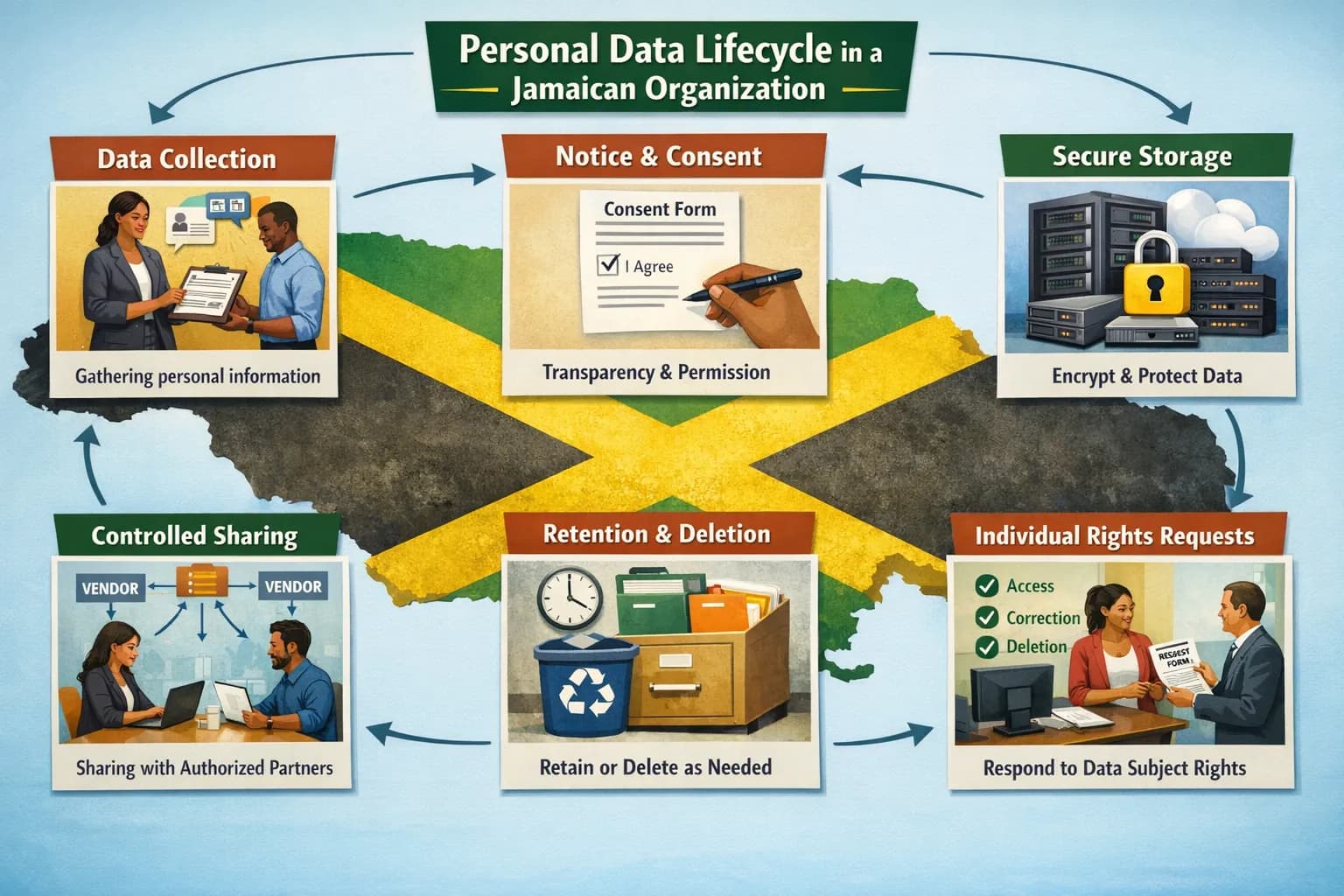
The rights of individuals under Jamaica’s privacy framework
A data privacy law is not only about what organizations must do. It is also about what individuals can request and control.
While the exact scope and conditions can vary depending on the circumstances (and may include specific exemptions), the rights commonly recognized in Jamaica’s data protection framework include the following.
Individual right | What it enables | What you can say when you use it |
Right to be informed | You can ask for clarity about what data is collected, why, and who it’s shared with | “Please explain what personal data you hold about me and how you use it.” |
Right of access | You can request a copy of personal data an organization holds about you | “I am requesting access to my personal data and related details of processing.” |
Right to correct (rectification) | You can ask for inaccurate or incomplete data to be fixed | “My address on file is wrong. Please update it and confirm when done.” |
Right to object (certain uses) | You can object to specific processing, especially intrusive or unwanted use | “I object to my data being used for direct marketing.” |
Rights around deletion/retention (where applicable) | You can question whether an organization needs to keep your data | “Your retention period has passed. Please delete or anonymize my data unless you must keep it by law.” |
Right to complain | You can escalate concerns to the regulator or relevant oversight body | “I have not received a response within a reasonable time. I am escalating this matter.” |
What individuals should include in a data request
To get faster, clearer outcomes when making an access or correction request, it helps to include:
Your full name and contact information
Enough details to locate your records (customer number, employee ID, service dates)
Exactly what you want (a copy of data, correction, explanation of sharing, deletion request)
Proof of identity if requested (organizations should verify identity carefully to avoid unauthorized disclosure)
Organizations should respond professionally, document how they handled the request, and apply consistent internal rules, not ad hoc decisions.
What organizations in Jamaica should do to meet the principles (without overcomplicating it)
Many privacy programs fail because they are treated as paperwork. A better approach is to build privacy into normal operations.
1) Map your data before you write policies
A simple data map answers:
What personal data do we collect?
Where does it live (email, shared drive, HR system, paper files, cloud apps)?
Who has access?
Who do we share it with (banks, payroll providers, insurers, couriers, marketing platforms)?
How long do we keep it?
Without this, even well-written policies will not match reality.
2) Align notices, forms, and scripts with real processing
Your privacy notices should reflect what actually happens in:
onboarding forms
customer service calls
CCTV signage
websites and mobile apps
employee monitoring and IT acceptable use
If your frontline teams say one thing and your policy says another, you are exposed.
3) Treat vendor risk as privacy risk
In Jamaica, many organizations rely heavily on vendors: payroll processors, cloud hosting, HR platforms, outsourced call centres, marketing agencies, and IT providers.
That makes vendor oversight essential. Good practice includes:
written agreements covering confidentiality and security
clear instructions on permitted processing
breach notification expectations
periodic reviews for high-risk vendors
For teams that need to scale this work, an AI-powered compliance management platform like OneTrust can help centralize regulatory watch, risk assessment workflows, documentation, and ongoing compliance monitoring, especially when resources are tight.
4) Build an incident response plan before you have an incident
A privacy incident is not only a hacker scenario. It can be:
an email sent to the wrong recipient
a lost laptop or USB drive
a staff member accessing records without a business need
a misconfigured cloud folder with public access
Your incident process should define who triages, who investigates, who communicates, what to document, and when to escalate.
5) Make training role-based, not generic
Privacy awareness works best when it matches real job duties:
HR and payroll teams need special handling rules for employee data
customer service needs verification and disclosure rules
IT needs secure access controls and logging practices
marketing needs rules for consent, opt-outs, and data sharing
Short, repeated training beats a once-a-year slide deck.
Common compliance gaps seen in Jamaican organizations
Even mature organizations can stumble on a few recurring issues:
Over-collection: requesting data “because the form always asked for it”
No retention rules: keeping files indefinitely across email and shared drives
Weak access control: too many staff with admin rights or shared accounts
Unmanaged vendors: no documented privacy or security expectations
Unclear ownership: nobody accountable for data privacy decisions
Fixing these is often more about governance and operational discipline than expensive tools.
Frequently Asked Questions
Does the Data Protection Act apply to small businesses in Jamaica? Yes, in many cases. If you collect or use personal data (for example, customer contact details, delivery addresses, employee records), you should assume privacy obligations apply and implement proportionate safeguards.
What is the difference between data privacy and cybersecurity? Privacy is about lawful, fair, and transparent use of personal data, including rights and governance. Cybersecurity focuses on protecting systems and information from unauthorized access and attacks. You need both, and they should work together.
Can a customer ask a company to stop using their information for marketing? In many situations, yes. Individuals can often object to direct marketing or opt out. Organizations should provide simple, reliable opt-out mechanisms and honor them promptly.
What should an organization do first if it wants to improve data privacy compliance? Start by mapping personal data and identifying the highest-risk areas (for example, HR data, financial data, health data, large customer databases, or vendor-heavy processes). Then align notices, retention, access controls, and training to that reality.
Do we need employee privacy policies in Jamaica? If you process employee personal data (which most employers do), you should have clear internal rules covering collection, monitoring, access, retention, sharing, and incident reporting, supported by staff training.
Strengthen your data privacy program with practical GRC support
If you want to move from “we have a policy” to a privacy program that actually works in day-to-day operations, Privacy & Legal Management Consultants Ltd. (PLMC) supports organizations in Jamaica with data protection implementation, privacy awareness training, risk assessment tools, and broader governance, risk, and compliance (GRC) integration.
Explore resources or request a consultation at Privacy & Legal Management Consultants Ltd..