

Data Protection Jamaica: Compliance Roadmap for 2026

If your organisation is still treating privacy as a one-off “policy project”, 2026 is the year to change that. In Jamaica, the Data Protection Act has moved data privacy firmly into day-to-day operational risk management, alongside cyber security, AML, and corporate governance. Customers, employees, vendors, and regulators increasingly expect evidence, not intentions: clear accountability, controlled data flows, secure systems, and repeatable processes for rights requests and incidents.
This roadmap is designed for Jamaican organisations that already understand the basics and now need a practical plan to execute, prove, and sustain compliance in 2026.
What “good” looks like in 2026 (and what auditors actually check)
Most compliance programmes fail for one reason: they are built around documents, not around how data actually moves through the business. In 2026, a credible privacy programme is typically measured by three outcomes.
Outcome 1: You can explain your data. You know what personal data you have, where it came from, why you have it, who you share it with, and when you delete it.
Outcome 2: You can control your data. Access controls, retention rules, vendor contracts, and security safeguards are applied consistently, not “when we remember.”
Outcome 3: You can prove your data practices. When a customer makes a request, when a breach happens, or when a counterparty asks for assurance, you can produce evidence quickly (records, logs, training completion, approvals, risk assessments).
That final point is the pivot for 2026: privacy is increasingly about operational proof.
Before you build: align the roadmap to your risk profile
A BPO handling overseas customer support data faces different realities than a local retailer, a school, or a medical practice. Before you copy a generic checklist, define your compliance “risk profile” by answering these questions:
What categories of personal data do we process (customer, employee, minors, health-related, financial, identifiers)?
What are our highest-volume systems (HR, CRM, payroll, website, WhatsApp, email, cloud drives)?
Who are our highest-risk vendors (IT support, payroll, cloud hosting, marketing, call centres)?
Do we transfer data outside Jamaica, or rely on overseas platforms that do?
What would be most damaging, a breach, an unlawful disclosure, failure to respond to a rights request, or contract loss?
If you have already read PLMC’s foundational guides, treat this article as the implementation layer that turns principles into a measurable programme. (For background refreshers, see PLMC’s explainer on the law and core obligations: Jamaica Data Protection Act Explained for Businesses.)
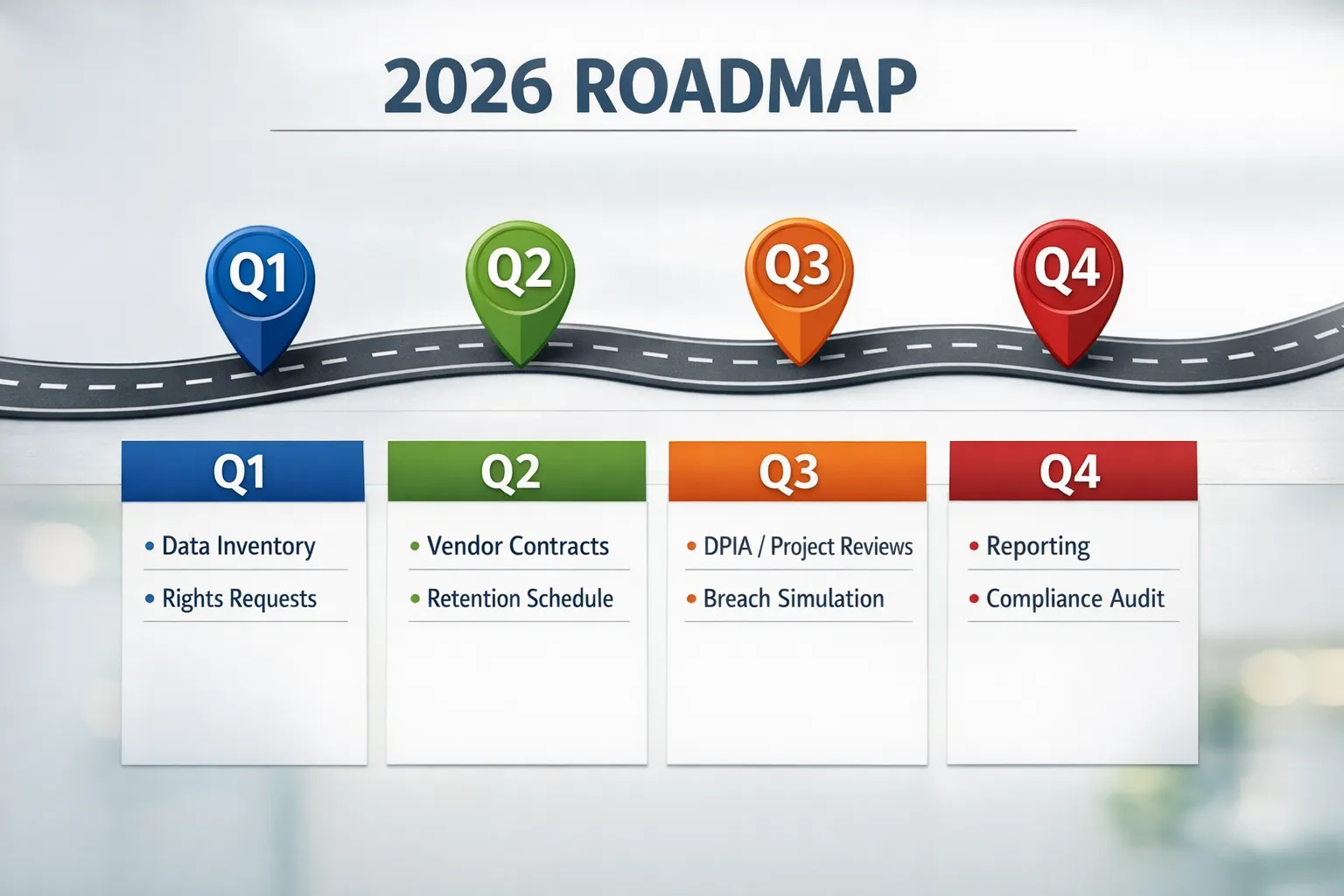
The 2026 compliance roadmap (by quarter)
A realistic roadmap should match the speed of your operations. The goal is not perfection by March, it is controlled progress with evidence at each stage.
Q1 2026: Build your compliance foundation (visibility + ownership)
In Q1, focus on creating a defensible baseline. Most organisations skip this and jump straight to privacy notices or training, then discover they cannot answer basic questions such as “Where is the data stored?”
Key deliverables for Q1:
Confirm your governance structure (who owns privacy, who approves risk decisions, who executes tasks)
Complete a data inventory and high-level data map
Establish your “records of processing” (or equivalent register) as a living document
Identify your legal bases for high-risk processing activities
Create a simple, central evidence library (policies, templates, approvals, vendor agreements, training logs)
Q2 2026: Implement controls (rights handling + vendor governance + security alignment)
In Q2, convert the inventory into controls that staff can actually follow. This is where you prevent common failures such as missed deadlines for requests, uncontrolled vendor access, or data kept indefinitely.
Key deliverables for Q2:
A documented process for individual rights requests (intake, identity verification, fulfilment, exemptions, response tracking)
Vendor and processor governance, including contract addenda and due diligence checks
A retention schedule that maps retention periods to systems and owners
Minimum security controls and access management aligned to your technology reality
This phase often requires both privacy and legal coordination, especially for customer terms, employment documents, and vendor contracts. When you need Jamaican legal support to sanity-check contract positions and risk language, it can help to consult an established local firm such as Henlin Gibson Henlin alongside your internal compliance team.
Q3 2026: Embed privacy into operations (projects + change management)
By Q3, the programme should be shifting from “compliance tasks” to “how we work.” If privacy is not embedded into onboarding, procurement, IT change, and incident handling, it will drift.
Key deliverables for Q3:
A privacy risk assessment approach for new projects (often called DPIAs for higher-risk changes)
A standard privacy review step in procurement and vendor onboarding
“Secure by default” practices for common tools (email, shared drives, CRM exports, WhatsApp usage, remote work)
Role-based training for teams that handle the most personal data (HR, customer service, IT, marketing)
Q4 2026: Assurance and readiness (testing + metrics + board reporting)
Q4 is where you pressure-test. The goal is to ensure that the programme can survive a real incident, a regulator inquiry, or a major client’s due diligence questionnaire.
Key deliverables for Q4:
A breach simulation or tabletop exercise (with clear lessons learned and remediation)
Internal audit-style checks on high-risk processing activities
Metrics that translate privacy into governance language (risk, trends, exceptions, vendor status)
A 2027 plan based on what failed, what improved, and what changed in your operations
A practical roadmap table you can use in management meetings
Use the table below to keep the roadmap measurable. The “evidence” column is critical, it turns activities into proof.
Quarter | Priority | What you deliver | Primary owner | Evidence to keep |
Q1 | Governance | Privacy roles, escalation path, approvals | Senior management + compliance | Org chart, TOR for committee, approval minutes |
Q1 | Data visibility | Data inventory, systems list, data map | Privacy lead + IT + business owners | Processing register, diagrams, system owners list |
Q2 | Rights handling | Rights request workflow + templates | Privacy lead + customer service/HR | SOPs, response tracker, sample completed cases |
Q2 | Vendor control | Vendor due diligence + contract terms | Procurement + legal/compliance | Vendor risk ratings, signed addenda, review logs |
Q2 | Retention | Retention schedule + deletion approach | Records/IT + business owners | Schedule, deletion tickets, disposal certificates |
Q3 | Project controls | Privacy risk assessment for changes | PMO/IT + privacy | Completed assessments, risk decisions, mitigations |
Q3 | Workforce behaviour | Role-based training | HR + privacy | Training materials, attendance, quizzes, refresh cadence |
Q4 | Readiness | Incident simulation + corrective actions | IT/security + privacy + leadership | Exercise report, action plan, closure evidence |
Q4 | Assurance | Internal compliance checks | Compliance/internal audit | Test scripts, findings, remediation tracking |
Turning principles into controls (what to implement, not just what to say)
Many Jamaican organisations already have “privacy language” in policies, but struggle to translate that into controls staff can follow. The mapping below helps teams connect privacy obligations to operational mechanisms.
Compliance requirement (in practice) | Control examples | Typical evidence |
Transparency | Privacy notices that match reality, consistent scripts for frontline staff | Published notices, version history, call centre scripts |
Data minimisation | Collect only what is necessary in forms and onboarding | Form reviews, approvals, screenshots of updated fields |
Purpose limitation | Stop reusing customer data for unrelated marketing without governance | Marketing approvals, consent records where applicable |
Security | Access controls, MFA, least privilege, logging, secure disposal | Access reviews, MFA enforcement, audit logs, disposal records |
Retention | Defined retention periods and deletion routines | Retention schedule, deletion tickets, archive policies |
Accountability | Assigned owners, risk assessments, training, vendor oversight | Committee minutes, DPIAs, training logs, vendor files |
You do not need to implement everything at once, but you should be able to show intentional prioritisation based on risk.
Rights requests: design for speed, not heroics
Rights requests are often where organisations get exposed, not because they refuse to comply, but because they cannot locate the data fast enough or they respond inconsistently. In 2026, build a workflow that assumes staff turnover, busy inboxes, and requests arriving through multiple channels.
A workable rights-request process typically includes:
A single intake route (web form, email alias, or helpdesk ticket type)
A standard identity verification approach that is proportional to risk
A playbook for common request types (access, correction, deletion where applicable)
A response tracker with deadlines and responsible persons
An escalation rule for complex cases (mixed data sources, third-party data, litigation hold)
This is also where your data inventory pays off. If you cannot quickly answer “Which systems contain this person’s data?”, your process will be slow no matter how good your templates are.
Vendor and cloud risk: the fastest way to lose control of personal data
Most personal data exposure today happens through third parties: cloud services, outsourced support, marketing platforms, payroll processors, IT contractors, and even informal “helpers” who get access because they are trusted.
In Jamaica, vendor governance is also increasingly commercial. Many enterprise clients and overseas partners will ask for privacy assurance before signing, renewing, or expanding work.
A practical vendor programme for 2026 should include:
A vendor inventory that flags which suppliers touch personal data
A risk rating that is simple enough to maintain (for example: low, medium, high)
A minimum contract position for processors (confidentiality, security obligations, breach notification, subcontractor controls, deletion/return)
A due diligence checklist for high-risk vendors (security posture, access controls, data location, incident history)
If you cannot renegotiate every legacy contract in 2026, prioritise. Start with vendors that have admin access, hold sensitive data, or operate critical systems.
Cross-border transfers: treat them as a governance topic, not an IT detail
Even if your business is “local,” your tools may not be. Email hosting, HR platforms, analytics, customer support systems, and cloud storage frequently involve overseas processing.
For 2026, your goal is to be able to answer these questions clearly:
Which systems store or process personal data outside Jamaica?
What is the purpose of each transfer?
What contractual and security safeguards exist?
Can you meet rights requests and deletion requests in those systems?
Organisations that map this early avoid surprises later, especially during client due diligence or incident response.
Incident readiness: assume something will go wrong
A privacy programme that has never been tested is a theoretical programme. In 2026, plan at least one breach simulation, even if it is simple.
A good tabletop exercise should test:
How incidents are detected and escalated internally
Who decides whether an event is a breach and what to do next
How you preserve evidence and prevent further leakage
How you communicate internally (leadership, IT, HR, customer service)
How you document decisions and remediate
The most valuable output is not the exercise itself, it is the list of control gaps you discovered and closed.
Training that works: role-based, scenario-led, and repeatable
One annual slideshow is rarely enough. In 2026, training should be aligned to real job functions and the tools people actually use.
Examples of role-based training topics:
HR teams: employee records, medical notes, disciplinary files, retention, sharing rules
Customer service teams: identity verification, secure disclosure, handling requests, avoiding oversharing
Marketing teams: lawful outreach practices, list hygiene, vendor controls, consent and preference management where applicable
IT and system admins: access controls, logging, backups, secure disposal, incident triage
Training becomes defensible when it is tracked, refreshed, and connected to measurable behaviour changes (for example, fewer unauthorised exports, fewer misdirected emails, better incident reporting).
How to tailor the roadmap for SMEs (without building a bureaucracy)
Smaller Jamaican organisations often assume privacy compliance is “enterprise-only.” In reality, SMEs can implement a strong baseline by focusing on the highest-risk areas.
For an SME-friendly 2026 plan, prioritise:
A simple data inventory (even a well-structured spreadsheet is better than guessing)
Clear retention rules for the most sensitive categories you hold
Vendor controls for your key service providers (payroll, IT support, cloud storage)
A basic rights request process (intake, verification, response tracking)
A practical incident response plan with phone numbers and escalation rules
The point is not to copy a multinational’s programme, it is to build a programme you can actually operate.
Where PLMC fits: turning the roadmap into execution
PLMC supports organisations in Jamaica with data protection implementation and compliance, while integrating privacy into broader governance, risk, and compliance (GRC) practices. Depending on where you are in your journey, support can include:
Implementation planning and programme setup
Risk assessments and practical tools to identify gaps
Training sessions for leadership and staff
Cyber security and GRC alignment so privacy controls fit into existing governance
Free consultations to help you prioritise next steps
If you want your 2026 programme to hold up under real-world pressure (client due diligence, vendor risk, incidents, and operational change), the roadmap above is a strong starting point. The difference between “we have a policy” and “we are compliant” is execution, evidence, and continuous improvement.
To build on the fundamentals, you can also review PLMC’s guide on baseline compliance actions for Jamaican firms: Data Protection Basics: What Jamaican Firms Must Know.