

Privacy and Data Protection Training: Role-Based Plan for 2026

Privacy and data protection is no longer “a policy on the intranet”. In 2026, it is an operational capability: how your staff collect, use, share, store, and dispose of personal data every day, across email, HR systems, call centres, WhatsApp groups, cloud apps, and vendors.
That is why the most effective organisations do not treat training as a once-a-year slideshow. They build role-based privacy and data protection training that matches real job tasks, real risks, and the evidence regulators, customers, and boards increasingly expect.
This guide gives Jamaican organisations a practical, role-based plan for 2026, including who needs what training, how often, and what records to keep.
Why role-based privacy and data protection training matters in 2026
Most privacy incidents still start with ordinary work: sending an email to the wrong recipient, sharing a spreadsheet without redacting, mis-handling an access request, using a personal device, or onboarding a vendor without proper controls.
Role-based training works because it targets the moments where errors happen.
It also helps you demonstrate accountability, which is central to any mature privacy programme. If you are building or strengthening your broader compliance roadmap, see Data Protection Jamaica: Compliance Roadmap for 2026.
What “role-based” means (and what it is not)
Role-based training is not “different slides for different departments”. It is a structured approach that aligns learning outcomes to:
The personal data each role touches (customer, employee, children’s data, health data, financial data)
The actions they perform (collect, verify, disclose, store, analyse, delete)
The decisions they make (lawful basis, retention, access rights, vendor selection)
The risk level and likely impact if something goes wrong
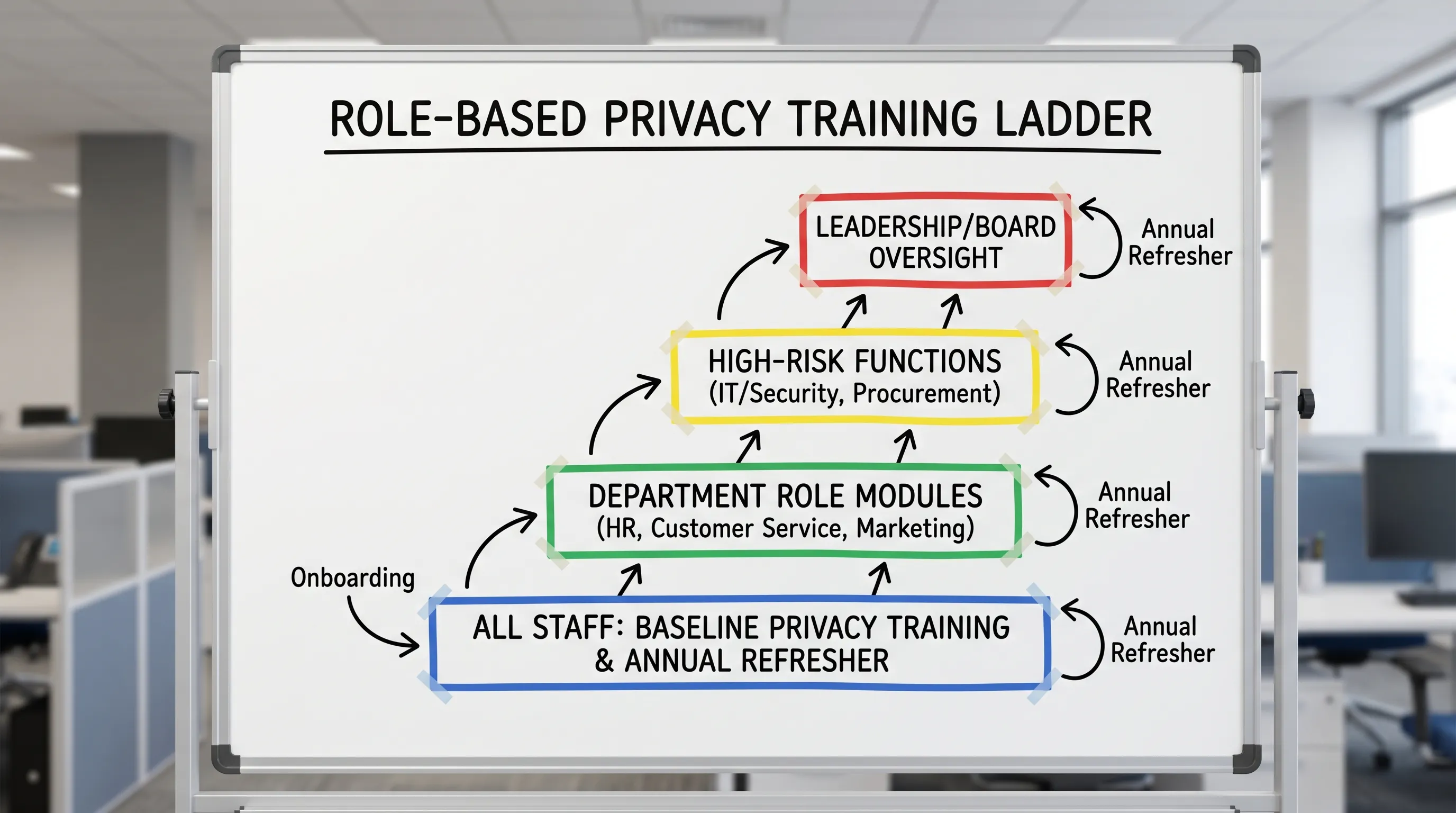
A good programme has one shared baseline for everyone, plus targeted modules for roles that handle higher-risk data or make higher-risk decisions.
Step 1: Map roles to data touchpoints and risks
Before you design training, do a quick “people and process” map. This can be lightweight, but it must be honest.
Use this as a starting point:
Role group | Typical personal data handled | Common risk points | Training priority |
All staff (baseline) | Names, contact details, emails, basic customer info | Mis-sent emails, weak passwords, oversharing, insecure storage | High |
Frontline and customer service | Customer records, IDs, transaction history, call recordings | Identity verification errors, disclosure to wrong person, unsafe notes | High |
HR and payroll | Employee files, medical notes, disciplinary records, banking details | Excess internal access, informal sharing, retention issues | High |
Marketing and sales | Leads, mailing lists, consent preferences, analytics | Unlawful messaging, unclear notices, vendor tools, list hygiene | Medium to High |
IT and security | Logs, access data, system admin capabilities | Over-privileged access, weak monitoring, misconfigured cloud | High |
Procurement and vendor owners | Vendor due diligence data, contracts, sub-processors | Missing data clauses, uncontrolled transfers, weak oversight | High |
Management and executives | Reports and escalations, approvals, risk acceptance | Poor tone from the top, under-resourcing, slow incident decisions | High |
Finance and AML functions | Customer identity data, KYC, transaction data | Over-collection, retention creep, third-party sharing | Medium to High |
If you need a broader compliance checklist to complement this training work, use Privacy and Data Protection: A Practical Checklist.
Step 2: Build a curriculum with one baseline plus role modules
A strong 2026 curriculum usually has:
Baseline module (everyone): principles, handling rules, reporting, and “dos and don’ts”
Role modules: deeper scenarios and decision-making for teams with specific responsibilities
Event-driven refreshers: short, timely training after incidents, system changes, new vendors, or new processing activities
Below is a practical training matrix you can adapt.
Audience | What they must be able to do after training | Recommended format | Frequency in 2026 | Evidence to keep |
All staff (baseline) | Recognise personal and sensitive data, handle it securely, follow retention rules, report incidents fast | 30 to 45 min e-learning or live session | Onboarding + annual refresh | Attendance/completion, quiz result, policy acknowledgement |
Managers and supervisors | Reinforce correct behaviour, spot risky practices, escalate issues, approve access appropriately | 60 min workshop | Annual + mid-year refresher | Attendance, scenario assessment, action notes |
HR and payroll | Share employee data lawfully, restrict access, manage medical/disciplinary files, retain and dispose properly | 90 min role workshop | Annual + onboarding for HR hires | Attendance, practical exercise output |
Customer service and operations | Verify identity, avoid over-disclosure, document accurately, handle recordings and notes correctly | 60 to 90 min scenario-based | Twice yearly | Attendance, call script checklist, spot-check results |
Marketing and digital teams | Apply transparency and preference management, manage lists, assess marketing tools, coordinate with privacy lead | 60 min workshop | Annual + campaign refresh | Attendance, campaign checklist, approval records |
Procurement and vendor owners | Run vendor due diligence, include contract clauses, track processors and sub-processors, manage renewals | 60 to 90 min workshop | Annual + prior to major procurements | Due diligence forms, contract playbook, vendor register updates |
IT admins and security | Support privacy by design, access controls, logging, breach readiness, secure configurations | 90 min technical session | Annual + quarterly drills | Drill records, access review logs, incident tabletop outputs |
Leadership and board | Set tone, approve risk appetite, fund controls, understand reporting, support enforcement readiness | 45 to 60 min briefing | Annual + Q3 update | Briefing deck, minutes, decisions and actions |
If your organisation is still aligning the basics under Jamaica’s Data Protection Act, you can pair this training plan with Jamaica Data Protection Act Explained for Businesses and Data Privacy in Jamaica: Key Principles and Rights.
Step 3: Use a 2026 delivery plan that fits operations (not the other way around)
Training fails when it is scheduled in a way that ignores operational reality. A workable plan keeps sessions short, repeats key messages, and uses real examples from your environment.
Here is a proven quarterly structure for 2026.
Q1: Baseline, onboarding, and “how we work” rules
Focus: establish shared language and minimum behaviours.
Include:
What counts as personal data and sensitive data in your business
The “golden rules” for email, messaging apps, sharing, and storage
Incident reporting: what to report, how fast, and to whom
Records and retention basics (what to keep, what to delete, and why)
Practical output: a one-page “privacy handling standard” that staff can follow.
Q2: Role modules and vendor discipline
Focus: training that prevents repeat incidents.
HR and payroll workshop (employee data confidentiality, access boundaries, retention and disposal)
Customer service workshop (identity verification and disclosure controls)
Procurement and vendor-owner workshop (due diligence and contract essentials)
Practical output: updated vendor onboarding checklist and a simple “before you share data” checklist.
For vendor and cloud risk management best practices, you can also reference guidance from the UK ICO on data processors and contracts (useful as a benchmark even when you are mapping your local compliance obligations).
Q3: Exercises, simulations, and privacy by design
Focus: build confidence under pressure.
Incident response tabletop exercise (include IT, comms, legal/compliance, business owners)
Access request simulation (from intake to identity verification to response)
Project privacy check-in for teams launching new systems or campaigns
Practical output: an issues log with owners and deadlines, plus updated runbooks.
A helpful reference for incident handling structure is NIST Computer Security Incident Handling Guide (SP 800-61).
Q4: Measurement, refreshers, and audit-ready evidence
Focus: demonstrate the programme works.
Micro-refreshers based on what happened in the year (top 3 incidents or near misses)
Targeted retraining for teams with recurring issues
Evidence pack preparation for audits, clients, and governance reporting
Practical output: a training report for leadership with completion rates, incident trends, and next-year priorities.
Step 4: Make training behavioural, not theoretical
Adults learn best when the content matches the decisions they must make at work. In 2026, aim for scenario-based training using your own processes.
Examples of scenarios that typically resonate in Jamaican organisations:
A staff member receives a WhatsApp message asking for “just a quick confirmation” of someone’s account details
A manager forwards a spreadsheet with ID numbers and payroll information to a personal email “to work from home”
A customer calls and asks for information about a relative’s account, claiming urgency
HR needs to share information with a benefits provider or medical professional, but is unsure what is permissible
Procurement wants to sign a SaaS tool quickly, but the vendor contract is silent on security and sub-processors
Also consider mixing formats:
Short live sessions for baseline and culture
Team workshops for role modules
Tabletop exercises for incident readiness
Simple knowledge checks (5 to 10 questions) for evidence and reinforcement

Step 5: Measure effectiveness and keep the evidence
Completion rates alone do not prove competence. In 2026, strong programmes add operational metrics and governance reporting.
Use a simple measurement set:
Measurement | What it tells you | How to collect it |
Training completion by role | Coverage and accountability | LMS report or attendance logs |
Quiz pass rate and repeat attempts | Understanding and where to improve | Post-training assessments |
Incident and near-miss trends | Whether behaviour is improving | Incident register and root-cause notes |
Access request handling time and quality | Readiness for individual rights | Case tracker and QA checks |
Vendor onboarding compliance | Whether procurement controls are real | Vendor register, contract checklist |
Evidence pack (keep this tidy): training materials, attendance/completions, assessment results, policy acknowledgements, exercise outputs, and your annual training report.
Common training gaps to avoid in 2026
These are issues we commonly see across organisations when training is treated as a checkbox:
One generic session for everyone, with no role scenarios
No onboarding training, so new hires guess the rules
No training for vendor owners and procurement teams (a major source of risk)
No practical exercises, so incident response fails under pressure
Weak records, meaning you cannot prove training happened or improved outcomes
How PLMC can help
Privacy & Legal Management Consultants Ltd. (PLMC) supports Jamaican organisations with privacy and data protection training that is practical, role-based, and aligned with broader Governance, Risk, and Compliance goals.
If you are building a 2026 programme, we can support with:
Role-based training sessions for staff, management, HR, IT/security, procurement, and operations
Training aligned to your policies, processes, and risk profile
Exercises and simulations (incident tabletop, access request walk-through)
Integration with your compliance roadmap and readiness assessments
You can also explore related resources, including Data Protection Basics: What Jamaican Firms Must Know.
Frequently Asked Questions
What is role-based privacy and data protection training? Role-based training means staff learn privacy practices that match the personal data they handle and the decisions they make, not a one-size-fits-all session.
How often should privacy training be done in 2026? Most organisations benefit from onboarding plus an annual baseline refresher for all staff, with twice-yearly sessions for frontline teams and quarterly exercises for incident readiness.
Do small businesses in Jamaica need the same training plan? The principles are the same, but the delivery can be lighter, for example shorter sessions and fewer role modules, focused on the highest-risk processes.
What evidence should we keep after training? Keep attendance or completion records, quiz results, policy acknowledgements, training materials, and outputs from exercises like incident tabletop notes and action plans.
Should vendors and contractors be trained too? If they handle personal data for you, they should receive appropriate onboarding and clear handling rules, and you should document what training or guidance was provided.
Build your 2026 role-based training plan with PLMC
If you want a training programme your staff will actually use, and your leadership team can confidently stand behind, PLMC can help you design and deliver role-based privacy and data protection training for 2026.
Book a free consultation via Privacy & Legal Management Consultants Ltd. to discuss your roles, risks, and an implementation schedule that fits your operations.