

Why Data Laws Matter Beyond Legal and IT Teams

Most organisations first encounter data laws through a legal memo, an IT security requirement, or a compliance deadline. That is understandable, but it can create a dangerous misconception: that privacy and data protection are problems for Legal and IT to solve on behalf of everyone else.
In reality, data laws govern everyday business decisions. They affect how HR collects medical certificates, how marketing builds email lists, how finance verifies customers, how customer service confirms identity, how procurement chooses vendors, and how senior leaders oversee risk.
For Jamaican organisations operating under the Data Protection Act, 2020, privacy is not simply a document or a technical control. It is a governance responsibility that must be built into the way people collect, use, share, store, retain, and dispose of personal data.
Legal and IT are essential. But they cannot, by themselves, control every privacy risk created across the business.
Data laws are operating rules, not just legal requirements
Data laws define the boundaries for how personal information should be handled. They ask practical questions: Why are we collecting this data? Have we told people what we will do with it? Are we using it only for the intended purpose? Who can access it? How long should we keep it? What happens if someone asks to see, correct, or delete their information?
Those questions rarely sit in one department.
The Office of the Information Commissioner in Jamaica provides information on the local data protection framework, but implementation depends on how each organisation translates the law into daily controls. The Data Protection Act, 2020 is built around principles such as fairness, transparency, purpose limitation, data minimisation, accuracy, security, retention, rights handling, and accountability. Each principle requires business input.
Legal may interpret the Act. IT may secure the systems. But the business decides what data is collected, why it is needed, how it is used, which vendors receive it, and whether old records are still being kept without a valid reason.
That is why privacy maturity depends on a simple idea: Legal interprets, IT enables, and the business executes.
The risk of treating data laws as a Legal or IT issue only
When data protection is treated as a Legal-only responsibility, organisations often end up with policies that look correct but do not reflect real workflows. A privacy notice may say one thing, while customer service, HR, or sales teams behave differently because no one translated the policy into their day-to-day tasks.
When data protection is treated as an IT-only responsibility, the focus often narrows to security. Security is critical, but privacy is broader. A file can be encrypted, access-controlled, and backed up, yet still be used for a purpose that was never explained to the individual. A marketing list can sit in a secure CRM and still create privacy risk if the organisation cannot justify how the list was collected or used.
This narrow approach also weakens incident response. If staff believe privacy belongs only to IT, they may delay reporting a wrong-recipient email, lost paper file, unauthorised disclosure, or suspicious vendor request. By the time Legal or IT becomes aware, the organisation may have lost valuable time to contain the issue and preserve evidence.
The biggest risk is accountability without proof. Boards and regulators do not only want to know that policies exist. They want to see that controls are operating, staff are trained, vendors are managed, and risks are reported through governance channels.
The wider data law landscape for Jamaican organisations
The Data Protection Act, 2020 is central to Jamaica data privacy compliance, but it is not the only obligation that affects personal information. Many organisations also need to consider cyber security, anti-money laundering, contractual duties, sector requirements, and international privacy expectations.
Data law or obligation | Why it matters beyond Legal and IT | Teams usually affected |
Data Protection Act, 2020 | Sets rules for lawful, fair, secure, and accountable handling of personal data | All teams handling personal information |
Anti-money laundering and counter-financing obligations | Requires collection and review of identity, transaction, and due diligence information while still protecting privacy | Finance, compliance, customer onboarding, operations |
Cyber security and cybercrime requirements | Makes secure access, incident reporting, and protection against misuse part of operational risk management | IT, HR, procurement, operations, leadership |
Sector and client requirements | Contracts, audits, and industry expectations may impose stricter privacy and security controls | Sales, legal, procurement, compliance, service delivery |
Cross-border and GDPR-related expectations | Jamaican organisations serving overseas clients or processing EU-related data may face additional due diligence | Leadership, sales, procurement, IT, legal |
For a deeper look at overlapping obligations, PLMC has also outlined data laws that shape privacy risk for Jamaican businesses.
This is why data protection compliance is a governance, risk, and compliance issue. Governance sets the ownership. Risk management prioritises the threats. Compliance produces the evidence that controls are working.
How each department owns part of privacy risk
A strong privacy programme does not ask every employee to become a lawyer. It asks each team to understand the privacy decisions built into its own work.
Business area | How data laws affect the team | Practical example |
Board and executives | Set risk appetite, approve resources, monitor compliance, and require evidence | Reviewing privacy KPIs, major incidents, vendor risks, and training completion |
HR | Handles employee, candidate, payroll, disciplinary, and health-related data | Limiting access to personnel files and setting retention rules for CVs |
Marketing and sales | Uses customer data for campaigns, lead generation, segmentation, and communications | Confirming that email lists are collected transparently and used for permitted purposes |
Customer service | Verifies identity, handles complaints, records calls, and may receive rights requests | Avoiding disclosure to the wrong person and escalating access requests correctly |
Finance and AML teams | Collects identity and transaction data for billing, due diligence, and reporting | Balancing KYC obligations with minimisation, confidentiality, and retention rules |
Procurement | Selects vendors that may process personal data on the organisation’s behalf | Checking contracts, access controls, breach duties, and cross-border processing risks |
Operations | Designs forms, workflows, filing systems, and service delivery processes | Removing unnecessary fields from forms and controlling paper records |
IT and cyber security | Protects systems, accounts, devices, networks, logs, and backups | Applying MFA, least privilege, patching, encryption, monitoring, and secure disposal |
The point is not to spread blame. The point is to make ownership visible. If privacy risk is created in a business process, the process owner must help manage it.
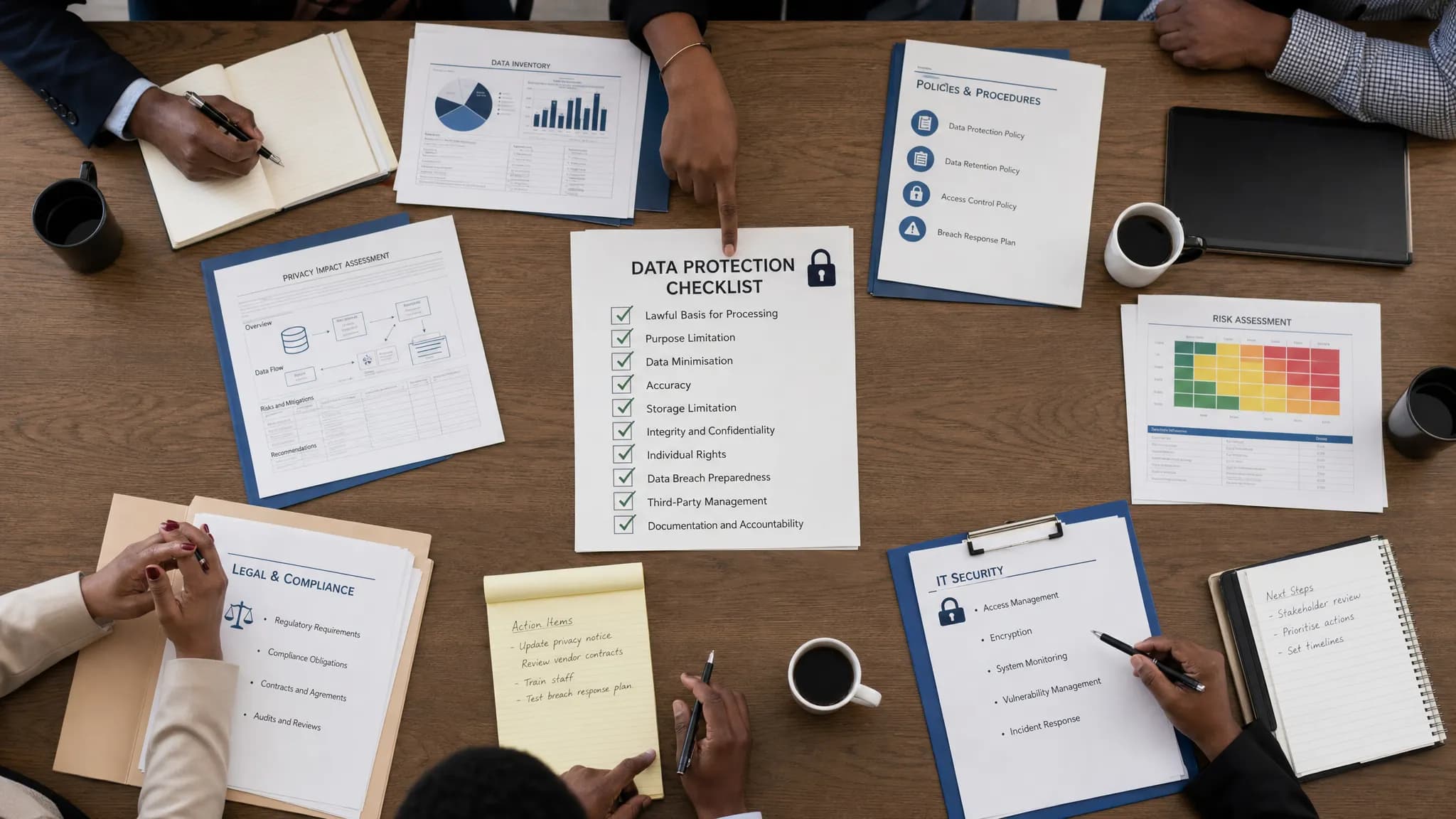
Practical examples: where non-Legal teams make the privacy decision
HR and employee records
HR teams handle some of the most sensitive information in an organisation. Recruitment records, employee evaluations, disciplinary files, medical certificates, emergency contacts, payroll records, and benefits information all require careful handling.
Legal can draft a policy for employee data. IT can restrict system access. But HR decides what information is requested on forms, which managers can see it, how long recruitment records are retained, and whether documents are shared by email, printed, or stored in shared drives.
If HR keeps every unsuccessful candidate’s documents indefinitely, that is a data protection risk. If managers access employee medical details without a need to know, that is a confidentiality and privacy risk. These are operational issues, not just legal issues.
Marketing and customer communications
Marketing teams often create privacy risk without intending to. A campaign may use old customer lists, purchased contact databases, website forms, event registrations, analytics tools, or social media audiences.
The key question is not only whether the CRM is secure. The questions are whether customers were told how their data would be used, whether the organisation has a lawful basis for the communication, whether preferences are respected, and whether data is shared with advertising or email platforms appropriately.
A privacy-aware marketing team can still be effective. In fact, clear consent practices, clean data, and transparent notices often improve trust and reduce wasted effort.
Finance, AML, and customer due diligence
For regulated sectors, anti-money laundering compliance may require organisations to collect identification documents, verify beneficial ownership, monitor transactions, and retain records. These obligations are important, but they do not remove the need for privacy discipline.
Teams must understand what information is required, who may access it, how it is secured, how long it is retained, and when it may be shared. AML and data protection should not be treated as competing goals. They should be integrated through clear governance, defined access, retention schedules, secure storage, and documented decision-making.
Procurement and third-party vendors
Many privacy failures happen outside the organisation’s walls. Cloud platforms, payroll providers, payment processors, marketing tools, call centres, consultants, and IT support providers may all process personal data.
Procurement therefore has a direct role in data protection. Before a vendor is selected, the organisation should understand what data the vendor will access, where it will be hosted, what security measures apply, whether subcontractors are involved, how incidents will be reported, and what happens when the contract ends.
Vendor risk cannot be fixed by Legal at the end of procurement. It must be built into the selection process.
Building a privacy operating model across the business
A cross-functional privacy programme does not need to be overcomplicated. It needs clear ownership, practical controls, and evidence that those controls are working. Organisations can start with five building blocks.
Map data by business process: Instead of only listing systems, identify where personal data enters, moves, gets shared, and leaves each process. Recruitment, onboarding, customer onboarding, complaints, marketing campaigns, vendor management, and incident handling should all be mapped.
Assign accountable owners: Each major process should have a business owner who understands the privacy obligations attached to it. Legal, compliance, privacy, and IT can support, but ownership should sit close to the activity that creates the risk.
Embed controls into workflow: Privacy rules should appear where work happens. Examples include form review checklists, vendor due diligence questions, identity verification scripts, retention triggers, access approval steps, and incident reporting channels.
Train by role: Generic annual training is not enough. HR, marketing, finance, customer service, procurement, IT, managers, and executives need examples that match their real decisions. PLMC’s guidance on a role-based privacy and data protection training plan explains how to structure this more effectively.
Report through governance: Privacy should appear in management and board reporting. Metrics might include training completion, rights request timeliness, vendor review status, incident trends, overdue retention actions, and high-risk assessments.
For organisations formalising ownership, a RACI-style approach can be especially useful. PLMC’s article on data protection governance, roles, RACI, and reporting provides a practical structure.
Data laws also protect business value
It is easy to frame privacy as a compliance burden. But good data governance also protects business value.
Customers are more likely to trust organisations that explain how their information is used. Employees are more likely to cooperate when monitoring, HR, and records practices are transparent. Corporate clients increasingly ask vendors to prove privacy and security controls before signing contracts. Insurers, auditors, investors, and regulators also expect evidence that data risks are managed.
Poor data practices create costs beyond penalties. They can delay sales, damage reputation, weaken audit outcomes, increase breach exposure, create customer complaints, and force expensive remediation after a problem becomes public.
Strong privacy practices improve data quality, reduce unnecessary storage, clarify ownership, strengthen cyber security, and make teams more disciplined in how they handle information.
Evidence matters as much as intention
Under modern data protection expectations, saying “we take privacy seriously” is not enough. Organisations need evidence.
Evidence type | Who contributes | What it helps prove |
Data inventory and process maps | Business units, privacy, IT | The organisation knows what personal data it handles |
Privacy notices and consent records | Legal, marketing, customer service | Individuals receive clear information about data use |
Access reviews | IT, managers, HR | Only appropriate persons can access personal data |
Vendor due diligence files | Procurement, legal, IT, compliance | Third-party processing risks are assessed and managed |
Training records | HR, managers, privacy lead | Staff were trained on relevant responsibilities |
Incident logs and response records | IT, legal, compliance, business teams | Issues are reported, assessed, contained, and documented |
Retention and disposal records | Records teams, HR, operations, IT | Personal data is not kept longer than necessary |
Evidence should be created as part of normal work, not assembled in a panic before an audit or client review.
Questions leaders should ask now
If your organisation still sees data protection as mainly a Legal or IT matter, start with a management conversation. The goal is to identify where personal data decisions actually happen.
Ask which teams collect the most personal data, which teams handle sensitive information, and which processes rely on third-party vendors. Ask whether privacy notices match real practices, whether staff know how to recognise a rights request, and whether incident reporting is understood outside IT.
Also ask whether the board or senior management receives privacy reporting. If leadership does not see privacy risk, it is unlikely to be properly resourced, monitored, or improved.
The most effective organisations treat data laws as part of corporate governance. They do not wait for an incident to discover that privacy ownership was unclear.
Frequently Asked Questions
Why are data laws not just a Legal issue? Legal teams can interpret obligations and draft documents, but business teams decide how personal data is collected, used, shared, and retained. Without operational ownership, legal advice may not translate into compliant behaviour.
Why are data laws not just an IT issue? IT protects systems and data, but privacy also concerns lawful use, transparency, purpose limitation, retention, individual rights, and accountability. A secure system can still support non-compliant data use if business processes are poorly designed.
Which departments need data privacy training in Jamaica? Any department that handles personal data should receive training. This usually includes HR, customer service, marketing, sales, finance, procurement, operations, IT, managers, and executives. Training should be tailored to each role’s real decisions.
How can leaders make data protection compliance practical? Leaders should assign owners, map data flows, embed controls into workflows, train staff by role, review vendors, track incidents, and require regular evidence-based reporting. Privacy should be managed as an ongoing governance and risk issue.
Make data laws practical across your organisation
Data laws matter because personal information moves through the whole organisation, not just through Legal and IT. The organisations that manage privacy well are the ones that turn legal duties into clear roles, practical controls, staff awareness, and evidence of compliance.
Privacy & Legal Management Consultants Ltd. helps Jamaican organisations strengthen data protection implementation, corporate governance, anti-money laundering compliance alignment, cyber security practices, GRC integration, training, and risk assessment. If your privacy programme still depends too heavily on one department, PLMC can help you build a more practical operating model.
Start with a free consultation with PLMC or explore our guide to the Jamaica Data Protection Act for businesses.