

7 Data Laws That Shape Privacy Risk for Jamaican Businesses
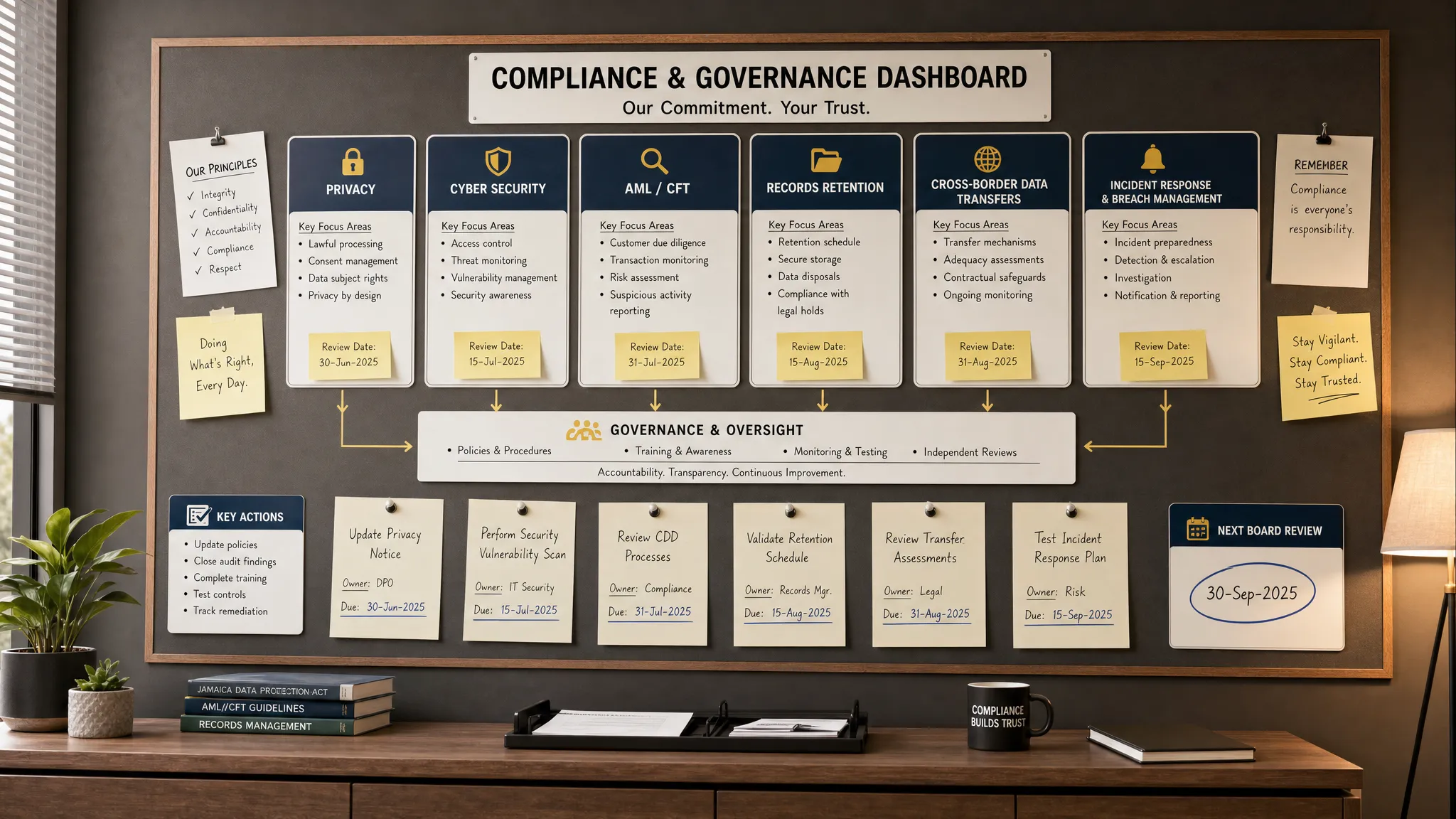
Privacy risk for Jamaican businesses is no longer a single-policy issue. A company may be trying to comply with Jamaica’s Data Protection Act, while also managing cybercrime exposure, AML obligations, digital records, public sector disclosure rules, and overseas privacy requirements in client contracts.
That overlap matters. The same customer file may be personal data under privacy law, evidence under an electronic transaction, a KYC record under anti-money laundering rules, and a breach concern if it is exposed through a cyber incident. Leaders who treat each law separately often miss the practical point: privacy risk is created at the intersection of legal duties, business processes, technology, and staff behaviour.
Below are seven data laws and legal frameworks that Jamaican businesses should understand when assessing privacy risk in 2026. Not every law applies to every organisation, and this article is general information rather than legal advice. The goal is to help boards, executives, compliance officers, HR teams, IT leaders, and operations managers know what to look for before a gap becomes a regulatory, contractual, or reputational problem.
Why privacy risk is a multi-law issue
A privacy programme should not be built around one statute alone. The Data Protection Act, 2020 is the central privacy law in Jamaica, but other laws influence what data must be collected, how long records should be kept, when information may be disclosed, and how electronic systems should be secured.
For example, a financial services firm may need to collect identity documents for AML compliance. A hotel may process passport, payment, marketing, and booking data for overseas guests. A BPO may handle personal data for international clients under contract. A school, clinic, charity, or public sector contractor may face privacy duties alongside confidentiality, access, cyber security, and records obligations.
The practical risk is not only whether a privacy policy exists. It is whether the organisation can show that its actual data handling is lawful, limited, secure, documented, and aligned with all applicable legal obligations.
Quick view: 7 laws that shape privacy risk
Law or framework | Where privacy risk appears | Businesses most affected | Evidence to maintain |
Data Protection Act, 2020 | Collection, use, sharing, retention, rights, security, transfers | Most organisations handling personal data | Data inventory, privacy notices, lawful basis records, rights logs, training records |
Cybercrimes Act, 2015 | Unauthorised access, system compromise, misuse of credentials, incident response | Any organisation using digital systems | Access logs, incident reports, security controls, investigation records |
Electronic Transactions Act, 2006 | Electronic consent, contracts, signatures, records, audit trails | E-commerce, HR, finance, customer service, online platforms | Consent wording, timestamps, identity checks, record integrity controls |
Proceeds of Crime Act | KYC, customer due diligence, transaction monitoring, suspicious activity reporting | Financial institutions and regulated businesses | KYC files, AML policies, retention rules, restricted access evidence |
Terrorism Prevention Act | Screening, sanctions-related checks, financing risk, reporting processes | Regulated sectors and higher-risk businesses | Screening records, escalation logs, governance approvals, training evidence |
Access to Information Act, 2002 | Disclosure, redaction, public records, personal data in government-held records | Public authorities and private entities working with them | Request logs, redaction decisions, disclosure approvals |
EU GDPR | EU customer data, monitoring, cross-border processing, client contract obligations | Tourism, BPOs, SaaS, exporters, online businesses | EU data maps, processor contracts, transfer safeguards, rights handling records |
1. Jamaica’s Data Protection Act, 2020
Jamaica’s Data Protection Act, 2020 is the foundation of Jamaica data privacy compliance. It governs how personal data should be collected, used, stored, shared, transferred, and disposed of. By 2026, organisations should treat compliance as an ongoing operating requirement, not a one-off transition project.
The Act is built around data protection standards that require personal data to be processed fairly and lawfully, used for specified purposes, kept accurate, protected by appropriate security, retained only as necessary, and handled in a way that respects individuals’ rights. The Office of the Information Commissioner of Jamaica is an important starting point for official information and updates.
The main privacy risk for businesses is mismatch. A mismatch occurs when the privacy notice says one thing, the CRM does another, the HR team keeps records indefinitely, or vendors receive personal data without clear contractual controls. These gaps are often discovered during complaints, audits, cyber incidents, employee disputes, or client due diligence.
Practical controls include a living data inventory, clear privacy notices, lawful basis records, role-based access, retention schedules, staff training, vendor due diligence, and a documented process for responding to individual rights requests. If your organisation has not yet mapped what personal data it holds and why, start there. PLMC’s guide to the Jamaica Data Protection Act for businesses offers a useful baseline for that work.
HR data deserves special attention. Recruitment records, interview notes, references, background checks, medical information, disciplinary files, and payroll data can expose a business if they are over-collected or poorly secured. Where employers use digital hiring tools, they should focus on relevance, transparency, and defensible decision-making. Verifiable hiring platforms such as TalentTrust show how credential trust and structured candidate information can support more accountable recruitment processes, but employers still need clear notices, access controls, and retention rules.
2. Cybercrimes Act, 2015
The Cybercrimes Act is not a privacy law in the same way as the Data Protection Act, but it strongly shapes data protection risk. It deals with unauthorised access, interference with computer systems, unauthorised modification of data, and related cyber offences. For businesses, this means a privacy incident may also involve cybercrime considerations.
A ransomware attack, compromised email account, stolen employee credentials, unauthorised database access, or insider misuse may expose personal data and trigger a broader investigation. The organisation then needs to preserve evidence, understand what happened, contain the risk, and decide whether affected individuals, regulators, customers, insurers, or law enforcement should be notified.
The common mistake is treating cyber security as purely technical. Privacy teams need to know what personal data was affected, whose data it was, whether the data was sensitive, whether the incident creates harm, and what records show the organisation acted responsibly.
A good privacy and cyber response process should define who triages incidents, who preserves logs, who communicates with management, who assesses notification obligations, and who approves external messaging. Access management, multi-factor authentication, patching, backups, logging, endpoint protection, and phishing training are not just IT controls. They are evidence that the organisation took reasonable steps to protect personal data.
3. Electronic Transactions Act, 2006
The Electronic Transactions Act supports the legal recognition of electronic records, electronic signatures, and digital transactions. This matters because more Jamaican businesses now onboard customers online, sign contracts electronically, collect web form consent, issue digital invoices, and store records in cloud platforms.
The privacy risk is that digital convenience can create excessive records. An online transaction may generate contact details, payment metadata, device information, timestamps, authentication records, IP addresses, chat transcripts, and marketing preferences. Some of this information may be necessary. Some may be retained by default without anyone deciding whether it is still needed.
Businesses should make electronic records reliable, traceable, and proportionate. If a customer consents to marketing online, the organisation should keep the wording, timestamp, method, and withdrawal mechanism. If an employee signs a policy electronically, HR should be able to show which version was accepted and when. If a contract is executed through a platform, legal and procurement teams should understand where records are stored, who can access them, and how long they remain available.
Digital trust depends on both validity and privacy. A business may be able to prove an electronic transaction occurred, but still fail if the supporting data was collected without transparency, shared with unnecessary third parties, or retained without a clear schedule.
4. Proceeds of Crime Act
The Proceeds of Crime Act and related anti-money laundering requirements create a different kind of privacy challenge. For regulated businesses, AML compliance often requires collecting and verifying identity information, understanding beneficial ownership, monitoring transactions, keeping records, and reporting suspicious activity where required.
This can appear to conflict with data minimisation. Privacy law asks organisations to collect what is necessary and retain it only as long as needed. AML law may require businesses to collect detailed KYC information and keep records for prescribed legal or regulatory periods. The right approach is not to ignore one duty in favour of the other. It is to document why the data is required, limit who can access it, protect it appropriately, and prevent it from being reused for unrelated purposes.
KYC files are attractive targets because they may include government-issued identification, addresses, signatures, financial information, source-of-funds details, and politically exposed person screening results. A breach of this data can create serious harm for individuals and significant reputational damage for the organisation.
Strong controls include restricted access, secure upload channels, encryption where appropriate, clear onboarding notices, clean desk practices for paper records, due diligence on outsourced compliance providers, and a retention schedule that aligns legal requirements with secure disposal.
5. Terrorism Prevention Act
The Terrorism Prevention Act and associated counter-terrorism financing obligations also shape privacy risk, especially for organisations in regulated or higher-risk sectors. Screening customers, transactions, counterparties, donors, suppliers, or beneficial owners can involve sensitive inferences and high-stakes decisions.
The privacy issue is not whether screening should occur where the law or risk profile requires it. The issue is how the process is governed. False positives, excessive data collection, unclear escalation procedures, or broad internal circulation of screening results can expose individuals and create unfair outcomes.
Businesses should define who performs screening, what data sources are used, how matches are reviewed, when matters are escalated, and how decisions are documented. Staff should know that privacy does not prevent lawful AML or counter-terrorism financing compliance, but it does require disciplined handling of the information involved.
This is a governance issue as much as a compliance issue. Boards and senior managers should ask whether AML, sanctions, counter-terrorism financing, privacy, and cyber security controls are aligned rather than managed in isolated silos.
6. Access to Information Act, 2002
The Access to Information Act primarily affects public authorities, but private organisations can still be pulled into access and disclosure issues when they work with government entities, provide outsourced services, manage public records, or handle personal data on behalf of public bodies.
The privacy risk arises when records requested under access to information rules include personal data, confidential business information, or third-party records. Disclosure decisions may require careful review, redaction, approval, and documentation. Releasing too much can harm individuals. Withholding too much can create transparency and accountability concerns.
Businesses that support public sector functions should clarify contractual responsibilities for records management, data ownership, response timelines, redaction, secure transfer, and deletion or return of data at the end of the engagement. They should also train staff not to release records informally simply because a request appears official.
A practical safeguard is to maintain a disclosure decision log. The log should record what was requested, who reviewed it, what was disclosed, what was redacted, the reason for the decision, and the approval trail. That evidence can be critical if a decision is challenged later.
7. EU GDPR
The General Data Protection Regulation is a European law, but it can still affect Jamaican businesses. GDPR Jamaica risk typically appears when a business offers goods or services to individuals in the EU, monitors EU individuals, handles EU personal data for a client, or signs contracts requiring GDPR-level controls.
This is common in tourism, outsourcing, professional services, software, online education, e-commerce, and international recruitment. A Jamaican business may not think of itself as operating in Europe, but its website, booking engine, analytics tools, client contracts, or cloud services may create cross-border obligations.
The GDPR is known for strict requirements around lawful processing, transparency, rights, processor contracts, security, breach notification, data protection impact assessments, and cross-border transfers. The European Commission’s data protection guidance is a useful reference point for organisations assessing EU exposure.
The main mistake is copying GDPR templates without understanding the underlying data flows. A better approach is to identify whether EU personal data is actually involved, map where it goes, review client and vendor contracts, confirm transfer mechanisms, and align rights request and incident response procedures. Even where GDPR does not directly apply, international clients may expect GDPR-style evidence as part of procurement or vendor due diligence.
How to manage overlapping data laws without overcomplicating compliance
The best way to manage these laws is not to create seven disconnected compliance projects. Instead, build a single privacy and GRC operating model that maps each legal obligation to practical controls, owners, and evidence.
Start with a data inventory that captures personal data categories, purposes, systems, owners, vendors, storage locations, retention periods, transfer points, and legal obligations. Then run a risk assessment to identify where the most serious exposure sits. High-risk areas often include HR files, customer onboarding, KYC records, health data, marketing databases, cloud platforms, vendor access, and unstructured email storage.
A practical control set should answer these questions:
What personal data do we collect, and why?
Which law, contract, or business purpose requires it?
Who can access it, and how is access reviewed?
Which vendors process it, and what contracts govern them?
How long do we keep it, and how do we dispose of it?
What happens if it is lost, misused, disclosed, or requested by an individual?
Once those answers are documented, compliance becomes easier to manage. Policies become more accurate. Training becomes more relevant. Cyber security priorities become clearer. Vendor reviews become more focused. Board reporting becomes more meaningful.
If you are unsure where to begin, a structured data protection risk assessment can help your organisation prioritise the laws, systems, and processes that create the greatest exposure.
What leaders should ask this quarter
Privacy risk should appear on the leadership agenda because it affects trust, operations, contracts, audits, and reputation. A short quarterly review can reveal whether your organisation is actually managing the risk or simply holding documents.
Ask management to confirm whether the data inventory is current, whether privacy notices match real practices, whether high-risk vendors have been reviewed, whether AML and privacy controls are aligned, whether incident response has been tested, and whether staff know how to report privacy concerns.
Boards should also ask for evidence, not just assurance. Evidence may include training completion reports, access review records, breach drill outcomes, rights request logs, vendor due diligence files, retention clean-up reports, and privacy risk registers. If the organisation cannot produce evidence, it may not be able to defend its compliance position when questioned by a regulator, client, auditor, or court.
Frequently Asked Questions
Do all seven laws apply to every Jamaican business? No. The Data Protection Act will be broadly relevant to organisations handling personal data, but laws such as POCA, the Terrorism Prevention Act, the Access to Information Act, and GDPR depend on your sector, clients, data flows, and business activities.
Is Jamaica’s Data Protection Act the same as GDPR? No. They share many privacy concepts, but they are separate legal regimes. Jamaican organisations should comply with local law first, then assess GDPR exposure if they handle EU personal data or have GDPR obligations in contracts.
Can AML obligations override privacy requirements? AML obligations may require certain data collection, monitoring, reporting, and retention, but privacy principles still matter. Organisations should document the legal basis, limit access, secure the data, and avoid using AML records for unrelated purposes.
What is the fastest way to reduce privacy risk? Start by mapping your highest-risk personal data, such as HR, customer, KYC, health, payment, and vendor-access data. Then fix obvious gaps in access control, retention, notices, vendor contracts, incident response, and staff training.
Should small businesses worry about cross-border privacy laws? Yes, if they serve overseas customers, use international platforms, process data for foreign clients, or collect data through websites and cloud tools. Cross-border exposure is often created by ordinary business systems, not only by large international operations.
Strengthen your privacy risk position with practical support
Privacy risk is easier to manage when legal duties, cyber security, AML compliance, corporate governance, and staff training are connected. Privacy & Legal Management Consultants Ltd. helps Jamaican organisations assess gaps, implement data protection controls, integrate GRC processes, and build practical awareness across teams.
If your organisation needs help identifying which laws apply, documenting evidence, or building a workable compliance programme, contact PLMC to discuss your next steps or request a free consultation.