

Privacy Impact Assessments: When Does Your Project Need One?

A privacy impact assessment (PIA) is not paperwork you complete after a system goes live. It is a decision tool for spotting privacy, security and compliance risks while you can still change the design. For Jamaican organisations preparing or maturing compliance under the Data Protection Act, 2020, it can be the difference between a clean launch and months of remediation.
Many projects that look operational at first are really data protection projects. A new HR attendance tool, customer relationship management platform, digital onboarding journey, cloud payroll service, CCTV upgrade, AI assistant or anti-money laundering monitoring solution may all involve personal data. If a project touches information about identifiable people, a PIA helps you decide whether the processing is fair, proportionate and properly controlled.
What a privacy impact assessment actually does
A PIA is a structured review of how a project will collect, use, store, share, protect and delete personal data. It looks at the effect on individuals and the organisation before the project is approved, procured or launched.
The term PIA is often used interchangeably with data protection impact assessment (DPIA). The UK Information Commissioner’s Office describes DPIAs as a process for identifying and minimising the data protection risks of a project. That framing is useful for Jamaican organisations too, even though the assessment must be adapted to local obligations under the Data Protection Act, 2020.
Under Jamaica’s data protection framework, organisations need to handle personal data in line with standards covering fairness, lawful purposes, data minimisation, accuracy, retention, individual rights, security and overseas transfers. The Office of the Information Commissioner Jamaica is the local authority for statutory context, so GDPR Jamaica templates should never be copied without local review.
A practical PIA should answer five questions:
What personal data will be processed and why?
Who will be affected, including customers, staff, patients, students, citizens or vendors?
What can go wrong for those individuals and for the organisation?
Which legal, technical and governance controls will reduce the risk?
Who accepts any remaining risk before the project goes live?
A good PIA is not a legal memo sitting in isolation. It should influence design decisions, vendor choices, security controls, privacy notices, staff training and approval gates.
Start with screening, not a full assessment every time
Not every project needs a full PIA. A routine software patch that does not change personal data use may only need a brief privacy screening. A new system that collects sensitive personal data, monitors employees or shares data with an overseas cloud provider usually needs a deeper review.
The strongest approach is to include privacy screening at project intake, consistent with Privacy by Design for new systems and projects. That way, teams identify high-risk projects early instead of discovering privacy issues during procurement, testing or launch.
Project scenario | Full PIA usually needed? | Why |
New CRM, patient portal, HR system or customer app | Often | New data flows, access rights and retention rules are likely |
New use of existing customer or employee data | Usually | The original purpose may not cover the new use |
Sensitive personal data, biometrics or children’s data | Yes | The potential harm to individuals is higher |
AI, profiling, scoring or automated decision support | Yes | Fairness, accuracy and explainability risks increase |
CCTV, location tracking or employee monitoring | Usually | Monitoring can affect expectations, rights and workplace trust |
New vendor, cloud service or offshore support team | Often | Third-party access, contracts, security and transfers must be checked |
Routine security patch with no change to data use | Usually no | A brief record may be enough if processing is unchanged |
Fully anonymised aggregate reporting | Usually no | Only if individuals cannot reasonably be re-identified |
Screening should be short enough that business teams actually use it. The goal is not to slow down every project. The goal is to route high-risk projects into a PIA before commitments are made.
Clear triggers that mean your project probably needs a PIA
You are collecting personal data for a new purpose
A PIA is usually needed when a project changes the purpose for which personal data is used. For example, customer data collected for service delivery may later be proposed for targeted marketing, loyalty scoring or product analytics. Employee attendance data may be proposed for productivity scoring. Transaction records may be proposed for enhanced fraud or anti-money laundering monitoring.
The issue is not whether the new purpose is useful. The issue is whether the use is lawful, fair, transparent and proportionate. A PIA forces the project owner to explain why the data is needed, whether less data could achieve the same outcome and how affected individuals will be informed.
The data could cause serious harm if misused
Projects involving sensitive personal data should almost always be assessed. This may include health information, biometric data, criminal record information, racial or ethnic origin, religious beliefs, political opinions, trade union membership or information about a person’s sexual life.
Other data can also be high impact even if it is not labelled sensitive in the same way. Taxpayer Registration Numbers, banking details, passport copies, identity documents, precise location records and login credentials can expose people to fraud, discrimination, reputational harm or financial loss if mishandled.
The higher the possible harm, the stronger the case for a PIA.
You are introducing AI, profiling or automated decisions
AI tools and automated scoring systems can create privacy risks that are easy to underestimate. A model may use more data than expected, produce inaccurate outputs, reveal confidential information or influence decisions about people in ways they do not understand.
Before staff connect personal data to generative AI, analytics platforms or decision support tools, organisations should review the purpose, inputs, outputs, vendor terms, security controls and human oversight. PLMC’s guide on how to review AI tools before staff start using them is a useful companion when AI is part of the project.
You are sharing data with a new vendor or overseas provider
A project often needs a PIA when a third party will host, access, analyse or support systems containing personal data. Vendor risk is not limited to cybersecurity. You also need to know what data the vendor receives, where it is stored, whether sub-processors are involved, how long the data is retained and what happens when the contract ends.
A PIA does not replace vendor due diligence. It pulls the vendor answers into the wider project decision. For narrower third-party reviews, a simple vendor privacy assessment can help you ask targeted questions before sharing personal data.
You are monitoring people or changing their reasonable expectations
Monitoring projects deserve careful treatment because they can affect trust and behaviour. CCTV expansion, vehicle tracking, device monitoring, time and attendance systems, call recording and productivity analytics may all be legitimate in the right context, but they can become excessive if poorly designed.
A PIA should examine where monitoring occurs, whether people are notified, whether the same objective can be achieved with less intrusive methods, who can access recordings or logs, how long records are kept and whether the controls match the stated purpose.
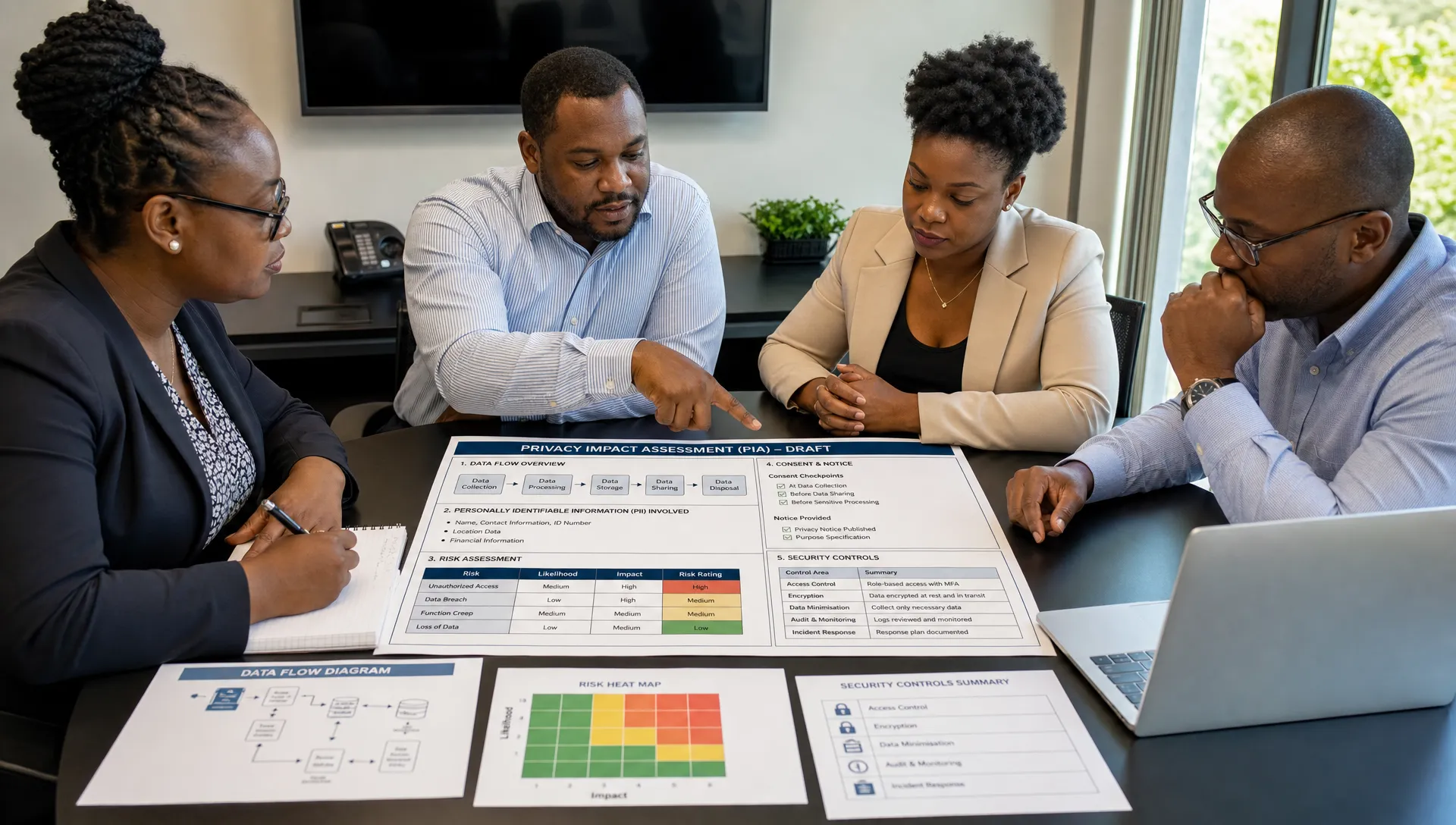
PIA, privacy screening and data protection risk assessment are not the same thing
The terms often overlap, but they should not be treated as identical. A privacy screening is a quick triage step. A data protection risk assessment is a broader risk identification exercise. A PIA is a deeper assessment used when a project may significantly affect individuals.
If your organisation is still building its first privacy risk process, PLMC’s guide to data protection risk assessment scope, steps and evidence explains the wider method. A PIA should sit within that governance structure rather than operate as a separate form.
Activity | Main purpose | Best used when |
Privacy screening | Decide whether privacy review is needed | Every new project, system change or data-sharing proposal |
Data protection risk assessment | Identify and rate privacy risks across a process, vendor or control area | Building or maintaining the compliance programme |
Privacy impact assessment | Analyse high-risk project impacts and document mitigation before launch | New, intrusive, sensitive or large-scale processing is proposed |
Vendor privacy assessment | Evaluate a third party before sharing personal data | A supplier will store, access or process personal data |
This distinction matters because overcomplication can make teams avoid the process. Use a short screen for ordinary projects and reserve the full PIA for projects that genuinely need deeper review.
A practical PIA screening test
A project should be escalated for a PIA if the answer is yes to any high-impact question or yes to several medium-risk questions. The following screening test works well at project intake, procurement review or change approval:
Will the project introduce or materially change the collection, use, sharing or retention of personal data?
Will it involve sensitive personal data, children’s data, identity documents, financial identifiers or location data?
Will it use AI, profiling, scoring, matching, behavioural analytics or automated decision support?
Will it monitor employees, customers, patients, students or members of the public?
Will a new vendor, cloud provider, consultant or offshore support team access the data?
Will data be combined from multiple systems in a way that creates new insights about individuals?
Would people be surprised by the use or have limited ability to object?
Would a breach, error or misuse cause financial loss, distress, discrimination, service denial or reputational harm?
One yes does not automatically mean the project is unacceptable. It means the organisation should slow down enough to document the risk and design the controls before launch.
What a completed PIA should contain
A PIA should produce evidence that a reviewer can understand months or years later. It should show the decision trail, not just the final approval.
PIA section | What it should document |
Project description | Business objective, system owner, launch timeline and affected stakeholders |
Data map | Types of personal data, source systems, users, vendors, storage locations and transfers |
Purpose and lawful basis | Why the processing is needed and which condition or legal basis supports it |
Necessity and proportionality | Why the data, retention period and access rights are not excessive |
Individual impact | Possible harm to people, including unfair treatment, loss of control, financial risk or distress |
Controls | Security, access management, contracts, notices, consent where applicable, retention and training |
Residual risk | Remaining risk after controls and who is accountable for accepting or reducing it |
Action plan | Open issues, owners, deadlines and sign-off requirements before go-live |
The most valuable part is often the discussion around necessity and proportionality. If the project can achieve its aim with fewer fields, shorter retention, stronger access controls or better transparency, the PIA has already improved the design.
When should the PIA be done?
The best time to start a PIA is before key decisions become expensive to change. That usually means before a vendor is selected, a contract is signed, a system is configured, data is migrated, a pilot is launched or staff are instructed to use a new tool.
A PIA can also be used for existing processes when the organisation discovers that a system is high risk or poorly documented. In that case, it becomes a remediation tool. The priority is to map the processing, identify gaps, reduce immediate risk and create a defensible record of improvement.
A PIA should be revisited when the project changes. New data fields, new analytics, new vendors, new jurisdictions, longer retention or a different user group can all change the risk profile.
Examples of projects that commonly need a PIA in Jamaica
In practice, the need for a PIA depends on context. The same tool can be low risk in one setting and high risk in another.
A bank or credit union upgrading transaction monitoring for anti-money laundering purposes will likely need a PIA because the project may involve profiling, alerts, identity records and decisions that affect customers. A healthcare provider launching a patient portal will also need one because the project involves health data, authentication, access controls and patient rights.
An employer replacing a simple paper sign-in sheet with biometric attendance may need a PIA because biometric data changes the level of intrusion and harm. A school adopting a learning app may need one because children’s data, parent communications, vendor access and overseas hosting all require scrutiny. A retailer expanding a loyalty programme into behavioural segmentation should assess whether customers were told about the use and whether the profiling is proportionate.
By contrast, a website content update or a system patch that does not alter personal data use may only require a screening record. The deciding factor is not the size of the IT budget. It is the effect on personal data and individuals.
What if the PIA finds high residual risk?
A PIA is useful only if the organisation is willing to act on the results. If residual risk remains high, the project team should consider reducing the amount of data collected, removing unnecessary fields, shortening retention, adding human review, improving notices, strengthening access controls, encrypting data, changing the vendor setup or delaying launch until controls are in place.
Some findings may require senior management approval because the risk cannot be eliminated entirely. That approval should be informed, documented and tied to a clear action plan. If the legal position is uncertain, the organisation should seek specialist advice before proceeding.
The worst response is to approve the project first and ask privacy, legal, compliance or cybersecurity teams to fix the issues later. Late fixes are usually more expensive and less effective.
Build PIAs into governance, not just compliance
Privacy impact assessments work best when they are part of normal governance. Project sponsors, procurement teams, IT, legal, compliance, cybersecurity, HR, marketing and operations should know when to trigger a review. The Data Protection Officer or privacy lead should not be the only person watching for risk.
For boards and senior executives, the PIA provides a practical line of sight into data protection compliance. It shows whether the organisation is managing privacy risk before harm occurs, not only reacting to complaints or breaches.
For project teams, the PIA gives structure. It turns broad privacy concerns into design choices, contract terms, access rules, training needs and launch conditions.
Frequently Asked Questions
Is a privacy impact assessment required for every project in Jamaica? No. Many low-risk projects only need a brief screening record. A full PIA is most appropriate where the project involves sensitive data, new technology, monitoring, large-scale processing, vendors, overseas transfers or a significant change in how personal data is used.
Is a PIA the same as a DPIA under GDPR? They are closely related. DPIA is the term commonly used under GDPR, while PIA is often used more broadly. Jamaican organisations can learn from GDPR-style DPIA methods, but the assessment should be adapted to the Data Protection Act, 2020 and local business context.
Who should approve a PIA? Approval should come from the accountable business owner with input from privacy, legal, compliance, cybersecurity, IT and any relevant operational team. High-risk projects should be escalated to senior management before launch.
Can a PIA be completed after the project goes live? It can be done after launch for existing systems, but that is a remedial exercise. For new projects, the PIA should happen early enough to influence design, procurement, contracts, security controls and communications with individuals.
Does using a cloud vendor always mean we need a PIA? Not always. A simple cloud tool with minimal personal data may only need screening and vendor due diligence. A cloud platform that stores sensitive data, supports core services, involves offshore access or changes how people’s data is used should usually have a PIA.
Need help deciding whether your project needs a PIA?
Privacy & Legal Management Consultants Ltd. supports organisations in Jamaica with data protection implementation, governance, risk and compliance, cybersecurity alignment, privacy training and practical assessment tools. If your team is planning a new system, vendor arrangement, monitoring initiative or data-driven project, PLMC can help you decide whether a PIA is needed and how to complete it properly.
For support with privacy impact assessments and data protection compliance, visit Privacy & Legal Management Consultants Ltd. to request a consultation.