

How to Run a Simple Vendor Privacy Assessment
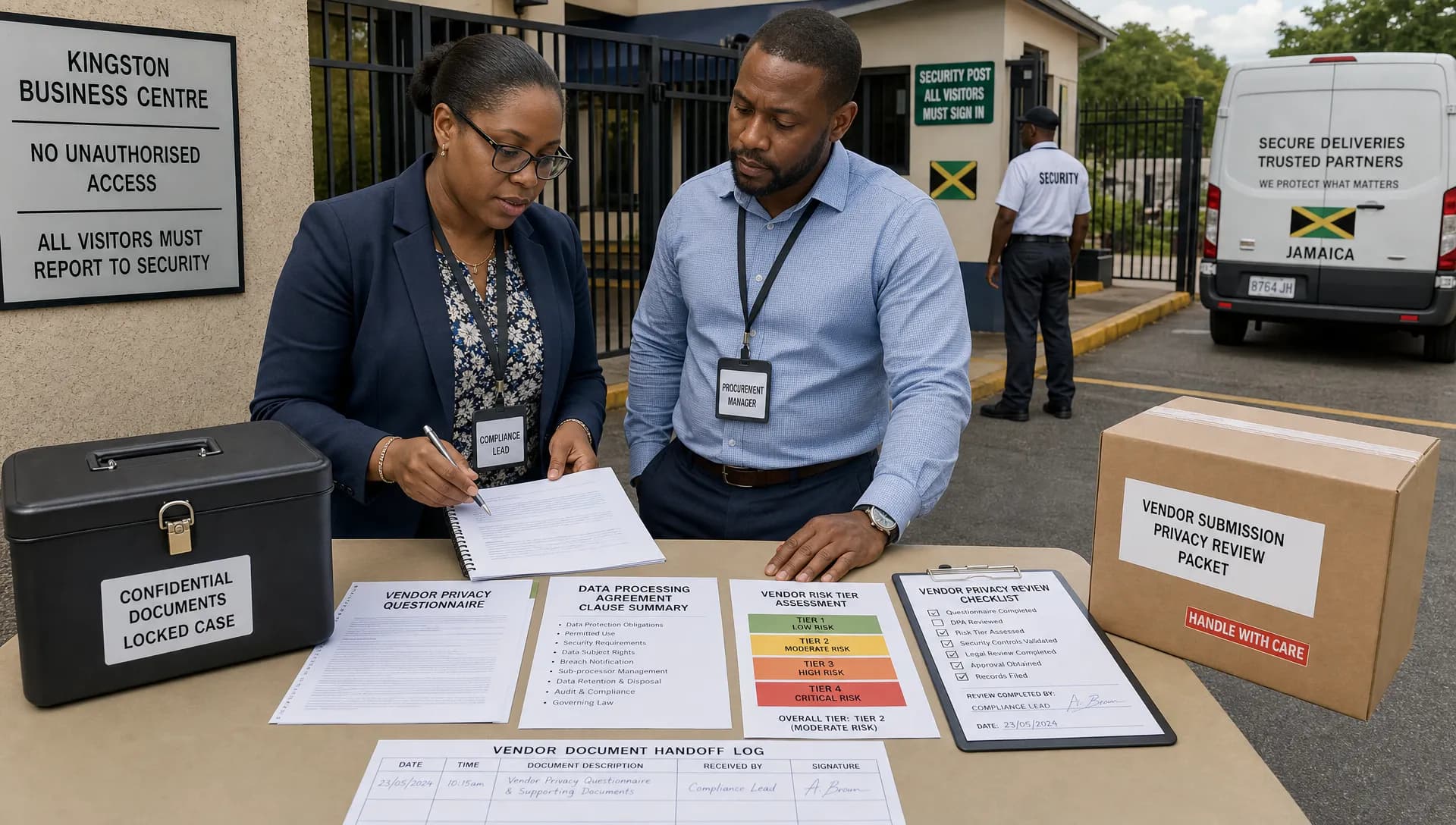
Most organisations rely on vendors long before they think about vendor privacy risk. Payroll providers, cloud platforms, marketing agencies, IT support companies, payment processors, accountants, security firms, and software vendors may all touch personal data in some way. If one of them mishandles that data, your organisation may still face regulatory, contractual, reputational, or operational consequences.
A vendor privacy assessment is a practical way to ask one simple question before you share data: can this vendor handle personal data safely, lawfully, and in line with our obligations?
For Jamaican organisations, this is especially important under the Data Protection Act, 2020, which places accountability on organisations that collect and use personal data. You do not need a complicated enterprise process to get started. A simple, consistent assessment is often enough to identify obvious risks, improve contracts, and decide whether extra controls are needed.
What a simple vendor privacy assessment should achieve
A good assessment does not try to audit every part of the vendor’s business. It focuses on the privacy risks created by your specific use of that vendor.
The goal is to understand:
What personal data the vendor will access, store, transmit, or process.
Why the vendor needs the data and whether the amount of data is proportionate.
Where the data will be stored or accessed from.
Whether subcontractors or cloud platforms are involved.
What security, confidentiality, retention, and deletion controls exist.
How the vendor handles incidents, data subject requests, and end-of-contract return or deletion.
Whether the contract gives your organisation enough protection and oversight.
This is not only a procurement exercise. It sits at the intersection of privacy, information security, legal, operations, and governance. If your organisation already has a broader privacy programme, this assessment should connect to your data inventory, risk register, contracts, and incident response process.
If you are still building that foundation, PLMC’s practical privacy and data protection checklist is a useful companion because it shows where vendor management fits into a wider compliance programme.
Step 1: Identify which vendors are in scope
Start by listing vendors that interact with personal data or confidential business information. Do not assess every supplier in the same way. The company that delivers office furniture is not the same as a payroll provider that stores employee bank details and tax information.
A vendor is usually in scope if it can view, receive, store, host, analyse, transmit, support, or dispose of personal data. This includes direct access, such as a call centre handling customer records, and indirect access, such as an IT support provider that can log into systems containing personal data.
Common in-scope vendors include:
Payroll, HR, recruitment, and benefits providers.
Cloud storage, SaaS, CRM, and email marketing platforms.
IT support, managed security, and system administration providers.
Payment processors, banks, and financial technology providers.
Professional advisers who receive employee, customer, or client files.
Document storage, shredding, scanning, and records management companies.
Outsourced customer service, debt collection, and logistics providers.
Once you have the list, capture the business owner for each vendor. Every vendor should have someone inside your organisation who understands the service, the data being shared, and the operational need.
Step 2: Tier vendors by privacy risk
A simple assessment works best when it is risk-based. High-risk vendors deserve more questions and stronger evidence. Low-risk vendors should not be buried under a long questionnaire that no one will review properly.
Use three tiers: low, medium, and high. Your scoring does not have to be perfect. It only needs to be consistent and reasonable.
Risk tier | Typical situation | Assessment depth |
Low | Vendor has no access to personal data or only receives limited business contact details | Basic screening and standard confidentiality terms |
Medium | Vendor processes routine personal data, such as customer contact details, employee records, or service history | Short questionnaire, contract review, and basic evidence check |
High | Vendor processes sensitive data, large volumes, financial data, children’s data, health data, or has administrator access to systems | Full questionnaire, stronger evidence, senior approval, and periodic review |
This tiering helps you spend time where it matters. A payroll platform, cloud database provider, or outsourced call centre will normally need closer review than a vendor that only receives a contact name and work email.
You can also use trigger questions to decide whether a vendor moves into a higher tier. For example, ask whether the vendor will process sensitive personal data, transfer data outside Jamaica, use subcontractors, connect to internal systems, or store data in a multi-tenant cloud environment.
Step 3: Ask only the questions that matter
Many vendor questionnaires fail because they are too long, too generic, and too difficult to review. A simple vendor privacy assessment should ask targeted questions that reveal practical risk.
Here is a short questionnaire structure that works well for most organisations.
Assessment area | Key question | Useful evidence |
Data scope | What personal data will the vendor process for this service? | Data fields, process description, data flow summary |
Purpose | Why does the vendor need this data? | Service description, statement of work, processing purpose |
Location | Where will the data be stored, hosted, or accessed from? | Hosting location, cloud region, remote access policy |
Subcontractors | Will any other party process the data? | List of subprocessors or subcontractors, approval process |
Security | How is the data protected from unauthorised access, loss, or misuse? | Access controls, encryption details, security policy summary |
Confidentiality | Are staff and contractors bound by confidentiality duties? | Contract clause, employee policy, training confirmation |
Retention | How long will the vendor keep the data? | Retention schedule, deletion procedure |
Incidents | How will the vendor notify you of a data breach or security incident? | Incident response procedure, notification timeline |
Individual rights | Can the vendor help with access, correction, deletion, or other rights requests? | Support process, service-level commitment |
End of service | What happens to the data when the contract ends? | Return and deletion clause, destruction certificate process |
The best answers are specific. “We use industry-standard security” is not enough by itself. A better answer explains access controls, authentication, encryption, staff responsibilities, incident escalation, and how customer data is segregated or protected.
For a deeper look at the full pre-engagement process, you can compare this simple approach with PLMC’s guide on vendor due diligence for privacy and compliance teams.
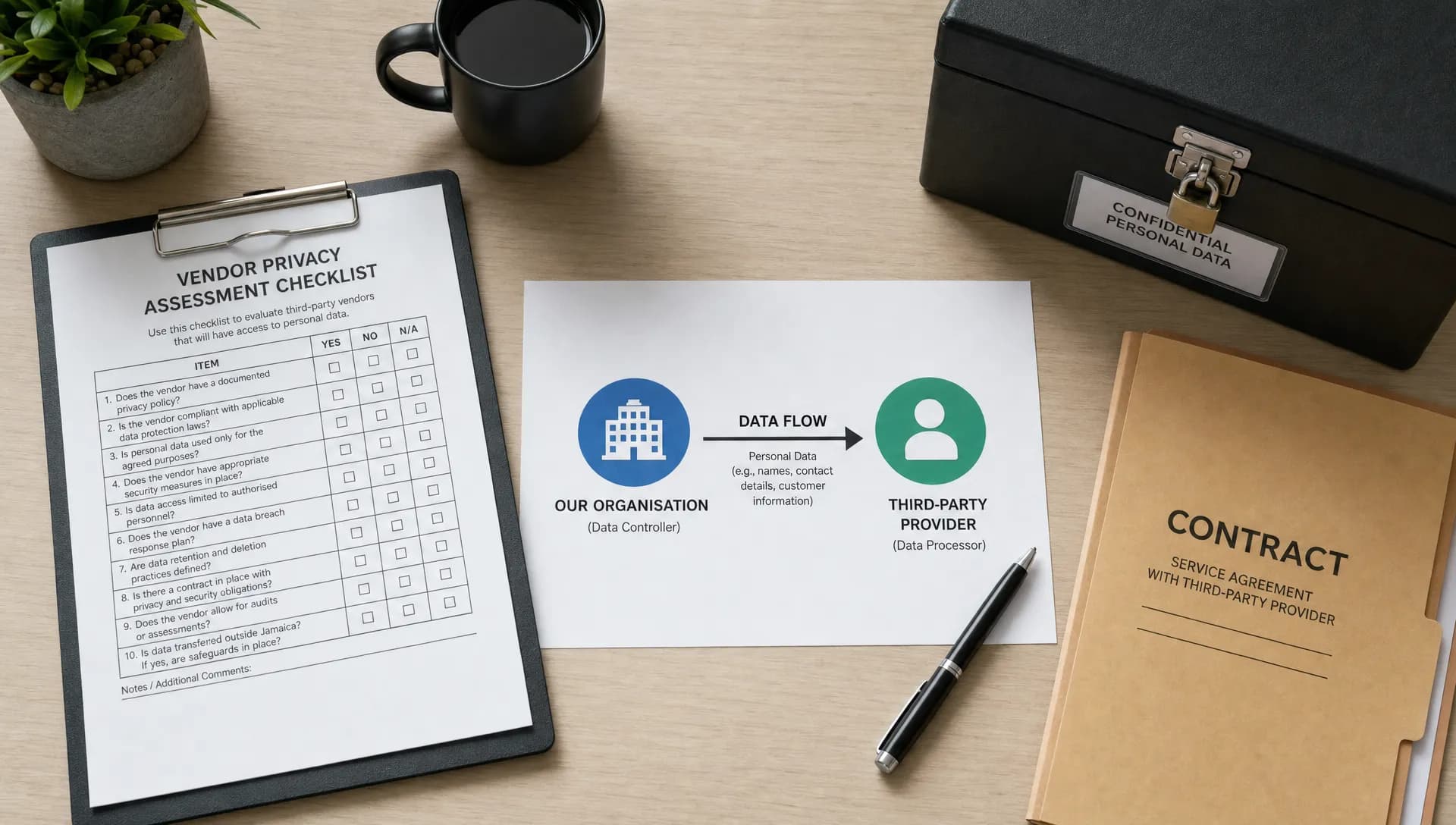
Step 4: Review the contract before data is shared
The questionnaire tells you what the vendor says it does. The contract determines what the vendor is actually obliged to do.
At minimum, the contract should address privacy, confidentiality, security, breach notification, subcontracting, retention, deletion, and cooperation with compliance obligations. If the vendor will process personal data on your behalf, the agreement should be clear about the vendor’s role, the purpose of processing, and the limits on how the data can be used.
Look for clauses that cover:
Processing only for authorised purposes and documented instructions.
Confidentiality obligations for personnel who can access the data.
Appropriate technical and organisational security measures.
Restrictions or approval requirements for subcontractors.
Prompt notice of actual or suspected data breaches.
Assistance with data subject requests and regulatory enquiries.
Return or secure deletion of data when the service ends.
Audit rights, evidence rights, or compliance reporting where risk justifies it.
If a high-risk vendor refuses to include basic privacy protections, that is a serious warning sign. The business may still decide to proceed, but the risk should be documented and approved at the right level.
Step 5: Check evidence without overcomplicating it
Evidence review does not mean you need to perform a full audit. For most vendors, you are checking whether their answers are credible and whether they can support key claims.
For lower-risk vendors, a completed questionnaire and signed contract may be enough. For medium-risk vendors, you may ask for a security policy summary, privacy notice, retention schedule, incident process, or proof of staff confidentiality obligations. For high-risk vendors, you may need stronger evidence such as independent security certifications, penetration test summaries, audit reports, business continuity documentation, or detailed access control information.
Be careful not to collect more sensitive information than you need. Vendor evidence can itself be confidential. Store it securely, limit access, and retain it only as long as necessary.
A practical evidence review should answer three questions: Does the vendor understand the data it will process? Are the controls proportionate to the risk? Can the vendor support its answers with something more than general assurances?
Step 6: Make a clear decision
Every assessment should end with a decision. Otherwise, the process becomes a paperwork exercise.
A simple decision model can look like this:
Decision | Meaning | Next step |
Approve | No material privacy concerns or risks are adequately controlled | Proceed and schedule review based on risk tier |
Approve with conditions | Risks exist but can be reduced through contract changes, technical controls, or operational limits | Complete conditions before launch or within an agreed timeline |
Escalate | Material concerns require legal, privacy, security, or senior management review | Do not share data until the escalation is resolved |
Reject or replace | Risks are unacceptable or vendor cannot meet minimum requirements | Select another vendor or redesign the process |
Conditions should be specific. “Improve security” is too vague. Better conditions include “add breach notification clause,” “remove unnecessary employee date-of-birth field,” “confirm data hosting location,” or “provide deletion confirmation at contract end.”
If the vendor privacy assessment identifies broader issues in your own process, such as unclear lawful basis, excessive data collection, or weak access controls, treat it as a privacy risk assessment issue. PLMC’s step-by-step guide to a data privacy risk assessment can help you analyse those internal risks more fully.
Step 7: Keep a vendor privacy register
A vendor privacy register is a simple tracking document that shows which vendors have been assessed, what data they handle, and when they need to be reviewed again. A spreadsheet is often enough for small and medium-sized organisations.
Useful fields include vendor name, business owner, service description, data categories, data subjects, risk tier, assessment date, decision, contract status, key conditions, data location, subcontractor status, and next review date.
Review frequency should match risk. High-risk vendors may need annual review or review when there is a major change. Medium-risk vendors can often be reviewed less frequently unless the service changes. Low-risk vendors may only need review when the contract, data use, or service scope changes.
The most important rule is this: reassess when something material changes. A vendor that previously handled only business contact details may become high-risk if it begins hosting customer identity documents, processing financial records, or integrating directly with your systems.
Common red flags to watch for
Some concerns do not automatically mean you must reject a vendor, but they should trigger follow-up questions. Red flags include vague security answers, no breach notification commitment, no deletion process, unrestricted subcontracting, refusal to identify hosting locations, unclear retention periods, and contract terms that allow the vendor to use your data for its own unrelated purposes.
Another red flag is a mismatch between what the business thinks the vendor does and what the contract or technical setup shows. For example, a department may describe a tool as a simple messaging service, while the platform actually stores customer documents, call recordings, or analytics data in multiple jurisdictions.
Cross-border processing also deserves attention. If personal data will be stored or accessed outside Jamaica, you should understand where it goes, who can access it, and what contractual or operational safeguards apply. Where needed, check guidance from Jamaica’s Office of the Information Commissioner and obtain legal or privacy advice specific to your organisation’s situation.
A simple one-page template
If you want to keep the process lightweight, use a one-page template with the following sections.
Section | What to record |
Vendor overview | Name, service, business owner, contract owner |
Data involved | Categories of personal data, data subjects, volume, sensitivity |
Processing details | Purpose, systems used, storage location, access method |
Risk tier | Low, medium, or high, with short reason |
Key controls | Security, confidentiality, retention, deletion, incident notification |
Contract check | Privacy clauses present, gaps, required amendments |
Decision | Approved, approved with conditions, escalated, or rejected |
Review date | Next review date and trigger events |
This template is intentionally simple. The point is not to create a perfect document. The point is to create a repeatable habit before personal data is shared.
Frequently Asked Questions
Is a vendor privacy assessment legally required in Jamaica? The Data Protection Act, 2020 does not prescribe one universal questionnaire for every vendor, but organisations are expected to manage personal data responsibly and demonstrate accountability. Assessing vendors that handle personal data is a practical way to support that accountability.
When should we assess a vendor? Assess the vendor before signing the contract or before personal data is shared. Also reassess when the service changes, the vendor adds new subprocessors, the data categories change, or a security or privacy incident occurs.
Do small businesses need vendor privacy assessments? Yes, but the process should match the size and risk of the business. A small organisation can use a short questionnaire, basic contract checks, and a simple vendor register rather than a large enterprise workflow.
What if a vendor refuses to answer privacy questions? First, explain why the information is needed and limit your request to questions relevant to the service. If the vendor still refuses, escalate the decision and consider whether the risk is acceptable, whether additional contractual protections are possible, or whether another vendor is safer.
What is the difference between vendor due diligence and a vendor privacy assessment? Vendor due diligence is broader and may include financial, operational, legal, security, anti-money laundering, and reputational checks. A vendor privacy assessment focuses specifically on how the vendor handles personal data and privacy obligations.
Build vendor privacy checks into everyday decisions
A simple vendor privacy assessment helps your organisation avoid preventable risk before data leaves your control. It also creates evidence that privacy was considered at the right time, by the right people, with the right level of care.
If your organisation in Jamaica needs support building a practical vendor assessment process, improving privacy controls, or aligning governance, risk, and compliance activities, Privacy & Legal Management Consultants Ltd. can help you take a structured, risk-based approach.