

Vendor Due Diligence for Privacy and Compliance Teams

A vendor does not have to be large, technical, or overseas to create serious privacy exposure. A payroll provider, courier, cloud platform, call centre, marketing agency, payment gateway, records storage company, or outsourced IT technician can all touch personal data in ways that affect your organisation's compliance posture.
For privacy and compliance teams, vendor due diligence is the process of deciding whether a supplier can be trusted with personal data, confidential information, regulated records, or systems access before the relationship creates risk. It is not just a procurement form. It is a governance control that supports accountability, cyber resilience, contract management, anti-money laundering controls where relevant, and data protection compliance.
In Jamaica, this matters because the Data Protection Act 2020 places greater expectations on organisations to know what personal data they process, why it is processed, who receives it, and how it is protected. When a vendor is involved, your team needs evidence that the vendor relationship is understood, controlled, and monitored.
Why vendor due diligence belongs in the privacy programme
Outsourcing a function does not remove responsibility for privacy risk. If a vendor hosts your customer database, processes employee records, screens customers for AML purposes, manages your website forms, or provides remote support into your environment, their controls can affect your organisation's ability to meet legal, regulatory, and contractual obligations.
The Office of the Information Commissioner in Jamaica is the central regulatory body for the country's data protection framework. As privacy expectations mature, organisations should be able to demonstrate that third parties handling personal data are subject to reasonable oversight. That means documenting decisions, not relying on informal assurances.
Vendor due diligence helps privacy and compliance teams answer four practical questions:
What data, systems, and business processes will the vendor access?
What could go wrong if the vendor misuses, loses, or exposes that data?
What evidence shows the vendor can manage that risk?
What contract terms, monitoring steps, and exit controls are required?
If your organisation is still building its wider operating model, vendor review should sit inside a broader data compliance programme that works in day-to-day operations, not as a one-off legal checkpoint.
Start by defining which vendors need review
Not every supplier needs the same level of scrutiny. A stationery supplier may not require a privacy review if it never sees personal data. A cloud HR platform, however, will likely require a deeper assessment because it may process employee identity, payroll, leave, disciplinary, and health-related information.
The first step is to define what counts as an in-scope vendor. Privacy and compliance teams should normally include any third party that processes personal data, has access to internal systems, stores confidential records, supports regulated activities, or can affect service continuity.
Vendor type | Common privacy or compliance concern | Typical internal owners |
Payroll and HR providers | Employee records, bank details, tax data, sensitive HR files | HR, Finance, Legal, Privacy |
Cloud and SaaS platforms | Data hosting, access controls, sub-processors, cross-border storage | IT, Security, Procurement, Privacy |
Marketing agencies and CRM tools | Consent, customer profiling, campaign lists, unsubscribe handling | Marketing, Privacy, Legal |
Payment, KYC, and AML vendors | Identity documents, sanctions checks, transaction records, audit trails | Compliance, Finance, Risk |
Outsourced IT and cyber providers | Privileged access, remote support, logs, incident response | IT, Security, Risk |
Records storage and shredding vendors | Physical security, retention, destruction evidence | Operations, Legal, Privacy |
Professional services firms | Confidential advice, client files, due diligence records | Legal, Finance, Executive team |
This definition should be included in procurement procedures so business teams know when to involve privacy, compliance, IT security, or legal before a contract is signed.
Use risk tiering before sending a questionnaire
A common mistake is to send the same long questionnaire to every vendor. That frustrates low-risk suppliers, wastes internal time, and still may not reveal the risks that matter. A better approach is to tier vendors based on the nature of the data, the sensitivity of the activity, and the impact of failure.
Risk tiering should happen early, ideally when the business owner requests a new vendor or renews an existing contract. It should be simple enough for procurement and business teams to use, but structured enough to support an audit trail.
Risk tier | Typical trigger | Review depth | Approval expectation |
Low | No personal data, limited business contact data, or one-time low-risk service | Basic intake and contractual confidentiality where needed | Business owner approval with privacy spot-check if required |
Medium | Routine personal data, limited system access, or non-critical processing | Privacy and security questionnaire, processing terms, retention review | Privacy or compliance review plus business owner sign-off |
High | Sensitive data, large volumes, financial or identity data, privileged access, critical operations, or cross-border processing | Full due diligence, security evidence, contract negotiation, risk treatment plan | Senior approval with documented rationale and monitoring cadence |
The purpose is not to create bureaucracy. The purpose is to spend the most effort where the organisation has the greatest exposure.
What privacy and compliance teams should assess
Good vendor due diligence is both privacy-focused and operational. A vendor may have a strong product but weak deletion processes. Another may have good security controls but unclear sub-processor arrangements. Your assessment should look across the full data lifecycle.
Due diligence area | What to ask | Why it matters |
Purpose and scope | What service is being provided, and what data is needed to provide it? | Prevents unnecessary data sharing and scope creep |
Data categories | Will the vendor process employee, customer, children, health, financial, biometric, or identity data? | Determines sensitivity and review depth |
Access controls | Who can access the data, how is access approved, and is multi-factor authentication used? | Reduces insider risk and unauthorised access |
Security controls | How does the vendor protect data in transit, at rest, and during support activity? | Supports confidentiality, integrity, and availability |
Sub-processors | Does the vendor rely on other vendors, hosting providers, or affiliates? | Reveals hidden third-party risk |
Location and transfers | Where will data be stored, accessed, backed up, or supported from? | Helps assess cross-border and jurisdictional risk |
Retention and deletion | How long is data kept, and how is deletion confirmed at termination? | Supports data minimisation and defensible disposal |
Incident response | How soon will the vendor notify you of a suspected breach or security incident? | Enables timely investigation and regulatory response |
Training and governance | Are staff trained on privacy, confidentiality, cyber security, and relevant compliance duties? | Shows whether controls are embedded in people and processes |
Regulated obligations | Does the vendor support AML, financial services, healthcare, public sector, or other regulated activity? | Aligns the review with sector-specific risk |
Where a vendor will process personal data, connect the review to your data inventory or record of processing activities. If your team is still mapping data flows, a practical data privacy assessment can help identify which vendors matter most.
Evidence to collect before approval
Vendor answers are useful, but evidence is stronger. For medium and high-risk vendors, privacy and compliance teams should collect documents that support the vendor's claims. The level of evidence should be proportionate. A small local service provider may not have a SOC 2 report, but it should still be able to explain how it controls access, protects records, trains staff, and reports incidents.
Useful evidence may include:
A completed vendor intake or privacy questionnaire
A summary of data processed and the business purpose
Security policy summaries or control descriptions
Independent assurance where available, such as SOC 2, ISO/IEC 27001, PCI DSS, or penetration test summaries
Incident response and breach escalation procedures
Sub-processor or hosting provider information
Retention, deletion, and backup practices
Confidentiality and staff training evidence
Insurance details where appropriate
Contact details for privacy, legal, security, and escalation matters
For cyber security questions, frameworks such as the NIST Cybersecurity Framework can provide a useful reference point, especially when teams need a common language for identifying, protecting, detecting, responding, and recovering.
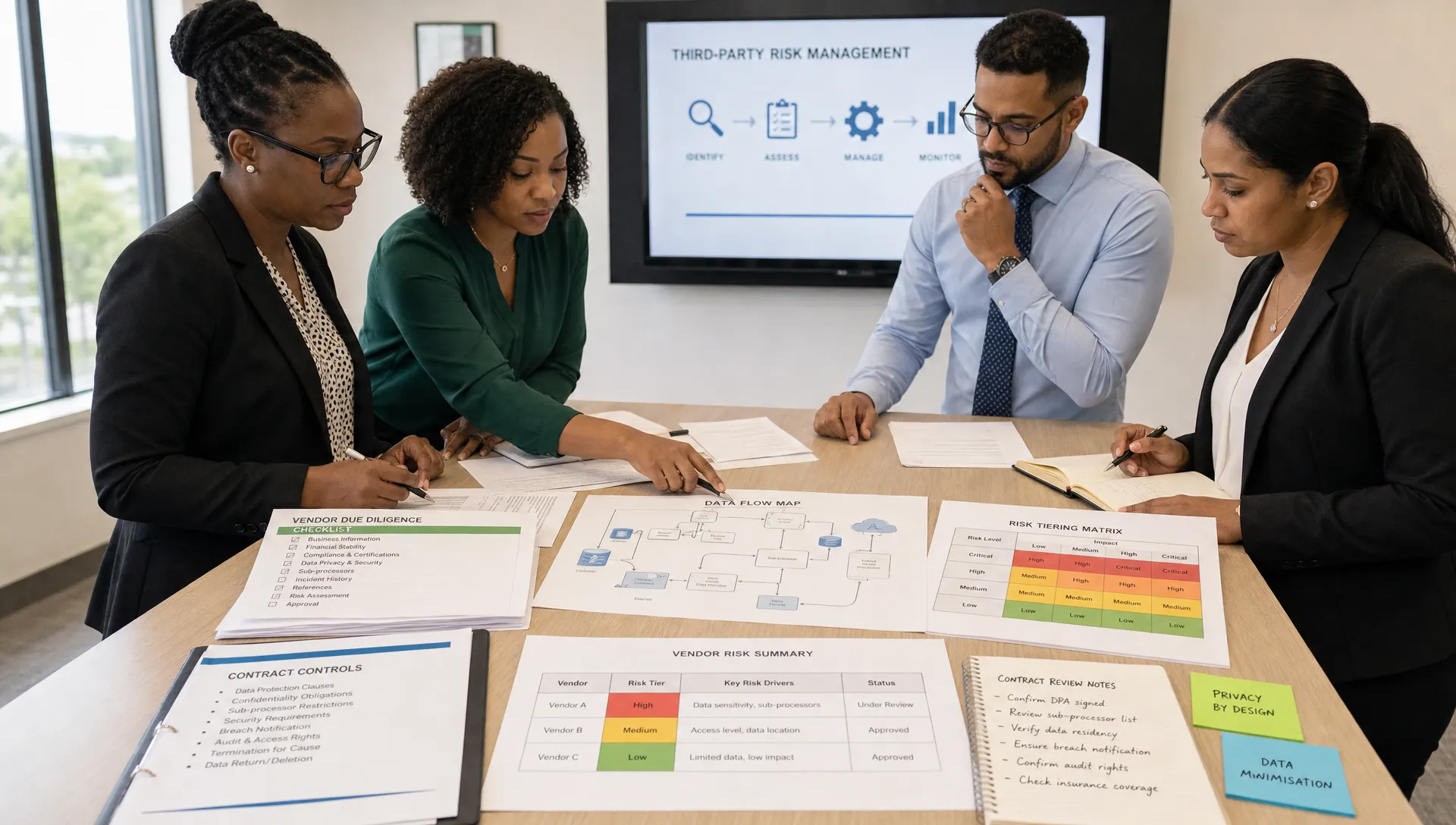
Contract clauses that make due diligence enforceable
Due diligence should influence the contract. If the review identifies privacy or compliance risk, the agreement should contain practical controls that the organisation can rely on later. A vendor questionnaire without contractual follow-through is weak evidence.
For vendors that process personal data or access sensitive systems, the contract should be clear on instructions, confidentiality, security, sub-processors, breach notification, retention, deletion, and audit rights. The wording should be adapted to the relationship and reviewed by legal counsel where appropriate.
Contract area | Practical purpose |
Processing instructions | Limits the vendor to agreed purposes and prevents unauthorised use of data |
Confidentiality | Requires staff and sub-contractors to protect information appropriately |
Security measures | Sets minimum technical and organisational controls |
Incident notification | Requires prompt notice of suspected or confirmed incidents |
Sub-processor approval | Gives visibility and control over downstream vendors |
Assistance obligations | Requires support for access requests, investigations, audits, and regulatory queries |
Retention and deletion | Defines what happens to data during and after the contract |
Audit or evidence rights | Allows review of controls through reports, attestations, or targeted audits |
Cross-border processing | Addresses locations, safeguards, and legal requirements for transfers |
Termination support | Ensures data return, deletion, transition assistance, and access removal |
The contract should also state who to contact in an incident, what timelines apply, and what evidence the vendor must provide. For high-risk arrangements, vague language such as appropriate security may not be enough. Teams should specify the outcomes they need, such as access controls, encryption, logging, staff confidentiality, backup protection, and deletion confirmation.
A practical vendor due diligence workflow
A strong workflow makes vendor due diligence repeatable. The goal is to avoid last-minute reviews when the business is ready to launch, but privacy, legal, and security have not seen the arrangement.
Create an intake trigger: Require business owners or procurement to flag any vendor that will process personal data, access systems, support regulated activity, or store confidential information.
Identify the data and purpose: Record what data will be shared, why it is needed, where it will flow, and whether the vendor is essential to the service.
Assign a risk tier: Use consistent criteria so low, medium, and high-risk vendors are reviewed proportionately.
Collect evidence: Request questionnaires, policies, assurance reports, sub-processor details, and security summaries based on the tier.
Review gaps and decide treatment: Accept the risk, require remediation, add contract controls, restrict the data shared, or reject the vendor.
Complete contract review: Ensure privacy, security, confidentiality, retention, deletion, and incident clauses reflect the assessment.
Approve and record the decision: Keep the risk rating, evidence, approvals, and conditions in a central register.
Monitor and offboard: Reassess material changes, track incidents, review renewals, and confirm data return or deletion at exit.
This workflow should be owned jointly. Procurement controls the buying process, the business owner understands the service, IT security understands technical exposure, legal handles contract terms, and privacy or compliance assesses data protection risk.
Ongoing monitoring is where many programmes fail
Vendor due diligence is not finished at onboarding. Vendors change hosting providers, add sub-processors, update products, expand integrations, suffer incidents, or start using data for new purposes. A vendor that was low risk two years ago may become high risk after a new feature, acquisition, or business expansion.
Monitoring should be risk-based. High-risk vendors may need annual review or review at each renewal. Medium-risk vendors may be reviewed on a set cycle or when the service changes. Low-risk vendors may only need review if the scope changes.
Monitoring trigger | What to review |
Contract renewal | Risk tier, processing scope, incidents, contract clauses, deletion commitments |
New data type | Whether the vendor now handles sensitive, financial, identity, or larger-volume data |
New integration | System access, authentication, logging, data flows, and API controls |
New sub-processor | Location, role, security, and contractual safeguards |
Security incident | Vendor response, root cause, affected data, remediation, and notification duties |
Business process change | Whether the original due diligence still reflects reality |
Termination | Return or deletion of data, removal of access, and confirmation of destruction |
A vendor register is one of the most useful privacy governance tools because it gives teams a living view of third-party risk. For practical ways to manage inventories, workflows, and accountability, see PLMC's guide to privacy governance tools that actually work.
Special considerations for Jamaican organisations
Jamaican organisations often work with a mix of local service providers, regional partners, and global cloud platforms. That makes vendor due diligence especially important because personal data may be stored or accessed from multiple jurisdictions.
If a vendor is outside Jamaica, privacy and compliance teams should understand where data will be hosted, where support teams are located, whether sub-processors are involved, and what contract safeguards apply. If your organisation handles data relating to persons in the UK, EU, or other jurisdictions, you may also need to consider GDPR-style expectations, international transfer rules, and customer contract requirements.
Regulated sectors should go further. Financial institutions, fintechs, insurance providers, professional services firms, and other AML-sensitive organisations should ask whether vendors support customer due diligence, sanctions screening, transaction monitoring, document verification, or record retention. In those cases, vendor failures can create both privacy and anti-money laundering risk.
Local SMEs should not be excluded simply because they lack international certifications. Due diligence should be fair and proportionate. A small vendor can still show practical controls, such as named accountability, secure storage, limited staff access, confidentiality commitments, privacy awareness training, incident escalation, and a clear deletion process.
Red flags that should be escalated
Some vendor responses deserve closer review before approval. A red flag does not always mean the vendor must be rejected, but it should trigger follow-up, remediation, or senior risk acceptance.
Watch for these warning signs:
The vendor cannot explain what personal data it will process or why it is needed
The vendor asks for more data than the service requires
There is no clear incident notification process or named escalation contact
Sub-processors are undisclosed or described vaguely
Administrative access is shared, unmanaged, or not protected by strong authentication
The vendor refuses reasonable privacy or security clauses
Data retention is indefinite or deletion cannot be confirmed
Support teams can access live personal data without logging or approval
The vendor has had recent incidents but cannot explain remediation
The contract allows broad use of your data for analytics, training, marketing, or product development without clear limits
When these issues arise, privacy and compliance teams should document the concern, decide whether the vendor can remediate, and ensure the business owner understands the risk before proceeding.
Make your vendor records audit-ready
The best vendor due diligence process creates evidence as it operates. If a regulator, board, auditor, client, or senior executive asks why a vendor was approved, your team should not have to search emails or reconstruct decisions from memory.
An audit-ready vendor file should include the intake record, data categories, risk tiering rationale, completed questionnaire, evidence reviewed, contract terms, approval decision, outstanding actions, monitoring history, and offboarding confirmation where relevant.
Record | Why it matters |
Vendor intake form | Shows who requested the vendor and what service is being provided |
Data flow summary | Explains what data is shared, where it goes, and who can access it |
Risk tiering decision | Demonstrates a proportionate assessment approach |
Evidence pack | Supports the vendor's security, privacy, and compliance claims |
Contract review notes | Links due diligence findings to enforceable terms |
Approval record | Shows who accepted the risk and under what conditions |
Monitoring log | Tracks renewals, incidents, changes, and remediation |
Exit confirmation | Proves access removal, data return, or deletion at termination |
This evidence does not need to be complex. It needs to be consistent, current, and easy to retrieve.
Frequently Asked Questions
What is vendor due diligence for privacy and compliance teams? Vendor due diligence is the structured review of a third party before and during a business relationship to understand privacy, security, legal, regulatory, and operational risks. It helps teams decide whether the vendor can process data safely and what controls are needed.
Do all vendors need the same due diligence process? No. The review should be risk-based. Vendors with no access to personal data or systems may only need basic checks, while vendors handling sensitive data, large volumes, financial records, or critical services need deeper review and stronger contract controls.
What should be checked before approving a SaaS or cloud vendor? Privacy and compliance teams should assess data categories, hosting locations, access controls, encryption, sub-processors, breach notification, retention, deletion, availability, support access, and contractual safeguards.
How often should vendors be reviewed after onboarding? Review frequency should depend on risk. High-risk vendors should be reviewed more regularly and whenever there is a material change, such as a new data type, new integration, incident, sub-processor change, or contract renewal.
Who should own vendor due diligence internally? Ownership should be shared. Procurement controls the buying process, the business owner explains the service, privacy and compliance assess data risk, IT security assesses technical risk, and legal ensures the contract reflects the required controls.
Need help strengthening vendor due diligence?
Privacy & Legal Management Consultants Ltd. supports organisations in Jamaica with data protection implementation, privacy compliance, GRC integration, training, cyber security support, and risk assessment tools. If your team needs a practical vendor due diligence process that fits your operations, start with a free consultation.