

Privacy by Design for New Systems and Projects
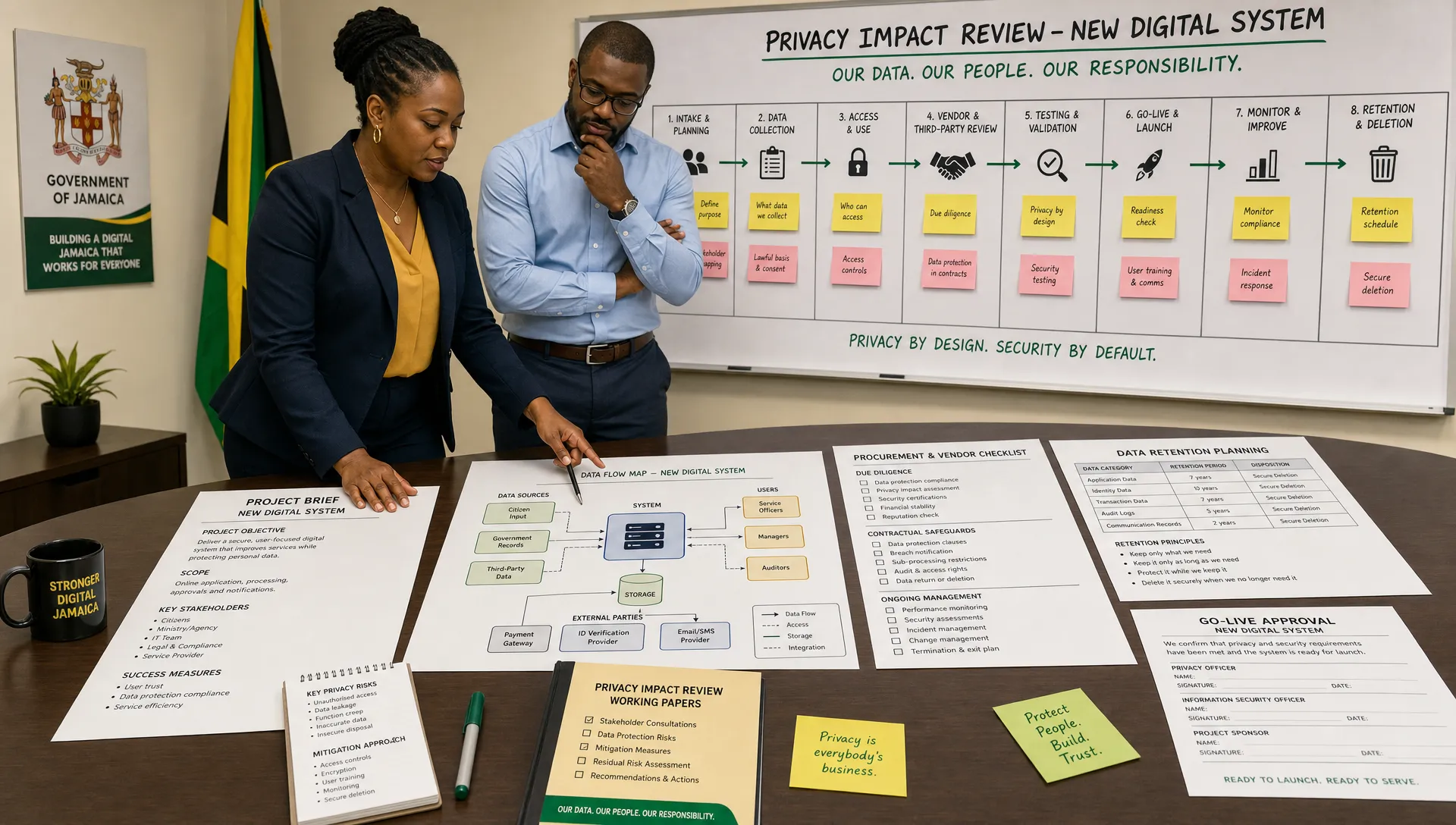
Every new system is a privacy decision. A customer portal, HR platform, mobile app, analytics dashboard, CRM upgrade, CCTV rollout, or vendor integration can all change how personal data is collected, used, shared, stored, and deleted. If privacy is only reviewed after launch, the organisation may discover expensive problems when contracts are signed, workflows are already live, and staff have built habits around risky processes.
Privacy by Design changes that. It places data protection, security, transparency, accountability, and user rights into the planning and delivery of new systems from the beginning. For Jamaican organisations working under the Data Protection Act, 2020, this approach is one of the most practical ways to reduce compliance risk while still moving projects forward.
The goal is not to slow innovation. The goal is to make better design decisions early, when they are cheaper, easier, and more effective.
What Privacy by Design means in practice
Privacy by Design means that privacy is treated as a core project requirement, not a legal review at the end. It asks teams to consider personal data at each stage of a project lifecycle, including business case, procurement, design, configuration, testing, launch, and ongoing management.
In practical terms, it means a project team should be able to answer questions such as:
What personal data will the system collect, and is each data field necessary?
What purpose will the data be used for, and has that purpose been clearly defined?
Who will have access, and what access level is appropriate for their role?
How long will the data be kept, and what will trigger deletion or anonymisation?
What vendors, cloud providers, or third parties will process the data?
How will people be informed about the processing, and how can they exercise their rights?
What technical and organisational measures will protect the data?
The UK Information Commissioner's Office guidance on data protection by design and default describes this as embedding data protection into processing activities and business practices from the design stage onwards. The same thinking is highly relevant for organisations in Jamaica, especially where projects involve large volumes of personal data, sensitive information, children, employees, customers, patients, students, or financial records.
Why Privacy by Design matters under Jamaica's Data Protection Act, 2020
Jamaica's Data Protection Act, 2020 sets out standards for how personal data should be handled. These include principles such as fair and lawful processing, specified purposes, data minimisation, accuracy, retention limits, data subject rights, security, and restrictions on certain transfers.
Privacy by Design helps operationalise these principles. Rather than asking whether a system is compliant after it has already been built, the organisation asks compliance questions while the system is still being shaped.
Privacy by Design question | Compliance value for new systems |
Do we need every data field being collected? | Supports data minimisation and reduces exposure |
Is the purpose clear and documented? | Supports lawful, fair, and purpose-based processing |
Are access rights based on job need? | Reduces unauthorised access and internal misuse |
Is retention built into the workflow? | Prevents personal data being kept indefinitely |
Are security controls configured before launch? | Supports appropriate technical and organisational protection |
Are notices, consent flows, or other transparency measures ready? | Improves fairness and helps individuals understand processing |
Are vendors assessed before contracting? | Reduces third-party and cross-border processing risk |
This is especially important in projects where business teams are under pressure to launch quickly. A system can appear efficient while quietly creating unnecessary privacy risk. For example, a new customer onboarding form may collect national identification, address, date of birth, employer details, and financial information even when only some of that data is needed. A staff portal may grant managers broader access than required. A marketing database may import historical contacts without a clear basis or retention plan.
These issues are much easier to prevent during design than to fix after the system is live.
Start privacy planning before procurement or development
One of the most common mistakes is waiting until a vendor has been selected or software has been configured before involving privacy, legal, compliance, IT security, or records management. By then, the organisation may already be locked into a workflow that conflicts with its data protection obligations.
Privacy planning should begin as soon as a project idea becomes serious. At the business case stage, the project sponsor should identify whether the project will involve personal data and whether it could create elevated risk. This does not need to be complicated. A short screening process can flag projects that need deeper review.
A privacy screening should consider the type of data involved, the number of people affected, the sensitivity of the information, the use of new technology, the involvement of third parties, and whether data will be transferred outside Jamaica. It should also ask whether the project affects vulnerable groups, uses automated decision-making, introduces monitoring, or combines data from multiple sources.
The NIST Privacy Framework is a useful reference for organisations that want a structured way to identify, govern, control, communicate, and protect privacy risks. For many Jamaican organisations, the most effective approach is to adapt these ideas into simple project controls that staff can actually use.
A practical Privacy by Design workflow for projects
Privacy by Design works best when it is built into the existing project methodology. Whether your organisation uses agile delivery, traditional project management, vendor-led implementation, or informal business projects, the following workflow can help.
Screen the project early: Confirm whether the project involves personal data and whether it needs a more detailed privacy review. A low-risk internal workflow may only need basic controls, while a high-risk platform may require a formal assessment.
Define the purpose and lawful basis: Document why the data is being collected and how it will be used. Avoid broad purposes such as improving services if the actual use is customer verification, fraud monitoring, HR administration, or marketing.
Minimise the data: Review each data field and remove anything that is not required. If the project team cannot explain why a field is necessary, it should not be collected by default.
Map the data lifecycle: Identify where data comes from, where it is stored, who can access it, which systems receive it, which vendors process it, and when it is deleted or archived.
Design access controls: Assign permissions based on role, need, and risk. Build approval, review, and revocation processes into the system administration model.
Build transparency into the user journey: Prepare privacy notices, collection statements, consent language where appropriate, and internal guidance so individuals understand what is happening with their data.
Assess vendors and contracts: Review whether suppliers provide adequate security, confidentiality, breach support, data return or deletion, subcontractor controls, and clarity on where data is stored.
Test privacy controls before go-live: Confirm that access, logging, retention, deletion, export controls, notices, and user rights processes work in practice.
Assign ownership after launch: Identify who will manage privacy risks, system changes, user access reviews, vendor performance, and future audits.
This workflow should be proportionate. A small change to an internal spreadsheet process will not need the same review as a national customer platform. The principle is simple: the higher the privacy risk, the stronger the design controls should be.
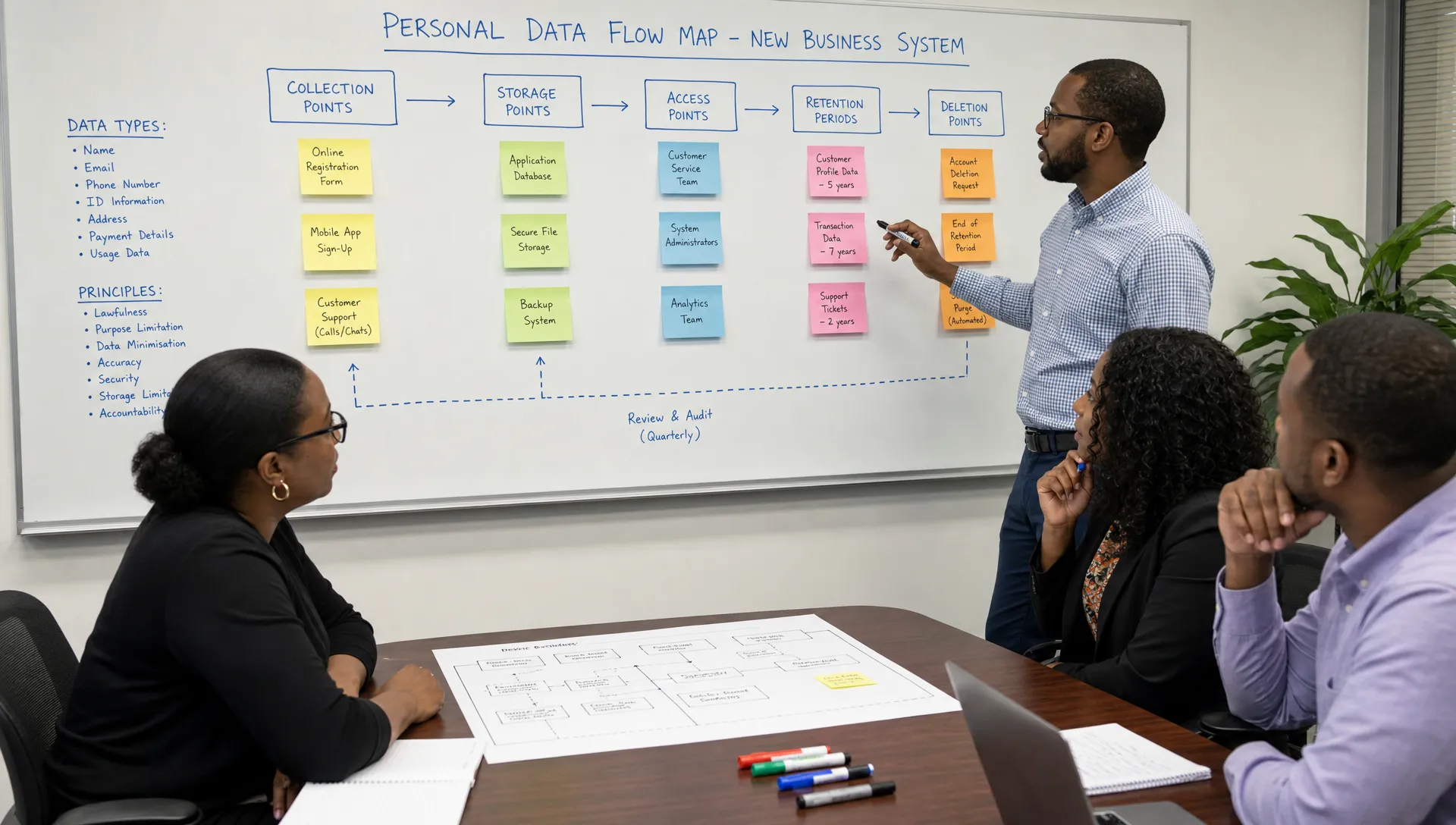
What to document before a new system goes live
Good documentation is not bureaucracy for its own sake. It proves that the organisation considered privacy risks, made informed decisions, and assigned accountability. It also helps future teams understand why the system was configured a certain way.
A practical project file should include the following records.
Document or record | What it should capture |
Privacy screening | Whether the project involves personal data and the level of review required |
Data inventory update | Data categories, sources, storage locations, users, recipients, and retention periods |
Risk assessment or DPIA-style review | Key privacy risks, mitigations, approvals, and residual risks |
Vendor due diligence | Supplier security, processing role, hosting location, subcontractors, and contract terms |
Access model | Roles, permissions, approval process, and review frequency |
Retention plan | How long data is kept and how deletion, archiving, or anonymisation works |
Privacy notice or staff communication | How individuals are informed about the processing |
Test evidence | Confirmation that privacy controls work before launch |
If your organisation is still building these foundations, it may help to strengthen the wider operating model first. PLMC's guide to building a privacy management programme that sticks explains how governance, roles, workflows, and continuous improvement support day-to-day compliance.
Common Privacy by Design mistakes to avoid
Many privacy risks in new systems are predictable. They often come from convenience, unclear ownership, or overreliance on vendor defaults.
A common mistake is collecting data because the system has a field for it. Software vendors often provide broad templates designed for many industries and jurisdictions. That does not mean every field is appropriate for your organisation. The project team should configure the system around business necessity, not around every available option.
Another mistake is treating security as the whole of privacy. Security is essential, but it is not enough. A system can be encrypted, password protected, and hosted securely while still collecting excessive data, keeping it too long, using it for unclear purposes, or sharing it with too many parties.
Organisations also run into trouble when access rights are copied from old systems without review. Legacy access models may reflect outdated reporting lines, temporary project roles, or historic exceptions. A new system is a good opportunity to reset permissions around least privilege.
Vendor risk is another frequent gap. A supplier may host data overseas, rely on subcontractors, use customer data to improve its own services, or apply standard deletion timelines that do not match your retention requirements. These issues should be reviewed before signing, not after implementation.
Finally, privacy controls often fail when staff are not trained on the new process. If employees do not understand what changed, why it changed, and what behaviour is expected, they may create workarounds that defeat the design. Practical awareness efforts, such as the ones covered in PLMC's article on data protection awareness campaigns that stick, can help reinforce the habits needed after launch.
Examples of Privacy by Design in common projects
Privacy by Design will look different depending on the system. The point is to apply the same principles to the specific business context.
Project type | Privacy by Design considerations |
Customer portal | Collect only required registration data, use strong authentication, provide clear privacy notices, limit staff access, and log account activity |
HR management system | Separate employee records by role, restrict sensitive HR data, define retention periods, and manage access for managers and HR staff |
Marketing platform | Confirm the basis for communications, segment contacts appropriately, honour opt-outs, and avoid importing outdated or unverified lists |
Case management system | Control access by matter, department, or client need, track disclosures, and document retention and closure procedures |
CCTV or monitoring project | Define the purpose, limit camera placement, control viewing access, set retention periods, and inform affected individuals where appropriate |
Analytics or reporting dashboard | Use aggregated or anonymised data where possible, reduce identifiers, and prevent re-identification through excessive detail |
These examples show why privacy should be part of design conversations, not only policy conversations. The people configuring the system need practical requirements they can build, test, and maintain.
Build privacy gates into project governance
Privacy by Design becomes sustainable when it is part of governance. Organisations should not depend on one privacy champion noticing every new system. Instead, project approval processes should include privacy checkpoints.
A simple governance model can include three gates. The first gate is project intake, where the team screens for personal data. The second gate is design approval, where privacy requirements, access controls, vendor issues, and retention rules are reviewed. The third gate is go-live approval, where the organisation confirms that controls have been tested and ownership is assigned.
This model works best when roles are clear. The project sponsor owns the business decision. IT owns technical configuration and security implementation. Legal, compliance, or the Data Protection Officer provides privacy advice. Procurement ensures vendor requirements are included in contracts. Business unit leaders ensure staff follow the approved process.
For organisations that need more structure, PLMC's article on privacy governance tools that actually work outlines practical tools such as data inventories, assessment workflows, vendor governance, and issue registers.
How to measure whether Privacy by Design is working
Privacy by Design should produce measurable improvements. If it is working, the organisation should see fewer late-stage legal escalations, fewer unnecessary data fields, clearer vendor responsibilities, stronger access controls, and better evidence of compliance decisions.
Useful measures include the percentage of projects screened for personal data, the number of high-risk projects reviewed before procurement, the number of systems with documented retention rules, the percentage of vendors assessed before contract signature, and the number of access reviews completed on schedule.
Qualitative feedback also matters. Project teams should find the process practical, not confusing. If privacy review is seen as a blocker, the process may be too late, too legalistic, or too disconnected from project realities. The better approach is to provide templates, checklists, decision trees, and early advice so teams know what good looks like before they build.
A simple starter checklist for new systems
Before a new system or project goes live, ask these questions:
Have we documented the purpose of the processing?
Have we removed unnecessary data fields?
Have we updated our data inventory or record of processing activity?
Have we confirmed who can access the data and why?
Have we set retention, deletion, or archiving rules?
Have we reviewed vendor processing, hosting, security, and subcontracting?
Have we prepared privacy notices or staff communications?
Have we tested access controls, audit logs, and deletion processes?
Have we assigned a business owner for ongoing compliance?
Have we documented risks, decisions, and approvals?
If the answer to several of these questions is no, the project is not ready from a privacy standpoint. That does not always mean it must stop, but it does mean the organisation should identify and address the gaps before launch.
Frequently Asked Questions
Is Privacy by Design legally required in Jamaica? Jamaica's Data Protection Act, 2020 requires organisations to meet data protection standards when handling personal data. Privacy by Design is a practical way to build those standards into systems, projects, and workflows from the start.
When should a privacy review happen in a project? The first review should happen at project intake or business case stage. A second review should happen during design or procurement, and a final check should happen before go-live.
Does Privacy by Design only apply to IT systems? No. It applies to any project that changes how personal data is handled, including paper-based processes, outsourcing arrangements, HR initiatives, marketing campaigns, monitoring programmes, and data analytics projects.
What is the difference between privacy and security in system design? Security protects data against unauthorised access, loss, and misuse. Privacy is broader and includes purpose, fairness, minimisation, transparency, retention, rights, sharing, and accountability.
Do small businesses need Privacy by Design? Yes, but the process should be proportionate. A small business may use a simple checklist and basic data map, while a larger or higher-risk project may need a more formal assessment and governance approval.
Build privacy into your next project from day one
New systems and projects are easier to get right when privacy is considered early. By building Privacy by Design into project scoping, procurement, configuration, testing, and governance, Jamaican organisations can reduce risk, improve trust, and support data protection compliance without unnecessary rework.
Privacy & Legal Management Consultants Ltd. helps organisations strengthen data protection implementation, governance, training, risk assessment, and compliance practices. If your organisation is planning a new system, vendor onboarding, digital transformation project, or data-driven initiative, consider seeking support before key design decisions are locked in.
Visit Privacy & Legal Management Consultants Ltd. to explore how PLMC can help your team build privacy into projects from the start.