

Global Data Breaches: Who Must Be Notified?
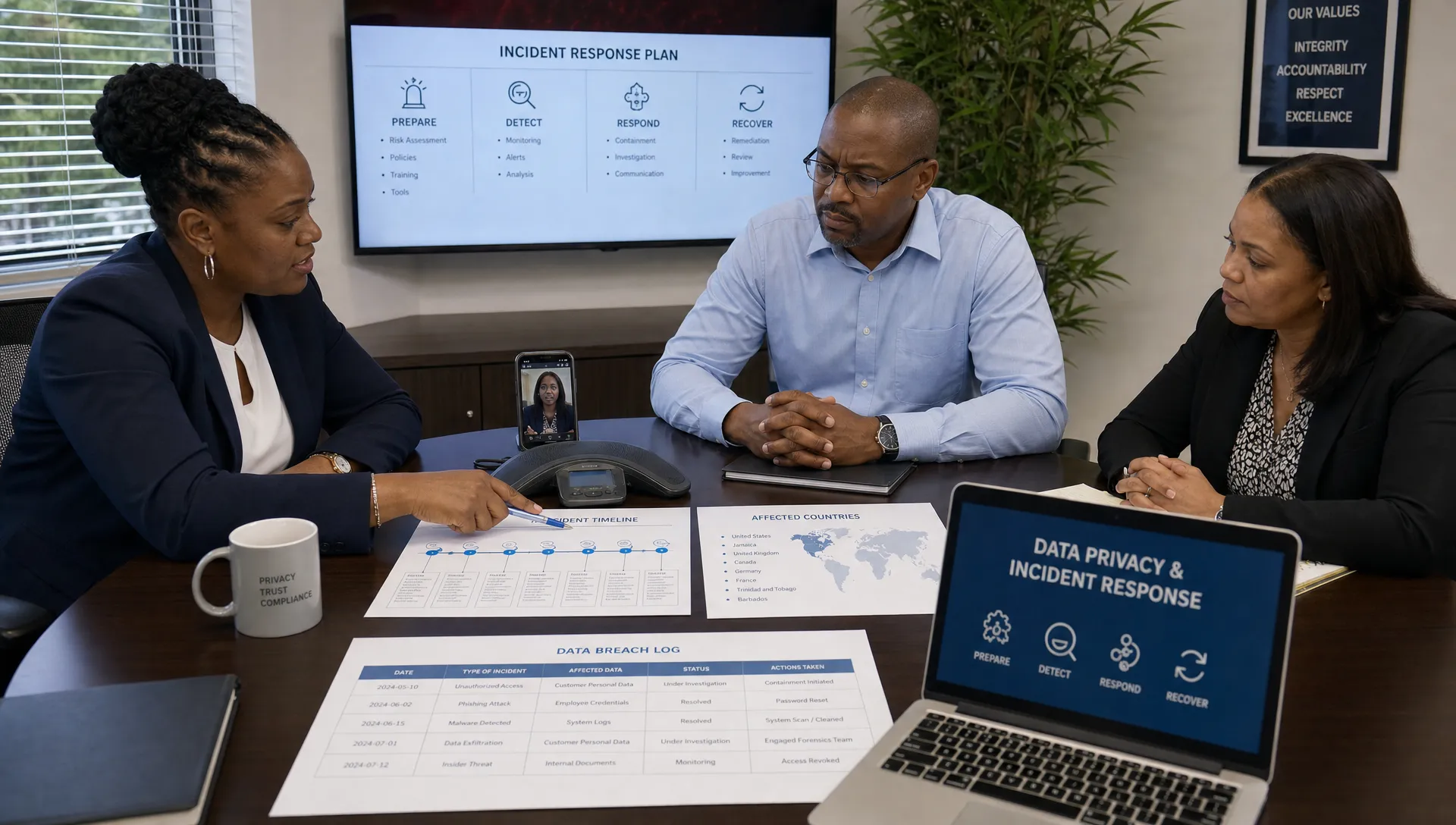
A breach rarely stays within one border. A Jamaican company may use a Canadian payroll platform, host files in a US cloud environment, serve customers in the United Kingdom and store employee data for regional offices. When something goes wrong, the urgent question is not only how to contain the incident. It is who must be notified, when and with what level of detail.
For global data breaches, notification is a legal, contractual and governance exercise. The right answer depends on the type of data, the people affected, where they are located, the role your organisation plays and the sector rules that apply. This guide gives Jamaican organisations a practical way to think through that notification map without treating every incident as the same.
Why breach notification is not just an IT decision
A cyber incident becomes a privacy issue when personal data is involved. That may include unauthorised access, accidental disclosure, loss, alteration, deletion or exposure of information that identifies a living person. Customer files, employee records, payment data, national identifiers, health information, login credentials and CCTV footage can all fall within the scope.
Not every security event is automatically notifiable. A blocked phishing email, for example, may be a near miss rather than a reportable breach. A spreadsheet sent to the wrong external recipient, a ransomware attack that exfiltrates files or a lost unencrypted laptop may require escalation.
The distinction matters because breach notification is not a public relations choice. It is tied to data protection compliance, corporate governance, contractual duties, cyber insurance conditions and sometimes anti-money laundering obligations. If your team needs a framework for incidents that almost become breaches, PLMC has also discussed risk management and data protection after a near miss.
Start with roles: controller, processor and joint controller
Before deciding who must be notified, identify your role. Many global data breaches become confusing because several organisations touch the same dataset but do not have the same legal duties.
Role | What it usually means | Typical notification responsibility |
Data controller | Decides why and how personal data is processed | Assesses legal duties, notifies the relevant regulator and affected people where required |
Data processor | Processes personal data for a controller, under instructions | Notifies the controller quickly and supports investigation, usually under contract |
Joint controller | Shares decision-making with another organisation | Coordinates notification decisions and allocates responsibilities in a clear arrangement |
Independent controller | Receives or uses data for its own purposes | Conducts its own legal assessment and may have separate notification duties |
A Jamaican outsourcing provider may be a processor for a foreign client. A bank, insurer, school, medical practice or retailer may be a controller for its own customer records. A regional group of companies may include several controllers if each entity decides how employee or customer data is used.
Contracts can make this more urgent. A service agreement may require notice to a client within 24 hours, even if a regulator allows more time. That is why legal, compliance, IT, risk and communications teams need to work from the same incident response plan.
Who must be notified after global data breaches?
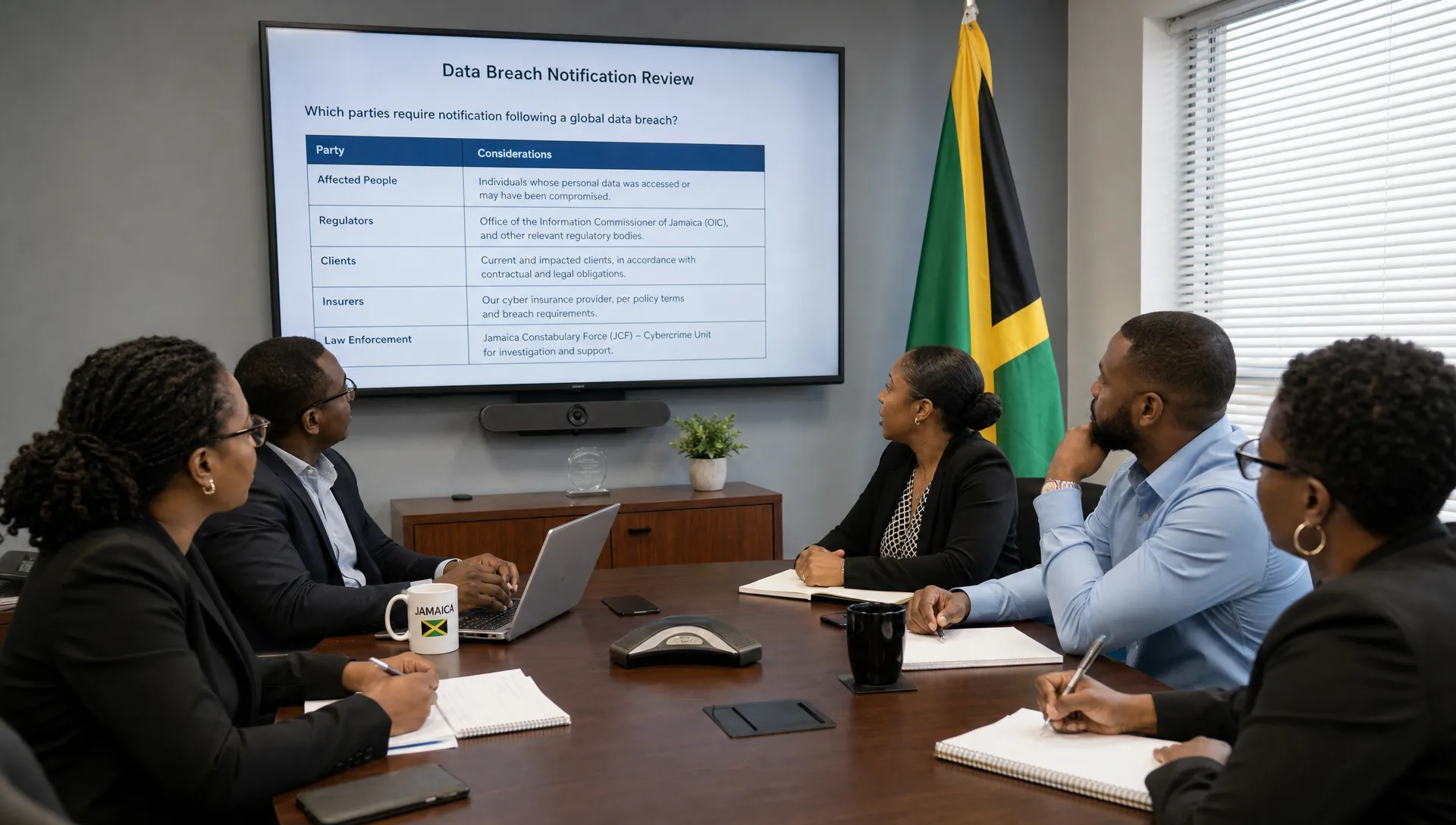
The notification list should be built from the facts, not from a template. In a cross-border incident, the same breach may require notice to several audiences.
Data protection authorities and privacy regulators
For Jamaican organisations, the local starting point is the Data Protection Act, 2020 and the Office of the Information Commissioner. Where a breach falls within Jamaica data privacy requirements, the organisation should assess whether the OIC must be notified and what information should be included.
If the breach affects people in other jurisdictions, additional regulators may come into scope. Under the EU General Data Protection Regulation, controllers must notify the relevant supervisory authority without undue delay and, where feasible, within 72 hours of becoming aware of a personal data breach unless the breach is unlikely to result in a risk to individuals. The UK Information Commissioner's Office gives similar practical guidance for organisations assessing whether to report a personal data breach.
Regulatory notices usually need the nature of the breach, categories of people affected, categories of personal data involved, likely consequences and steps taken or proposed to address the incident. If all facts are not yet known, many regimes allow phased updates, but silence is rarely a safe strategy.
Affected individuals
Individuals may need direct notification when the breach creates a meaningful risk of harm. That risk is higher where the incident involves identity documents, financial data, health information, children’s data, login credentials, biometric data, precise location data or sensitive employment records.
Good individual notices are clear and practical. They explain what happened, what information was involved, what the organisation has done and what the person can do next. They should avoid technical jargon, blame-shifting and vague reassurance.
Notification to individuals also needs care. If the breach involves an active criminal investigation, your team may need to coordinate timing with law enforcement. If stolen passwords are involved, the notice should prompt password resets and multi-factor authentication without revealing security details that could help attackers.
Clients, customers and contracting parties
In business-to-business breaches, the first external notification may be to a client rather than a regulator. A processor that hosts customer data for a controller should usually notify the controller as soon as it becomes aware of a relevant incident. The controller then decides its own regulatory and individual notification duties.
This is especially important for Jamaican firms that provide services to overseas clients. A local call centre, payroll provider, software vendor or professional services firm may not control the affected data, but it may still have strict contractual notice obligations.
Review contracts before an incident occurs. The breach clause should identify the notice deadline, contact points, required content, evidence preservation obligations and approval process for communications.
Law enforcement and cyber response partners
Law enforcement notice is not a substitute for privacy notification, but it may be necessary where there is ransomware, extortion, fraud, theft, unauthorised access or insider wrongdoing. If the incident involves active compromise, your cyber response team may also need to coordinate with forensic specialists, threat intelligence providers and legal counsel.
Ransomware is a common example. Restoring systems is only part of the response. The privacy team must still determine whether personal data was accessed, copied or made unavailable in a way that creates risk. PLMC’s guidance on ransomware response and privacy steps beyond IT recovery explores that issue in more detail.
Sector regulators, banks and payment networks
Some sectors have additional notification channels. Financial institutions, payment processors, insurers, telecommunications providers, healthcare organisations and public bodies may face sector-specific rules or supervisory expectations.
Payment card incidents can trigger notices to acquiring banks, card brands and forensic investigators under payment card rules. A breach involving suspected fraud, account takeover or misuse of customer due diligence information may require review by the anti-money laundering compliance team. That does not mean every breach is an AML report, but it does mean privacy and financial crime teams should not operate in silos.
Insurers, boards, auditors and employees
Cyber insurance policies often require prompt notice of incidents that may lead to a claim. Late notice can affect coverage, so risk managers should know the trigger before a breach occurs.
Boards and senior management also need timely reporting, particularly where the incident may affect customers, operations, regulators, finances or reputation. Employees may need notification both as internal stakeholders and as affected data subjects if their own personal data is involved.
Cross-border notification: how to map the jurisdictions
A global breach assessment should start with a jurisdiction map. Do not focus only on where your head office is located. Privacy laws often apply based on where affected individuals live, where services are offered, where monitoring takes place, where systems are hosted or what contract governs the processing.
For Jamaican organisations, GDPR Jamaica questions often arise when a local business offers goods or services to people in the European Economic Area, monitors their behaviour or processes EU personal data for a client. US obligations are different because the United States does not have one general federal breach notification law. Instead, state breach laws, sector rules and regulator expectations may apply. PLMC has a separate guide on when Jamaican businesses need to know US data protection rules.
Trigger to check | Why it matters |
Location of affected individuals | Their local privacy or breach notification laws may apply |
Location of your establishment | Your home regulator may expect notice |
Role in the processing chain | Controllers and processors have different duties |
Type of data involved | Sensitive data, credentials and financial data increase notification risk |
Sector involved | Finance, health, telecoms and public sector rules may add duties |
Contract terms | Client notice deadlines may be shorter than legal deadlines |
A useful approach is to create a breach matrix for every serious incident. List each country, regulator, affected group, legal threshold, deadline, owner and status. This prevents a team from notifying one authority while missing a contractual or sector duty elsewhere.
A practical notification decision tree
A decision tree does not replace legal analysis, but it helps teams move quickly. The first hours after discovery should focus on containment, evidence preservation and classification.
Question | If yes | If no |
Is personal data involved? | Start privacy breach assessment | Treat as a security incident and continue monitoring |
Are individuals identifiable? | Identify affected groups and countries | Document why the risk is low |
Is sensitive or high-risk data involved? | Escalate to legal, privacy and senior management | Assess context and volume |
Are you a processor? | Notify the controller under contract | Assess controller duties directly |
Are affected people outside Jamaica? | Check foreign law and client obligations | Continue with local and sector analysis |
Is there evidence of criminal activity? | Consider law enforcement and insurer notice | Continue forensic review |
The point is to document reasoning as much as the final decision. Regulators will often ask not only what you did, but how you reached the conclusion. A well-kept incident log can show that your organisation acted promptly and proportionately.
What should a breach notification say?
A breach notification should be accurate, concise and useful. It should not speculate, minimise the incident or promise outcomes before the investigation supports them.
Notification element | Why it matters |
Description of the incident | Helps recipients understand the nature of the breach |
Date discovered and relevant time period | Shows when the organisation became aware and what window is affected |
Categories of personal data | Allows risk assessment without exposing more data |
Categories or number of affected people | Helps regulators and clients understand scale |
Likely consequences | Explains potential harm such as fraud, identity theft or distress |
Measures taken | Shows containment, remediation and future safeguards |
Recommended individual steps | Gives affected people practical actions to reduce harm |
Contact details | Provides a route for questions and follow-up |
For individual notices, plain language is essential. Affected people should not have to decode legal phrasing to understand whether their passport number, payroll record or medical information was involved.
For regulator and client notices, keep a version history. If the first notice is preliminary, say so. Follow-up reports should be consistent with earlier statements or explain why the facts have changed.
Common mistakes that delay notification
One common mistake is waiting for perfect forensic certainty. Investigation is important, but many breach laws focus on when an organisation becomes aware of enough facts to assess risk. If your team waits weeks for a final report before escalating, it may miss important deadlines.
Another mistake is using one message for every audience. Regulators, individuals, banks, insurers and clients need different levels of detail. Affected individuals need practical protective steps. Regulators need risk analysis. Clients need contractual impact and remediation details.
Organisations also lose time when contact points are unclear. If the privacy officer, IT lead, legal adviser, cyber insurer and executive sponsor are not named in advance, valuable hours are spent finding the right people. This is why breach simulations are so useful. PLMC has outlined what a good breach tabletop exercise looks like for organisations that want to test their process before a real incident.
Finally, public statements should be controlled. A social media post, press comment or customer service script that contradicts the legal notice can create confusion and undermine credibility.
Building a global breach notification plan
A strong notification plan should be prepared before a crisis. It should identify applicable laws, regulators, client notice obligations, internal decision-makers and escalation timelines. It should also include templates that can be adapted quickly without turning the response into a copy-and-paste exercise.
The plan should sit within your wider corporate governance and risk framework. Data protection, cyber security, anti-money laundering, business continuity, vendor management and communications all intersect during a serious incident.
Training matters as much as documentation. Staff who handle personal data should know how to recognise a breach, who to contact and why early reporting protects the organisation. In many cases, the employee who spots the issue first is not a lawyer or IT specialist. They may be a customer service representative, HR officer, accounts clerk or branch manager.
Frequently Asked Questions
Do all global data breaches require notification? No. Notification depends on the law, the type of data, the likelihood of harm, your role and the people affected. Even when external notification is not required, the decision should be documented.
If a Jamaican company uses an overseas cloud provider, who reports the breach? It depends on the roles and contracts. The cloud provider may need to notify the Jamaican organisation as its customer, while the Jamaican organisation may have regulator or individual notification duties if it is the controller.
Must affected individuals be notified before the regulator? Not always. Some regimes require regulator notice first or allow parallel notice. Timing should be assessed based on legal requirements, risk to individuals and any law enforcement considerations.
Is ransomware automatically a notifiable data breach? Not automatically, but it should be treated as high risk until assessed. If personal data was accessed, copied, encrypted or made unavailable in a way that creates risk, notification may be required.
Can a breach trigger anti-money laundering obligations? Sometimes. A privacy breach alone is not necessarily an AML event, but suspected fraud, identity theft, account takeover or suspicious transaction activity should be reviewed by the AML compliance team.
Need help deciding who must be notified?
Global data breaches require fast decisions, reliable documentation and a clear understanding of Jamaica’s Data Protection Act, 2020 alongside foreign and sector obligations. Privacy & Legal Management Consultants Ltd. supports organisations with data protection implementation, cyber security services, GRC integration, risk assessment tools, training sessions and free consultations.
If your organisation needs a breach notification plan, tabletop exercise or practical data privacy training in Jamaica, contact Privacy & Legal Management Consultants Ltd. before the next incident tests your process.