

Ransomware Response: Privacy Steps Beyond IT Recovery
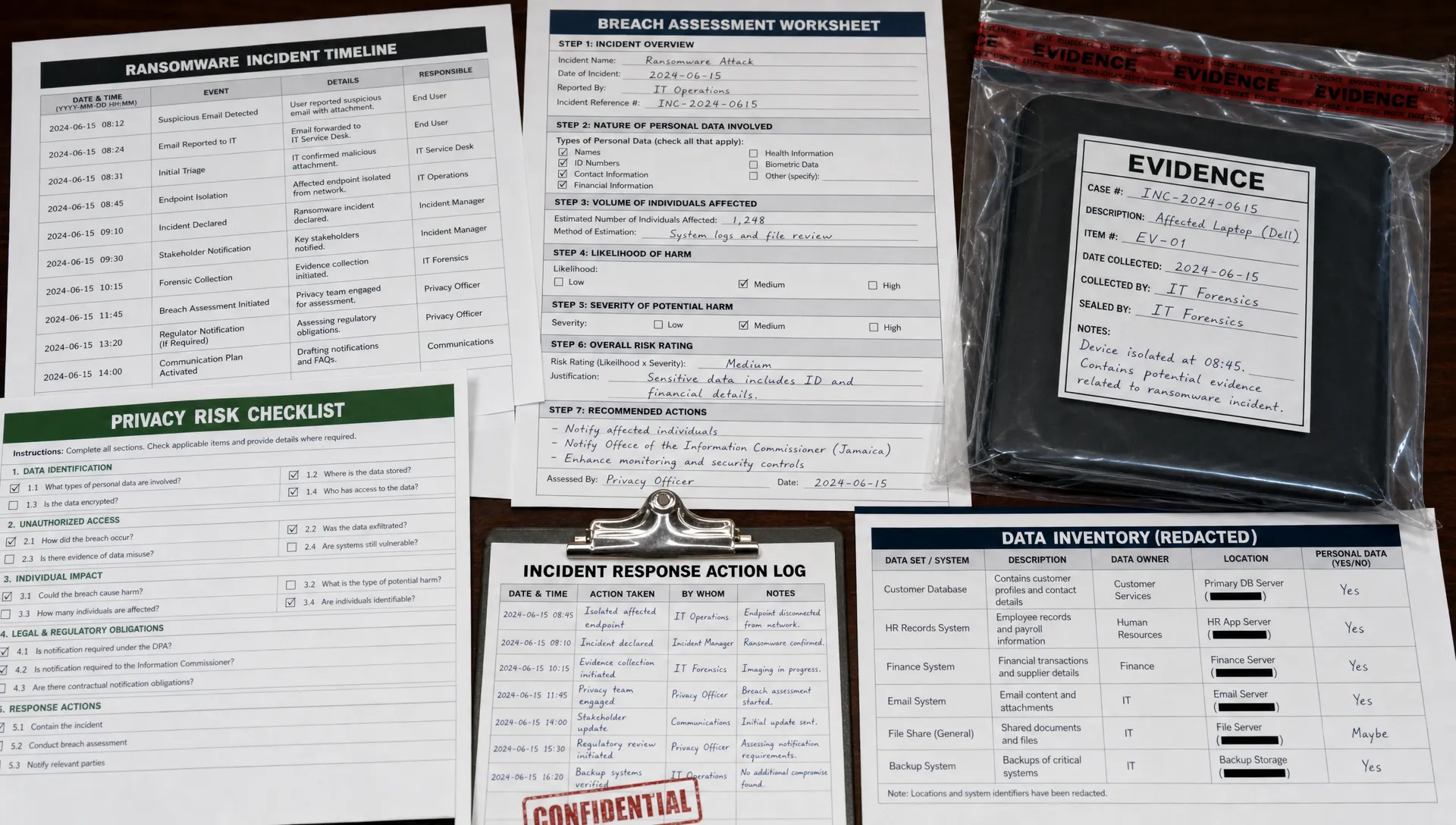
When ransomware hits, the first instinct is usually to restore systems, contain malware, and get the business running again. That urgency is understandable. But ransomware is not only an IT outage. It can also be a privacy incident, a legal exposure, a governance failure, and a trust crisis.
For Jamaican organisations subject to the Data Protection Act, 2020, the privacy work cannot wait until servers are back online. If personal data was accessed, copied, encrypted, exposed, or made unavailable, the organisation needs a clear privacy response alongside technical recovery. That means understanding what personal data is involved, who may be affected, what duties may be triggered, and what evidence must be preserved.
The goal is not to slow IT down. The goal is to make sure recovery decisions do not create new privacy, regulatory, or reputational risks.
Why ransomware response must go beyond IT recovery
Traditional disaster recovery asks, “How quickly can we restore operations?” Privacy response asks a different set of questions: “Whose personal data is at risk, what harm could result, and what must we do to protect individuals?”
Modern ransomware often involves more than encryption. Attackers may steal data before locking systems, threaten to publish files, contact customers or staff directly, or exploit weak identity controls to move across systems. Even if backups work and operations resume quickly, the privacy incident may still be ongoing.
The CISA StopRansomware Guide recommends coordinated preparation, detection, containment, and communication. For organisations processing personal data, that coordination should include privacy, legal, compliance, HR, customer service, executive leadership, and communications teams, not only IT.
A practical way to frame the issue is this: IT recovery restores systems, while privacy response protects people and proves accountability.
IT recovery focus | Privacy response focus |
Remove malware and isolate affected systems | Identify whether personal data was accessed, altered, lost, encrypted, or disclosed |
Restore backups and business applications | Assess potential harm to customers, employees, vendors, and other individuals |
Rebuild infrastructure securely | Preserve evidence for breach assessment, regulator engagement, and possible claims |
Resume business operations | Decide whether notifications, support measures, or contractual reporting are required |
Close technical vulnerabilities | Update governance, policies, training, and controls to reduce recurrence |
Step 1: Activate a joint ransomware and privacy incident team
A ransomware event needs clear command. Confusion in the first hours can lead to inconsistent communications, evidence loss, duplicated work, and unnecessary exposure of sensitive details.
Your incident team should include representatives from IT security, privacy or data protection, legal, risk, compliance, communications, HR, and affected business units. If the organisation has a Data Protection Officer or designated privacy lead, that person should be involved early, not after the technical postmortem.
The first meeting should confirm who is responsible for decisions, who approves external communications, who contacts insurers or external advisers, and who maintains the incident log. It should also establish a secure communication channel that is not dependent on compromised email or messaging systems.
This is where preparation matters. Organisations that have already aligned cyber security and privacy responsibilities are better positioned to respond quickly. If your teams are still operating in silos, PLMC has outlined practical ways to improve coordination in its guide on how cyber security and privacy teams can work together.
Step 2: Preserve evidence before systems are wiped or restored
Speed is important, but uncontrolled restoration can destroy evidence needed for privacy assessment. If servers are rebuilt too quickly, logs may be lost. If infected devices are reimaged without forensic capture, the organisation may never know whether data was exfiltrated.
Evidence preservation does not mean leaving systems exposed. It means making deliberate decisions with forensic, privacy, and legal input. Important evidence may include authentication logs, endpoint alerts, VPN activity, email forwarding rules, file access records, ransom notes, attacker communications, and backup integrity reports.
The privacy team does not need to run the forensic investigation, but it should help define the questions that investigation must answer. For example, did the attacker access HR folders? Were customer identity documents in the affected environment? Were health, financial, children’s, or other sensitive categories of data involved? Did the attacker create archives or transfer files externally?
A strong incident log should record decisions in real time. That log may later support internal governance reviews, board reporting, insurance discussions, regulator communications, and customer enquiries. It should be factual, dated, and controlled.
Step 3: Identify the personal data at risk
Ransomware privacy response depends on understanding the data. Without a data map, the organisation may be forced to make decisions based on assumptions. That is risky, especially if the affected systems contain mixed information from customers, staff, suppliers, and business partners.
Start by identifying affected systems and connecting them to business processes. A payroll server, customer relationship management platform, shared drive, email archive, payment system, or case management database will each raise different privacy concerns.
The assessment should consider:
What categories of personal data were stored or processed in the affected systems
Whether sensitive personal data or confidential records were involved
Whether data was encrypted only, or whether access or exfiltration is suspected
How many individuals may be affected and where they are located
Whether the data was protected by encryption, access controls, masking, or segregation
Whether backups include the same personal data and whether they remain secure
For Jamaican organisations, this exercise is closely connected to data protection compliance. The Data Protection Act, 2020 is built around accountability, lawful processing, security, purpose limitation, and respect for data subject rights. A ransomware incident can affect several of those obligations at once.
If your organisation does not already maintain an inventory of personal data, ransomware will expose that weakness immediately. PLMC’s article on data privacy in cyber security controls that matter explains why data inventory and access controls are privacy controls as much as security controls.
Step 4: Assess whether the incident is a personal data breach
Not every ransomware incident has the same privacy impact. A workstation encrypted before any data access may present a different risk from a file server where attackers downloaded HR records and customer identity documents.
The assessment should look at confidentiality, integrity, and availability. Many organisations focus only on confidentiality, meaning whether data was viewed or stolen. But ransomware can also affect availability if individuals cannot access services or if the organisation cannot fulfil rights, contracts, or essential processes. Integrity may also be affected if data was altered, corrupted, or restored from an unreliable backup.
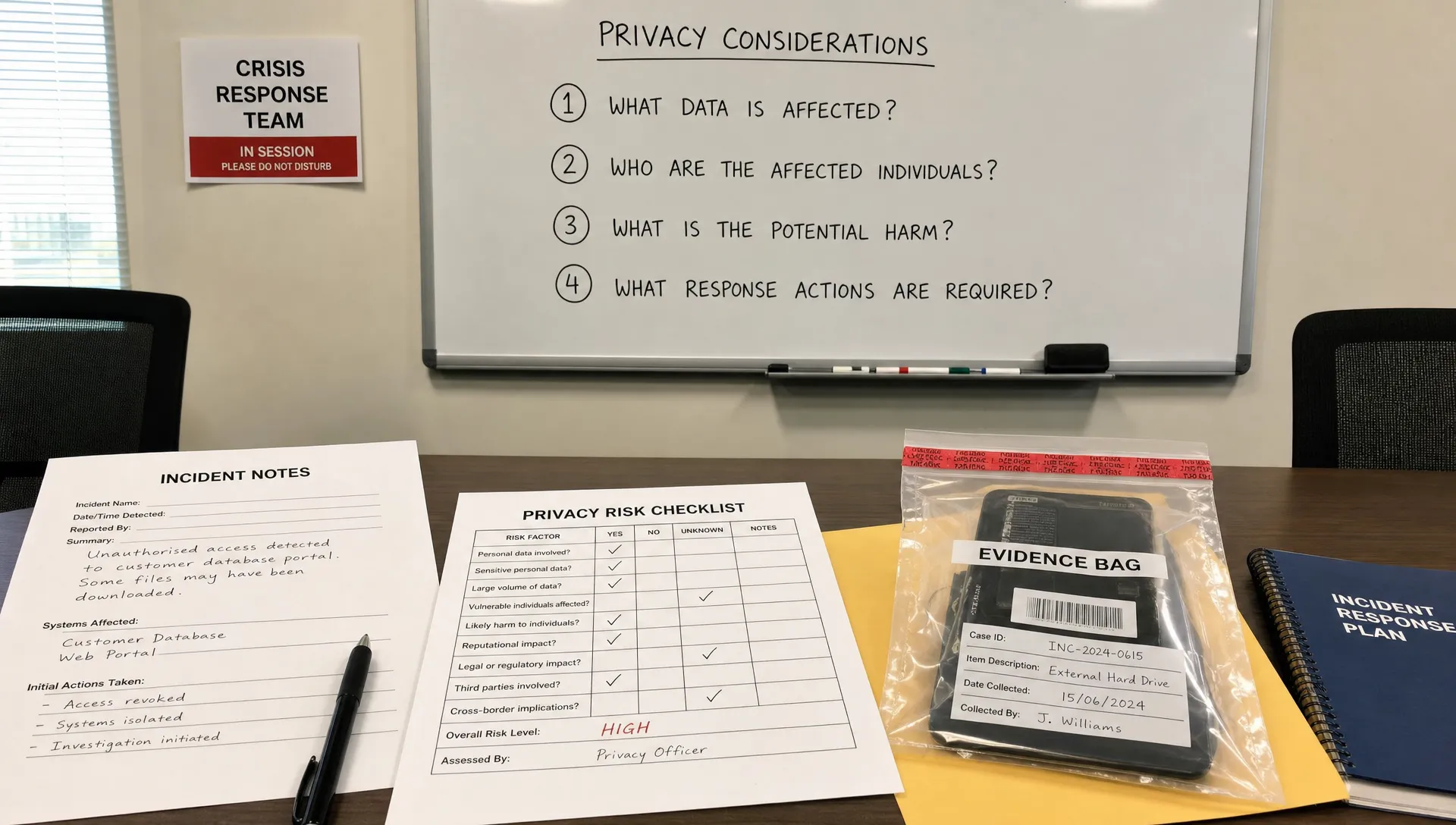
A structured breach assessment should examine four questions:
What happened to the personal data? Was it encrypted, accessed, copied, deleted, altered, disclosed, or made unavailable?
Who could be affected? Consider customers, employees, former employees, minors, patients, students, vendors, and other individuals.
What harm could result? Consider identity theft, fraud, financial loss, discrimination, embarrassment, service disruption, safety risks, or loss of confidentiality.
What evidence supports the conclusion? Record the logs, forensic findings, system inventories, interviews, and assumptions used.
This assessment should be documented even if the conclusion is that notification is not required. Regulators and business partners may later ask how the organisation reached its decision.
Step 5: Decide on regulator, individual, and contractual notifications
Once the organisation understands the likely privacy impact, it must decide whether to notify regulators, affected individuals, insurers, business partners, or other stakeholders. This is a legal and governance decision, not just a communications task.
Under Jamaica’s Data Protection Act, 2020, organisations should be prepared to demonstrate accountability and appropriate security for personal data. Depending on the facts, ransomware may require engagement with the Information Commissioner, affected data subjects, sector regulators, law enforcement, contractual counterparties, or overseas regulators.
If your organisation processes data for international clients, operates across borders, or handles information relating to individuals outside Jamaica, additional contractual or legal obligations may apply. For example, a Jamaican service provider handling EU personal data may need to consider GDPR-related processor obligations through its contracts, even if the core incident occurred in Jamaica.
Notification decisions should be timely, accurate, and coordinated. Avoid making public statements that minimise the issue before the facts are known. At the same time, do not wait for perfect certainty if individuals need urgent guidance to protect themselves.
Effective notifications usually explain what happened, what personal data may be involved, what the organisation is doing, what affected individuals can do, and where they can ask questions. They should be written in plain language. If the affected population includes customers, employees, elderly persons, or vulnerable groups, communication channels should be chosen with accessibility in mind.
Step 6: Protect affected individuals, not only the organisation
A privacy-centred ransomware response asks what practical support individuals need. That support will depend on the type of data involved.
If contact details were exposed, individuals may need to watch for phishing. If identity documents, tax information, payroll records, or financial details were involved, they may need guidance on fraud monitoring and account protection. If employee disciplinary, medical, or sensitive HR records were exposed, the organisation may need a more careful, confidential support process.
The response should also consider internal audiences. Employees often learn about ransomware through rumours before formal updates. If staff accounts were compromised, payroll systems were affected, or HR files were accessed, employees are not only part of the recovery team. They may also be affected data subjects.
Customer service and HR teams should be briefed before notifications go out. They need approved scripts, escalation paths, and a way to record enquiries. Without this, well-meaning staff may provide inconsistent answers or disclose more information than they should.
Step 7: Manage third-party and processor risk
Ransomware often involves third parties. A cloud provider, managed service provider, payroll vendor, call centre, payment processor, or software supplier may be involved in the affected environment. The organisation must quickly determine whether the incident occurred in its own systems, a processor’s systems, or a connected environment.
Contracts matter. Data processing agreements, service level agreements, cyber insurance policies, outsourcing arrangements, and customer contracts may include reporting duties, cooperation obligations, audit rights, evidence preservation requirements, and restrictions on public statements.
The privacy team should review key contracts early and identify who must be informed. If a processor is affected, the controller will need enough information to assess risk to individuals and meet its own obligations. If the organisation is the processor, it may need to notify the controller quickly and avoid taking unilateral steps outside the contract.
Third-party coordination should not become a blame exercise during the emergency. The immediate priorities are containment, evidence, facts, communication, and protection of individuals. Accountability can be reviewed in more detail after the incident is stabilised.
Step 8: Rebuild with privacy safeguards, not just cleaner servers
A common ransomware mistake is to restore systems exactly as they were before. That may bring operations back quickly, but it can also recreate the same privacy risk.
Before restoring personal data, confirm that access rights are still appropriate, inactive accounts are disabled, privileged access is limited, and sensitive folders are not broadly available. If the incident revealed unnecessary copies of personal data, outdated archives, or uncontrolled shared drives, use recovery as an opportunity to reduce data exposure.
Privacy-enhancing recovery may include stronger access reviews, multifactor authentication for key systems, data retention cleanup, secure deletion of obsolete files, encryption improvements, better logging, and segmentation of high-risk data repositories. It may also include revised procedures for handling personal data during manual workarounds.
For example, if the organisation runs payroll manually during recovery, staff may export spreadsheets, email files, or store temporary copies on local devices. Those workarounds can create new privacy incidents if they are not controlled. Temporary processes should have owners, retention dates, and secure storage instructions.
Step 9: Create proof of accountability
After a ransomware incident, organisations need more than a technical closure report. They need evidence that privacy risk was assessed, decisions were reasonable, and follow-up actions were tracked.
Accountability records may include the incident timeline, breach assessment, forensic findings, notification analysis, regulator correspondence, individual communications, board updates, third-party correspondence, remediation plan, and lessons learned report.
This proof is valuable even if no regulator investigation follows. It helps leadership understand the real causes of the incident and shows auditors, insurers, partners, and customers that the organisation took the matter seriously.
A useful post-incident review should answer:
Which personal data was most exposed and why
Which controls worked as intended and which failed
Whether staff knew how to escalate suspicious activity
Whether contracts and processor arrangements supported timely response
Whether the incident response plan included privacy decision points
Whether retention practices increased the volume of exposed data
PLMC has also written about the importance of building data security and privacy controls with audit-ready proof, which is especially relevant after a ransomware event.
Ransomware privacy response checklist
Use this checklist as a practical starting point for leadership, privacy, compliance, and IT teams. It is not a substitute for legal advice, but it can help structure the response.
Response area | Privacy action |
Governance | Activate a cross-functional incident team with defined decision authority |
Evidence | Preserve logs, ransom communications, forensic images, and decision records |
Data mapping | Identify affected systems, data categories, individuals, and locations |
Breach assessment | Assess confidentiality, integrity, and availability impacts on personal data |
Legal duties | Review Data Protection Act, 2020 obligations, contracts, sector rules, and cross-border issues |
Communications | Prepare consistent messages for staff, customers, regulators, partners, and media where needed |
Individual support | Provide practical steps based on the type of personal data involved |
Recovery | Restore systems with improved access controls, retention discipline, and monitoring |
Accountability | Document decisions, evidence, remediation, and lessons learned |
Common mistakes to avoid
The most damaging ransomware errors are often governance failures rather than purely technical mistakes. They happen when teams act quickly but separately.
Avoid telling customers “no data was accessed” before the forensic evidence supports that statement. Avoid assuming that encryption alone means there is no breach. Avoid restoring from backups without checking whether the attacker still has access. Avoid letting each department communicate its own version of events. Avoid overlooking employees as potentially affected individuals.
Also avoid treating the incident as finished when systems are back online. For privacy purposes, the response may continue for weeks or months through notifications, enquiries, regulator engagement, remediation, and monitoring of leaked data claims.
Preparing before the next incident
The best ransomware privacy response starts before ransomware occurs. Organisations should have an incident response plan that includes privacy triggers, notification decision workflows, contact lists, evidence preservation steps, and draft communication templates.
Training is equally important. Staff should know how to report suspicious activity quickly, but leaders should also know how to make privacy decisions under pressure. Tabletop exercises can help teams practise realistic scenarios, such as a ransomware note claiming stolen HR files or a vendor reporting that customer data may have been accessed.
Preparation should also include data minimisation. The less unnecessary personal data an organisation stores, the less data can be exposed in a ransomware incident. Retention schedules, access reviews, and secure disposal are not just compliance tasks. They are ransomware risk reduction measures.
Frequently Asked Questions
Is ransomware always a personal data breach? Not always. It depends on whether personal data was accessed, disclosed, altered, lost, encrypted, or made unavailable in a way that creates risk to individuals. The organisation should document its assessment even if it concludes that no notification is required.
Should privacy teams wait for the forensic report before getting involved? No. Privacy teams should be involved from the start so that forensic investigators know which data protection questions must be answered. Waiting too long can lead to lost evidence and delayed decisions.
What if the attacker claims data was stolen but provides no proof? Treat the claim seriously, but assess it against technical evidence. Look for signs of file access, compression, unusual outbound traffic, attacker tools, and exposed data samples. Record assumptions and update the assessment as facts change.
Do Jamaican organisations need to consider GDPR during ransomware response? Sometimes. If the organisation processes EU personal data, serves international clients, or has contracts with GDPR obligations, those duties may affect reporting, cooperation, and communication timelines. The facts and contracts should be reviewed promptly.
Who should approve ransomware communications to customers or staff? Communications should be approved through a coordinated process involving leadership, legal, privacy, IT security, and communications. Messages should be accurate, plain, and consistent across all channels.
Build privacy into your ransomware readiness
Ransomware recovery is not complete when the network comes back online. It is complete when the organisation understands the privacy impact, protects affected individuals, documents its decisions, and strengthens the controls that failed.
Privacy & Legal Management Consultants Ltd. supports Jamaican organisations with data protection implementation, governance, compliance, cyber security alignment, training, and risk management. If your organisation wants to review its ransomware readiness or strengthen its Data Protection Act, 2020 compliance programme, contact PLMC for a consultation.