

Data Privacy in Cyber Security: Controls That Matter

A strong cyber security programme can still fail privacy if no one knows what personal data is being collected, why it is being kept, who can access it, and which vendors receive it. Firewalls and antivirus tools matter, but they do not answer privacy questions on their own.
That is why data privacy in cyber security should be treated as a control design issue, not just a legal or IT issue. The controls that matter are the ones that reduce real risk to people, support lawful handling of personal data, and give management evidence that safeguards are working.
For Jamaican organisations operating under the Data Protection Act, 2020, this means aligning security safeguards with privacy principles such as fairness, purpose limitation, minimisation, retention, accountability, and appropriate protection. The practical question is not “How many tools do we have?” It is “Do our controls protect the personal data we actually hold?”
What makes a cyber security control a privacy control?
A cyber security control becomes a privacy control when it protects personal data in a way that supports lawful, fair, and accountable processing.
For example, multi-factor authentication protects accounts from compromise. From a privacy perspective, it also helps ensure that only authorised users can access employee files, customer records, patient information, financial documents, or identity documents. Similarly, logging is a security control, but it also supports privacy by helping an organisation investigate whether personal data was accessed, changed, exported, or misused.
The connection is important because cyber security often focuses on confidentiality, integrity, and availability. Data privacy asks additional questions: should this data have been collected, should this person have access, should the data still be retained, and was the individual told how it would be used?
Security activity | Privacy question it supports | Control outcome |
Access management | Who should see this personal data? | Least privilege, role-based access, access reviews |
Encryption | How is personal data protected if a device or database is exposed? | Reduced risk of readable disclosure |
Logging and monitoring | Can we detect and investigate misuse? | Evidence for incident response and accountability |
Retention controls | Do we still need this data? | Reduced exposure from over-retention |
Vendor due diligence | Who else handles personal data for us? | Better control over processors, cloud tools, and third parties |
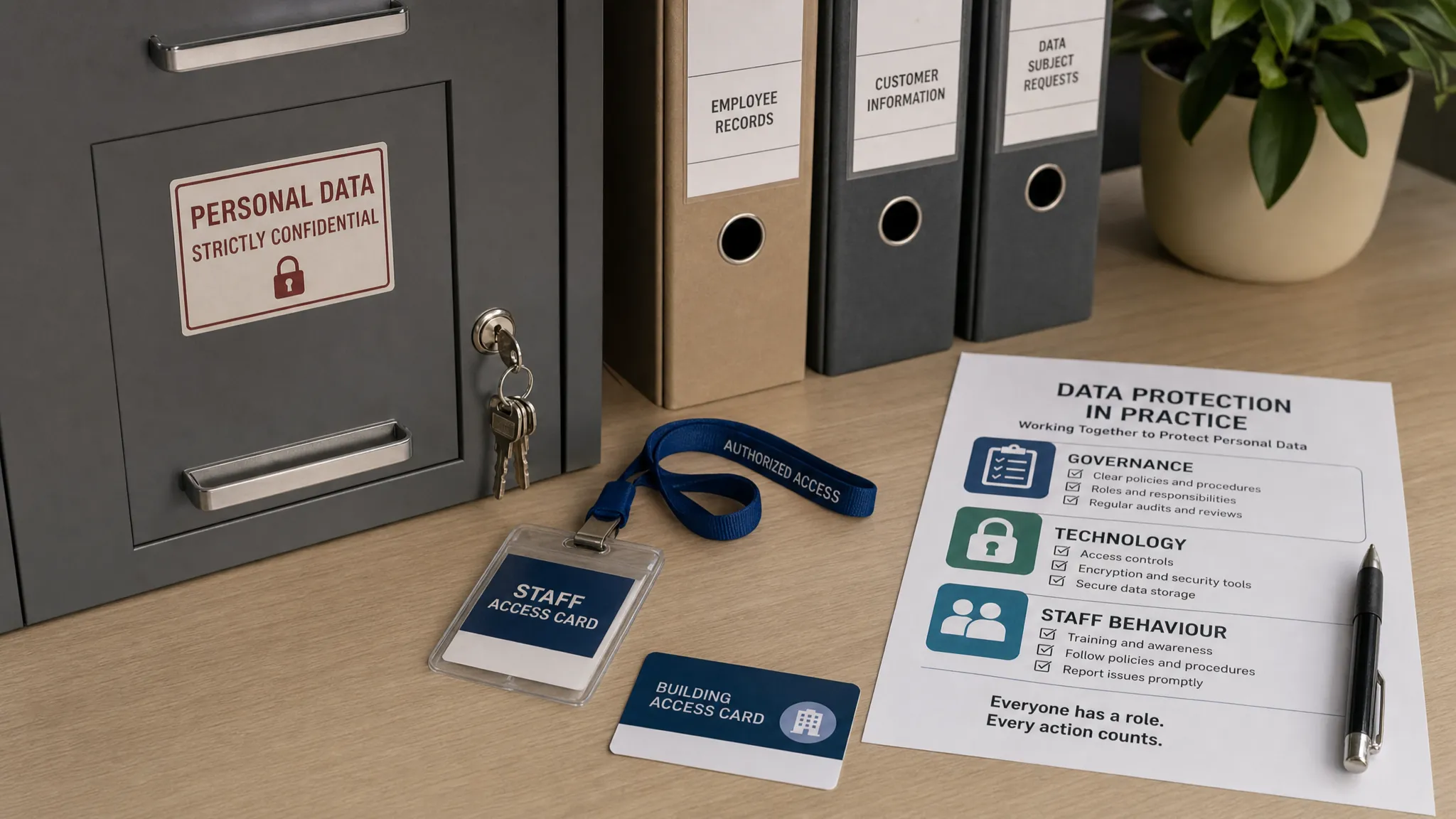
Start with personal data risk, not a tool catalogue
Many organisations begin cyber security planning by listing tools: endpoint protection, firewalls, backup software, phishing filters, and monitoring platforms. Those tools may be useful, but privacy-focused cyber security starts with the personal data lifecycle.
Before selecting or improving controls, ask:
What categories of personal data do we hold, including sensitive personal data?
Where is the data stored, processed, backed up, exported, printed, or archived?
Who needs access to perform a legitimate role?
Which vendors, consultants, cloud platforms, or overseas service providers handle it?
How long should the data be retained, and how is it securely deleted?
What harm could arise if the data is disclosed, altered, lost, or misused?
This risk-first approach prevents two common mistakes. The first is overprotecting low-risk systems while neglecting high-risk spreadsheets, shared drives, email inboxes, and cloud platforms. The second is buying technology without changing the behaviours and processes that cause privacy failures.
For a broader legal and operational overview, PLMC’s guide to the Jamaica Data Protection Act explained for businesses is a useful companion to this control-focused article.
The controls that matter most
1. Data inventory and classification
You cannot protect what you cannot identify. A practical data inventory should show what personal data is collected, where it lives, who owns it, why it is used, who it is shared with, and how long it is retained.
Classification then helps teams apply proportionate safeguards. Not every document needs the same level of protection, but records containing national identifiers, financial information, health data, children’s data, employee disciplinary records, or customer authentication details should receive stronger controls.
Good evidence includes a current data inventory, system owners, data flow diagrams, classification labels, and review dates. The inventory should be updated when new systems, vendors, campaigns, forms, or business processes are introduced.
2. Identity, access, and least privilege
Access control is one of the clearest places where privacy and cyber security meet. If too many people can access personal data, the risk of misuse, accidental disclosure, and breach increases.
At a minimum, organisations should implement role-based access, strong password rules, multi-factor authentication for high-risk systems, restricted administrator privileges, and a formal joiner-mover-leaver process. Staff should not keep access to systems simply because they once needed it.
Access reviews are especially important for HR systems, payroll, customer databases, finance platforms, health records, legal files, and cloud storage folders. A quarterly review is often sensible for higher-risk systems, while lower-risk systems may be reviewed less frequently depending on the organisation’s risk profile.
3. Data minimisation, retention, and secure deletion
Cyber security teams often focus on preventing unauthorised access. Privacy teams also ask whether the organisation should still have the data at all.
Old personal data increases breach impact. A compromised mailbox containing ten years of identification documents, job applications, customer complaints, or financial records creates much more exposure than a mailbox governed by retention rules.
Retention controls should include documented retention schedules, system-level deletion settings where possible, secure destruction of paper records, deletion or anonymisation of obsolete records, and legal hold procedures where data must be preserved for a legitimate reason.
The strongest control is often simple: stop keeping personal data “just in case” when there is no lawful, operational, contractual, or regulatory reason to retain it.
4. Encryption and secure storage
Encryption helps reduce the risk of readable disclosure if laptops, backups, databases, removable media, or cloud storage are compromised. It is particularly important for portable devices, sensitive files, remote work arrangements, and data transfers.
However, encryption is not a substitute for privacy governance. Encrypted data may still be excessive, inaccurate, unlawfully collected, or kept too long. It must be paired with access control, retention rules, lawful purpose checks, and vendor oversight.
Secure storage also includes disabling public links by default, limiting downloads from cloud folders, restricting removable media, applying secure configuration standards, and separating production data from testing or development environments.
5. Patching, secure configuration, and vulnerability management
Many breaches begin with preventable weaknesses: unpatched systems, exposed remote access, default passwords, misconfigured cloud storage, abandoned user accounts, or unsupported software.
From a privacy perspective, vulnerability management should prioritise systems that store or process personal data. An internet-facing customer portal, HR platform, payment-related system, or clinic management tool should not be treated the same as a low-risk internal reference site.
A workable programme includes asset ownership, patch timelines based on severity, vulnerability scanning, secure configuration baselines, remediation tracking, and management reporting on overdue fixes.
6. Logging and monitoring with privacy guardrails
Monitoring helps detect account compromise, unusual downloads, privilege misuse, suspicious logins, and data exfiltration. It also provides evidence when an organisation needs to determine what happened during an incident.
But monitoring itself can create privacy risk. Logs may contain user identifiers, IP addresses, file names, message metadata, location data, or behavioural information about employees and customers. Organisations should define why logs are collected, who can access them, how long they are retained, and how monitoring is communicated internally where appropriate.
The goal is proportionate monitoring, not surveillance without purpose. Privacy-aware logging gives the organisation enough evidence to detect and investigate threats while limiting unnecessary collection and access.
7. Secure sharing and data loss prevention
Many privacy incidents are not sophisticated attacks. They are everyday mistakes: sending a spreadsheet to the wrong recipient, attaching the wrong file, using personal email, sharing unrestricted cloud links, failing to redact documents, or sending identity documents through unsecured channels.
Controls should match the way staff actually work. Email warning banners, external recipient alerts, approved secure transfer tools, redaction checks, document classification labels, restricted sharing permissions, and clear rules for WhatsApp or personal messaging tools can all reduce practical risk.
For high-risk teams such as HR, finance, customer service, legal, healthcare, education, and compliance, secure sharing rules should be reinforced through scenario-based training.
8. Vendor and cloud controls
Modern organisations rarely handle personal data alone. Payroll providers, CRM systems, website forms, analytics platforms, cloud storage, recruitment tools, payment processors, IT support providers, and marketing partners may all touch personal data.
Vendor controls should be built before data is shared, not after a problem occurs. This includes due diligence, written data processing terms, security expectations, breach notification obligations, sub-processor transparency, cross-border transfer review, access restrictions, and return or deletion requirements at the end of the relationship.
This applies equally to technology vendors and professional service partners. For example, when a sales or marketing team works with external growth marketing and web development partners, privacy and security teams should understand what customer data, website data, analytics data, or lead information is being collected and how it is protected.
9. Incident response and breach decisioning
A cyber incident becomes a privacy crisis when personal data is involved and the organisation cannot quickly answer basic questions: what data was affected, how many individuals were impacted, whether the data was sensitive, whether it was accessed or only at risk, and what harm could follow.
Incident response plans should include privacy, legal, IT, communications, management, and relevant business owners. They should define escalation triggers, evidence preservation, containment steps, decision-making roles, notification considerations, and post-incident review.
Tabletop exercises are valuable because they reveal gaps before a real incident. Test scenarios should include ransomware, compromised email, lost laptop, wrong-recipient disclosure, vendor breach, and insider misuse.
10. Training and accountability
Technical controls fail when staff do not understand them or work around them. Privacy-aware cyber security requires role-based training, clear ownership, and management follow-up.
General awareness training should cover recognising personal data, phishing, secure sharing, reporting incidents, using approved systems, and respecting retention rules. Specialist training should be tailored for IT, HR, marketing, procurement, finance, customer service, records management, and executives.
Training evidence should include attendance, materials, role coverage, assessment results, refresher dates, and changes made after incidents or near misses.
A control-to-evidence matrix for privacy and cyber teams
Controls are only credible when they can be demonstrated. If an auditor, regulator, board member, client, or insurer asks how personal data is protected, the organisation should be able to show evidence, not just describe intentions.
Control area | What to test | Evidence to retain |
Data inventory | Are high-risk systems and data flows documented? | Inventory, data flow maps, owners, review logs |
Access control | Do users have access only where needed? | Access review reports, approval records, leaver checklists |
MFA | Is MFA enabled for high-risk systems and administrators? | MFA configuration screenshots, policy settings, exception logs |
Retention | Is obsolete personal data deleted or archived lawfully? | Retention schedule, deletion logs, disposal certificates |
Vendor management | Are vendors assessed before receiving personal data? | Due diligence records, contracts, risk ratings, review notes |
Incident response | Can the team assess privacy impact quickly? | Incident plan, tabletop results, breach logs, lessons learned |
Training | Do staff know how to handle personal data securely? | Attendance records, training content, quiz results, reminders |
Monitoring | Are suspicious activities detected without excessive monitoring? | Logging policy, alert reports, access to logs, retention rules |
This matrix also helps separate policy from proof. A policy may say that access is restricted, but the access review report proves whether that rule is being applied.
Prioritising controls in 2026: what Jamaican leaders should fix first
By 2026, Jamaican organisations should be moving beyond awareness and policy drafting into operational proof. Management should be asking whether privacy and cyber controls are embedded into daily work, vendor onboarding, system changes, staff exits, and incident response.
Not every control can be implemented at once. Prioritise based on the likelihood of exposure and the potential harm to individuals.
Priority area | Why it matters | First practical action |
Email and cloud storage | Common source of accidental disclosure and account compromise | Enable MFA, review sharing settings, remove stale access |
HR and payroll data | Contains sensitive employee and financial information | Review access, retention, vendor contracts, and secure transfer methods |
Customer databases and CRMs | High-volume personal data and marketing risk | Confirm lawful use, restrict exports, review user roles |
Vendor-managed systems | Risk sits outside direct internal control | Update vendor inventory and assess high-risk providers |
Backups and recovery | Ransomware resilience depends on restoration capability | Test restore procedures and protect backup access |
Incident response | Slow decisions worsen privacy impact | Run a tabletop exercise involving privacy and IT teams |
A practical 90-day approach may look like this: first, confirm where high-risk personal data is stored and who owns each system. Next, review access and vendor controls for the highest-risk systems. Then test incident response, retention, backup restoration, and evidence collection.
The objective is not perfection. The objective is risk-based progress supported by documentation.
Where organisations often get data privacy in cyber security wrong
One common mistake is treating cyber security as purely technical. If IT is expected to “secure the data” without guidance from privacy, legal, compliance, and business owners, technical controls may not reflect lawful purposes, retention requirements, or individual rights.
Another mistake is assuming that encryption or MFA automatically equals compliance. These controls are important, but they do not fix over-collection, unclear privacy notices, poor vendor contracts, missing retention schedules, or excessive employee access.
A third mistake is ignoring day-to-day workarounds. Staff may use personal messaging apps, personal email accounts, uncontrolled spreadsheets, screenshots, USB drives, or shared passwords because official processes are too slow or unclear. Privacy-aware control design must make the safe way the easy way.
Organisations also get into trouble when incident response is treated as an IT-only process. A personal data incident requires privacy assessment, legal consideration, management decisions, communication planning, and evidence preservation.
Finally, many teams fail to maintain evidence. Controls that are not reviewed, tested, logged, or documented become difficult to defend. Under a governance, risk, and compliance approach, proof matters.
How to bring privacy and cyber teams together
Privacy and cyber security teams should not operate as separate silos. They should share a common risk register, agree on high-risk systems, coordinate vendor reviews, align incident response procedures, and report meaningful metrics to leadership.
Useful shared metrics include the number of high-risk systems with current access reviews, percentage of privileged accounts protected by MFA, overdue critical patches on systems holding personal data, unresolved vendor privacy risks, retention exceptions, incident response test results, and training completion by role.
Boards and senior management do not need every technical detail. They need to know whether the organisation understands its personal data risks, has controls proportionate to those risks, and can prove those controls are operating.
Frequently Asked Questions
Is data privacy part of cyber security? Data privacy and cyber security are separate but closely connected. Cyber security protects systems and data from threats, while data privacy governs the lawful, fair, and accountable use of personal data. Security controls support privacy when they protect personal data and help enforce privacy rules.
Which control should we implement first? Start with visibility. Build or update your personal data inventory, identify high-risk systems, and confirm who has access. Once you know where personal data is stored and shared, prioritise MFA, access reviews, vendor controls, retention, backups, and incident response.
Does MFA alone satisfy data protection requirements? No. MFA is an important access control, but it does not address lawful processing, transparency, minimisation, retention, individual rights, vendor governance, or incident decisioning. It should be part of a broader privacy and security control framework.
How often should access reviews be performed? High-risk systems should usually be reviewed more frequently, often quarterly or after major staffing or role changes. Lower-risk systems may be reviewed on a different schedule. The key is to document the risk basis, review results, and remediation actions.
What evidence should management ask for? Management should ask for data inventories, access review reports, MFA coverage, vendor due diligence records, incident logs, training records, retention evidence, backup test results, and remediation trackers. Evidence shows whether controls are active, not just written in policy.
Do small businesses in Jamaica need the same controls as large organisations? Small businesses should use proportionate controls, but they still need to protect personal data. A smaller organisation may not need complex enterprise tools, but it should still know what data it holds, restrict access, secure cloud accounts, manage vendors, train staff, and prepare for incidents.
Build privacy controls that stand up to cyber risk
Data privacy in cyber security is not about adding more paperwork or buying every available tool. It is about selecting controls that protect personal data, reduce harm to individuals, support Jamaica Data Protection Act compliance, and produce evidence that leaders can rely on.
Privacy & Legal Management Consultants Ltd. helps organisations in Jamaica strengthen data protection implementation, cyber security alignment, governance, risk, compliance, training, and privacy awareness. If your organisation needs to assess current controls, close gaps, or prepare evidence for management and audits, PLMC can help you move from policy to practical protection.