

How to Align Cyber Security and Privacy Teams
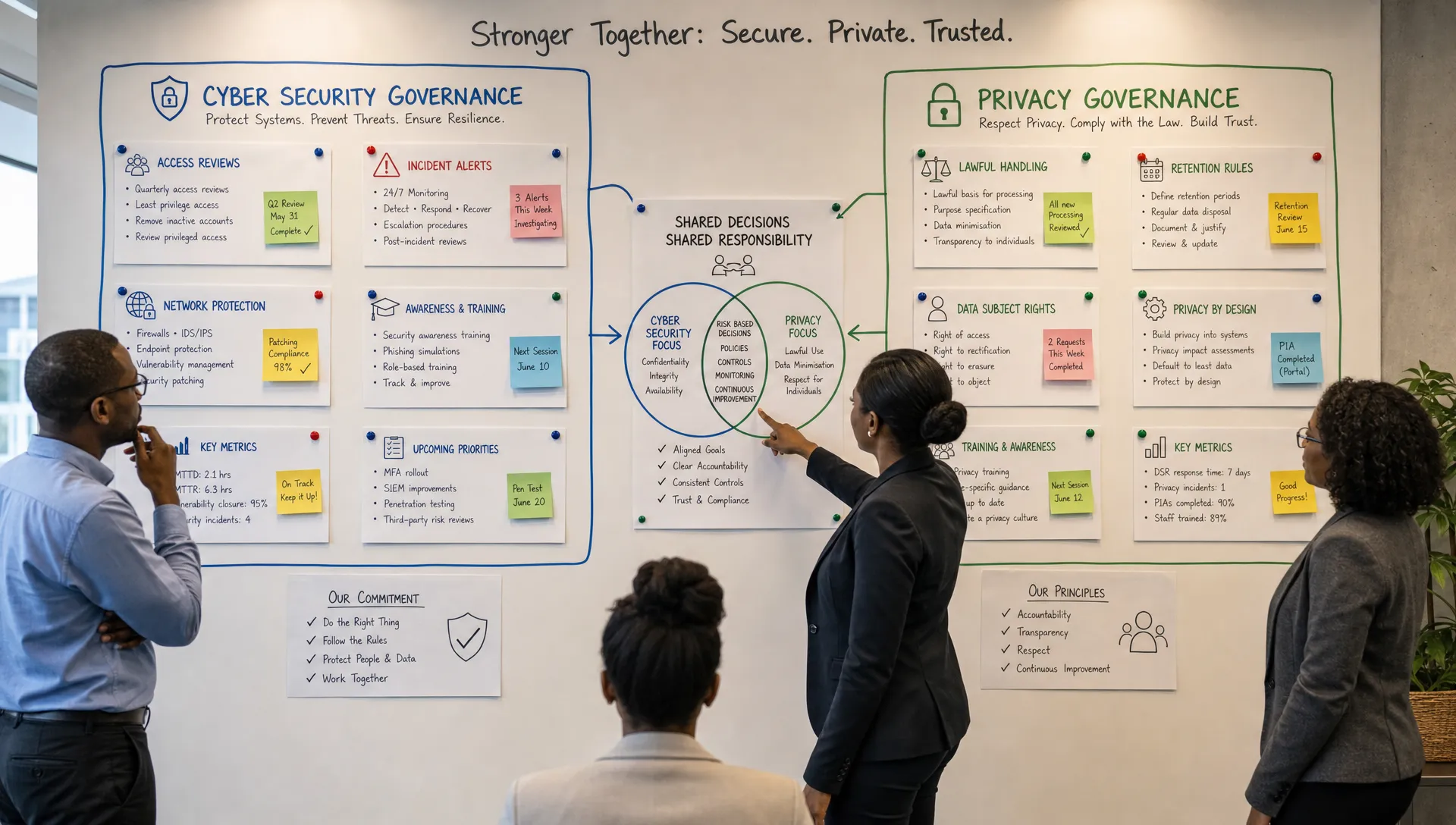
Cyber security and privacy teams often protect the same organisation from different angles. Cyber security focuses on preventing unauthorised access, disruption, misuse, and data loss. Privacy focuses on whether personal data is collected, used, shared, retained, and disclosed lawfully, fairly, and transparently.
When these functions work in isolation, gaps appear quickly. A system may be technically secure but collect more personal data than necessary. A privacy notice may be legally sound but unsupported by access controls, monitoring, or incident response. A breach may be contained by IT while the privacy team is informed too late to assess notification duties or harm to individuals.
For Jamaican organisations operating under the Data Protection Act, 2020, alignment is no longer a best practice reserved for large enterprises. It is a practical requirement for reducing compliance risk, protecting customers, and giving boards confidence that data protection is being managed across the business.
Why cyber security and privacy need alignment
Cyber security and privacy are connected, but they are not interchangeable. Security protects information, systems, networks, and services. Privacy protects people by governing how their personal information is handled throughout its life cycle.
If your organisation still treats the two disciplines as the same thing, it helps to first clarify where security ends and privacy begins. That distinction matters because each team sees different risks. Security may ask whether a database is encrypted. Privacy may ask whether the organisation should have collected that data in the first place, whether the retention period is justified, and whether individuals were properly informed.
The need for alignment is also increasing because data environments are more complex. Cloud platforms, third-party processors, remote work, AI-enabled tools, customer portals, and digital payment systems all create shared risk. A privacy decision can affect security architecture, and a security decision can affect individual rights.
The NIST Cybersecurity Framework 2.0 recognises governance as a core cyber security function. That is significant because modern cyber security is not only about firewalls, endpoint tools, and technical controls. It is about decisions, accountability, risk ownership, policies, and evidence. Those are also central to privacy compliance.
Start with a shared outcome, not a forced merger
Alignment does not mean combining cyber security and privacy into one team. In many organisations, especially small and medium-sized businesses in Jamaica, privacy may sit with legal, compliance, risk, internal audit, or a designated data protection lead. Cyber security may sit with IT, an outsourced service provider, or a Chief Information Security Officer.
The goal is not to blur responsibilities. The goal is to make sure both teams contribute to one outcome: personal data is used in ways that are lawful, secure, necessary, accountable, and resilient.
Function | Primary question | If it works alone | Aligned outcome |
Cyber security | Is the data protected from compromise or disruption? | Secure systems may still support excessive or unclear processing. | Controls protect data in line with privacy obligations. |
Privacy | Is the data handled lawfully, fairly, and transparently? | Policies may exist without technical enforcement. | Privacy requirements are built into systems and operations. |
Governance and risk | Who owns the decision and evidence? | Reporting becomes fragmented. | Management sees one risk picture with clear accountability. |
This shared outcome should be approved by leadership and reflected in policies, project governance, procurement, incident response, training, and board reporting.
Define who owns what
Many alignment problems begin with vague ownership. Cyber security assumes privacy is handling all compliance questions. Privacy assumes IT has implemented the right safeguards. Business units assume both teams have approved a new tool because one of them reviewed it.
A practical operating model should define responsibilities before a problem occurs. For more detail on structuring roles and escalation, PLMC has also covered data protection governance with roles, RACI and reporting, which is especially useful when multiple departments share accountability.
A simple responsibility split may look like this:
Area | Cyber security leads | Privacy leads | Joint decision required |
Data inventory | System locations, access paths, technical owners | Categories of personal data, purposes, data subjects, lawful handling | Which systems process high-risk or sensitive personal data |
Access control | Authentication, privileges, access reviews, privileged accounts | Purpose-based access, role justification, excessive access concerns | Who should access personal data and why |
Vendor review | Security posture, hosting, encryption, vulnerability management | Processing purpose, contractual privacy terms, cross-border risk | Whether a vendor can process personal data safely and lawfully |
Incident response | Detection, containment, recovery, forensic support | Harm assessment, notification analysis, individual impact | Whether an event is a personal data breach and what actions follow |
Retention and deletion | Technical deletion capability, backups, archive controls | Retention schedule, legal basis, minimisation | How long data remains accessible and when it is securely disposed of |
This table should be adapted to the organisation. A bank, healthcare provider, school, charity, retailer, BPO, or public sector body will each have different risk profiles. The principle is the same: one risk area should not have two silent owners or no owner at all.
Create a joint intake process for new projects
Privacy and cyber security teams often get involved too late. A department selects a software platform, uploads customer data, builds a workflow, or launches a campaign. Only after go-live does someone ask whether the tool is secure or whether the data processing is compliant.
A joint intake process fixes this. Before a new system, vendor, campaign, app, or data analytics project is approved, the business should answer a few standard questions. What personal data will be used? Who will access it? Where will it be stored? Is a third party involved? Will the data leave Jamaica? How long will it be retained? What security controls are required? Could the activity create harm or unfairness for individuals?
The intake does not need to be complicated. In fact, the best process is often a short screening form that routes low-risk activities quickly and sends higher-risk projects to privacy and cyber security for deeper review. The purpose is not to slow innovation. It is to prevent expensive redesign, regulatory exposure, and reputational damage later.
Map controls to the data life cycle
Cyber security controls are strongest when they are tied to how data actually moves through the organisation. Privacy controls are strongest when they are supported by technical and operational enforcement. The data life cycle gives both teams a shared map.
Data life cycle stage | Privacy focus | Cyber security focus | Alignment question |
Collection | Purpose, transparency, necessity, consent or other basis where applicable | Secure forms, authentication, encrypted transmission | Are we collecting only what we need through a secure channel? |
Use | Fair use, purpose limitation, role justification | Access control, segregation of duties, monitoring | Can only authorised people use the data for approved purposes? |
Storage | Retention, classification, data subject rights support | Encryption, backups, vulnerability management | Is stored data protected according to sensitivity and risk? |
Sharing | Vendor due diligence, contractual controls, transfer risk | Secure transfer, third-party access, logging | Can recipients protect the data and use it only as agreed? |
Retention and disposal | Retention schedule, deletion rules, legal hold exceptions | Secure deletion, backup expiry, archive protection | Can the organisation prove data is deleted or restricted when required? |
Incident response | Harm assessment, notification analysis, records of decision | Detection, containment, eradication, recovery | Are privacy and security decisions made quickly from the same facts? |
This life cycle view helps prevent a common mistake: designing cyber security controls only around systems instead of around personal data. The system matters, but privacy risk follows the data.
Embed privacy into cyber security workflows
Alignment becomes real when privacy checkpoints are built into routine cyber security work. The following areas are good starting points.
Access management
Cyber security teams usually manage authentication, identity tools, privileged accounts, and access reviews. Privacy should help define why access is needed and whether it matches the employee's role. Least privilege is not only a security principle. It also supports data minimisation and purpose limitation.
For example, a customer service employee may need to view contact details to resolve a query, but not full identification documents, payment records, or unrelated complaint history. Privacy defines the acceptable use. Cyber security enforces it through roles, permissions, monitoring, and review.
Security monitoring and logging
Logs are essential for detecting suspicious activity, investigating incidents, and demonstrating accountability. However, logs may contain personal data such as usernames, IP addresses, device identifiers, location details, or activity history.
Privacy and cyber security should agree on what is logged, how long logs are retained, who can view them, and how monitoring is explained to employees or users where appropriate. Over-collection of logs can create privacy risk. Under-collection can weaken security and incident investigation. Alignment helps find the right balance.
Secure development and system changes
Where organisations build or customise systems, privacy should be part of secure development. Security reviews should test for vulnerabilities, misconfigurations, insecure APIs, weak authentication, and poor encryption. Privacy reviews should test for excessive data fields, unclear default settings, missing notices, unnecessary profiling, and weak deletion processes.
This is especially important for customer portals, HR systems, financial platforms, health records, education platforms, and any workflow involving sensitive personal information.
Incident response
During an incident, time matters. Cyber security may be focused on containment and recovery, while privacy must assess whether personal data was involved, whose data may be affected, what harm could result, and what regulatory or contractual steps may follow.
The incident response plan should require early privacy involvement when personal data may be implicated. It should also define how evidence is preserved, who approves communications, who contacts external advisers if needed, and how decisions are documented.
Vendor and cloud reviews
Many privacy and cyber security risks now sit outside the organisation's direct environment. Cloud providers, payroll vendors, marketing platforms, payment processors, analytics tools, outsourced IT providers, and consultants may all process or access personal data.
A joint vendor review should cover both security and privacy. Security questions look at controls such as encryption, access, vulnerability management, hosting, backup, incident notification, and business continuity. Privacy questions look at processing purpose, data categories, retention, onward sharing, contractual obligations, and cross-border implications.

Use one risk language
Privacy teams and cyber security teams can both talk about risk while meaning different things. Security may rate risk based on exploitability, threat likelihood, and operational impact. Privacy may rate risk based on harm to individuals, fairness, sensitivity, transparency, and regulatory exposure.
Neither view is complete on its own. A low-likelihood cyber event may still create serious privacy harm if it involves sensitive data. A privacy weakness may create reputational damage even if no attacker is involved. For example, collecting unnecessary customer identification documents may not be a cyber incident, but it increases the impact of any future breach and may raise compliance concerns.
A common scoring model should consider both organisational impact and individual impact. It should also identify when a risk requires senior management approval rather than operational acceptance.
Risk factor | Why privacy cares | Why cyber security cares |
Sensitivity of data | Higher potential harm to individuals | Stronger protection and monitoring may be needed |
Volume of records | Greater number of affected data subjects | Larger breach impact and recovery burden |
Access exposure | Excessive access may breach purpose expectations | More accounts increase attack surface |
Vendor involvement | Accountability and contractual control are required | External systems may introduce weaknesses |
Retention period | Keeping data too long increases compliance risk | Stored data remains available to attackers |
Incident detectability | Delayed discovery affects harm assessment | Delayed detection increases compromise window |
Once risk language is shared, decisions become faster and better documented. A project can be approved, redesigned, delayed, or rejected for reasons that leadership understands.
Maintain shared evidence
Compliance is not only about doing the right thing. It is also about proving that the organisation acted responsibly. If privacy and cyber security maintain separate records that do not match, management will struggle to see the real picture.
A shared evidence set may include data inventories, risk assessments, vendor reviews, access review records, training completion, incident logs, policy approvals, system change approvals, and remediation plans. This evidence should be consistent enough that internal audit, regulators, customers, insurers, and boards are not receiving conflicting answers.
This is where governance, risk, and compliance integration becomes valuable. The strongest programmes align people, process, and technology around the same control objectives. PLMC discusses this broader approach in its article on aligning people, process and technology for data protection and security.
Train teams together, then train roles differently
General privacy awareness is useful, but alignment requires more than annual training slides. Cyber security staff should understand core privacy principles, including minimisation, retention, data subject rights, lawful handling, breach assessment, and transparency. Privacy staff should understand the basics of access control, encryption, logging, vulnerability management, phishing, cloud risk, and incident response.
Joint workshops are especially useful for scenario-based learning. For example, teams can walk through a ransomware incident, a misdirected email, a lost laptop, a vendor breach, or an employee accessing records without a business reason. These exercises reveal gaps in escalation, evidence collection, decision-making, and communications.
After joint training, role-based training should follow. HR needs different examples from IT. Customer-facing staff need different guidance from finance. Executives need to understand risk appetite, accountability, and reporting. The aim is to make privacy and cyber security practical in daily operations, not abstract compliance topics.
Report metrics that leadership can act on
Boards and senior management do not need every operational detail. They need clear indicators showing whether data protection and cyber security risk is increasing, decreasing, or staying the same.
Useful metrics include:
Metric | What it shows |
Percentage of high-risk systems with named data owners | Whether accountability is clear |
Percentage of new projects screened before launch | Whether privacy and security are involved early |
Percentage of critical access rights reviewed on schedule | Whether excessive access is being controlled |
Number of high-risk vendors assessed for privacy and security | Whether third-party risk is being managed |
Time taken to classify incidents involving personal data | Whether breach assessment can happen quickly |
Completion rate for role-based training | Whether staff understand their responsibilities |
Open remediation actions by risk rating | Whether known issues are being fixed |
Metrics should not become a paperwork exercise. If a metric does not help management make decisions, improve resources, or challenge delays, it should be revised.
A practical 90-day alignment plan
Organisations do not need to solve everything at once. A focused 90-day plan can create momentum and expose the biggest gaps.
Timeframe | Priority actions | Expected result |
Days 0-30 | Identify privacy and cyber security owners, review current policies, map critical systems that process personal data, and agree on escalation points. | Clear ownership and a starting view of high-risk data environments. |
Days 31-60 | Create a joint project intake form, update vendor review questions, test incident response escalation, and agree on shared risk scoring. | Privacy and security become part of routine decisions. |
Days 61-90 | Report key metrics to management, close urgent access or vendor gaps, run a tabletop incident exercise, and approve a longer-term roadmap. | Leadership receives evidence of progress and remaining risk. |
The 90-day plan should end with a roadmap, not a celebration that the work is finished. Alignment is an operating rhythm. It must continue as systems, threats, laws, vendors, and business models change.
Common mistakes to avoid
One common mistake is involving privacy only after cyber security has selected or configured a tool. By then, the organisation may have already embedded excessive data collection, weak retention rules, or unclear user notices.
Another mistake is assuming that a secure system is automatically compliant. A system can have strong encryption, monitoring, and access controls while still processing personal data for unclear purposes or retaining it for too long.
A third mistake is placing all responsibility on IT. Cyber security is technical in part, but privacy and data protection require business ownership. Departments that collect and use personal data must be accountable for their decisions.
Finally, organisations should avoid treating alignment as a one-time policy project. Policies matter, but day-to-day decisions matter more. The real test is whether teams work together during procurement, system changes, access reviews, complaints, incidents, audits, and executive reporting.
Frequently Asked Questions
Should cyber security and privacy be managed by the same person? Not always. In smaller organisations, one person may coordinate both areas, but the responsibilities should still be clearly separated. Cyber security and privacy require different expertise, and important decisions should include both perspectives.
Does compliance with the Data Protection Act, 2020 require cyber security controls? Yes, data protection compliance depends on appropriate safeguards for personal data. Privacy policies alone are not enough if systems, access, vendors, and incident response are weak.
What is the best first step to align cyber security and privacy teams? Start by mapping who owns key decisions involving personal data. Then create a joint intake process for new systems, vendors, and projects so privacy and security risks are reviewed before launch.
How often should privacy and cyber security teams meet? The frequency depends on organisational risk, but high-risk organisations should have a regular forum, usually monthly or quarterly, plus immediate escalation for incidents, major vendors, and high-risk projects.
Strengthen privacy and cyber security alignment in your organisation
Aligning cyber security and privacy teams helps Jamaican organisations reduce risk, improve decision-making, and demonstrate accountability under the Data Protection Act, 2020. It also gives leadership a clearer view of whether personal data is being protected in practice, not only in policy.
Privacy & Legal Management Consultants Ltd. supports organisations with data protection implementation, cyber security, corporate governance, GRC integration, training, and compliance readiness. If your organisation needs practical guidance, you can learn more through Privacy & Legal Management Consultants Ltd. and explore the next steps for building a stronger, more coordinated data protection programme.