

Risk Management and Data Protection After a Near Miss
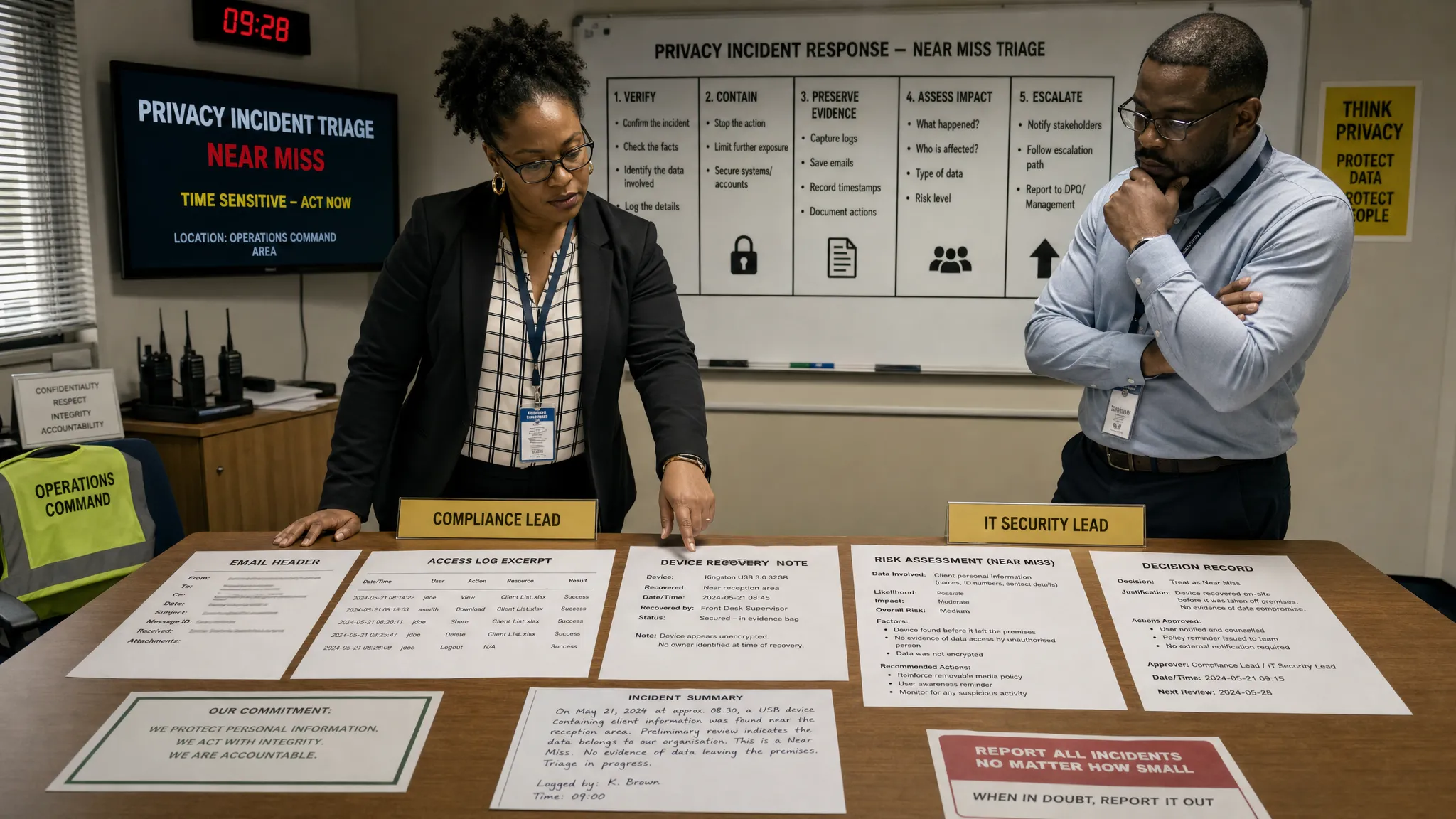
A data protection near miss can feel like good fortune. The email was recalled before the attachment was opened. The lost phone was recovered. The phishing link was reported before credentials were entered. The cloud folder was spotted before anyone outside the organisation accessed it.
But from a risk management perspective, a near miss is not a non-event. It is evidence that a control almost failed, or that a gap already exists and has not yet produced visible harm. For Jamaican organisations working to meet Data Protection Act 2020 expectations, that evidence should be captured, assessed, and used to strengthen governance before a real breach occurs.
The objective after a near miss is not to assign blame. It is to answer a more useful question: what conditions allowed this to almost happen, and what needs to change so it is less likely to happen again?
This article provides general information and is not legal advice. Organisations should assess their own facts and, where necessary, seek professional guidance.
What counts as a data protection near miss?
A near miss is an event that could have resulted in unauthorised access, loss, disclosure, alteration, or misuse of personal data, but was stopped, contained, or avoided before confirmed harm occurred.
It may involve human error, weak process design, technology misconfiguration, vendor activity, or a security threat. The common thread is that personal data was exposed to a realistic risk, even if the incident did not become a confirmed breach.
Near miss scenario | Why it matters | Risk management question |
A staff member almost sends a payroll file to the wrong recipient | Sensitive employment and financial data could be disclosed | Are email controls, approval steps, and staff training adequate? |
A laptop containing customer data is misplaced but recovered | Data could be accessed if the device is not secured | Are encryption, device tracking, and remote wipe controls in place? |
A phishing email is reported before credentials are entered | Attackers attempted to compromise access | Are MFA, awareness, and reporting channels working consistently? |
A shared folder is accidentally made available to too many internal users | Access may exceed business need | Are permissions reviewed and limited by role? |
A vendor requests more personal data than necessary | Overcollection or purpose drift may occur | Are vendor instructions and data sharing agreements clear? |
Near misses are valuable because they show you where risk is active. They also reveal which controls worked. A reported phishing email, for example, may show that awareness training and escalation channels are effective, even if technical controls still need improvement.
First response: verify, contain, and preserve evidence
The first hours after a close call should be calm, structured, and evidence-led. Avoid the instinct to minimise the event simply because harm was avoided. At the same time, do not label it as a breach before the facts are understood.
Start by confirming what happened, what personal data was involved, who may have had access, and whether any unauthorised access can be ruled out. If a system, device, vendor platform, or email account is involved, preserve logs and records before they are overwritten. If the event involves staff behaviour, capture the timeline while memories are fresh.
A practical first response should cover:
Containment, such as revoking access, recalling a message, disabling a link, changing passwords, or recovering a device.
Evidence preservation, including logs, screenshots, email headers, access records, and the names of people involved in the response.
Data identification, including the categories of personal data, number of individuals potentially affected, and whether sensitive data is involved.
Impact assessment, including possible harm to individuals, operational impact, regulatory exposure, and reputational risk.
Decision recording, including why the organisation concluded it was a near miss, a suspected breach, or a confirmed incident.
Escalation, including notification to the data protection officer, senior management, legal counsel, IT security, or the relevant business owner where appropriate.
This is where risk management and privacy governance meet. A near miss should not sit only in an IT ticket, an HR conversation, or a compliance email thread. It should become part of the organisation’s risk evidence.
Decide whether it is truly only a near miss
Not every close call is a reportable data breach, but every close call deserves a disciplined triage. Under Jamaica’s Data Protection Act 2020, organisations are expected to protect personal data with appropriate organisational and technical measures. If an event suggests that personal data may have been compromised, the organisation should assess whether notification, escalation, or further investigation is required.
The safest approach is to document the decision-making process. If the conclusion is that no personal data was accessed or disclosed, record the evidence supporting that conclusion. If the facts are uncertain, treat the matter as a suspected incident until further assessment is complete.
The Office of the Information Commissioner is the key Jamaican authority for data protection guidance, and organisations should stay aligned with current regulatory expectations.
Question | Why it matters |
Was personal data involved? | If no personal data was involved, the event may be a security or operational issue rather than a privacy incident. |
Was access unauthorised or excessive? | A near miss may still expose weak access governance even if there is no confirmed external disclosure. |
Can the organisation prove that data was not accessed? | Evidence matters. Assumptions are weaker than logs, audit trails, or system records. |
Could individuals suffer harm if the risk had materialised? | Potential harm helps determine severity and the urgency of corrective action. |
Is the same event likely to happen again? | Recurrence risk may turn a small event into a significant governance issue. |
A near miss that is poorly documented can later become a compliance problem. If the same issue happens again, management, regulators, or affected individuals may ask why the earlier warning was not addressed.
Turn the close call into a data protection risk assessment
A near miss is a practical trigger for a focused risk assessment. Rather than reviewing the entire organisation, examine the specific process, system, team, vendor, or data flow involved.
For example, if a customer file was nearly sent to the wrong recipient, assess the full workflow: how the file is created, who approves it, how recipients are selected, whether attachments are encrypted, whether there is a second check, and whether staff understand the consequences of error. The root cause may not be carelessness. It may be a process that depends too heavily on memory and manual effort.
A useful assessment should identify the data at risk, the threat or failure scenario, the vulnerability that allowed the near miss, the potential impact, existing controls, and the treatment required. If your team needs a structured method, PLMC’s guide to data protection risk assessment scope, steps, and evidence explains how to build a defensible assessment process.
International risk frameworks support this evidence-based approach. ISO 31000 frames risk management around identifying, analysing, evaluating, treating, monitoring, and communicating risk. The NIST Cybersecurity Framework 2.0 also reinforces the need to govern, identify, protect, detect, respond, and recover. For data protection, these ideas translate into a simple principle: privacy risk should be managed continuously, not only after a confirmed breach.
Update the risk register and assign ownership
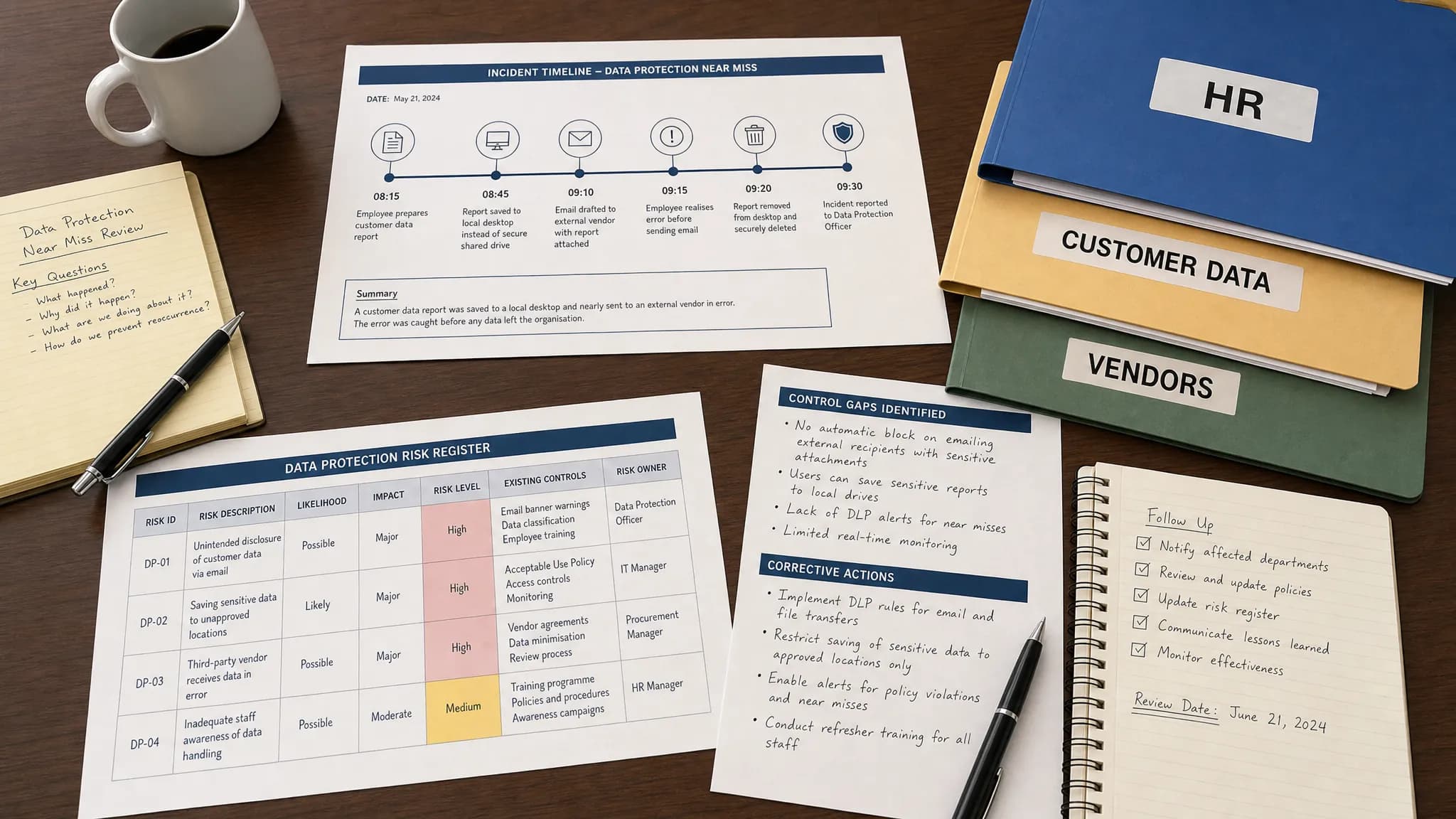
If a near miss reveals a meaningful weakness, it should be reflected in the risk register. This does not mean every minor mistake deserves board-level escalation. It does mean that recurring, high-impact, or systemic privacy risks should be visible to the people responsible for governance.
A strong risk register entry should describe the risk clearly, not just the event. For instance, instead of recording email sent to wrong person, a better risk statement would be: personal data may be disclosed to unauthorised recipients because sensitive files are sent by email without verification, encryption, or approval controls.
That wording helps management understand the cause, consequence, and treatment options. It also supports accountability because someone can be assigned to fix the weakness.
At minimum, the risk record should include the risk owner, affected process, data categories, current controls, risk rating, treatment plan, deadline, evidence required, and residual risk after treatment. PLMC has a practical resource on how to add data protection to your risk register if your organisation needs a clearer structure.
Build a 30-day improvement plan
The best time to improve controls is while the near miss is still fresh. A 30-day plan keeps momentum without turning the response into an open-ended project.
Timeframe | Action | Evidence to keep |
Days 1 to 3 | Confirm facts, contain the issue, preserve records, and document the initial decision | Incident timeline, logs, emails, screenshots, meeting notes |
Days 4 to 7 | Complete a focused risk assessment and identify root causes | Risk assessment notes, data flow details, control gap analysis |
Days 8 to 14 | Approve corrective actions and assign owners | Updated risk register, action plan, management approval |
Days 15 to 21 | Implement priority controls and communicate process changes | Revised procedures, access changes, system settings, staff notices |
Days 22 to 30 | Test the fix and review whether residual risk is acceptable | Test results, sign-off, updated training records, assurance report |
This plan should be proportionate. A small internal error involving low-risk data may require a short review and a process change. A near miss involving sensitive data, vulnerable individuals, privileged access, or a key vendor may require deeper investigation and senior management oversight.
Strengthen controls in layers
Near misses often expose the danger of relying on one control. If the only thing preventing a breach is one careful employee, the organisation is carrying more risk than it may realise.
Controls should work in layers across people, process, and technology. People need awareness and clear reporting channels. Processes need approvals, checks, retention rules, and escalation paths. Technology should reduce avoidable error through access controls, encryption, multi-factor authentication, logging, data loss prevention, and secure configuration where appropriate.
Control layer | Example after a near miss | What good evidence looks like |
People | Staff are briefed on the actual scenario and how to report similar risks | Attendance records, scenario materials, quiz results, manager confirmation |
Process | A second check is added before sending sensitive files externally | Updated procedure, approval logs, sample checks |
Technology | Access is restricted by role and reviewed periodically | Access review records, system configuration, audit logs |
Governance | The risk is recorded and monitored until treatment is complete | Risk register entry, owner updates, management minutes |
The key is not to add controls for appearance. Controls should reduce real risk and be testable. If nobody can show whether a control is working, it is difficult to rely on it.
Use the near miss to improve reporting culture
Many organisations only hear about near misses when an employee feels safe enough to report them. A blame-heavy culture pushes small problems underground until they become large problems.
Management should thank staff who report close calls promptly, even where the employee made a mistake. This does not remove accountability, but it sends the right message: early reporting protects individuals, customers, and the organisation.
Training should also use realistic examples from the organisation’s own environment, with sensitive details removed. Generic privacy training may explain the law, but scenario-based training helps people recognise risk during everyday work. If your awareness programme needs to become more practical, consider building data protection awareness training around real scenarios rather than relying only on policy summaries.
What leadership should ask after a near miss
Boards, executives, and senior managers do not need to investigate every technical detail. They do need to ask the right governance questions.
Leadership should ask whether the event was isolated or systemic, whether similar risks exist in other departments, whether the organisation has evidence to support its conclusion, whether corrective actions are funded and assigned, and whether the same issue has appeared before. If the answer to any of these questions is unclear, the organisation may need stronger privacy governance.
A near miss is also a chance to connect data protection with wider governance, risk, and compliance. Personal data risk is not only an IT matter. It can affect customer trust, employment relationships, vendor management, regulatory exposure, and business continuity.
Common mistakes to avoid
One of the biggest mistakes after a near miss is treating it as proof that controls are working. Sometimes that is true. Other times, the organisation was simply lucky.
Another mistake is fixing only the visible symptom. If an employee almost sent data to the wrong person, training may help, but the deeper issue may be an unclear process, weak data classification, or a system that makes it too easy to attach sensitive files without verification.
Organisations should also avoid informal decision-making. A verbal conclusion that no breach occurred may not be enough months later if the same issue returns. Document the rationale, the evidence reviewed, and the corrective actions approved.
Finally, do not let corrective actions drift. A near miss loses value when lessons learned are captured but never implemented. Assign owners, set deadlines, and require evidence of completion.
Frequently Asked Questions
What is a data protection near miss? A data protection near miss is an event that could have caused unauthorised access, loss, disclosure, alteration, or misuse of personal data, but was stopped or contained before confirmed harm occurred.
Does a near miss need to be reported to the regulator in Jamaica? Not every near miss is reportable, but each event should be assessed carefully. If personal data may have been compromised, the organisation should review its obligations under the Data Protection Act 2020 and seek guidance where needed.
Should near misses be included in the risk register? Significant, recurring, or systemic near misses should be included in the risk register because they reveal active privacy risks. Minor events may still be logged locally and monitored for patterns.
Who should own corrective actions after a near miss? Ownership should sit with the person who can change the relevant process, system, or behaviour. That may be a business manager, IT lead, data protection officer, vendor manager, or senior executive, depending on the cause.
How can training help after a near miss? Training helps when it is tied to the real scenario that occurred. Staff should understand what almost happened, what warning signs to notice, how to prevent recurrence, and how to report concerns quickly.
Turn a close call into stronger compliance
A near miss is a warning, but it is also an opportunity. If your organisation responds with evidence, risk assessment, governance oversight, and practical control improvements, the event can strengthen your data protection programme before a serious incident occurs.
Privacy & Legal Management Consultants Ltd. supports organisations in Jamaica with data protection implementation, risk assessment, governance, compliance, cyber security, and training. If your organisation has experienced a close call or wants to improve readiness under the Data Protection Act 2020, you can learn more about PLMC’s work at Privacy & Legal Management Consultants Ltd. and request support for your next steps.