

Build Data Protection Awareness Training Around Real Scenarios
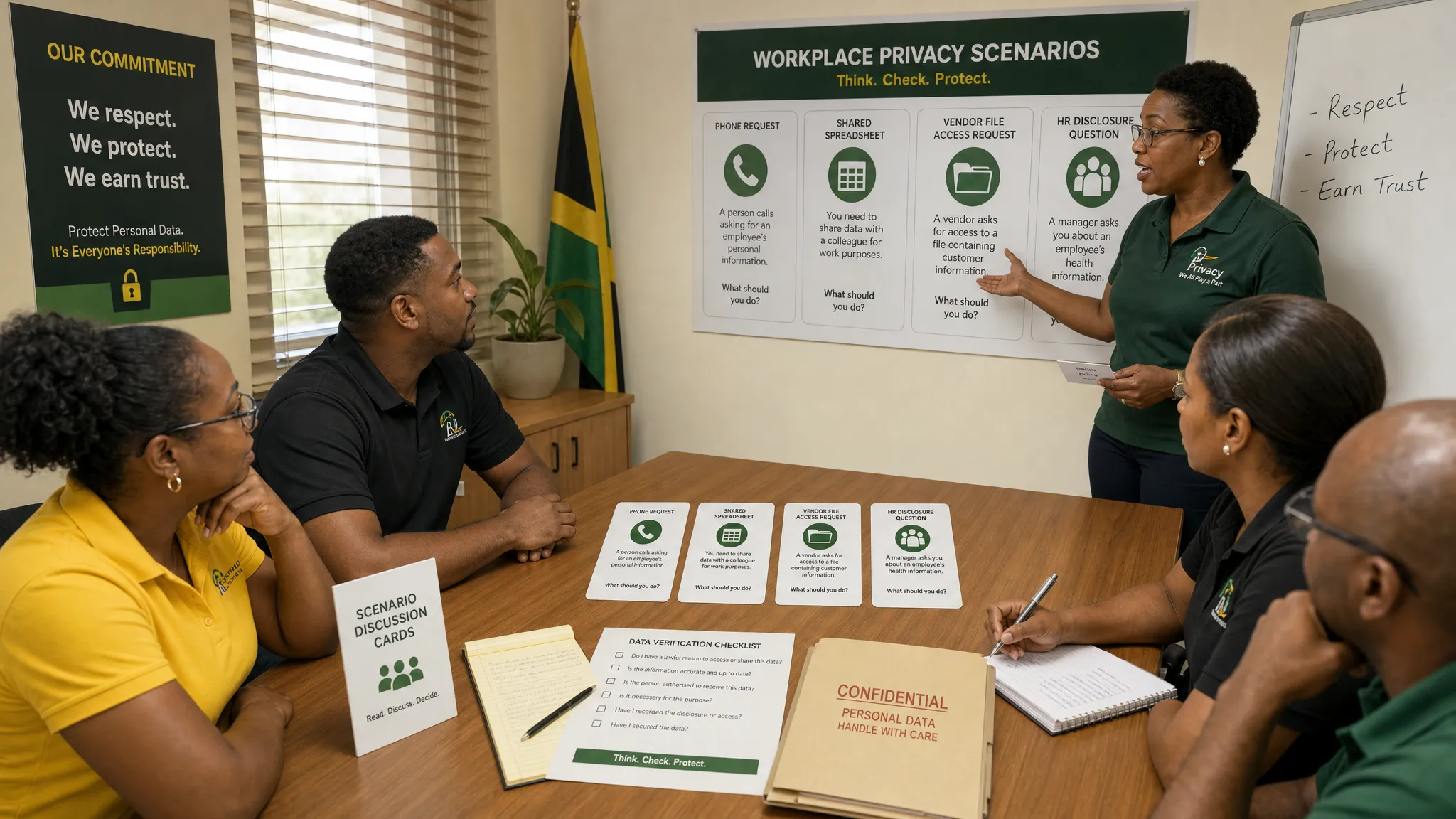
Most employees do not mishandle personal data because they are careless. They make mistakes because the risky moment looks ordinary: a spreadsheet sent quickly before lunch, a customer asking for help on the phone, a WhatsApp message from a manager, or a vendor requesting access to files.
That is why data protection awareness training becomes far more useful when it is built around real workplace scenarios. Policies explain what the organisation expects. Scenarios help people recognise what those expectations look like in the middle of a busy day.
For Jamaican organisations, this matters even more now that compliance with Jamaica’s Data Protection Act, 2020 is an active governance responsibility. Awareness training should not simply prove that staff attended a session. It should help employees make better privacy decisions, escalate issues earlier, and reduce avoidable risk across HR, customer service, IT, finance, operations, and leadership.
Why real scenarios change behaviour better than generic training
Generic privacy training often sounds correct but feels distant. Staff hear about lawful processing, consent, transparency, data minimisation, security safeguards, data subject rights, and breach reporting. Then they return to work and face a situation that does not announce itself as a privacy issue.
Scenario-based training closes that gap. It moves the discussion from abstract rules to practical judgement. Instead of asking employees to memorise a principle, it asks them to decide what they would do when a customer requests account information, a supervisor wants an employee file, or a vendor asks for a full database export.
Good scenarios also make training safer. Staff can practise difficult decisions before a real incident occurs. They can ask questions, challenge assumptions, and learn the correct escalation route without feeling blamed.
If your organisation is still defining the basics, it may help to first review what good data protection training looks like in practice, then use scenarios to turn those principles into daily habits.
What counts as a real data protection scenario?
A real scenario does not have to be a real breach. In fact, it should usually be a sanitised version of a common business situation. The goal is realism, not drama.
A useful scenario has four qualities. It involves personal data, it reflects a task employees actually perform, it includes a decision point, and it shows the consequences of different choices.
For example, this is too vague: staff must protect customer information. This is more useful: a customer service agent receives a call from someone claiming to be a customer’s spouse and asking for the customer’s account balance because the customer is unavailable. What should the agent verify before disclosing anything, and when should the request be refused or escalated?
The second version feels familiar. It gives employees a moment to pause, identify the personal data involved, consider authentication, apply the organisation’s policy, and choose a response.
Start with the moments where personal data moves
The best scenarios come from your organisation’s actual workflows. Look for the points where personal data is collected, accessed, shared, stored, corrected, exported, archived, or deleted. These are the moments where privacy risk becomes operational risk.
Useful sources include:
Customer complaints, access requests, correction requests, and service queries.
HR processes such as recruitment, onboarding, payroll, benefits, disciplinary matters, and employee medical information.
IT tickets involving access permissions, password resets, shared drives, cloud tools, device loss, or vendor access.
Marketing activities such as promotions, mailing lists, event registration, photography, and customer segmentation.
Finance, compliance, and anti-money laundering workflows involving identity documents, transaction records, source of funds information, and due diligence files.
Near misses, internal audit findings, incident reports, and informal questions staff frequently ask.
When collecting these examples, remove names, account numbers, screenshots, and details that could identify a person. You want staff to recognise the risk pattern, not the individual involved.
Build each scenario around a decision, not a lecture
A scenario should not read like a policy paragraph with names added. It should place the learner inside a decision.
The easiest way to design one is to use a short scenario card. Keep it concise enough to discuss in five to ten minutes, especially for awareness sessions with non-specialist staff.
Scenario element | What to include | Example |
Business context | Where the situation happens | A customer calls the branch before closing time |
Personal data involved | The information at risk | Account details, contact number, transaction history |
Trigger | What creates the pressure | The caller says the matter is urgent |
Decision point | What the employee must choose | Disclose, refuse, verify, or escalate |
Correct behaviour | The action you want repeated | Follow authentication steps and document the request |
Compliance link | The principle or policy behind it | Confidentiality, security safeguards, lawful disclosure |
Escalation route | Who to contact if unsure | Supervisor, privacy lead, compliance officer, IT security |
This format keeps the session grounded. Employees do not need a long legal explanation before they can participate. They first decide what they would do, then the facilitator connects the answer to the Data Protection Act, internal policy, and the organisation’s risk appetite.
Use role-specific scenarios so staff see themselves in the training
One of the fastest ways to lose attention is to train every team on the same examples. A receptionist, payroll officer, IT administrator, loan officer, marketing coordinator, and executive assistant do not encounter privacy risk in the same way.
Role-based scenarios help employees see that data protection is part of their job, not a separate compliance topic. They also help managers understand where controls may be unclear.
Team or function | Scenario to practise | Behaviour to reinforce |
HR | A manager asks HR to email an employee’s medical certificate to a wider management group | Share only what is necessary, limit recipients, and consider confidentiality before sending |
Customer service | A caller requests information about another person’s account or application | Authenticate properly and avoid unauthorised disclosure |
IT | A vendor asks for admin access to troubleshoot a system containing customer records | Verify approval, limit access, document activity, and apply secure access controls |
Marketing | A team wants to reuse an old event registration list for a new campaign | Check the original purpose, notice, consent position, and opt-out process |
Finance and AML | Staff collect identity documents for due diligence and store copies in an open shared folder | Balance AML obligations with access control, retention, and secure storage |
Operations | Printed delivery notes with customer addresses are left visible at a front desk | Reduce unnecessary exposure and apply clean desk practices |
Senior leadership | An executive wants a full customer report for a board update | Use aggregated or minimised data where possible and challenge unnecessary detail |
The point is not to make every employee a legal expert. The point is to help each person recognise the situations where they must slow down, verify, minimise, secure, or escalate.
For a deeper role-by-role approach, PLMC has also outlined how to tailor sessions for HR, IT, and customer-facing teams.
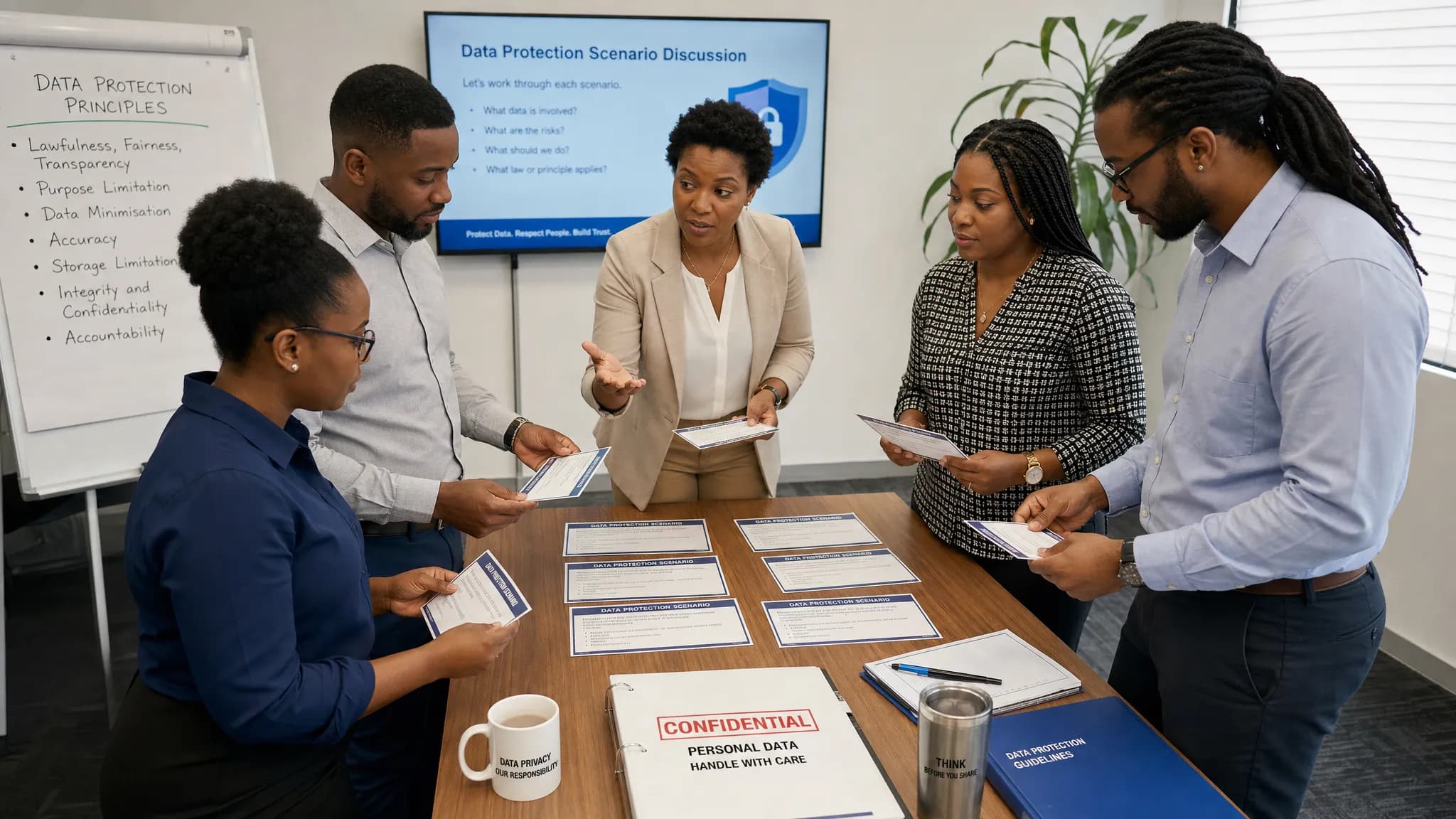
Make Jamaican compliance practical, not theoretical
Jamaica’s Data Protection Act, 2020 sets expectations for how personal data should be processed, protected, and respected. The Office of the Information Commissioner is the national authority for data protection oversight, and organisations should ensure their internal practices align with current regulatory guidance.
In training, however, it is rarely enough to repeat the law. Staff need to understand how legal principles translate into daily choices.
A scenario about collecting customer information can teach data minimisation. A scenario about using old contact lists can teach purpose limitation and transparency. A scenario about sending payroll files can teach security safeguards. A scenario about a customer asking for a copy of their information can teach data subject rights and escalation.
This approach also supports governance. When employees can explain why they took a privacy-conscious action, the organisation is building evidence of accountability, not merely attendance records.
For organisations that operate internationally or serve customers outside Jamaica, scenarios can also help identify where GDPR or other cross-border privacy requirements may affect workflows. The key is to avoid overwhelming staff with multiple legal frameworks. Start with the decision they must make, then explain the compliance reason in plain language.
Facilitate scenarios as conversations, not exams
Scenario-based training works best when employees feel safe enough to say what they would actually do. If the session feels like a test, participants will guess the answer they think compliance wants to hear.
A better facilitation method is to ask simple questions in sequence. What personal data is involved? Who is asking for it? What could go wrong? What should you check before acting? Who should you contact if you are unsure?
This creates a repeatable thinking pattern. Over time, staff learn to pause before sending, sharing, collecting, or deleting personal data.
You can also use branching scenarios. Present the first decision, then reveal what happens next. For example, if an employee emails a spreadsheet to the wrong external address, what should they do in the first 15 minutes? If the recipient replies that they opened the file, what changes? If the file contains sensitive employee data, who must be involved?
The value is in the discussion. Employees hear how colleagues think, managers hear where processes are unclear, and the privacy or compliance lead can correct misunderstandings before they become incidents.
Connect every scenario to a control employees can use
A scenario should end with a practical control, not simply a warning. Otherwise, staff may understand the risk but still not know what to do on Monday morning.
For each scenario, identify the tool, policy, form, approval step, script, or escalation route that supports the right behaviour. If none exists, the scenario has revealed a control gap.
Scenario outcome | Control to confirm or create |
Staff are unsure how to verify callers | Authentication script or verification checklist |
Teams overshare spreadsheets | Approved secure transfer method and recipient check process |
Managers request too much employee information | HR disclosure protocol and need-to-know guidance |
Vendors request broad system access | Vendor access approval workflow and access review schedule |
Marketing reuses old data | Campaign privacy checklist and consent review process |
Staff do not know how to report incidents | Simple incident reporting channel and response timeline |
This is where awareness training becomes a governance tool. It does not only tell people to be careful. It tests whether the organisation has made careful behaviour easy to follow.
The NIST Privacy Framework also reflects this practical idea: privacy risk management should be connected to business processes, roles, controls, and outcomes, not treated as a separate document exercise.
Measure whether the scenarios are working
Completion rates matter, but they do not prove awareness. A staff member can complete a module and still disclose personal data to the wrong person the next day.
To measure scenario-based training, look for evidence that behaviour is changing. Useful indicators include better incident reporting, fewer repeat mistakes, stronger manager questions, cleaner access reviews, and improved confidence in handling data subject requests.
What to measure | What it may show |
Scenario response scores before and after training | Whether staff understand the expected action |
Number of privacy questions raised by teams | Whether employees are recognising issues earlier |
Near-miss and incident reporting trends | Whether staff know when and how to escalate |
Audit findings linked to personal data handling | Whether training is reducing recurring control gaps |
Manager feedback after team discussions | Whether privacy expectations are becoming part of supervision |
Be careful when interpreting the data. An increase in reported near misses after training may be a positive sign. It can mean employees are noticing issues that were previously hidden.
Keep your scenario library alive
Data protection awareness training should not be built once and repeated unchanged for years. Workflows change. New systems are introduced. Vendors change. Staff turnover affects institutional knowledge. New scams and social engineering tactics appear.
Review your scenarios at least annually, and more often if your organisation experiences a significant incident, launches a new digital service, changes a major vendor, or updates a customer-facing process.
A strong scenario library should include common events, high-risk events, and emerging risks. It should also reflect local realities, such as how customers actually communicate with your organisation, how managers request information, and how teams share documents across branches, departments, or external partners.
The best sign that your training is maturing is when staff begin contributing scenarios themselves. When employees say, this happened last week, can we discuss the right way to handle it, awareness is becoming part of the culture.
Frequently Asked Questions
How many scenarios should a data protection awareness session include? For a short awareness session, two to four well-chosen scenarios are usually enough. It is better to discuss a few realistic situations properly than rush through many examples without changing behaviour.
Should scenarios be based on real incidents? They can be, but they must be sanitised. Remove names, identifiers, dates, account details, and any facts that could embarrass or expose an individual. The purpose is learning, not blame.
Do all employees need the same data protection scenarios? No. All employees need a shared foundation, but scenarios should reflect their actual work. HR, IT, customer service, finance, marketing, and leadership teams face different privacy risks.
How does scenario-based training support Data Protection Act compliance in Jamaica? It helps employees apply data protection principles in real situations, such as verifying identity, limiting disclosure, securing files, respecting purpose, and escalating incidents. This supports stronger accountability and safer personal data handling.
Can scenario training replace policies and procedures? No. Scenarios make policies easier to apply, but they do not replace documented controls. The strongest programmes connect each scenario to the relevant policy, checklist, approval step, or reporting route.
Build awareness that survives the workday
Real data protection awareness is not measured by how well staff remember a slide. It is measured by what they do when personal data is in front of them and the pressure is on.
Privacy & Legal Management Consultants Ltd. supports Jamaican organisations with data protection implementation, compliance, governance, risk, cyber security, AML alignment, and training. If your organisation wants practical support building scenario-based awareness around Jamaica’s Data Protection Act, you can start with Privacy & Legal Management Consultants Ltd. and explore the right next step for your team.