
Data Protection Training for HR, IT, and Customer Teams
Generic privacy training usually gives every employee the same slides, the same definitions, and the same quiz. That may tick an attendance box, but it does not prepare HR, IT, and customer-facing teams for the very different privacy decisions they make every day.
For Jamaican organisations, data protection training now needs to be practical, role-specific, and tied to how personal data actually moves through the business. HR handles employee and applicant records. IT controls the systems, access, backups, and security measures that protect those records. Customer teams collect, verify, update, and disclose personal information in real time, often under pressure.
Under Jamaica’s Data Protection Act, 2020, organisations need more than general awareness. They need staff who can recognise privacy risk before it becomes a complaint, breach, regulatory issue, or loss of trust. The most effective training does not turn everyone into lawyers. It gives each team clear behaviours, escalation points, and examples they can apply immediately.
Why HR, IT, and Customer Teams Need Different Data Protection Training
Data protection is an organisation-wide obligation, but the risks are not distributed evenly. A finance clerk, software administrator, HR manager, and customer service representative may all handle personal data, but they do it in different contexts and with different consequences.
HR may process sensitive employment information, disciplinary files, medical certificates, salary data, references, and recruitment records. A small mistake, such as sending an employee file to the wrong manager or keeping rejected applicant information indefinitely, can create legal, reputational, and workplace trust issues.
IT may not decide why data is collected, but it often determines whether data is properly protected. Access permissions, cloud storage, vendor integrations, system logs, testing environments, and backups can either support compliance or quietly undermine it.
Customer teams are often the first point of contact with the public. They need to know when they can disclose information, how to verify identity, what to say about privacy notices, how to handle complaints, and when to escalate a data subject request.
This is why role-based training matters. If your organisation is still designing a general programme, PLMC’s guide on how to plan data protection training that staff will apply is a useful companion to this team-specific approach.
The Shared Foundation Every Team Still Needs
Role-specific training works best when everyone starts from the same foundation. HR, IT, and customer teams should all understand the basic principles behind lawful, fair, secure, and accountable handling of personal data.
That shared foundation should cover:
What counts as personal data and sensitive personal data
Why purpose matters before collecting or using information
How data minimisation reduces risk
Why accuracy, retention, and secure disposal matter
How data subject rights may appear in everyday work
What a personal data breach can look like
Who to contact internally when something goes wrong
The mistake is stopping there. Staff may be able to define personal data in a quiz, but still mishandle it in a recruitment email, customer call, system export, or shared spreadsheet. The foundation gives the language. Role-based training gives the judgement.
A Role-Based Training Matrix for HR, IT, and Customer Teams
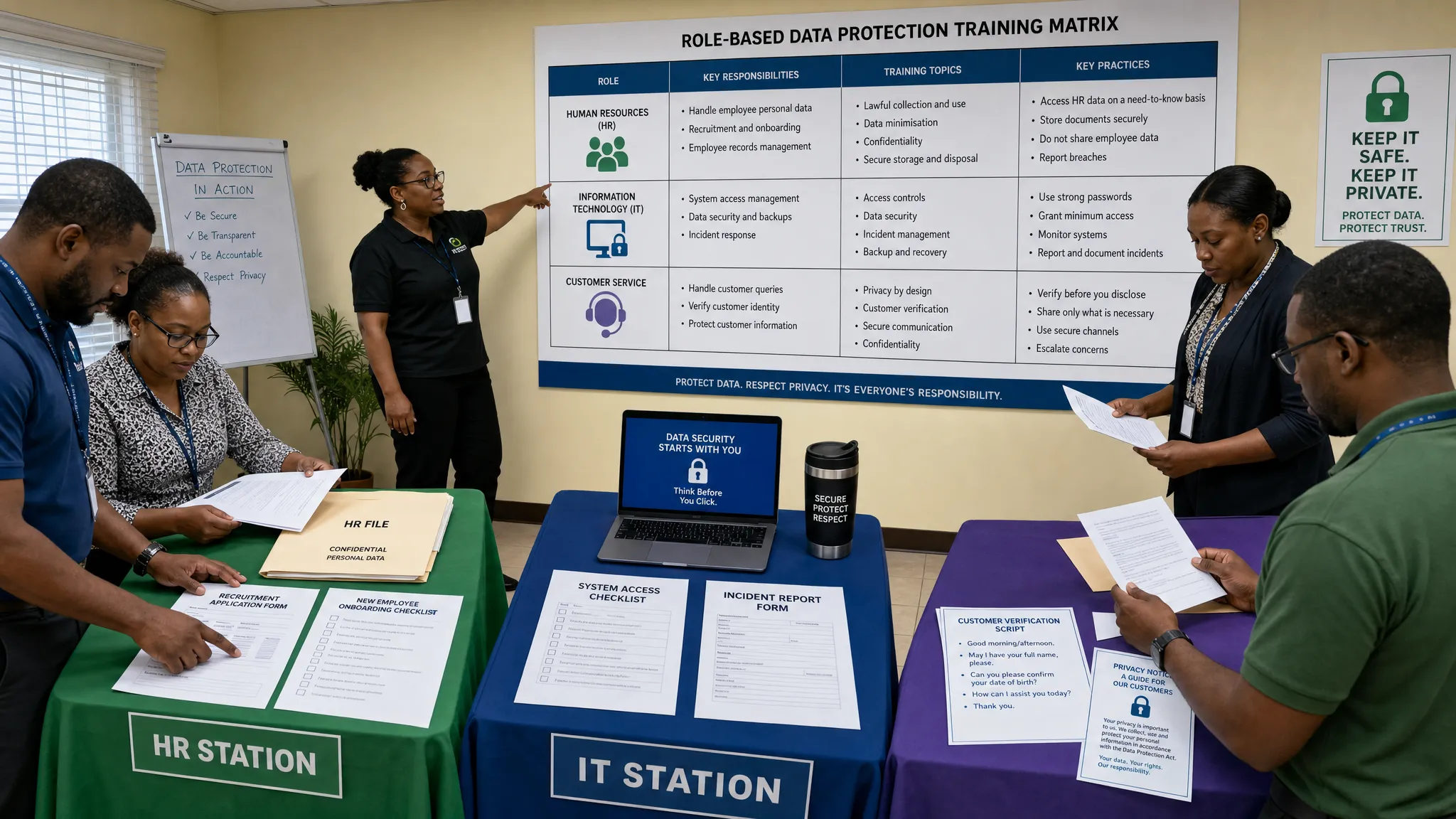
The table below shows how training priorities should differ by team. It is not a full curriculum, but it gives a practical structure for designing sessions that match real workplace risk.
Team | Key privacy risks | Training should focus on | Practical exercises |
HR | Over-collection, sensitive records, employee monitoring, retention, internal disclosure | Recruitment privacy, employee records, lawful use, restricted access, retention schedules | Review a job application form, classify HR records, respond to an employee access request |
IT | Weak access controls, insecure storage, unmanaged vendors, poor incident response, test data misuse | Privacy by design, access management, breach escalation, encryption, logging, vendor risk | Map a system data flow, review user permissions, triage a suspected breach |
Customer teams | Wrong disclosures, poor identity checks, unclear consent, insecure channels, complaint mishandling | Identity verification, call scripts, privacy notices, marketing preferences, escalation routes | Handle a customer data request, identify risky disclosures, rewrite a collection script |
A good training plan should make each team answer one practical question: “What do I need to do differently tomorrow?” If the training cannot answer that, it is too abstract.
Data Protection Training for HR Teams
HR teams sit at the centre of the employee data lifecycle. They collect personal information before someone joins the organisation, use it throughout employment, and retain selected records after the employment relationship ends.
Training for HR should begin with recruitment. Staff should know how to collect only what is necessary for the stage of the process. For example, some information may be relevant after a conditional offer but not at the first application stage. HR should also understand how privacy notices apply to applicants, how references and background checks should be handled, and why interview notes must be professional, relevant, and securely stored.
Once someone becomes an employee, HR training should cover access control and confidentiality. Not every manager needs to see every document in an employee file. Medical records, disciplinary matters, payroll information, and performance records should have clear access rules. HR staff should be trained to pause before forwarding employee information internally, even when the request comes from senior management.
Retention is another major HR topic. Keeping records “just in case” increases risk. HR teams should understand the organisation’s retention schedule, what must be retained for legal or operational reasons, and what should be securely disposed of when no longer needed.
HR also needs scenario-based training on employee requests. An employee may ask for a copy of records, challenge inaccurate information, question how monitoring is used, or complain about unnecessary disclosure. HR does not need to resolve every issue alone, but it must recognise when a request triggers a formal process and who should be involved.
Data Protection Training for IT Teams
IT teams are often asked to “secure the data,” but data protection is broader than cybersecurity. Security is essential, but privacy also requires understanding purpose, access, accountability, retention, data flows, and system design.
IT training should begin with data mapping. Teams need to know what personal data is stored in each system, who can access it, where it is hosted, how long it is retained, and which vendors or integrations touch it. Without that visibility, it is difficult to manage risk or respond confidently to a breach or data subject request.
Access management should be a core module. IT staff should be trained on least privilege, joiner-mover-leaver processes, privileged account monitoring, multi-factor authentication where appropriate, and periodic access reviews. A common privacy failure is not a sophisticated cyberattack. It is an employee keeping access after changing roles or leaving the organisation.
IT should also receive training on incident response. Staff must know the difference between a routine technical issue and a possible personal data breach. A lost laptop, misdirected email export, exposed cloud folder, ransomware incident, or unauthorised database access may all require quick escalation. The goal is not to create panic, but to prevent delay.
Vendor and cloud risk should be included as well. If personal data is processed by third-party systems, IT should understand the importance of due diligence, contractual safeguards, access restrictions, logging, deletion, and support for data subject rights. For organisations trying to connect privacy, cybersecurity, and governance, the PLMC article on aligning people, process, and technology for data protection security gives a broader framework.
Data Protection Training for Customer Teams
Customer-facing staff need training that is simple, realistic, and easy to apply during busy interactions. These teams may include call centre agents, branch staff, reception teams, sales teams, account managers, support staff, and complaints handlers.
The first priority is identity verification. Staff should know what they must confirm before discussing account details, updating records, sending documents, or disclosing information. Training should include examples of social engineering, family member requests, shared phones, business email compromise, and customers using informal channels such as messaging apps.
Customer teams also need to understand fair collection. If a form, call script, or online process asks for personal data, staff should be able to explain why the information is needed, how it will be used, and where the customer can find more privacy information. They do not need to recite legislation, but they should avoid vague explanations such as “the system requires it” when the organisation has a specific purpose.
Marketing preferences are another practical area. Staff should know the difference between service communications and promotional messages, how to record opt-outs, and why consent or preferences must not be ignored. A small failure in this area can quickly become a customer trust issue.
Finally, customer teams should know how to spot and route data subject requests. A customer may not use legal language. They might say, “What information do you have on me?” or “Delete my account,” or “Stop sending my details to that department.” Training should help staff recognise these statements and escalate them correctly.
The Workflows That Connect All Three Teams
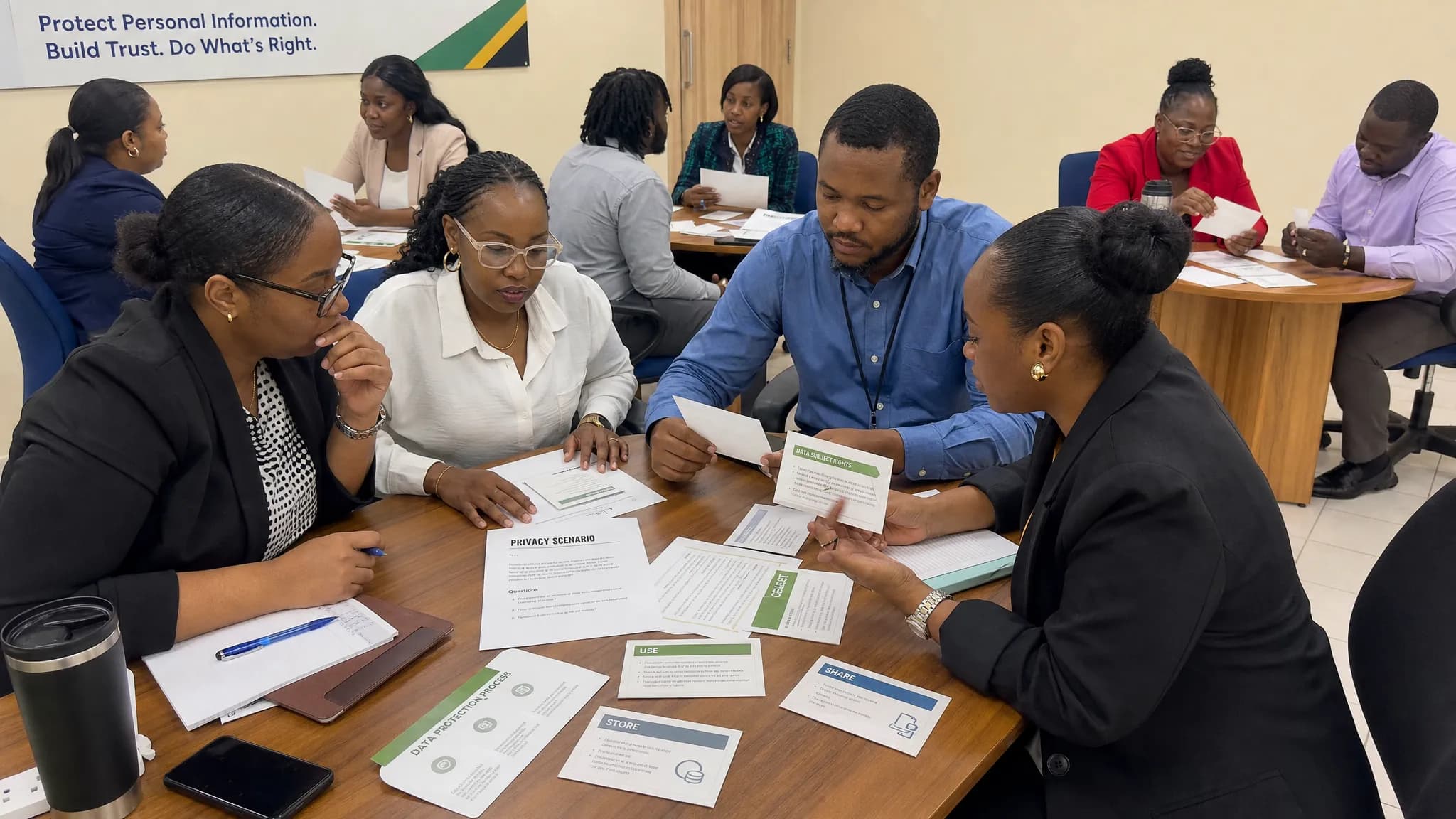
Training HR, IT, and customer teams separately is useful, but privacy risk often appears between departments. The strongest programmes train cross-functional workflows, not just isolated roles.
One important workflow is handling data subject requests. A customer request may arrive through customer service, but IT may need to search systems and HR may need to advise if the request relates to an employee or former employee. Training should clarify intake, identity verification, deadlines, search responsibilities, exemptions, approvals, and response quality.
Another workflow is incident reporting. A customer agent may notice an email sent to the wrong person. HR may discover a spreadsheet with salary data was shared too widely. IT may detect unusual access to a system. If each team uses a different definition of “incident,” the organisation will lose time. A shared incident pathway helps staff report quickly without fear or confusion.
Vendor onboarding is also cross-functional. HR may want a recruitment platform, customer service may want a messaging tool, and IT may be asked to approve access or integration. Training should teach teams not to adopt new tools casually when personal data is involved. Procurement, legal, IT security, and privacy review should be part of the process before data is uploaded.
Retention and disposal also require coordination. HR may own personnel records, customer teams may own case files, and IT may control backups and deletion processes. If business teams decide to delete data but IT backups keep it indefinitely without controls, the organisation may still carry unnecessary risk.
How to Structure the Training Programme
A practical data protection training programme for HR, IT, and customer teams should combine a common foundation with role-specific modules and refreshers. Annual training alone is rarely enough, especially for teams that handle personal data daily.
Training layer | Recommended audience | Purpose |
Foundation session | All staff | Build shared understanding of personal data, privacy principles, breach reporting, and internal escalation |
HR deep dive | HR, payroll, people managers | Apply privacy rules to recruitment, employee records, sensitive data, retention, and employee requests |
IT deep dive | IT, security, systems administrators | Apply privacy requirements to access, data flows, vendors, backups, testing, and incident response |
Customer team deep dive | Customer service, sales, support, front desk | Apply privacy rules to verification, collection scripts, disclosure, complaints, and customer rights |
Scenario refreshers | High-risk teams | Reinforce behaviour through short exercises based on real incidents or near misses |
Training should also be updated when the organisation changes. A new HR system, CRM, customer portal, AI tool, cloud platform, outsourcing arrangement, or marketing campaign may introduce new privacy risks. Training should follow the risk, not just the calendar.
For organisations trying to improve retention and engagement, practical awareness techniques can help. PLMC has also outlined data protection awareness training ideas that actually stick, which can support shorter refreshers between formal sessions.
What Good Training Scenarios Look Like
The best scenarios feel familiar. They should be based on the types of decisions staff actually face, not extreme examples that seem unlikely.
For HR, a useful scenario might ask whether a manager should receive a full medical certificate or only the work-related information needed to manage absence. Another may ask how long rejected candidate CVs should be kept and who should have access.
For IT, a scenario might involve an administrator asked to restore a former employee’s mailbox for a manager. The discussion should cover authority, purpose, approval, audit trail, and whether the request is proportionate. Another scenario may involve production customer data being copied into a testing environment.
For customer teams, a scenario might involve a caller claiming to be the spouse of a customer and asking for account details. Another could involve a customer requesting deletion while there is an active contract, complaint, or legal retention requirement.
These exercises should end with clear actions: what to say, what not to say, what system notes to make, and when to escalate.
Measuring Whether Training Is Working
Attendance records and quiz scores are useful, but they do not prove that behaviour has changed. Organisations should measure whether training improves privacy outcomes.
Better indicators include fewer misdirected emails, faster incident reporting, improved access review completion, cleaner retention practices, better routing of customer requests, and fewer unnecessary data fields on forms. Managers can also review whether staff are asking better questions before launching new processes.
A simple measurement plan might track:
Completion rates for each role-based module
Number and quality of privacy questions raised by staff
Time taken to escalate suspected incidents
Accuracy of data subject request routing
Completion of HR and IT access reviews
Reduction in unnecessary personal data collected on forms
The aim is not to punish staff. It is to see where the organisation needs clearer procedures, better tools, or additional coaching.
Common Mistakes to Avoid
The first mistake is treating data protection as a legal presentation rather than a workplace skill. Staff need enough legal context to understand why the issue matters, but they also need scripts, checklists, examples, and escalation routes.
The second mistake is training IT only on cybersecurity. Cybersecurity is critical, but privacy also depends on access governance, vendor controls, data minimisation, retention, and system design.
The third mistake is assuming customer teams only need “be careful” reminders. Front-line staff make fast decisions under pressure. They need specific rules for verification, disclosure, complaint handling, and marketing preferences.
The fourth mistake is excluding managers. Managers often request reports, exports, employee records, customer lists, or system access. If they do not understand data protection, they may pressure staff into risky shortcuts.
The fifth mistake is failing to document training. Organisations should retain records of who was trained, what was covered, when refreshers occurred, and how training aligns with internal policies and risk assessments.
Frequently Asked Questions
What is data protection training for HR, IT, and customer teams? It is role-based training that teaches each team how to handle personal data in the situations they face at work. HR focuses on employee and applicant records, IT focuses on systems and security controls, and customer teams focus on collection, verification, disclosure, and customer requests.
Is general privacy awareness training enough for compliance? General awareness is a helpful starting point, but it is usually not enough for high-risk teams. Organisations should add role-specific modules so staff can apply privacy principles to their actual duties.
How often should data protection training be delivered? Organisations should provide training during onboarding, refresh it regularly, and update it when systems, laws, vendors, processes, or risk levels change. High-risk teams may need shorter scenario refreshers between formal sessions.
Should IT staff receive privacy training if they already receive cybersecurity training? Yes. Cybersecurity training focuses on protecting systems from threats, while privacy training also covers lawful use, data minimisation, access governance, retention, vendor processing, and support for data subject rights.
What should customer service staff do if someone asks for their personal data? They should follow the organisation’s identity verification process, avoid unnecessary disclosure, record the request correctly, and escalate it through the approved data protection procedure if it may be a formal rights request.
Build Training Around the Way Your Teams Actually Work
Data protection training is most effective when it reflects real roles, real systems, and real decisions. HR, IT, and customer teams each need different guidance, but they also need a shared understanding of how privacy risk moves across the organisation.
Privacy & Legal Management Consultants Ltd. supports Jamaican organisations with data protection implementation, privacy and compliance training, governance, cybersecurity, and GRC alignment. If your organisation needs practical, role-based data protection training, contact PLMC to discuss a programme that fits your teams and compliance objectives.