

How to Plan Data Protection Training That Staff Will Apply
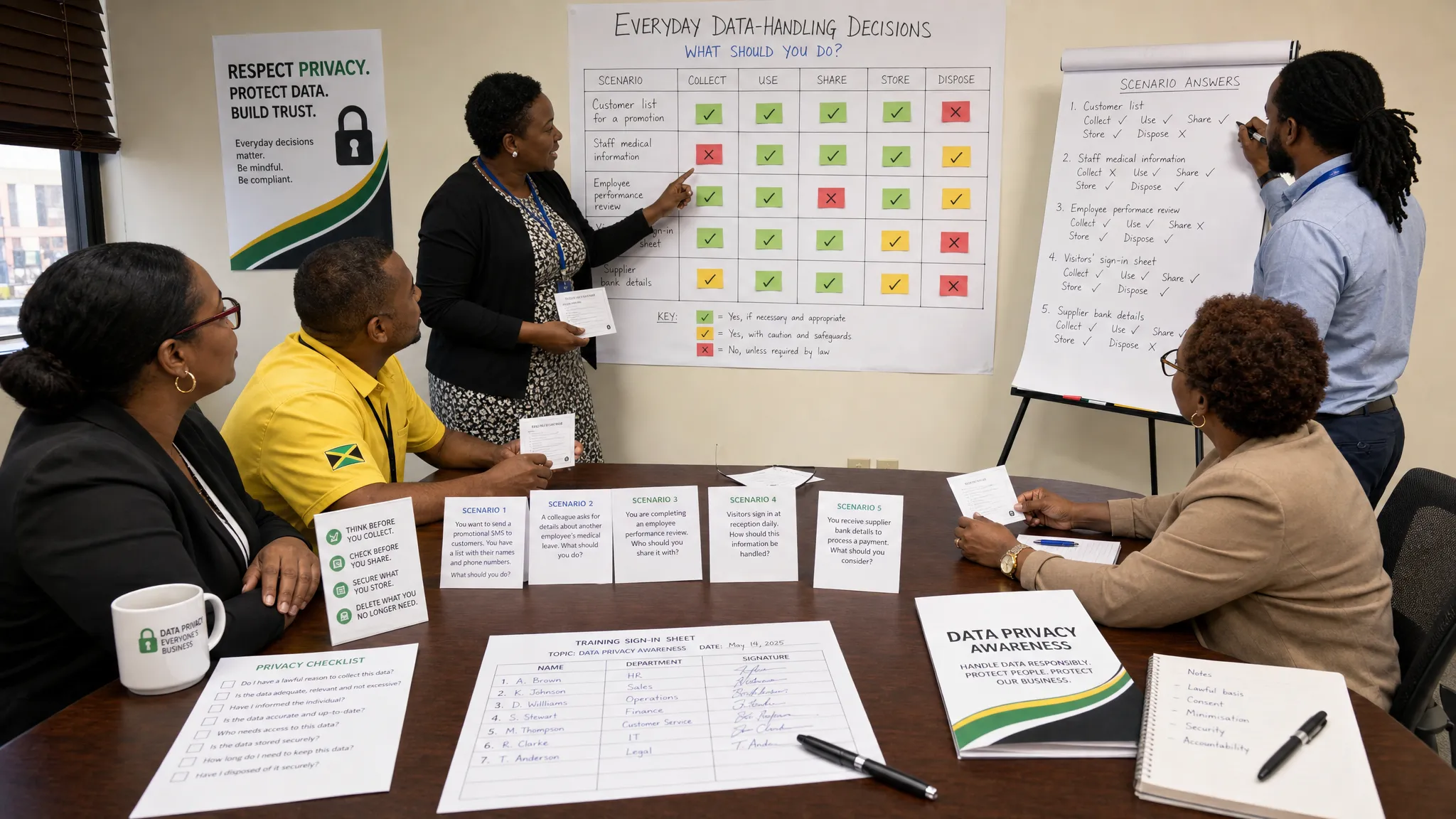
Completion certificates are useful, but they do not prove that employees can make the right decision when personal data is in front of them. A receptionist may still disclose information to the wrong caller. A manager may still keep employee files longer than needed. A sales team may still upload customer lists to an unapproved tool.
That is why effective data protection training should be planned around application, not attendance. The goal is not simply to explain Jamaica’s Data Protection Act, 2020. The goal is to help staff recognise personal data, handle it properly, escalate concerns, and document what they did.
For Jamaican organisations, this matters because data protection compliance is not handled by one department. It is lived every day by HR, finance, customer service, marketing, IT, procurement, records teams, executives, and frontline employees. A good training plan turns legal duties into repeatable workplace habits.
Start with the behaviour you need, not the slides you have
Many privacy training programmes begin with a slide deck about definitions, principles, penalties, and policies. Those topics have their place, but they should not be the starting point.
Start by asking: “What should staff do differently after training?”
For example, a good outcome is not “employees understand lawful processing.” A stronger outcome is “employees know when to ask whether a new collection of personal data has a clear purpose, notice, lawful basis, and approved storage location.”
Similarly, a good outcome is not “staff understand breaches.” A stronger outcome is “staff report a suspected lost file, wrong-recipient email, phishing incident, or unauthorised disclosure immediately through the correct internal channel.”
The Office of the Information Commissioner in Jamaica provides information on the local data protection framework, but each organisation must translate legal expectations into its own operational rules. Training is one of the main ways to make that translation practical.
Identify the privacy moments that create real risk
The most useful training plan begins with the personal data lifecycle. Look at where your organisation collects, uses, shares, stores, retains, and disposes of personal data. Then identify the moments where staff decisions can create risk.
This approach keeps training relevant. Staff are more likely to apply what they learn when the examples match the systems, forms, customers, patients, students, employees, or vendors they deal with every day.
Privacy moment | Common risk | Training behaviour staff should apply | Evidence to keep |
Collecting customer data | Asking for more information than needed | Check the purpose before collecting data | Updated forms, scripts, and collection notices |
Responding to requests | Disclosing data to the wrong person | Verify identity before releasing information | Request logs and verification steps |
Sharing spreadsheets | Sending personal data to the wrong recipient | Confirm recipient, need, and secure transfer method | Email guidance, secure sharing records |
Using vendors | Uploading data to unapproved platforms | Check approval before using third-party tools | Vendor review records and staff acknowledgements |
Keeping records | Retaining files indefinitely | Follow retention and disposal instructions | Retention schedule and disposal logs |
Suspected incident | Delay in escalation | Report concerns immediately, even if uncertain | Incident reports and response timelines |
If you have not yet mapped these privacy moments, start with your highest-risk processes. HR files, customer service records, KYC documents, health data, payment information, CCTV, marketing databases, and vendor platforms are common places to begin.

Segment training by what each role actually does
Everyone needs a baseline understanding of personal data, confidentiality, secure handling, and incident reporting. But not everyone needs the same depth of training.
A board member needs to understand oversight, risk, accountability, and reporting. A customer service officer needs practical rules for identity verification and disclosure. HR needs guidance on sensitive employee records, retention, references, medical information, and internal access. IT needs to understand how security controls support lawful and accountable processing.
A simple model works well:
All staff receive short core training on personal data, safe handling, phishing awareness, secure sharing, clean desk practices, retention basics, and incident reporting.
High-risk functions receive role-specific scenarios based on the data they handle, such as HR, finance, customer service, marketing, IT, procurement, legal, compliance, and records management.
Managers and executives receive focused training on accountability, escalation, resourcing, reporting, vendor oversight, and culture.
If you need a fuller role breakdown, PLMC’s guide on data protection training courses by role can help you decide what each team should learn.
Build training around realistic scenarios
Staff remember rules better when they practise decisions. Scenario-based training is especially useful for data protection because many mistakes happen in ordinary moments, not formal compliance meetings.
For example, instead of asking employees to memorise the principle of data minimisation, give them a scenario:
A department wants to add date of birth, TRN, home address, emergency contact, and proof of ID to a form for a basic newsletter sign-up. Which fields are necessary? Which fields create unnecessary risk? Who should approve the form before it goes live?
Instead of defining a data subject access request in abstract terms, ask:
A customer sends a WhatsApp message asking for “all the information you have about me.” The message is sent to a staff member who normally handles sales. What should the employee do next? Should they respond directly, ignore it, or escalate it to the designated person?
Strong scenarios should be short, recognisable, and linked to a clear action. They should also include borderline cases, because staff need to know when to pause and ask for help.
Useful scenario themes include:
Wrong-recipient emails and misdirected attachments
Customer identity verification before disclosure
Employee medical certificates and HR confidentiality
Marketing consent and unsubscribe handling
Use of WhatsApp, personal email, or unapproved cloud storage
Vendor access to customer or employee records
Paper files left on desks, printers, or reception counters
CCTV access requests and internal monitoring questions
Suspected phishing, ransomware, or lost devices
The NIST Privacy Framework also reinforces the value of managing privacy risk as part of organisational processes. Training should therefore connect to real workflows, not sit apart from them.
Turn policies into job aids staff can use
A data protection policy may be necessary, but it is rarely enough on its own. If the policy is long, legalistic, or difficult to find, staff may not use it when they are under time pressure.
Training should introduce practical job aids that help employees act correctly in the moment. These can include a one-page incident reporting guide, a before-you-send checklist, an approved storage guide, a retention quick reference, or a script for verifying identity before disclosure.
The best job aids answer simple questions:
Can I collect this information?
Can I share this record?
Where should I store this file?
How long should I keep it?
Who approves this vendor or tool?
What do I do if something goes wrong?
This is where training links directly to compliance evidence. If you train employees to use a rights request log, incident form, retention schedule, or vendor approval process, you are not only improving behaviour. You are also creating proof that your controls are being used.
For more on connecting practical controls to compliance documentation, see PLMC’s privacy and data protection checklist.
Choose formats that match the risk and audience
There is no single best format for data protection training. The right format depends on the audience, the risk level, and the behaviour you want to change.
A short e-learning module may work for annual baseline awareness. A live workshop may be better for HR, customer service, IT, or procurement teams that need to discuss complex scenarios. A board briefing should be concise, risk-based, and focused on oversight. Refresher campaigns can reinforce key habits throughout the year.
Training format | Best use | Limitation | How to improve application |
E-learning | Baseline awareness across all staff | Can become passive | Add scenario questions and local examples |
Live virtual session | Distributed teams and Q&A | May lose attention if too long | Keep sessions short and interactive |
In-person workshop | High-risk teams and process redesign | Requires scheduling | Use actual forms, systems, and workflows |
Microlearning | Reinforcing one behaviour at a time | Not enough for complex topics | Link each message to a specific action |
Tabletop exercise | Incident response and breach readiness | Needs facilitation | Test escalation, decisions, and evidence capture |
Executive briefing | Board and senior management oversight | Too little detail for operations | Focus on risk, accountability, and KPIs |
For many organisations, the strongest approach is blended. Use baseline training to establish common expectations, role-based workshops for high-risk teams, and short reminders to keep behaviours visible.
Make managers part of the training plan
Training does not transfer into daily work unless managers reinforce it. If a manager rewards speed over safe handling, staff will cut corners. If a manager ignores retention rules, the team will likely do the same. If a manager treats incident reporting as blame, employees may delay or hide mistakes.
Managers should know what their teams were taught and what behaviours they are expected to reinforce. After training, give managers a short discussion guide so they can ask practical questions in team meetings.
For example:
Which personal data do we handle most often?
Where are we most likely to send information to the wrong person?
What should we do if a customer asks for a copy of their data?
Which files or systems should only be accessed by certain roles?
What is the fastest way to report a suspected incident?
This also helps create a privacy culture. Employees are more likely to apply data protection training when they see that supervisors, executives, and peers treat it as part of normal work.
The UK Information Commissioner’s Office also highlights training and awareness as part of accountability. While UK guidance is not Jamaican law, the principle is useful: organisations should be able to show that staff receive appropriate training and that awareness is maintained.
Test whether staff can apply the training
A quiz at the end of a course is helpful, but it is not enough. If the goal is application, you need to test real decision-making.
Instead of only asking “What is personal data?”, ask staff what they would do in situations such as a lost laptop, a customer access request, a suspicious email, a request from a vendor, or a manager asking for more data than necessary.
You can measure application in several ways:
Measurement area | What to check | What it tells you |
Attendance | Who completed required training | Whether coverage is adequate |
Knowledge | Quiz scores and scenario responses | Whether staff understand core rules |
Behaviour | Incident reporting speed, secure sharing use, access request routing | Whether training is being applied |
Process quality | Fewer incomplete forms, fewer wrong-recipient emails, better vendor checks | Whether workflows are improving |
Management oversight | Team discussions, risk reviews, corrective actions | Whether leaders are reinforcing expectations |
Evidence | Training logs, materials, assessments, follow-up actions | Whether compliance can be demonstrated |
Be careful not to treat a rise in reported incidents as automatic failure. After better training, reports may increase because employees recognise issues earlier and feel safer escalating them. That can be a sign of improving awareness.
Plan reinforcement before the first session starts
One-time training fades quickly. Reinforcement should be built into the plan from the beginning.
A practical reinforcement calendar might include a monthly privacy tip, quarterly scenario challenge, annual refresher, manager discussion prompt, and periodic tabletop exercise. Keep each reinforcement focused on one behaviour. For example, February could focus on secure sharing, March on retention, April on incident reporting, and May on rights requests.
The key is consistency. Short, repeated prompts often work better than a long annual session that staff forget within weeks.
Reinforcement should also respond to actual risk. If your organisation experiences repeated near misses involving email attachments, reinforce recipient checks and secure sharing. If staff are unsure how to handle data subject requests, reinforce escalation routes and scripts. If vendors are being onboarded without privacy review, train procurement and department heads on the approval process.
Keep an audit-ready training evidence pack
Training evidence should show more than completion. It should show that the programme was planned, risk-based, delivered, understood, and improved.
Your evidence pack may include:
Training needs analysis and risk rationale
Role-based training matrix
Session materials and scenario exercises
Attendance logs and completion reports
Quiz or assessment results
Manager follow-up records
Staff acknowledgements of key policies
Corrective actions from incidents or assessments
Annual review notes and updates to content
This evidence can support internal assurance, board reporting, vendor due diligence, client questionnaires, and regulatory readiness. It also helps you improve the programme over time instead of repeating the same generic content every year.
If your organisation is also reviewing wider compliance gaps, PLMC’s article on data protection risk assessments explains how to connect risk, controls, and evidence.
A practical 30-day plan for better training
You do not need to redesign everything at once. A focused 30-day planning sprint can make your next training cycle far more practical.
Timeline | Action | Output |
Days 1 to 5 | Identify high-risk data handling activities | Short list of priority training scenarios |
Days 6 to 10 | Segment staff by role and exposure to personal data | Training matrix by audience |
Days 11 to 15 | Convert policies into practical behaviours | Job aids, checklists, and escalation routes |
Days 16 to 20 | Build scenario-based content | Exercises based on real workplace decisions |
Days 21 to 25 | Brief managers and schedule delivery | Manager reinforcement plan |
Days 26 to 30 | Define metrics and evidence requirements | Training evidence pack and improvement plan |
This sprint works best when privacy, compliance, HR, IT, records management, and business unit leaders contribute. The privacy or compliance lead may coordinate the programme, but the business must own the behaviours.
Common mistakes to avoid
A training plan can look complete on paper and still fail in practice. The most common mistake is making the programme too legalistic. Staff need to understand the law, but they also need clear instructions for the systems and situations they use every day.
Another mistake is treating all employees the same. A general course is useful for baseline awareness, but higher-risk roles need deeper examples. HR, IT, finance, customer-facing teams, and procurement often need additional training because they make decisions that directly affect privacy risk.
Organisations also weaken training by failing to update it. If new systems, vendors, AI tools, marketing channels, or data-sharing arrangements are introduced, the training should change. A privacy programme that does not reflect current operations will quickly lose credibility.
Finally, do not separate training from accountability. Employees should know where to find the policy, who to contact, how to report concerns, and what evidence they must create. Managers should know how to reinforce the rules. Leadership should receive metrics that show whether the programme is working.
Frequently Asked Questions
How often should data protection training be delivered? Most organisations should provide baseline training at onboarding and at least annually, with shorter refreshers during the year. Higher-risk teams may need more frequent scenario-based sessions, especially after incidents, system changes, new vendors, or policy updates.
What should be included in data protection training for all staff? All staff should learn what personal data is, how to collect only what is needed, how to share information securely, how to protect passwords and devices, how to recognise suspicious requests, how to follow retention rules, and how to report suspected incidents quickly.
Should executives and board members attend data protection training? Yes. Their training should focus on accountability, governance, risk appetite, reporting, resourcing, breach readiness, vendor oversight, and evidence of compliance. They do not need the same operational detail as frontline teams, but they do need to understand their oversight role.
How do we know whether staff are applying the training? Look beyond completion rates. Review scenario assessment results, incident reporting patterns, secure sharing practices, rights request routing, vendor approval compliance, retention activity, and manager follow-up. These indicators show whether training is changing behaviour.
Can generic online training satisfy compliance needs? Generic training can support baseline awareness, but it is rarely enough on its own. Staff are more likely to apply training when it includes local legal context, role-specific examples, your internal procedures, and realistic scenarios based on the data they handle.
Make data protection training practical, measurable, and usable
Effective data protection training is not a once-a-year presentation. It is a planned programme that helps people make better decisions with personal data every day.
Privacy & Legal Management Consultants Ltd. supports organisations in Jamaica with data protection implementation, training sessions, compliance support, risk assessment tools, and privacy awareness initiatives. If your current training is too generic, difficult to evidence, or not changing staff behaviour, PLMC can help you design a programme that fits your risks, roles, and obligations.
To discuss practical data protection training for your organisation, visit Privacy & Legal Management Consultants Ltd. and request support for your next training cycle.