
When Jamaican Businesses Need to Know US Data Protection Rules
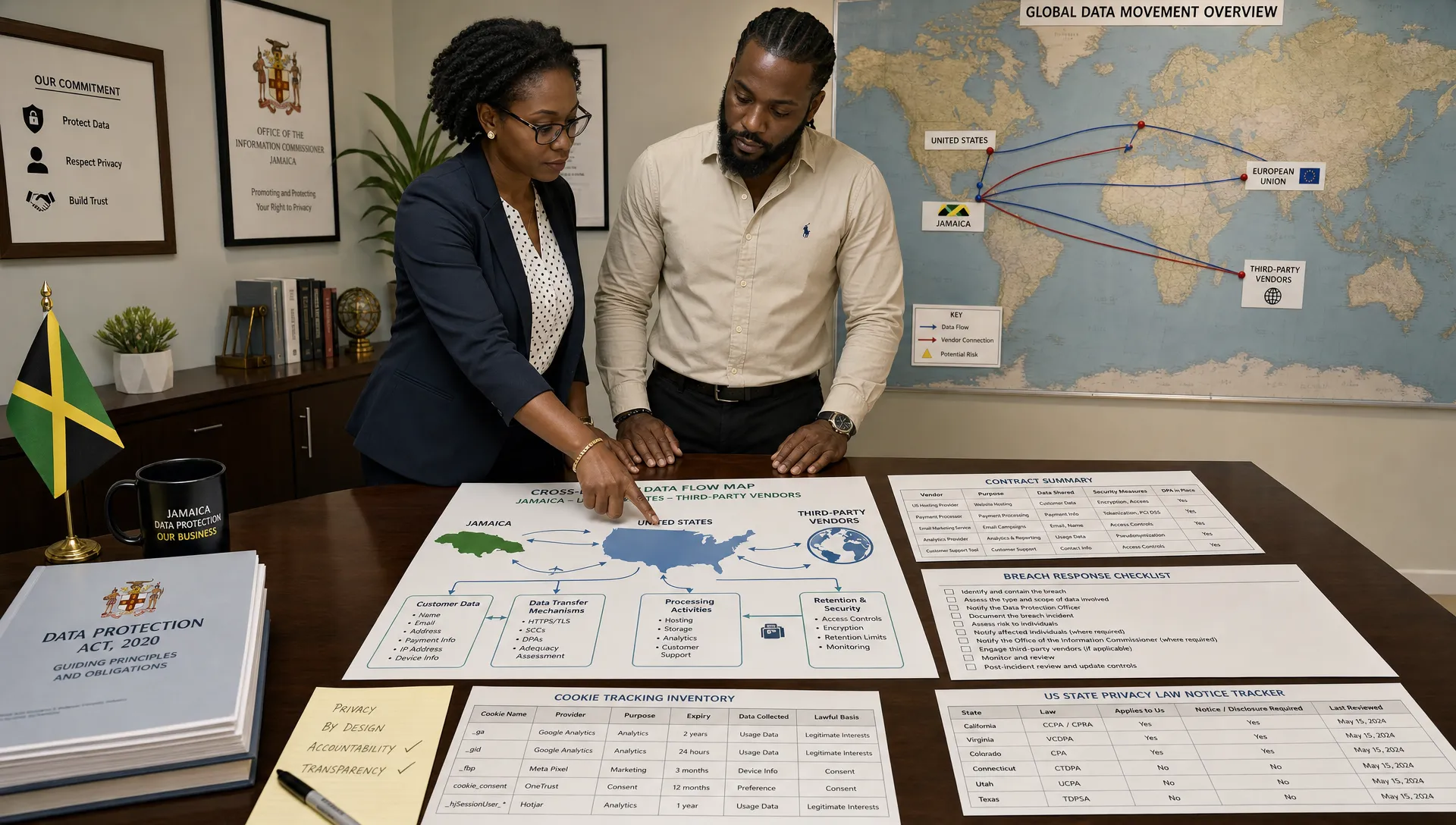
Jamaican businesses are increasingly serving customers, partners and clients far beyond Jamaica’s borders. A Kingston e-commerce store may ship to Florida. A Montego Bay hotel may collect booking details from guests in New York. A Jamaican BPO, fintech, marketing agency or software provider may process personal information on behalf of a US client without ever opening a US office.
That is why the right question is not only “What does Jamaica’s Data Protection Act require?” It is also “When do we need to understand data protection in the US?”
The short answer: Jamaican businesses should pay attention to US data protection rules when they intentionally deal with US residents, process personal information for US organisations, handle regulated categories of US data, use contracts that impose US privacy obligations, or experience a security incident involving US individuals.
This does not mean every Jamaican firm with a website automatically falls under every US privacy law. US data protection is a patchwork, and obligations depend on the facts. But knowing the trigger points early helps your organisation avoid contract disputes, regulatory exposure, reputational harm and costly remediation.
First, understand that US data protection is not one law
Unlike Jamaica’s Data Protection Act, 2020, the United States does not have a single comprehensive federal privacy law that applies to all personal data across all sectors. Instead, US privacy and data protection obligations come from several sources.
These include state consumer privacy laws, sector-specific federal laws, Federal Trade Commission enforcement, data breach notification laws, cybersecurity rules and commercial contracts. For example, the Federal Trade Commission can take action against unfair or deceptive privacy and security practices, while California has a detailed consumer privacy framework administered in part by the California Privacy Protection Agency.
For a Jamaican business, this creates a practical challenge. You do not need to memorise every US rule. You need to know when your activities create enough US exposure to justify a closer review.
For a deeper overview of the main laws and regulators, PLMC has also published a guide to key US privacy rules Jamaican firms should know. This article takes a different angle: when those rules should enter your risk assessment.
Key situations where US rules may become relevant
The following table summarises common trigger points for Jamaican organisations.
Business situation | Why US rules may matter | What to check first |
You sell goods or services to US residents | State privacy, consumer protection and marketing rules may apply depending on targeting and scale | Which states your customers are in, what data you collect and whether thresholds apply |
You process data for a US client | Contracts may impose US privacy, cybersecurity, audit and breach duties | Your role as processor, service provider, vendor or subcontractor |
You handle health, financial, children’s or education data | Sector-specific federal rules may apply in certain relationships | Whether your client is a regulated entity and whether you are acting on its behalf |
You use US-based technology vendors | Vendor contracts, cross-border transfers and incident response obligations may be affected | Where data is hosted, who can access it and what the contract says |
You suffer a breach involving US residents | State breach notification laws may require notices to individuals or regulators | The state of residence, data type, encryption status and contractual notice deadlines |
You advertise, track or profile US users online | State privacy laws may regulate targeted advertising, sale or sharing of personal information | Cookies, pixels, analytics tools, opt-out rights and privacy notices |
1. You intentionally target US customers
A Jamaican business should consider US data protection rules when it deliberately markets to, sells to or builds services for US residents.
Examples include an online retailer pricing in US dollars and shipping to US addresses, a tourism business collecting guest profiles from US travellers, a SaaS company onboarding US users, or a professional services firm running ads targeted at US prospects.
The key word is “intentionally.” A random visit from a US IP address is usually less significant than a business model built around US customers. Regulators and courts often look at practical indicators such as targeted advertising, US-specific terms, shipping arrangements, customer support, sales volume and the nature of the data collected.
US state privacy laws often include thresholds, such as revenue levels, the number of residents whose data is processed, or whether the business sells or shares personal information. Those thresholds vary by state and can change. For many Jamaican SMEs, the first step is not assuming compliance is impossible. It is confirming whether the business is actually within scope.
If your website uses cookies, pixels, analytics or advertising technologies for US users, take extra care. Several US state laws focus heavily on transparency, consumer rights and opt-outs for targeted advertising or certain forms of data sharing.
2. You process personal information for a US client
Many Jamaican businesses encounter US data protection rules through contracts rather than direct regulation. This is especially common for BPO providers, call centres, software developers, payroll support firms, marketing agencies, consultants, accounting support providers, cloud service resellers and cybersecurity vendors.
A US client may require your Jamaican company to sign a data processing agreement, business associate agreement, information security addendum or vendor risk questionnaire. These documents may require you to follow specific US privacy laws, maintain security controls, restrict subcontractors, support consumer rights requests, delete or return data, undergo audits, and notify the client quickly after a suspected incident.
This matters because contract obligations can be stricter than the law itself. For example, a US client may require notification within 24 or 48 hours of discovering a potential security incident, even where a regulator’s legal deadline is different.
Before signing, Jamaican businesses should understand what they are accepting. A privacy clause that looks routine can create operational duties for IT, HR, customer service, records management and senior leadership.
3. You handle regulated categories of US data
Some categories of personal information create higher risk under US law. These areas are particularly important because they may involve sector-specific laws, not just general state privacy laws.
Health information is a common example. The US Health Insurance Portability and Accountability Act, known as HIPAA, applies to covered entities and their business associates in specific health care relationships. A Jamaican company is not automatically covered simply because it sees health-related information, but it may have duties if it provides services to a US health plan, health care provider or clearinghouse in a covered capacity. The US Department of Health and Human Services provides official guidance on the HIPAA Privacy Rule.
Children’s data is another high-risk area. The Children’s Online Privacy Protection Act, known as COPPA, applies to certain online services directed to children under 13 or that knowingly collect personal information from children under 13. The FTC maintains information on the COPPA Rule.
Financial information may also bring additional obligations, especially where a Jamaican firm supports US financial institutions, lenders, insurers, investment firms, payment services or related vendors. The same is true for government identifiers, biometric data, precise geolocation, account credentials and other sensitive information.
The practical point is simple: the more sensitive the data, the earlier you should seek a proper privacy and legal review.
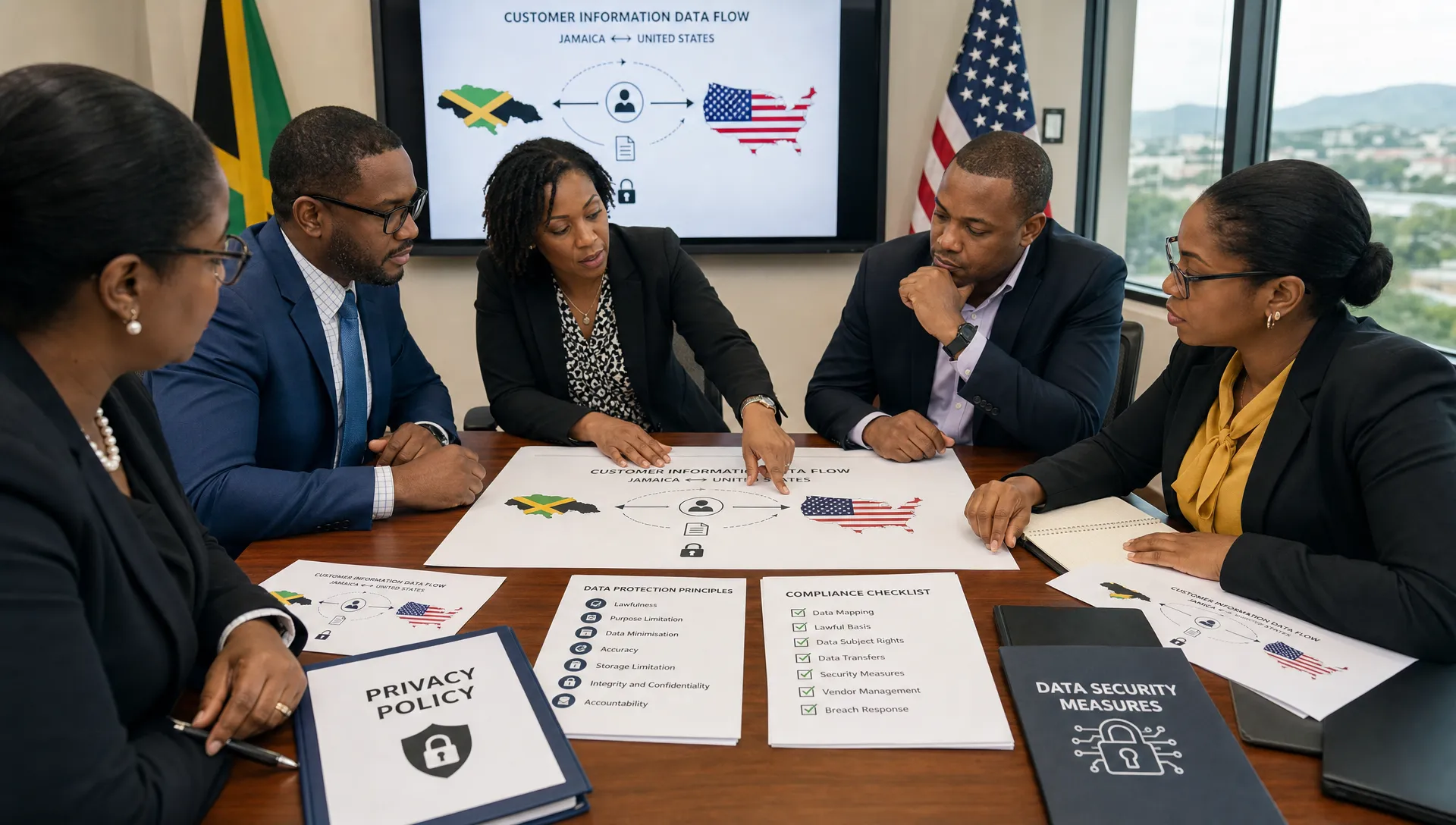
4. You use US vendors, platforms or cloud services
Using a US-based cloud provider, CRM, payment processor, email platform or analytics tool does not automatically make your Jamaican business subject to every US privacy law. However, it can affect your compliance position in several ways.
First, vendor contracts may include privacy and cybersecurity duties. Second, personal data may be stored, accessed or supported from outside Jamaica. Third, your incident response may depend on how quickly the vendor provides logs, notices and technical support. Fourth, your customers may expect clear explanations of how their information is shared with third parties.
This is also where Jamaican law remains essential. Under Jamaica’s Data Protection Act, organisations need to understand their own controller and processor relationships, security obligations, data sharing practices and safeguards. If your organisation is still building that foundation, PLMC’s practical 2026 guide to data protection for businesses in Jamaica is a useful companion resource.
A strong Jamaican data protection programme makes US exposure easier to manage. Data mapping, vendor due diligence, access controls, retention rules, privacy notices and incident response planning are useful on both sides of the border.
5. You have a breach involving US residents
A security incident can quickly turn a local operational problem into a cross-border compliance issue. If compromised data includes US residents, your organisation may need to assess US state breach notification laws.
Every US state has a data breach notification law, but the details vary. Definitions of personal information, notification deadlines, regulator reporting duties and exceptions can differ from state to state. The National Conference of State Legislatures maintains an overview of US security breach notification laws.
For Jamaican businesses, the first 24 to 72 hours after discovery are critical. You need to determine what happened, what systems were affected, whether personal information was accessed or acquired, whether the data was encrypted, where affected individuals reside, and what your contracts require.
Do not wait until a breach occurs to answer these questions. Incident response plans should include a cross-border decision tree, especially if your organisation has US customers, US clients or US vendors.
6. You are preparing for US expansion, investment or acquisition
US data protection rules also matter during growth. If your Jamaican business is seeking US investors, entering a US partnership, acquiring a US customer base, selling software into the US, or preparing for a merger, privacy due diligence will likely be part of the process.
Investors and enterprise customers often ask for evidence of privacy governance. They may want to see data inventories, policies, training records, vendor reviews, breach logs, security controls, retention schedules and proof that privacy notices match actual practices.
This is not only a legal issue. It is a business readiness issue. A company that can explain its data flows and risk controls is easier to trust, easier to contract with and often better prepared for enterprise opportunities.
A practical decision framework for Jamaican businesses
If you are unsure whether US privacy rules matter to your organisation, start with a focused internal review. The goal is to identify exposure, not to overcomplicate the process.
Ask these questions:
Do we intentionally market to or serve individuals in the US?
Do we collect personal information from US residents through our website, app, forms, bookings or customer service channels?
Do we know which US states our customers, users or data subjects are located in?
Do we process personal information on behalf of any US client or partner?
Do our contracts mention US privacy laws, security standards, breach notification or audit rights?
Do we handle health, financial, children’s, biometric, precise location or account credential data?
Do we use cookies, pixels or targeted advertising for US audiences?
Do we have an incident response plan that covers US residents and US client contracts?
Once you answer these questions, you can prioritise action based on risk. A small business with occasional US customers may need updated notices and better vendor records. A BPO handling sensitive data for a US health care client may need a much more formal compliance framework.
What to do if US exposure is confirmed
If your review shows meaningful US exposure, do not jump straight into copying a US privacy policy template. Start with the operational basics.
Priority | Practical action | Why it matters |
Data mapping | Identify what US personal information you collect, where it comes from and where it goes | You cannot manage obligations without knowing the data flow |
Role analysis | Confirm whether you are acting as a business, controller, processor, service provider or vendor | Your duties depend heavily on your role |
Contract review | Check client, vendor and platform agreements for privacy and security clauses | Many US obligations enter through contracts |
Notice review | Ensure privacy notices accurately explain collection, use, sharing, retention and rights | US rules often focus on transparency and consumer choice |
Security review | Assess access controls, encryption, logging, backups and incident response | Security failures create legal, financial and reputational risk |
Breach planning | Prepare state, client and internal escalation procedures | Deadlines can be short and fact-specific |
Training | Educate staff who handle US data or client systems | Human error remains a major privacy risk |
This approach also supports compliance with Jamaica’s own data protection framework. For a refresher on local obligations, see PLMC’s guide to data protection legal duties every Jamaican firm should know.
Common mistake: treating US rules as “foreign” and irrelevant
One of the biggest mistakes Jamaican organisations make is assuming US privacy law is irrelevant unless they have a US office. In practice, data moves through websites, apps, outsourcing relationships, payment systems, cloud platforms and customer support workflows.
A Jamaican company may have no US premises but still process US customer data every day. It may be bound by US-related privacy clauses in a client contract. It may have to respond to a US enterprise customer’s vendor risk review. It may face breach notification questions if US residents are affected by an incident.
The better approach is proportionate compliance. Not every Jamaican business needs a large US privacy programme. But any business with meaningful US exposure should know the rules that are most likely to affect its operations.
Frequently Asked Questions
Does a Jamaican company need to comply with US privacy law just because someone in the US visits its website? Usually, a single incidental website visit is not enough by itself. Risk increases when the business intentionally targets US residents, collects their personal information, sells to them, tracks them for advertising, or processes their data at scale.
Do US state privacy laws apply to companies outside the United States? They can, depending on the state law and the company’s activities. Many state privacy laws focus on businesses that do business with residents of that state and meet specific thresholds. A factual review is needed.
What is the biggest US data protection risk for Jamaican BPOs? Contractual risk is often the first issue. US clients may impose strict privacy, cybersecurity, audit, subcontracting and breach notification duties, even where the Jamaican provider is not directly regulated in the same way as the US client.
Is data protection in the US stricter than data protection in Jamaica? It is different rather than simply stricter. Jamaica has a broad national Data Protection Act, while the US uses a mix of state, federal sector-specific, enforcement and contractual rules. A Jamaican business may need to comply with both.
Should a Jamaican business mention US privacy rights in its privacy notice? If the business intentionally serves US residents or falls within a US state privacy law, its privacy notice may need US-specific disclosures. Avoid adding rights that do not apply, but do not omit rights that are legally required.
Does using a US cloud provider create US privacy obligations? Not automatically. However, it affects vendor management, cross-border data flows, contract terms, security expectations and incident response. It should be included in your data mapping and risk assessment.
Need help assessing your US data protection exposure?
If your Jamaican organisation serves US customers, supports US clients, uses US vendors or handles sensitive data, it is worth reviewing your exposure before a contract, complaint or breach forces the issue.
Privacy & Legal Management Consultants Ltd. supports organisations in Jamaica with data protection implementation, governance, risk and compliance integration, cybersecurity services, training and privacy awareness. If you are unsure whether US data protection rules affect your business, a structured review can help you identify practical next steps and reduce avoidable risk.