

What a Good Breach Tabletop Exercise Looks Like

A breach tabletop exercise should feel like a realistic rehearsal, not a compliance presentation. The point is to discover whether your organisation can recognise a personal data breach, bring the right people together, make defensible decisions, communicate clearly, and recover without confusion.
For Jamaican organisations working toward stronger data protection compliance under the Data Protection Act, 2020, a well-designed tabletop exercise is one of the most practical ways to test whether policies actually work. It turns breach response from a document on a shared drive into a coordinated organisational capability.
What is a breach tabletop exercise?
A breach tabletop exercise is a facilitated discussion where key staff respond to a simulated data breach scenario. No systems are taken offline, and no live incident response tools are usually deployed. Instead, participants walk through what they would do, what information they would need, who would make decisions, and how the organisation would document its response.
A good exercise tests decision-making under pressure. It should reveal gaps in roles, escalation paths, vendor management, communications, legal assessment, board reporting, and evidence preservation. It should also help teams understand how data protection, cyber security, corporate governance, and business continuity connect during a real incident.
This is especially important because a personal data breach is not only an IT issue. A ransomware event, misdirected email, stolen laptop, compromised payroll file, or unauthorised vendor access can quickly become a privacy, legal, operational, reputational, and governance problem.
What “good” looks like before the exercise begins
The quality of a tabletop exercise is usually determined before anyone enters the room. If the scenario is too vague, the participants are too junior, or the objective is unclear, the session becomes a conversation rather than a test.
A strong breach tabletop starts with a specific purpose. For example, the organisation may want to test whether staff know when to escalate a suspected breach, whether the incident response team can assess notification obligations, or whether senior leaders can approve external communications quickly.
It should also be tailored to the organisation’s actual risk environment. A financial institution, healthcare provider, school, law firm, retailer, charity, and government contractor will not face the same breach scenarios. The best exercises use business processes, systems, data types, and third-party relationships that participants recognise.
Before the session, the facilitator should confirm:
The exercise objectives and success criteria
The departments and decision-makers who must attend
The scenario, including the type of personal data involved
The assumed facts, unknowns, and timeline
The rules of engagement, including a no-blame approach
The documents to be tested, such as the incident response plan, breach register, communications templates, and escalation matrix
If the organisation has not yet trained staff on realistic privacy scenarios, the tabletop may expose avoidable confusion. Scenario-led learning can help employees recognise risk earlier, and PLMC has written separately on how to build data protection awareness training around real workplace scenarios.
The right people are in the room
A common weakness in breach exercises is treating them as an IT-only activity. Cyber security is essential, but a personal data breach requires coordinated governance.
A good exercise includes the people who would actually be involved in a real breach. Depending on the organisation, this may include representatives from IT, legal, compliance, data protection, risk, human resources, operations, customer service, communications, procurement, executive leadership, and the board or board committee.
The Data Protection Officer or privacy lead should play a central role where one exists. They should help assess whether personal data is involved, whether individuals could be harmed, what records must be created, and whether notification to the relevant authority or affected individuals may be required.
Senior leadership should not attend only for the opening remarks. In a real incident, leaders may need to approve containment actions, public statements, customer notifications, regulator engagement, external forensic support, or temporary operational changes. If they are absent from the exercise, the organisation does not truly know whether its response model works.
The scenario is realistic, not dramatic for its own sake
A breach tabletop does not need a cinematic ransomware plot to be useful. In many organisations, the most likely breach is far more ordinary: an email sent to the wrong recipient, a spreadsheet shared with excessive access, a former employee account left active, or a supplier exposing customer data.
The scenario should be credible enough that participants take it seriously. It should include ambiguity because real incidents rarely arrive with perfect facts. Participants may need to decide what to do before they know exactly how many records were affected, whether data was exfiltrated, or whether the incident is still ongoing.
Good scenarios often include:
A clear triggering event, such as a suspicious login, vendor alert, customer complaint, or lost device
Personal data categories, such as names, contact details, financial data, health information, employee records, or identification numbers
A timeline that unfolds through staged updates
Operational pressure, such as media interest, customer calls, service interruption, or board concern
Legal and regulatory uncertainty that must be assessed and documented
The scenario should not be designed to embarrass participants. It should be designed to create useful friction, the type that reveals whether procedures are clear enough to use during stress.
The exercise tests decisions, not memory
A poor tabletop asks participants to recite the breach policy. A good tabletop asks them to use it.
The facilitator should ask practical questions: Who receives the first report? How is the incident classified? Who opens the incident record? Who confirms whether personal data is involved? Who contacts the vendor? Who preserves logs? Who approves customer communications? What is documented at each stage?
The goal is not for every participant to know every answer immediately. The goal is to test whether the organisation can find the answer, assign ownership, and move forward in a controlled way.
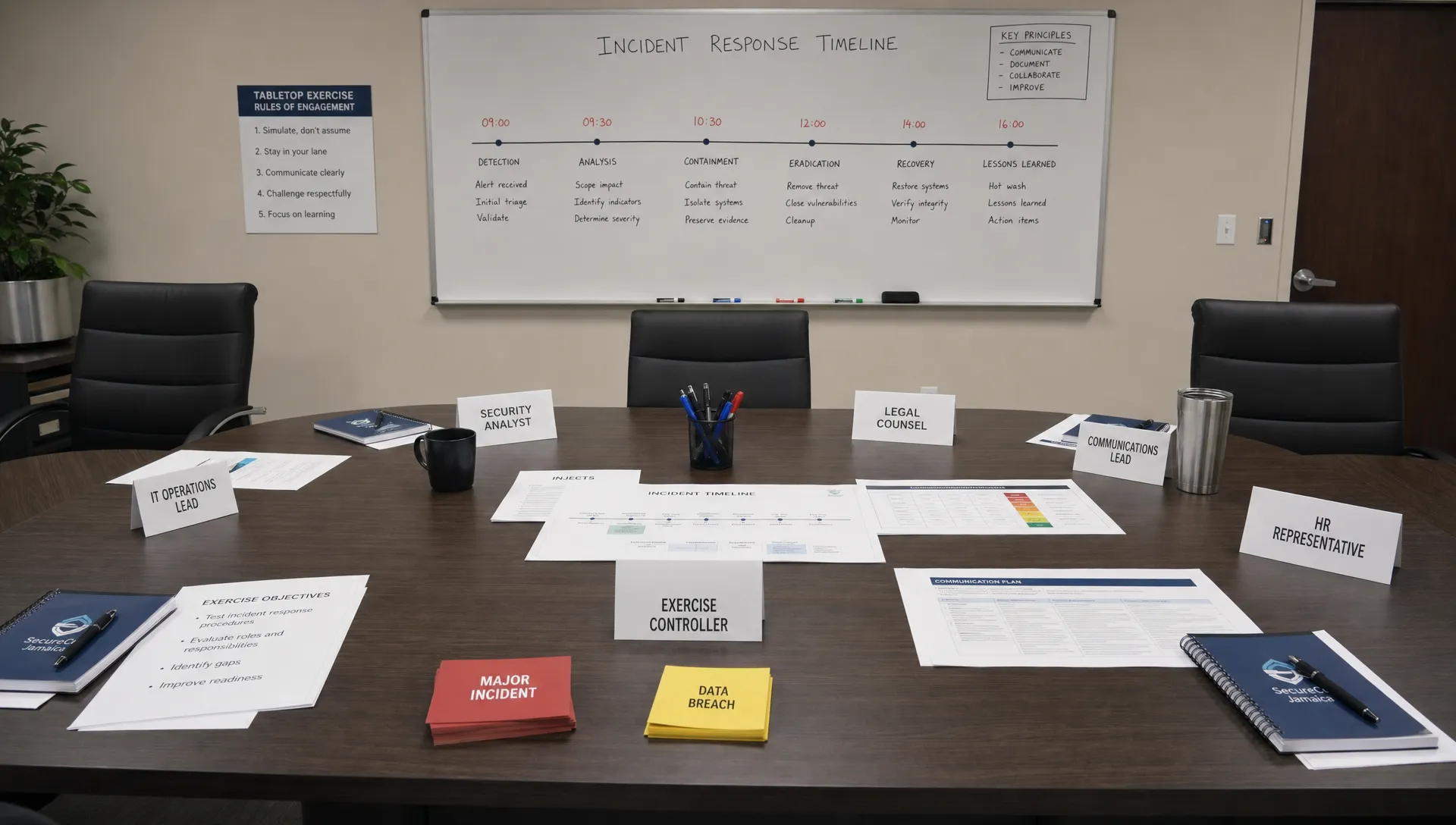
A useful approach is to divide the exercise into “injects.” An inject is a new piece of information introduced during the session. For example, the first inject may be a suspected phishing email. The second may reveal that payroll data was accessed. The third may be a journalist asking for comment. The fourth may be a vendor saying logs will take 48 hours to retrieve.
This structure helps test how decisions change as facts develop. It also gives the facilitator a way to observe whether teams escalate appropriately or remain stuck in departmental silos.
The legal and regulatory assessment is built into the discussion
A breach tabletop should include a structured discussion of legal and regulatory obligations. For Jamaican organisations, this means considering the Data Protection Act, 2020 and the organisation’s responsibilities as a data controller or processor.
The exercise should not turn into a legal lecture. However, participants should be able to identify the questions that matter, including whether personal data was involved, whether the data was protected by encryption or other safeguards, whether individuals may suffer harm, and whether the incident needs to be escalated for notification analysis.
The Office of the Information Commissioner Jamaica is the key regulator for data protection in Jamaica. A tabletop exercise should help the organisation practise how it would gather the facts needed to make timely, defensible decisions about engagement with the regulator and affected individuals.
The legal assessment should also cover contracts. If a third-party processor, cloud provider, payroll vendor, marketing agency, or managed service provider is involved, the organisation needs to know what the contract says about breach notification, cooperation, log access, forensic support, and timelines.
A sample breach tabletop exercise structure
A tabletop can be as short as 90 minutes or as detailed as a half-day session. The right format depends on maturity, risk, and the complexity of the organisation. The table below shows a practical structure that can be adapted for Jamaican organisations.
Exercise stage | What happens | What good looks like |
Opening and objectives | Facilitator explains scope, assumptions, and ground rules | Participants understand this is a learning exercise, not a blame exercise |
Scenario briefing | The initial breach facts are introduced | The scenario is realistic, relevant, and linked to actual business processes |
First response discussion | Teams identify immediate actions and escalation steps | Roles are clear, the incident is logged, and containment begins promptly |
Developing facts | New injects introduce uncertainty, pressure, or wider impact | Participants update decisions as facts change and document assumptions |
Notification assessment | Privacy, legal, and leadership teams consider obligations | The organisation can explain what information is needed and who decides |
Communications review | Internal, customer, regulator, media, and board messages are discussed | Communications are accurate, coordinated, and not premature |
Lessons learned | Facilitator captures gaps, strengths, and action items | Clear owners and deadlines are assigned for improvements |
For organisations building a broader privacy programme, a tabletop can also sit alongside a practical workshop. If you are planning a working session before or after the exercise, this guide to a data protection workshop agenda, outcomes, and templates may help structure the next step.
What the facilitator should observe
The facilitator is not there only to read the scenario. Their role is to guide the discussion, manage time, introduce injects, and observe how the organisation behaves under realistic pressure.
They should listen for signs of confusion. Do people know who owns the incident? Are there competing versions of the escalation path? Does IT understand when cyber incident response becomes a data protection issue? Does legal have enough information to advise? Does communications know who can approve a statement? Does leadership understand the risk without minimising or exaggerating it?
The facilitator should also watch for documentation habits. In a real incident, the organisation may later need to show what it knew, when it knew it, what decisions were made, and why. If the tabletop discussion produces no decision log, no issue list, and no assigned actions, it has missed a major opportunity.
The NIST Computer Security Incident Handling Guide is a useful reference for incident handling concepts such as preparation, detection, analysis, containment, eradication, recovery, and post-incident activity. While every organisation should adapt its approach to local legal and business requirements, the basic discipline of structured incident response is widely recognised.
What should be tested during the exercise?
A good breach tabletop tests both the written plan and the informal reality of how work gets done. If the policy says one thing but staff routinely do another, the exercise should bring that gap to the surface.
Key areas to test include incident identification, internal escalation, breach classification, containment, evidence preservation, data mapping, third-party coordination, notification assessment, communications, business continuity, executive decision-making, and post-incident remediation.
The exercise should also test whether the organisation understands the affected individuals. A breach involving employee medical information, children’s data, financial records, identity documents, or vulnerable customers may require a different level of urgency and care than a lower-risk incident.
One useful question is: “If this happened on a Friday afternoon before a public holiday, what would we do?” That question often reveals whether the response process depends too heavily on one person or one department.
The best exercises produce tangible outputs
A tabletop that ends with “that was useful” but no follow-up is not enough. The value comes from converting discussion into improvements.
At minimum, the organisation should leave with:
An after-action report summarising what was tested
A list of strengths and weaknesses observed during the exercise
A decision log or sample decision log format
Updates needed to the breach response plan
Owners and deadlines for corrective actions
Training needs for specific teams or roles
Issues requiring board, executive, vendor, or legal follow-up
The action plan should be realistic. If the exercise identifies 35 improvements, not all of them can be urgent. Prioritise the issues that would most affect containment, notification, legal defensibility, customer trust, or business continuity.
A good after-action report should avoid vague recommendations such as “improve communication.” It should say what needs to change, who owns it, and how success will be checked. For example, “Update the incident escalation matrix to include after-hours contacts for IT, legal, communications, executive leadership, and the Data Protection Officer by 30 September.”
Common mistakes that weaken breach tabletop exercises
Many organisations run tabletop exercises with good intentions but limited impact. The most common mistake is making the scenario too easy. If every fact is clear and every decision is obvious, the exercise does not reflect reality.
Another mistake is excluding senior leaders. If executives only see the after-action report, they miss the pressure of real-time decision-making. They also miss the chance to understand how privacy risk affects operations, reputation, and governance.
Some exercises focus too heavily on technology. Technical containment matters, but a breach response also needs legal analysis, regulator strategy, customer care, employee messaging, vendor coordination, and board visibility.
It is also risky to treat the tabletop as a one-off event. Breach response capability improves through repetition. Staff change, systems change, vendors change, and legal expectations evolve. The exercise programme should evolve with the organisation’s risk profile.
How often should a breach tabletop exercise be conducted?
There is no single schedule that fits every organisation. A higher-risk organisation, such as one handling sensitive personal data, large volumes of customer information, financial information, or regulated services, may need more frequent testing.
As a practical starting point, many organisations benefit from conducting at least one formal breach tabletop exercise each year, with smaller scenario discussions or departmental drills in between. Exercises should also be considered after major system changes, mergers, new vendor arrangements, serious near misses, or significant updates to privacy and cyber security policies.
Frequency is less important than follow-through. Running an annual exercise without closing last year’s gaps creates a false sense of readiness. The organisation should track whether corrective actions are completed and whether staff behaviour improves over time.
If your organisation already runs data protection training, the results of a tabletop can help you decide whether that training is working. PLMC’s article on measuring results from data protection training explains how to look beyond attendance and assess whether people can apply privacy principles in practice.
A simple maturity check: questions to ask after the exercise
After the session, leadership should ask whether the organisation is genuinely more prepared. This should be an honest review, not a pass or fail ceremony.
Strong questions include:
Did the right people receive the breach report quickly?
Did participants understand who had authority to make decisions?
Could the team identify what personal data was affected?
Did the organisation know where to find contracts, logs, policies, and contact lists?
Were notification questions considered early enough?
Were customer, employee, regulator, media, and board communications coordinated?
Did the exercise reveal dependency on one person, one vendor, or one undocumented process?
Are the corrective actions specific, owned, and time-bound?
If the answer to several of these questions is unclear, the exercise has done its job. It has revealed the work needed before a real breach occurs.
Frequently Asked Questions
What is the main purpose of a breach tabletop exercise? The main purpose is to test how the organisation would respond to a realistic data breach scenario. It helps confirm roles, escalation paths, decision-making, documentation, communications, and legal assessment before a real incident occurs.
Who should attend a breach tabletop exercise? Attendees should include the people who would be involved in a real breach, such as IT, legal, compliance, privacy, risk, communications, operations, human resources, senior leadership, and the Data Protection Officer or privacy lead where applicable.
How long should a breach tabletop exercise take? A focused exercise can take 90 minutes, while a more detailed session may run for half a day. The best length depends on the organisation’s maturity, the scenario complexity, and whether the session includes a full lessons-learned discussion.
Should the exercise include Jamaica’s Data Protection Act, 2020? Yes. For Jamaican organisations, the exercise should include discussion of whether personal data is involved, what risks may affect individuals, what facts are needed for notification analysis, and who is responsible for regulatory and data subject communications.
What should happen after the tabletop exercise? The organisation should produce an after-action report, update its breach response plan, assign corrective actions, improve training where needed, and track completion of the most important remediation steps.
Make breach readiness practical
A good breach tabletop exercise gives your organisation more than a discussion. It gives you evidence of what works, what fails, and what must be improved before a real incident tests your privacy and governance programme.
Privacy & Legal Management Consultants Ltd. supports organisations with data protection implementation, privacy training, risk assessment, cyber security alignment, and GRC integration. If your organisation needs help designing a practical breach tabletop exercise or strengthening breach response under Jamaica’s Data Protection Act, you can start with PLMC’s privacy and compliance support.