

How to Measure Results From Data Protection Training

Data protection training should do more than prove that employees attended a session. For Jamaican organisations working to comply with the Data Protection Act, training should reduce avoidable privacy risks, improve day-to-day decisions, and create evidence that the organisation takes accountability seriously.
The challenge is that many organisations measure the easiest thing, attendance, instead of the most useful thing, behaviour change. A signed register may show that staff were present. It does not show whether an employee will recognise a data subject request, avoid sending personal data to the wrong recipient, escalate a suspected breach, or question unnecessary data collection.
Measuring results from data protection training means connecting training to practical outcomes. It requires a mix of learning checks, workplace observations, incident trends, policy compliance, and management reporting. Done well, it helps privacy, legal, HR, IT, compliance, and executive teams see what is working and where staff still need support.
Start With the Result You Want to See
Before choosing metrics, be clear about the behaviour the training is supposed to improve. A general objective such as “staff should understand data protection” is too broad to measure. A better objective is specific, observable, and linked to a real business risk.
For example, after training, customer-facing staff should be able to identify a data subject access request and route it to the correct person. HR staff should understand how to handle employee records securely. IT staff should know when a system change may require privacy input. Managers should know when to involve the Data Protection Officer or privacy lead before launching a new project.
This is why measurement should be built into the training design from the beginning, not added after the session ends. If your organisation is still shaping its programme, it may help to first review how to plan data protection training that staff will apply, then attach clear success measures to each learning outcome.
A practical results statement might look like this:
“Within 90 days of training, 90% of customer service staff should correctly identify data subject requests in sample scenarios, and the privacy team should see fewer misrouted requests.”
That sentence gives you four things to measure: timeframe, audience, behaviour, and expected business impact.
Establish a Baseline Before Training
You cannot show improvement if you do not know the starting point. A baseline does not need to be complex, but it should capture the current level of knowledge, behaviour, and risk.
Useful baseline measures include pre-training quiz scores, recent privacy incidents, misdirected emails, late escalations, unresolved data subject requests, audit findings, and staff confidence surveys. You can also use short interviews with team leaders to identify recurring issues, such as employees saving personal data in the wrong locations or collecting more information than needed.
The baseline should be honest, not punitive. Staff may be reluctant to report mistakes if they think the purpose is blame. Make it clear that the goal is to strengthen organisational controls and support employees in doing the right thing.
A strong baseline answers three questions:
What privacy risks are currently showing up in daily operations?
Which teams or roles are most exposed to those risks?
What does successful improvement look like after training?
This approach is especially important because privacy incidents often involve human decisions. The Verizon 2024 Data Breach Investigations Report found that the human element was involved in a large share of breaches, which reinforces why training must be measured beyond simple completion.
Use a Four-Level Measurement Framework
A balanced measurement approach should examine reaction, learning, behaviour, and organisational results. This is adapted from the well-known Kirkpatrick training evaluation model, but applied specifically to data protection compliance.
Measurement level | What it tells you | Example data protection metrics |
Reaction | Whether staff found the training relevant and usable | Feedback scores, comments on clarity, confidence ratings |
Learning | Whether staff understood the content | Pre-training and post-training quiz scores, scenario test results |
Behaviour | Whether staff apply the training at work | Correct escalation of suspected breaches, proper handling of data subject requests, secure file sharing practices |
Results | Whether privacy risk is reduced or compliance improves | Fewer repeat audit findings, faster issue escalation, improved policy adherence, reduced avoidable incidents |
The lower levels are easier to measure quickly, but the higher levels are more valuable. A high quiz score is useful, but it does not prove that employees will behave correctly under pressure. A stronger indicator is whether staff apply the training weeks later, when they are handling real personal data.
For that reason, measurement should continue after the session. Review behaviour at 30, 60, and 90 days, especially in higher-risk teams such as HR, IT, finance, customer service, sales, operations, and compliance.
Measure Knowledge, But Do Not Stop There
Quizzes are useful because they show whether staff absorbed key concepts. They are also easy to administer, compare, and report. However, knowledge checks should test judgement, not just definitions.
Instead of asking only “What is personal data?”, use scenario-based questions such as:
A customer emails asking for “all information you have about me.” What should you do first?
You receive a spreadsheet with customer names, phone numbers, and account details that you did not request. What is the safest response?
A colleague asks you to share employee medical information for a non-HR purpose. What should you consider before responding?
Scenario questions help reveal whether staff can apply data protection principles in realistic situations. They also make results more meaningful for managers because the answers relate directly to operational risk.
A good target is not necessarily a perfect score. The better question is whether scores improve after training and whether the weakest areas match known risks. For example, if staff consistently miss questions about retention, breach reporting, or data subject rights, those topics should be reinforced in follow-up communications.
Track Behaviour in the Workplace
Behavioural measurement is where many training programmes become more credible. It shows whether employees are changing what they do, not just what they know.
For data protection training, behaviour can be measured through ordinary business processes. You do not need to monitor employees excessively or create a heavy reporting burden. Instead, use evidence that already exists in your compliance, HR, IT, and customer service workflows.
Practical behavioural indicators include:
Percentage of suspected privacy incidents escalated within the expected internal timeframe
Number of data subject requests correctly identified and routed to the privacy team
Reduction in personal data stored in unapproved shared folders
Improvement in completion of privacy checks before new projects or vendor engagements
Fewer repeat errors found during file reviews, audits, or quality assurance checks
Increase in staff asking privacy questions before taking risky action
Be careful when interpreting incident numbers. Immediately after training, reported incidents or near misses may increase. That is not always bad. It may mean staff are more aware and more willing to report concerns. Over time, the goal is to see better reporting quality, faster escalation, and fewer repeat mistakes.
Measure by Role, Not Just Organisation-Wide
A single organisation-wide training score can hide important gaps. HR, IT, marketing, customer service, finance, and senior management all handle personal data differently. Their risks and expected behaviours are not the same.
For example, HR training results may focus on secure employee record handling, confidentiality, retention, and lawful sharing of staff information. IT metrics may focus on access controls, incident escalation, system changes, and vendor security. Customer service metrics may focus on identity verification, data subject requests, call handling, and avoiding unauthorised disclosure.
This is why role-based reporting is more useful than one blended average. A company-wide quiz score of 85% may look strong, but if customer-facing teams scored poorly on data subject request scenarios, the organisation still has a practical compliance risk. For more guidance on tailoring expectations, see this overview of data protection training for HR, IT, and customer teams.
Role-based measurement also helps leaders allocate follow-up support. Some teams may need a refresher, while others may need job aids, revised procedures, manager coaching, or stronger technical controls.
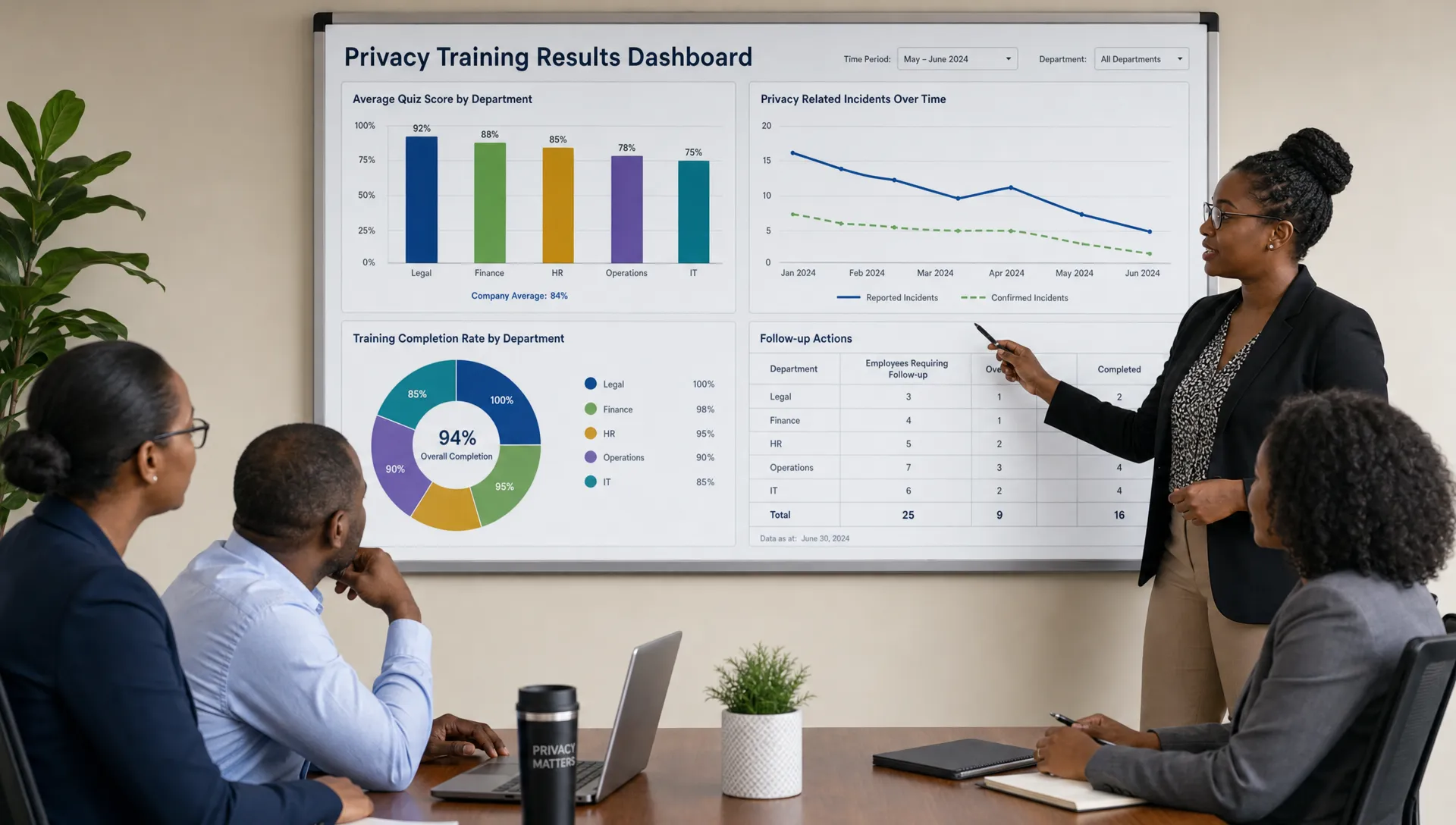
Build a Simple Training Results Dashboard
A data protection training dashboard does not need to be complicated. It should give management a clear view of participation, learning, behaviour, and risk reduction. Keep it practical enough to update regularly.
A useful dashboard might include:
Metric | Why it matters | Suggested review frequency |
Training completion rate | Shows coverage across teams and new joiners | Monthly or quarterly |
Average scenario score by role | Shows whether staff can apply the rules | After each training cycle |
Top three misunderstood topics | Identifies where reinforcement is needed | After each quiz or survey |
Privacy escalations received | Shows awareness and reporting behaviour | Monthly |
Repeat audit findings | Shows whether training is reducing recurring errors | Quarterly |
Correct handling of data subject requests | Shows operational readiness | Monthly or quarterly |
The dashboard should lead to decisions. If the report shows that staff understand privacy basics but still mishandle requests, the answer may not be another lecture. It may be a clearer workflow, a shorter escalation form, a decision tree, or supervisor reinforcement during team meetings.
For senior management and boards, focus on risk and governance. Executives usually need to know whether the organisation has trained the right people, whether high-risk gaps are being addressed, and whether the evidence supports compliance with internal policies and applicable legal obligations.
Collect Evidence for Audits and Accountability
Training measurement also supports accountability. If a regulator, auditor, client, or business partner asks how your organisation manages privacy risk, you should be able to show more than a slide deck.
Useful evidence includes attendance records, training materials, quiz results, role-based learning objectives, feedback summaries, follow-up actions, refresher schedules, management reports, and examples of process improvements made because of training findings.
The NIST Special Publication 800-50 on security awareness and training highlights the importance of evaluating training effectiveness and maintaining an ongoing programme. While it focuses on information security, the same principle applies to privacy and data protection: awareness must be managed as a continuing risk control, not a one-time event.
For Jamaican organisations, this evidence can also support stronger governance under the Data Protection Act. It demonstrates that the organisation is taking practical steps to educate staff, manage personal data responsibly, and correct weaknesses when they are identified.
Calculate Value Without Overpromising ROI
It is tempting to reduce training value to a single return-on-investment number. In practice, privacy training often delivers value through risk reduction, faster response, better compliance evidence, and fewer avoidable mistakes. Some of these outcomes are measurable in money. Others are better reported as operational or governance improvements.
You can estimate value by looking at the costs of privacy failures that training may help reduce. These may include investigation time, legal review, customer communication, remediation, rework, lost productivity, reputational damage, and management attention. Be conservative. The goal is not to claim that training prevents every incident, but to show that it reduces known risks and improves readiness.
A practical value statement might be:
“After role-based training and follow-up reminders, the customer service team improved correct routing of data subject requests from 62% to 91%, reducing delays and privacy team rework.”
That type of result is more credible than a vague claim that training “improved compliance.” It connects learning to a business process.
Turn Measurement Into Continuous Improvement
Measurement should not be the end of the training cycle. It should guide the next cycle. If staff struggle with a topic, simplify the policy, provide examples, and reinforce the behaviour in smaller reminders.
This is where awareness campaigns can help. A formal session may introduce the requirements, but short reminders, team briefings, posters, intranet messages, and manager talking points keep the behaviour alive. If your metrics show that staff forget key steps after training, consider using practical data protection awareness training ideas that actually stick to reinforce the message over time.
A simple 90-day measurement cycle works well:
Define the top privacy behaviours each role must demonstrate.
Measure the baseline before training.
Deliver practical, scenario-based training.
Test knowledge immediately after training.
Review workplace indicators at 30 and 60 days.
Report results to managers and agree follow-up actions.
Recheck the highest-risk behaviours at 90 days.
This creates a feedback loop. Training identifies gaps, measurement confirms whether behaviour changed, and leadership uses the evidence to strengthen controls.
Common Mistakes to Avoid
The most common mistake is relying only on attendance. Completion matters, especially for compliance records, but it is not enough.
Another mistake is using quizzes that are too easy. If everyone scores 100% because the questions only test definitions, the organisation may gain false confidence. Scenarios are better because they test judgement.
A third mistake is ignoring managers. Employees are more likely to apply training when supervisors reinforce it in daily work. If managers treat privacy as a compliance formality, staff will too.
Finally, avoid measuring in a way that discourages reporting. A rise in near-miss reports may be a sign of healthier awareness. Look at the quality, speed, and follow-up of reporting, not just the number of reports.
Frequently Asked Questions
What is the best way to measure data protection training results? The best approach is to combine several measures: completion rates, quiz or scenario scores, behaviour indicators, incident trends, audit findings, and management follow-up actions. No single metric gives the full picture.
How soon should we measure results after training? Measure knowledge immediately after training, then check behaviour over time. A practical approach is to review workplace indicators at 30, 60, and 90 days, especially for high-risk teams.
Should data protection training results be reported to senior management? Yes. Senior management should receive a concise summary showing coverage, key risk areas, improvement trends, and actions being taken. This supports governance and accountability.
What if incident reports increase after training? An increase may be positive if it shows that staff are recognising and escalating issues more effectively. Look for improved reporting quality, faster escalation, and fewer repeat errors over time.
Do different teams need different training metrics? Yes. HR, IT, customer service, finance, marketing, and management face different privacy risks. Measuring by role gives a clearer picture of whether training is working where it matters most.
Need Help Measuring the Impact of Your Data Protection Training?
Effective training is only one part of a strong privacy programme. Your organisation also needs practical metrics, clear evidence, role-based reinforcement, and management reporting that supports compliance with Jamaica’s Data Protection Act.
Privacy & Legal Management Consultants Ltd. helps organisations strengthen data protection implementation, privacy awareness, governance, risk, and compliance programmes. If you want to assess whether your training is producing real results, contact PLMC to discuss a practical approach for your organisation.