

Data Privacy Training Topics Employees Need Most
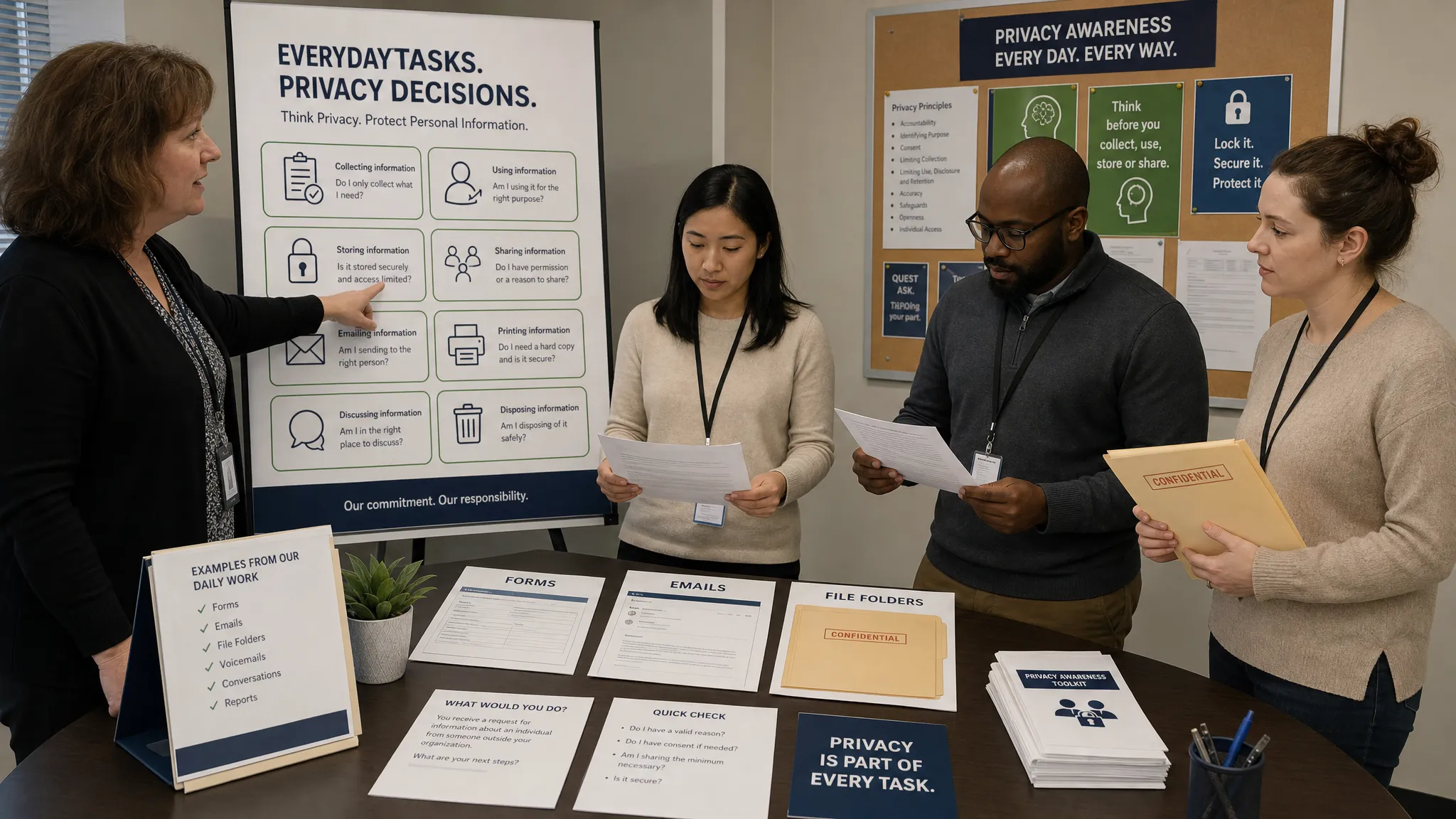
Data privacy training works best when it reflects how employees actually work: opening emails, updating customer records, using spreadsheets, speaking with clients, approving vendors, storing documents, and responding when something goes wrong. A yearly legal presentation may tick a box, but it rarely changes behaviour.
For Jamaican organisations operating under the Data Protection Act, 2020, the training goal should be practical: help staff recognise personal data, use it only for legitimate purposes, protect it appropriately, and escalate issues early. Employees do not need to become lawyers, but they do need to understand the privacy decisions hidden inside everyday tasks.
The following data privacy training topics are the ones employees need most because they address the most common sources of real exposure: over-collection, misdirected sharing, weak access habits, vendor leakage, delayed incident reporting, poor retention, and unclear accountability.
Why data privacy training must focus on behaviour, not theory
Most privacy failures begin with ordinary actions. A staff member sends a file to the wrong recipient. A manager keeps old employee records “just in case.” A team uploads customer information into an unapproved tool. A frontline employee shares information without verifying the requester’s identity. None of these situations require a sophisticated cyberattack to create risk.
This is why training should connect legal obligations to work routines. Jamaica’s Data Protection Act is built around principles such as fairness, lawful processing, purpose limitation, data minimisation, accuracy, retention limits, security, individual rights, and accountability. Employees need to know what those principles mean when they are collecting a form, answering a client, using a cloud platform, or disposing of paper records.
Global breach research reinforces the point. The Verizon Data Breach Investigations Report has repeatedly highlighted the role of human behaviour in security and data incidents. Training cannot eliminate every mistake, but it can reduce avoidable errors and create a culture where employees ask the right questions before risk escalates.
For organisations building a wider compliance programme, training should sit alongside governance, policies, technical controls, vendor oversight, and monitoring. PLMC’s guide on privacy and data protection training explains how role-based learning can support that wider operating model.
1. Recognising personal data and sensitive personal data
The first topic employees need is deceptively simple: what counts as personal data? Many staff members understand obvious examples such as names, addresses, TRN numbers, phone numbers, and identification documents. Fewer recognise that customer reference numbers, account notes, CCTV footage, device identifiers, location data, interview records, complaint details, or combined spreadsheet fields may also identify a person.
Training should also explain sensitive personal data in plain language. Health information, biometric data, religious beliefs, political opinions, criminal allegations, and other sensitive categories require heightened care because misuse can cause greater harm.
A strong module should use examples from the organisation’s own environment. For a clinic, the examples might include patient files, lab results, appointment logs, and insurance correspondence. For a financial services firm, they might include due diligence documents, transaction records, source of funds information, and AML screening notes. For a school, they might include student records, parent contact information, disciplinary records, and medical details.
The objective is not memorisation. Employees should leave with a habit: if information can identify a living individual, directly or indirectly, treat it as personal data until confirmed otherwise.

2. Collecting only what is necessary
Over-collection is one of the easiest privacy risks to create and one of the hardest to clean up later. Employees often ask for extra information because a form has always included a field, a spreadsheet template was copied from another department, or they think more data may be useful in the future.
Data privacy training should teach staff to pause before collecting information and ask three questions:
Do we genuinely need this information for a clear business purpose?
Have we told the individual why we need it?
Is there a less intrusive way to achieve the same outcome?
This topic is especially important for HR, customer onboarding, marketing, membership applications, credit checks, event registration, and service delivery teams. If information is not needed, it should not be collected. If it is needed, staff should understand the purpose and the approved process for collecting it.
A practical exercise works well here. Give employees a sample form and ask them to identify fields that are essential, optional, unclear, or excessive. This helps privacy principles become operational, not abstract.
3. Using data only for the approved purpose
Purpose limitation is a common weak point because business teams often want to reuse data. A customer gives information to receive a service, then another team wants to use the same list for marketing. An employee provides emergency contact details, then someone uses those details for unrelated internal communication. A vendor receives personal data for payroll support, then tries to analyse it for another purpose.
Employees should be trained to recognise “purpose creep,” which happens when data collected for one reason is gradually used for another without proper review. This does not mean reuse is always prohibited, but it does mean staff should not make that decision informally.
Training should explain when employees must escalate a proposed new use of personal data to the privacy, legal, compliance, or management function. This is particularly important for analytics projects, new software, customer campaigns, HR initiatives, AI tools, and data sharing arrangements.
A helpful rule for staff is: if the new use would surprise the person who provided the information, stop and seek guidance.
4. Sharing personal data safely
Wrong-recipient emails, informal messaging, and uncontrolled attachments remain everyday privacy risks. Employees should receive clear guidance on when and how personal data may be shared internally, externally, and with third parties.
Training should cover practical behaviours such as checking recipients before sending, avoiding unnecessary “reply all,” using approved secure transfer channels, password-protecting sensitive files where appropriate, confirming authority before disclosure, and limiting attachments to the minimum required information.
This topic should also address verbal disclosures. Frontline staff may receive calls from relatives, customers, employees, law enforcement, regulators, service providers, or business partners asking for information. Training should make clear that helpfulness cannot replace verification. Staff need a consistent process for confirming identity, confirming authority, and documenting disclosures.
For more day-to-day handling guidance, PLMC’s article on personal information privacy handling rules provides practical rules managers can adapt into team procedures.
5. Passwords, access control, and secure work habits
Privacy training should not become a full cyber security course, but employees must understand the security habits that protect personal data. Access control is a privacy issue because unauthorised access can expose information even where no external attacker is involved.
Employees need to know why they should never share passwords, why multi-factor authentication matters, why personal email accounts should not be used for work files, why screens should be locked, and why access should be limited to those who need it for their role.
Training should also address common workarounds. Staff may download data to personal devices to work faster, save client files to unapproved cloud drives, share logins with temporary workers, or keep old exports on desktops. These habits can undermine even strong policies.
The most useful message is simple: convenience does not override approved controls. If the approved process is too slow or impractical, employees should report the issue so the process can be improved safely.
6. Phishing, social engineering, and identity verification
Phishing training is often treated as an IT issue, but it is also a data privacy training topic. Attackers often target staff to obtain credentials, payroll information, customer records, or confidential documents. Social engineering may happen through email, phone calls, messaging platforms, or fake supplier requests.
Employees should be trained to spot warning signs such as urgency, unusual payment or document requests, unexpected links, mismatched email domains, requests to bypass procedures, and pressure from someone pretending to be senior management.
Just as importantly, staff should know what to do next. They should report suspicious messages, avoid forwarding potentially harmful links widely, and use approved verification channels before releasing information or changing account details.
A short simulation or scenario discussion can be more effective than a long lecture. For example, employees can review a fake vendor email asking for updated bank details and identify the verification steps required before responding.
7. Individual rights and customer requests
Employees do not need to manage every legal detail of rights requests, but they must recognise them. A customer, patient, employee, student, or member may ask to access their data, correct inaccurate information, object to certain uses, or understand how their information is being handled.
If frontline staff do not recognise these requests, the organisation may miss deadlines, respond inconsistently, or disclose information incorrectly. Training should give employees examples of informal wording that may still trigger a process. A person may not say “I am making a data subject access request.” They might say, “Send me everything you have on my account,” or “I want to know why you are using my information.”
Staff should know where to route these requests, what details to record, and what not to promise before the request is assessed. They should also be trained not to delete, alter, or withhold records simply because a request has been made.
8. Incident reporting and breach response
One of the most important data privacy training topics is incident reporting. Employees should understand that a privacy incident is not limited to hacking. It may include a lost laptop, misdirected email, missing paper file, unauthorised access, accidental publication, improper disposal, or disclosure to the wrong person.
The training message should be clear: report quickly, even if you are unsure. Early reporting gives the organisation time to contain the issue, assess risk, notify the appropriate people where required, and preserve evidence.
Staff should know the internal reporting channel, what information to provide, and what immediate containment steps are safe to take. They should also know what not to do, such as trying to cover up the incident, deleting evidence, contacting affected individuals without authorisation, or discussing the incident publicly.
The Office of the Information Commissioner in Jamaica provides regulatory context for data protection oversight. Organisations should align their internal procedures with applicable legal requirements and their own incident response plans.
9. Retention, deletion, and safe disposal
Employees often assume that keeping records forever is safer. In privacy terms, unnecessary retention creates risk. Old records may be inaccurate, irrelevant, unsecured, or difficult to locate when an individual makes a request.
Training should explain retention in practical terms. Staff should know which records must be kept, where retention periods are documented, who approves deletion, and how paper and electronic records should be disposed of securely.
This topic is especially important for shared drives, email inboxes, WhatsApp exports, old customer lists, archived HR files, CCTV footage, and downloaded reports. Employees should understand that deleting records must be controlled and documented, not done randomly. The goal is to retain what is required and remove what is no longer justified.
10. Vendor, cloud, and third-party handling
Many employees interact with vendors before legal, procurement, IT, or compliance teams become involved. They may sign up for online tools, send spreadsheets to service providers, invite consultants to shared folders, or ask a software vendor to troubleshoot live customer data.
Training should teach employees that third-party sharing is not just a purchasing decision. It is a privacy decision. Before personal data is shared with a vendor, the organisation should understand what data is involved, why the vendor needs it, where it will be stored, whether subcontractors are used, what security controls apply, and what contractual protections are required.
This is especially relevant in 2026 as organisations continue adopting cloud services, AI-enabled tools, remote collaboration platforms, and outsourced business processes. Staff should know that free or convenient tools may still create compliance risk if personal data is uploaded without review.
PLMC’s guidance on data processing duties for controllers and vendors explains how vendor responsibilities should be managed in a compliance programme.
11. AI tools and automated processing
AI is now a necessary privacy training topic for many organisations. Employees may use generative AI tools to draft emails, summarise documents, analyse customer feedback, translate content, or create reports. These tools can be useful, but they can also create risk if staff paste personal data, confidential information, or sensitive business records into unapproved platforms.
Training should give employees clear rules on approved tools, prohibited uses, review requirements, and escalation points. Staff should understand that anonymising information is not always as simple as removing a name. A combination of details may still identify someone, especially in small communities, specialist roles, or unique circumstances.
Employees should also be trained to check AI-generated outputs for accuracy, bias, and inappropriate disclosure. If automated tools influence decisions about customers, employees, applicants, patients, or service users, the organisation should review the privacy, fairness, transparency, and governance implications before deployment.
A practical training topic matrix
The best curriculum does not treat every employee the same. Start with a core module for all staff, then add deeper scenarios based on role and risk.
Training topic | Employees who need it most | Practical exercise | Evidence to retain |
Recognising personal data | All staff | Identify personal data in sample records | Attendance, quiz results, examples used |
Data minimisation | HR, onboarding, marketing, operations | Review a form and remove unnecessary fields | Updated form, training record |
Safe sharing | All staff, customer-facing teams | Spot errors in an email disclosure scenario | Scenario responses, policy acknowledgement |
Rights requests | Customer service, HR, managers | Route sample requests to the correct owner | Request handling checklist, attendance |
Incident reporting | All staff | Decide whether sample events are reportable | Incident drill record, reporting guide |
Vendor and cloud use | Procurement, IT, business owners | Assess a proposed software tool | Vendor review checklist, approval record |
AI tool use | Knowledge workers, managers, analysts | Rewrite a prompt to remove personal data | AI use guidance, completion record |
Retention and disposal | HR, finance, admin, records teams | Classify records for retention or disposal | Retention schedule training evidence |
This matrix also helps management demonstrate that training is not generic. It shows a risk-based approach, which is more useful for compliance, audits, and internal assurance.
Role-specific examples employees remember
Employees retain privacy lessons when they recognise the scenario. A finance officer needs different examples from a receptionist. A marketing team needs different examples from IT. Training should therefore include short, role-specific situations.
For HR, focus on recruitment records, medical notes, disciplinary files, references, payroll details, employee monitoring, and access to personnel files. HR teams should be especially careful with sensitive information and internal disclosures.
For customer service, focus on identity verification, account notes, complaints, call recordings, screenshots, and requests from family members or representatives. The key skill is balancing helpful service with controlled disclosure.
For marketing and communications, focus on consent, opt-outs, mailing lists, event photography, analytics, campaign data, and reuse of customer information. Teams should understand that a contact list collected for one purpose may not automatically be available for another.
For IT and security, focus on access management, logging, backups, encryption, system changes, test data, privileged accounts, and incident containment. IT teams need to understand both confidentiality and privacy obligations.
For managers, focus on accountability, approvals, escalation, exception handling, and leading by example. Managers shape privacy culture because employees watch what supervisors tolerate.
For procurement and vendor owners, focus on third-party due diligence, contracts, cross-border processing, cloud storage, subcontractors, and ongoing monitoring. Vendor risk often begins before a contract is signed.
How to make data privacy training stick
Employees are more likely to remember training when it is short, relevant, repeated, and connected to real decisions. A two-hour annual session may be useful for orientation, but it should be reinforced by team briefings, scenario refreshers, posters, checklists, manager reminders, and tabletop exercises.
A practical training programme should include four elements: a core baseline for all employees, role-specific modules for higher-risk functions, scenario-based exercises to test judgement, and evidence that shows who was trained and what they understood.
Measurement matters. Organisations should track completion, assessment scores, repeat incidents, late escalations, policy acknowledgements, and improvement actions. If the same type of incident keeps recurring, the answer may not be “more training” in general. It may be a clearer process, a better template, a technical control, or targeted coaching for a specific team.
PLMC’s data protection workshop guidance can help organisations turn training topics into practical agendas, exercises, and templates.
What evidence should organisations keep?
Training is not only about awareness. It is also part of accountability. Jamaican organisations should be able to show that staff received appropriate privacy training, that training reflected actual risks, and that the organisation acted on lessons learned.
Useful evidence may include training attendance records, curriculum outlines, slide decks, quiz results, role-based training matrices, policy acknowledgements, incident drill records, updated procedures, communications to staff, and management reports on completion and effectiveness.
This evidence should be organised and retrievable. If a privacy incident, audit, vendor review, or board question arises, the organisation should not have to search across inboxes to prove what training occurred.
Frequently Asked Questions
What is the most important data privacy training topic for employees? The most important starting point is recognising personal data and knowing when to escalate. If employees can identify personal data, understand approved purposes, and report concerns early, the organisation can prevent many avoidable privacy failures.
How often should employees receive data privacy training? Most organisations should provide onboarding training for new staff, annual refresher training for all employees, and targeted updates when laws, systems, vendors, incidents, or business processes change. High-risk roles may need shorter refreshers throughout the year.
Should data privacy training be the same for every employee? No. Every employee needs a core baseline, but role-specific training is more effective. HR, IT, customer service, finance, marketing, procurement, and managers face different privacy decisions and need scenarios that match their work.
Does privacy training also cover cyber security? It should cover the cyber security habits that affect personal data, such as passwords, phishing, access control, approved storage, secure sharing, and incident reporting. Deeper technical security training may still be needed for IT and security teams.
How can an organisation prove that privacy training is working? Track more than attendance. Use quizzes, scenario exercises, incident trends, reporting speed, policy acknowledgements, audit findings, and manager feedback to measure whether employees understand and apply the training.
Build a training programme employees can actually use
The best data privacy training topics are not chosen because they sound impressive. They are chosen because they reduce real risk in daily work. Employees need to know what personal data is, why purpose matters, how to share safely, when to verify identity, how to report incidents, when to question vendor tools, and how to avoid unnecessary retention.
Privacy & Legal Management Consultants Ltd. supports organisations in Jamaica with data protection implementation, training sessions, governance, cyber security alignment, risk assessment tools, and compliance support. If your organisation needs help building practical data privacy training that reflects Jamaica’s Data Protection Act and your operational risks, contact PLMC to discuss your next steps or request a consultation.