

Data Processing Act Duties for Controllers and Vendors

Every vendor relationship is also a data relationship. Payroll providers, cloud platforms, marketing agencies, IT support companies, call centres, payment partners and professional advisers may all touch personal data on behalf of a Jamaican organisation.
That creates a practical compliance question: who is responsible for what?
The phrase Data Processing Act is often used informally when organisations mean Jamaica’s Data Protection Act, 2020 and the duties that apply when personal data is collected, used, stored, shared or otherwise processed. For controllers, the central lesson is simple: you may outsource a function, but you do not outsource accountability. For vendors, the lesson is equally important: handling another organisation’s personal data creates privacy and security obligations that must be managed deliberately.
This guide explains how controllers and vendors should divide responsibilities, what should be covered in contracts, and what evidence Jamaican organisations should keep to demonstrate compliance.
Start with the correct role: controller, processor or independent controller
Before a contract is signed, the parties should decide what role each organisation plays. The label in the contract is useful, but the real test is what each party actually does with the data.
A data controller decides why personal data is processed and the main means of processing. For example, an employer that decides to collect staff bank details for payroll is acting as a controller.
A data processor processes personal data on behalf of a controller, usually under the controller’s instructions. A payroll software provider or outsourced HR administrator may be a processor if it uses the employee data only to deliver the contracted service.
A vendor is a business term, not always a legal role. Some vendors are processors. Some are independent controllers. Some relationships may involve shared decision-making, especially where parties jointly determine the purposes of processing.
This distinction matters because it affects privacy notices, contracts, due diligence, security expectations, individual rights handling, breach response and cross-border transfer controls.
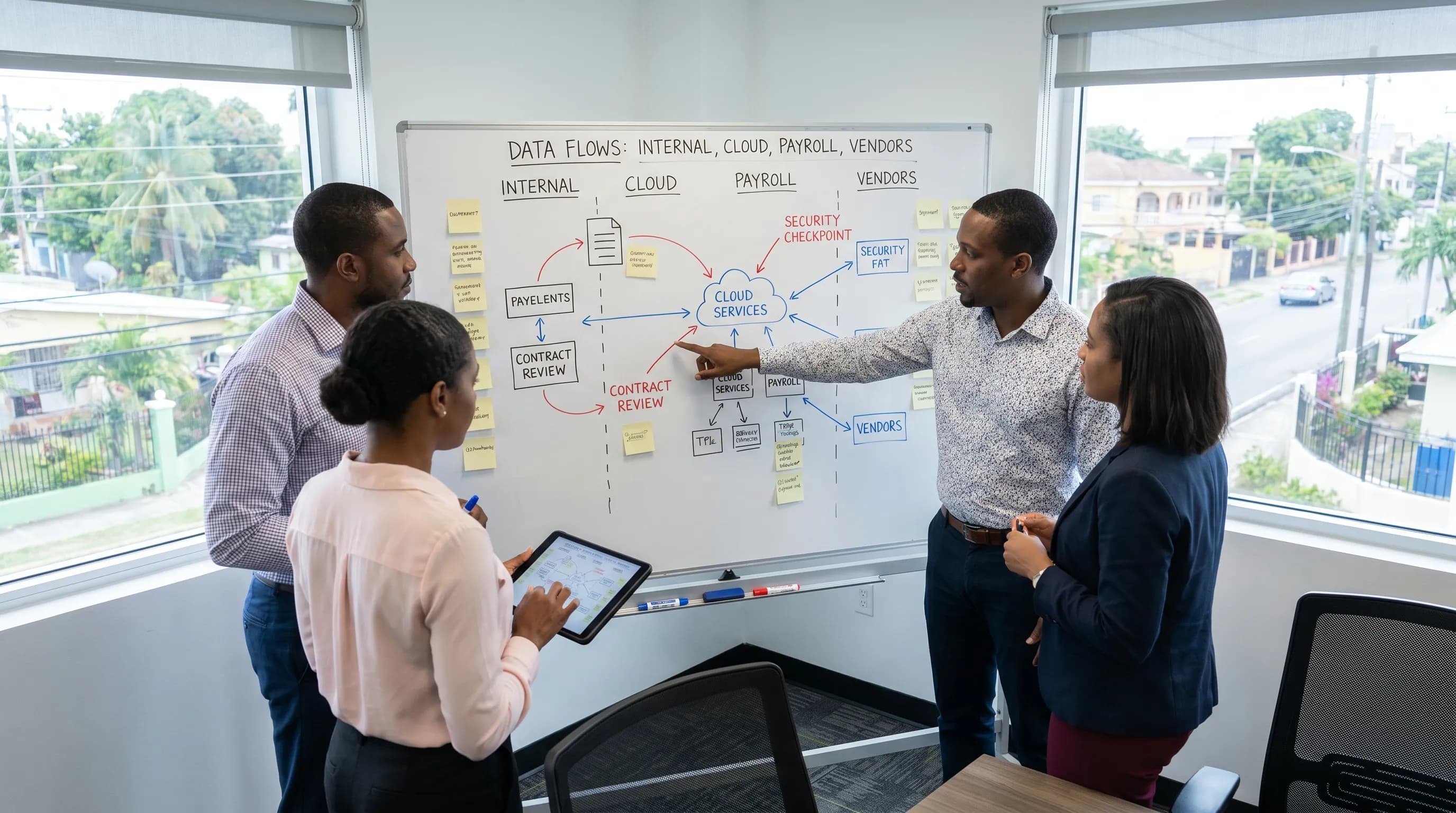
Why controllers remain accountable when vendors are involved
Controllers are responsible for ensuring that personal data is processed fairly, lawfully, transparently, securely and only for appropriate purposes. A vendor can help deliver the service, but the controller still needs to know what personal data is being shared, why it is being shared, where it is going, how long it is kept and who can access it.
This is especially important in Jamaica because many organisations use regional or international technology providers. Customer relationship management tools, email platforms, cloud storage, HR systems and accounting platforms may store or access data outside Jamaica. That does not automatically make the arrangement unlawful, but it does mean the controller needs clear records, safeguards and transfer governance.
For official regulatory updates, organisations should monitor Jamaica’s Office of the Information Commissioner. For a broader business overview, PLMC’s guide to the Jamaica Data Protection Act explained for businesses provides helpful context.
Core duties for controllers before sharing data with a vendor
Controllers should not treat vendor onboarding as a procurement exercise only. It is a privacy, security and governance decision. The stronger the data risk, the more structured the review should be.
Controller duty | What it means in practice | Evidence to keep |
Define the purpose | Explain why the vendor needs the data and what service the vendor will provide | Business purpose note, procurement request, data inventory entry |
Classify the data | Identify whether the data includes sensitive personal data, children’s data, financial data or high-volume customer records | Data map, record of processing activity, risk assessment |
Apply minimisation | Share only the data the vendor needs to perform the service | Field list, integration design, access permissions |
Check the vendor | Review privacy, security, governance and operational controls before onboarding | Due diligence questionnaire, security review, references, certifications if available |
Put contract controls in place | Include data processing, confidentiality, security, audit, sub-vendor and deletion provisions | Signed contract, data processing terms, service schedules |
Manage cross-border risk | Understand where data is stored, accessed and supported from | Hosting locations, sub-processor list, transfer assessment, contract clauses |
Prepare for incidents | Ensure the vendor can notify, investigate and support breach response quickly | Incident clause, escalation contacts, tabletop exercise notes |
Monitor over time | Review the vendor periodically, especially after system, ownership or service changes | Annual review, risk rating, remediation tracker |
A common weakness is starting this review only after a breach or complaint. A better approach is to include privacy questions in procurement, renewals and project approvals. For more on technical and organisational safeguards, see PLMC’s article on privacy security controls that strengthen compliance.
Core duties for vendors and processors
Vendors that process personal data for a controller should not assume that privacy compliance is the controller’s problem alone. Even where the controller remains accountable, the vendor’s behaviour can create or reduce risk.
A processor should process personal data only in line with documented instructions, unless a legal obligation requires otherwise. It should also protect confidentiality, restrict staff access, apply appropriate security measures, support the controller with rights requests, assist with incident investigation and return or delete data when the service ends.
Vendors should be especially careful when they want to use client data for their own purposes. Examples include using customer records for marketing, product analytics, artificial intelligence training, benchmarking or service improvement beyond the agreed scope. If the vendor determines a new purpose for the data, it may no longer be acting only as a processor. That can change its legal responsibilities and may require updated notices, lawful basis analysis and contract terms.
A responsible vendor should also maintain its own governance records. These may include staff confidentiality commitments, access logs, security policies, incident response procedures, sub-vendor approvals, retention schedules and training records.
What a data processing agreement should cover
A data processing agreement is not just a legal formality. It is the operational rulebook for how the vendor will handle personal data. In Jamaica, organisations sometimes use the abbreviation DPA for the Data Protection Act, so it is clearer to refer to vendor terms as a data processing agreement or data processing clauses.
Contract area | Why it matters | Practical questions to ask |
Subject matter and duration | Defines what service the vendor is providing and how long processing will continue | What data is processed, for what service, and until when? |
Categories of data and individuals | Helps identify risk and required safeguards | Does the vendor receive staff, customer, patient, student or financial data? |
Documented instructions | Prevents unauthorised reuse of data | Can the vendor use data only for the contracted service? |
Confidentiality | Reduces insider and onward disclosure risk | Are vendor staff bound by confidentiality obligations? |
Security measures | Converts general security promises into clear expectations | Are access controls, encryption, logging, backups and vulnerability management addressed? |
Sub-vendors | Controls hidden onward processing | Can the vendor appoint sub-processors without approval or notice? |
International access or storage | Supports transfer governance | Where is data hosted, supported and backed up? |
Assistance with rights requests | Ensures individuals’ requests can be handled on time | How quickly must the vendor help retrieve, correct, restrict or delete data? |
Breach notification | Enables timely incident response | How fast must the vendor notify the controller after discovering an incident? |
Return and deletion | Prevents data being retained indefinitely after termination | What happens to live data, archives, logs and backups? |
Audit and evidence | Allows the controller to verify compliance | Will the vendor provide reports, attestations or access for review? |
The agreement should be realistic. A small local service provider may not have the same documentation as a global cloud platform, but every vendor should be able to explain how it protects personal data and what it will do if something goes wrong.
Common vendor scenarios for Jamaican organisations
Different vendor relationships carry different privacy risks. The role analysis should be done carefully and documented, especially where the vendor has discretion over how the data is used.
Scenario | Likely role issue | Key control to prioritise |
Payroll provider | Usually processes employee data on the employer’s behalf | Strong confidentiality, bank detail protection, access control and deletion terms |
Cloud storage platform | Often acts as processor, but terms vary by service | Hosting location, encryption, sub-processors and administrative access |
Marketing agency | May be processor or independent controller depending on campaign control | Consent or lawful basis, suppression lists, opt-out handling and data reuse limits |
IT support provider | May access many systems without owning the data | Privileged access management, logging, confidentiality and incident escalation |
Payment service provider | Often acts as an independent controller for payment processing | Clear notices, PCI-related controls, contractual responsibility boundaries |
External accountant or auditor | Role may depend on professional obligations and engagement scope | Engagement letter, confidentiality, retention and secure file transfer |
Call centre or customer support vendor | Often processes customer records for the controller | Scripts, identity verification, monitoring, training and secure case management |
The phrase likely role issue is intentional. Organisations should not rely on assumptions. A vendor that begins as a processor can become an independent controller if it decides to use data for its own separate purposes.
Cross-border processing: cloud use needs governance
Many Jamaican organisations rely on overseas cloud and software services because they are efficient, scalable and commercially practical. The compliance issue is not whether cloud use is allowed. The issue is whether the organisation understands and governs the transfer and access arrangements.
Controllers should identify where data is stored, where support teams can access it, whether backups are held in other jurisdictions and which sub-vendors are involved. They should also check whether the vendor can notify them of changes to hosting or sub-processor arrangements.
Cross-border governance is not just a legal clause. It should connect to operational controls such as encryption, identity management, logging, tenant configuration, retention settings and secure deletion. A contract that promises protection is helpful, but it must be supported by actual configuration and monitoring.
A practical controller-vendor workflow
A workable compliance programme does not need to be overly complicated. It needs to be consistent, risk-based and documented.
Identify the business process and the personal data involved.
Decide whether the vendor is a processor, independent controller or another type of partner.
Record the purpose, lawful basis, data categories, retention period and transfer locations.
Complete vendor due diligence before the first transfer of personal data.
Put appropriate data processing, confidentiality, security and breach clauses in the contract.
Configure access rights, integrations, encryption, logging and deletion settings before go-live.
Review the vendor periodically and update the risk assessment when services, systems or laws change.
This workflow also supports accountability. If a regulator, board member, auditor or major client asks how a vendor relationship is controlled, the organisation can show evidence instead of relying on verbal assurances.
Questions leaders should ask before approving a vendor
Senior leaders do not need to review every technical setting, but they should ask enough questions to know whether the risk is being governed.
What personal data will the vendor receive or access?
Is the vendor acting on our instructions, or will it use data for its own purposes?
What sensitive or high-risk data is involved?
Where will the data be stored, supported and backed up?
Who at the vendor can access the data, and how is that access approved?
What happens if an individual asks to access, correct or delete their data?
How quickly will the vendor notify us of a suspected breach?
What evidence will we receive to confirm that controls remain effective?
If the answers are vague, the relationship may not be ready for approval. Vague statements such as we are secure or we comply with all laws should be replaced with specific controls, responsibilities and timelines.
Red flags in vendor data processing arrangements
Vendor risk often becomes visible before an incident occurs. The challenge is recognising warning signs early enough to fix them.
Red flag | Why it matters | Better practice |
No clear list of data fields shared | The organisation cannot prove minimisation | Maintain a data-sharing schedule |
Vendor refuses to discuss sub-vendors | Hidden parties may access the data | Require disclosure or change notification |
Contract is silent on breach notification | The controller may lose time during an incident | Set notification triggers and timelines |
No deletion process after termination | Data may remain in systems indefinitely | Agree return, deletion and backup handling |
Vendor wants broad rights to reuse data | The vendor may become a controller for new purposes | Limit reuse or complete a separate legal assessment |
Staff share data through personal email or messaging apps | Contract controls may be bypassed | Use approved secure channels and training |
These red flags are not limited to large enterprises. Small and medium-sized organisations are often more exposed because vendor relationships are handled informally, without a central register or review process.
Training is part of vendor compliance
Even the best contract can fail if staff do not understand how to work with vendors safely. Procurement teams need to know when privacy review is required. HR and finance teams need to know how to protect employee and payment data. IT teams need to manage access, logs and offboarding. Customer-facing teams need to know when they can share records with external support providers.
Role-based training helps staff recognise vendor risk in real situations. It also gives the organisation evidence that privacy controls are not just written policies. PLMC’s guide on training privacy by role explains how organisations can move beyond one-size-fits-all awareness sessions.
What evidence should controllers and vendors keep?
Compliance is easier to defend when evidence is collected during normal operations, not reconstructed after an issue. Controllers should maintain a vendor register, data inventory, signed contract terms, risk assessments, transfer information, security reviews, rights request logs, breach records and periodic review notes.
Vendors should keep evidence showing that they follow instructions and protect data. This may include internal policies, staff training logs, access reviews, incident response records, encryption and backup standards, secure deletion confirmations, sub-vendor records and audit reports where available.
The goal is not paperwork for its own sake. The goal is to make privacy obligations traceable. When a decision is made, there should be a record of who made it, what risk was considered and what control was put in place.
Frequently Asked Questions
Is there a Data Processing Act in Jamaica? Many people use the phrase Data Processing Act informally, but the main Jamaican privacy law is the Data Protection Act, 2020. It governs how personal data is processed and creates duties for organisations that control or process personal data.
Can a controller blame a vendor for non-compliance? A vendor may be responsible for its own failures, but the controller generally remains accountable for selecting, instructing and overseeing vendors that process personal data on its behalf. Accountability requires due diligence, contracts and ongoing monitoring.
Does every vendor need a data processing agreement? If a vendor processes personal data on behalf of the organisation, data processing terms should be in place. The detail should reflect the risk, volume and sensitivity of the data, as well as the nature of the service.
What if the vendor is outside Jamaica? Cross-border processing should be assessed and governed. Controllers should understand where data is stored and accessed, what safeguards apply, whether sub-vendors are involved and whether the arrangement aligns with Data Protection Act requirements.
Are small businesses expected to manage vendor risk? Yes. Smaller organisations may use simpler tools, but they still need to know which vendors handle personal data, what data is shared, how it is protected and what happens when the relationship ends.
Strengthen your controller and vendor compliance programme
Controller-vendor compliance is one of the areas where privacy risk becomes operational very quickly. A weak contract, an unknown sub-vendor, excessive data sharing or unclear breach process can create regulatory, financial and reputational exposure.
Privacy & Legal Management Consultants Ltd. helps organisations in Jamaica with data protection implementation, governance, cyber security, training, risk assessment and GRC integration. If your organisation is reviewing vendor relationships or building a practical compliance programme for 2026, PLMC can help you move from policy to evidence.
Explore more practical guidance in PLMC’s Data Protection Jamaica compliance roadmap for 2026, or contact Privacy & Legal Management Consultants Ltd. to discuss your next steps.