

Data Privacy Protection Act: What It Means in Jamaica

In Jamaica, “data privacy” is no longer just a good practice or an IT concern, it is a legal expectation. The law many people refer to as the Data Privacy Protection Act is Jamaica’s Data Protection Act, 2020, and it reshapes how organisations collect, use, store, share, and dispose of personal information.
For businesses, it raises the bar on governance, transparency, and security. For individuals, it creates clearer rights and pathways to challenge misuse of their data. Understanding what the Act means in practical terms is now essential for customer trust, regulatory readiness, and doing business locally and internationally.
What the “Data Privacy Protection Act” is in Jamaica
Jamaica’s Data Protection Act, 2020 sets rules for processing personal data and establishes accountability expectations for organisations that handle personal information.
It aligns with internationally recognised privacy concepts (similar in spirit to regimes like the EU GDPR), but it is a Jamaican law with Jamaican enforcement expectations. That matters because compliance is not just about having a template policy, it is about demonstrating that your organisation’s day-to-day operations reflect the law’s principles.
If you want to read the regulator-facing context and public guidance as it evolves, keep an eye on the Office of the Information Commissioner (Jamaica), which plays a central role in Jamaica’s information rights landscape.
Who the Act affects (it is broader than many expect)
A common misconception is that data protection laws only apply to “big tech” or banks. In reality, the Act impacts any organisation that handles personal data in the course of operations.
That includes, for example:
Employers managing employee records, payroll, performance notes, and HR files
Schools and training providers holding student information
Healthcare providers handling medical and billing information
Hospitality and tourism businesses collecting passport data, guest preferences, CCTV footage
E-commerce and delivery businesses using customer addresses, phone numbers, order history
Financial and professional services firms using KYC details and due diligence documentation
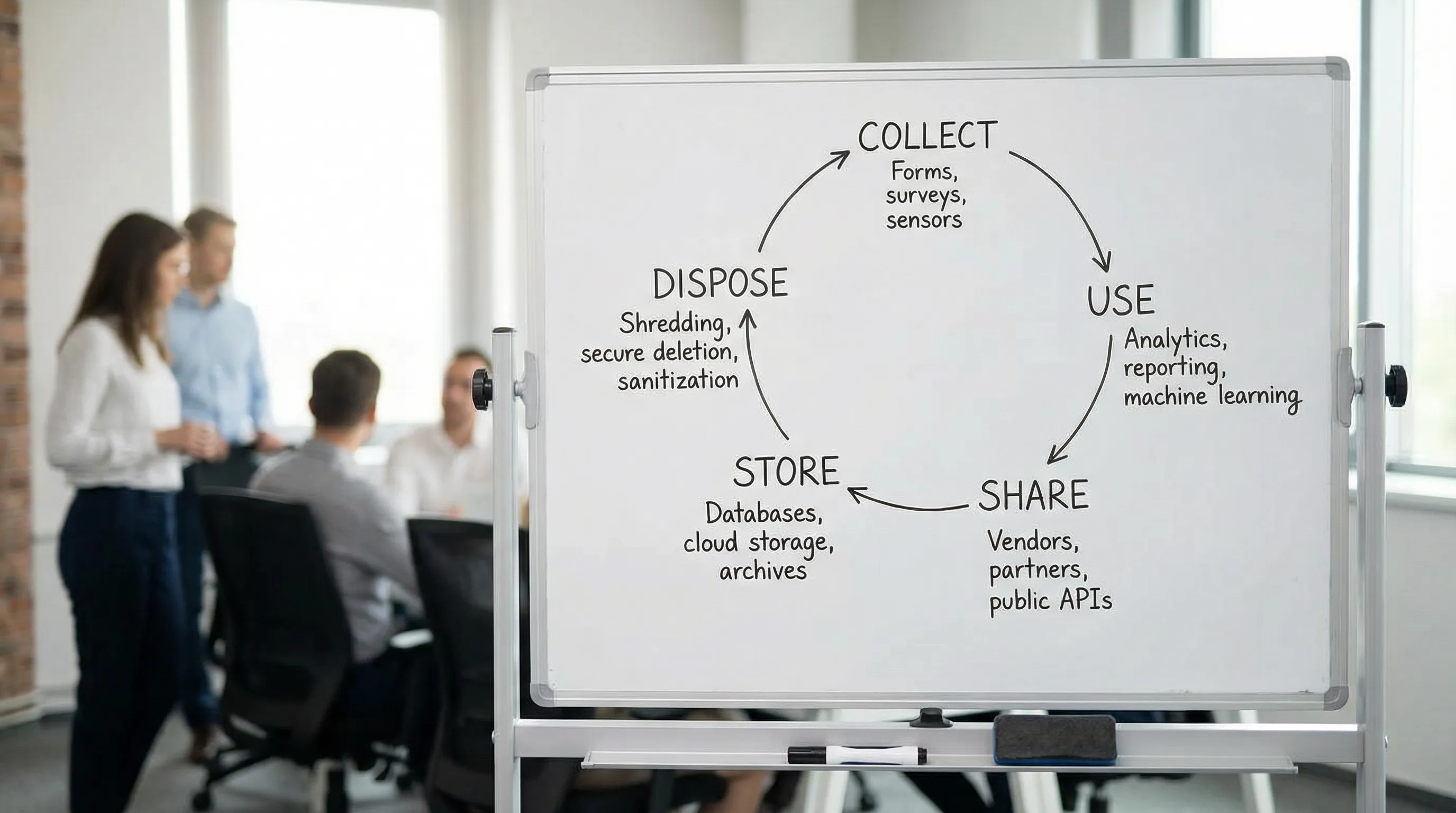
It also applies across the data lifecycle, from initial collection to archiving and disposal.
What counts as “personal data” and why definitions matter
The Act focuses on personal data, meaning information that can identify an individual directly or indirectly.
In practice, this can include obvious identifiers (name, TRN, passport number) and less obvious ones (online identifiers, customer numbers, location data, CCTV footage when linked to a person).
It also recognises that some data types carry higher risk and therefore demand stronger handling. Organisations in Jamaica should treat health information, financial details, children’s data, and identity documents as high-impact categories even before a regulator ever asks the question.
Why this matters: compliance failures often start at the definition stage. If a team does not recognise that a dataset is personal data, it will not apply the right controls.
The core shift: from “we have data” to “we can justify data”
The Act pushes organisations toward a simple but demanding standard: you should be able to explain and evidence:
Why you collected the personal data
What you will use it for
How long you will keep it
Who you will share it with
How you will protect it
How individuals can exercise their rights
This is why privacy is increasingly tied to corporate governance. It is not only a policy exercise, it is operational discipline.
Key expectations in plain language
While the legal language can be technical, the day-to-day expectations are straightforward:
Be transparent: people should not have to guess what you are doing with their information.
Collect only what you need: if a process works without extra data, do not collect it “just in case.”
Use data for stated purposes: avoid reusing data in ways that surprise customers or employees.
Keep data accurate: incorrect data can harm individuals and create business risk.
Do not keep data forever: retention must be justified and defensible.
Secure it properly: security controls should match the sensitivity and volume of data.
Be accountable: assign ownership and be able to prove what you did.
If you want a deeper dive into principles and rights in a Jamaica-first format, see Data Privacy in Jamaica: Key Principles and Rights.
What it means for individuals in Jamaica
For members of the public, the most important practical change is that privacy is not only a “customer service” issue. It is tied to rights.
Depending on the context, individuals may be able to:
Ask what personal data an organisation holds about them
Request corrections where data is inaccurate
Challenge unfair or unjustified processing
Expect better protection and more careful sharing
In real life, this affects common situations such as:
A customer disputing why their information was shared with a third party
An employee questioning access to HR records
A patient asking who can view their health data
A consumer wanting clarity on CCTV retention periods
For organisations, this means front-line staff and managers need to know how to identify a rights request and route it properly. One of the fastest ways to create a compliance incident is to mishandle an access request because the team treated it like a normal complaint.
What it means for Jamaican organisations (beyond “update your privacy policy”)
Many organisations start with a website privacy notice. That is important, but it is not enough.
The Act effectively requires organisations to treat privacy as a managed risk, similar to financial risk, cyber risk, or AML risk. That means leadership should understand privacy as part of governance, not a one-off legal deliverable.
1) You need clear internal ownership
Even if your organisation does not have a formal privacy office, someone must be responsible for coordinating privacy decisions. Without clear ownership, common gaps appear quickly:
Different departments collecting overlapping datasets with no shared inventory
Vendors onboarded without privacy due diligence
No consistent approach to retention and disposal
Delayed response when an incident occurs
2) Your vendor and outsourcing model becomes a compliance issue
If a third party processes personal data on your behalf (payroll provider, cloud provider, marketing agency, call centre, software platform), your organisation still carries risk.
Practical expectation: you should be able to show that you assessed vendors, set contractual expectations, and monitored performance in proportion to the risk.
3) Cross-border data transfers are no longer “invisible”
Many Jamaican organisations use cloud services where data is stored or accessed overseas. The Act raises the need to understand where data goes, and what safeguards exist.
This is one area where Jamaican businesses interacting with international clients often feel pressure. Clients and partners may ask questions that sound like GDPR language, even when your operations are Jamaica-based.
For a more implementation-focused view, PLMC has published Data Protection Basics: What Jamaican Firms Must Know.
4) Security becomes a privacy requirement, not only an IT objective
Data protection and cyber security are now inseparable in practice. If personal data is exposed due to weak access controls, poor configuration, lost devices, or phishing, the consequences include:
Harm to individuals (identity theft, embarrassment, discrimination)
Business disruption and reputational damage
Contractual consequences with customers and partners
Regulatory exposure
This is why many organisations are moving toward a combined approach: privacy controls supported by cyber controls, governed through an integrated GRC lens.
5) “Evidence” is the new standard
A mature privacy programme is not defined by how many documents you have. It is defined by whether you can prove what you do.
Examples of evidence leadership should expect to see over time include:
A current view of key personal data flows (even if not perfect)
Records showing how requests are handled and closed
Logs or reports showing access management and periodic review
Vendor due diligence records proportionate to risk
Training completion and role-based training coverage
If you prefer a structured way to validate readiness, Privacy and Data Protection: A Practical Checklist is a strong internal working tool.
The boardroom angle: why governance teams should pay attention
Privacy compliance is increasingly assessed like any other governance matter: what is the risk, who owns it, what controls exist, and how does leadership know they work?
For boards and senior leadership in Jamaica, useful questions include:
Where are our highest-risk datasets (HR, customer ID documents, health, financial, children’s data)?
Which vendors can access personal data, and what do our contracts actually say?
How quickly could we respond to a rights request or a suspected breach?
Are our retention periods defined and followed, or are we “keeping everything”?
Do staff understand privacy expectations in their roles, not only in theory?
In other words, the Act makes privacy a measurable part of governance and risk management.
A practical snapshot: “What changes” for organisations vs individuals
Area | What individuals can reasonably expect | What organisations must be ready to demonstrate |
Transparency | Clear explanations about data use | Privacy notices and aligned internal practices |
Data minimisation | Only necessary data collected | Forms and processes designed to avoid excess collection |
Security | Better protection against misuse and exposure | Technical and organisational safeguards matched to risk |
Retention | Data not kept indefinitely without reason | Documented retention rules and consistent disposal |
Accountability | Clear point of contact and response path | Assigned responsibility and evidence of compliance activities |
Common misconceptions that create avoidable risk
“We are too small to be a target”
Small and mid-sized organisations often hold highly sensitive information, sometimes with fewer controls. Regulators, customers, banks, and enterprise clients may all expect baseline privacy discipline regardless of company size.
“We bought a security tool, so we are compliant”
Tools help, but compliance also requires governance: defined processes, staff training, access discipline, vendor oversight, and clear retention practices.
“Our privacy policy covers us”
A policy that says the right things, while the business does different things, can increase risk. A privacy notice is a promise. Your operations must match it.
Where to start if you want progress without overwhelm
If your organisation is early on its privacy journey, aim for clarity before complexity:
Identify the personal data your organisation depends on to operate
Prioritise the highest-risk processes (HR, customer onboarding, payments, health data, identity documents)
Confirm who owns privacy decisions internally
Validate vendor access to personal data and tighten expectations
Train staff on what to do when a privacy issue appears, not only on definitions
For organisations that want a structured, Jamaica-specific plan for the current environment, Data Protection Jamaica: Compliance Roadmap for 2026 provides a quarter-by-quarter view focused on operational evidence.
How PLMC can support Jamaican organisations
Privacy compliance is easiest when it is integrated into governance, risk, and compliance routines, rather than treated as a one-time legal project.
Privacy & Legal Management Consultants Ltd. (PLMC) supports organisations in Jamaica with practical data protection implementation, privacy awareness and training sessions, risk assessment tools, and broader GRC-aligned support (including corporate governance, cyber security services, and anti-money laundering compliance).
If you are interpreting what the Data Protection Act means for your specific workflows, vendors, and risk profile, start with PLMC’s resources on the PLMC blog and consider a free consultation to map next steps in a way that fits your organisation’s size and sector.