

Data Breach Response Plan for Jamaican Organisations
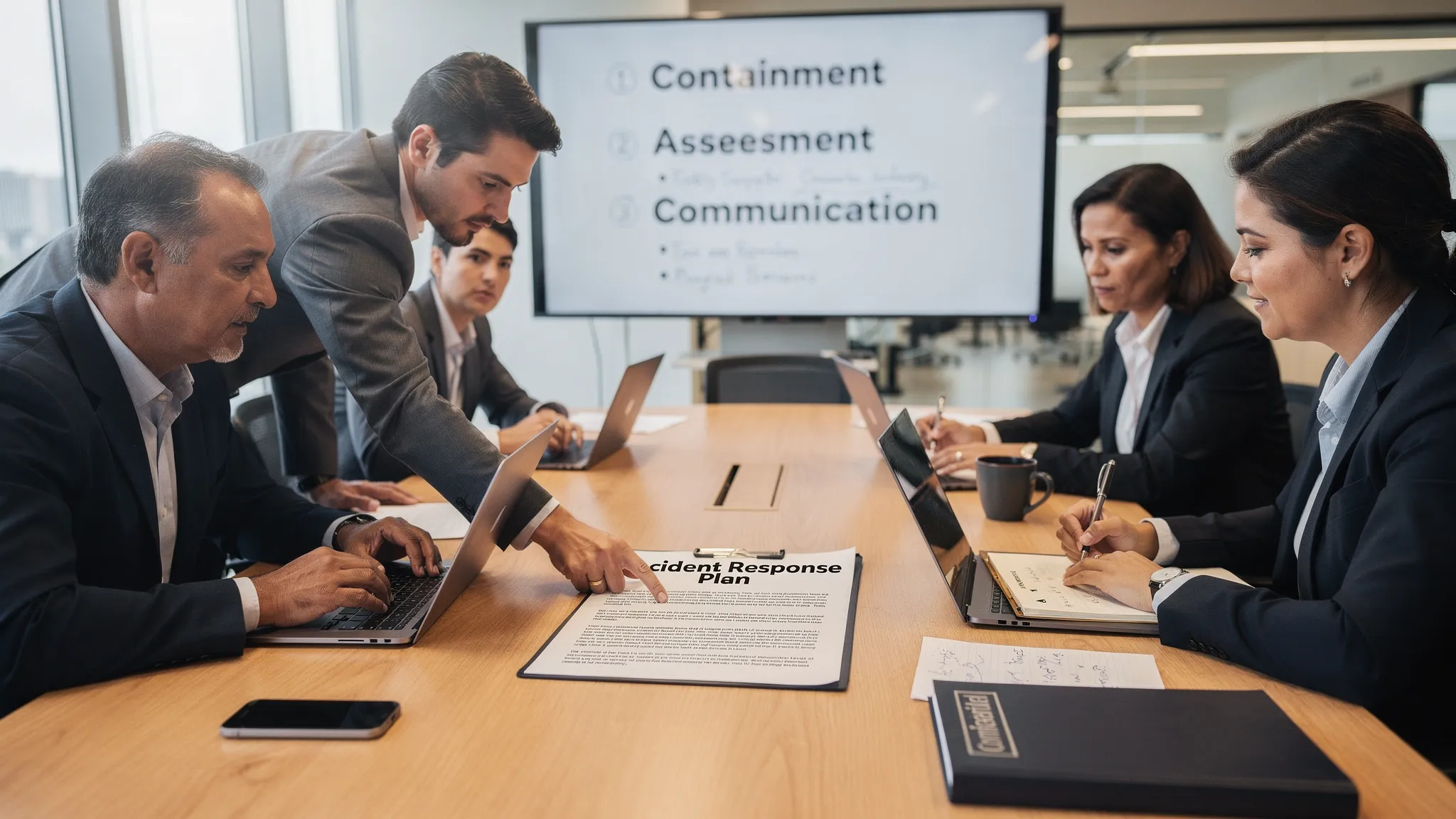
Most data breaches are not discovered in a dramatic “we’ve been hacked” moment. In Jamaican organisations, they often start as something smaller and very human: a phishing email that captures a password, a laptop left in a taxi, a misdirected spreadsheet, a vendor account that was never disabled.
A data breach response plan turns those first confusing hours into a repeatable, evidence-based process. It helps you contain the incident, protect affected people, make defensible notification decisions under Jamaica’s Data Protection Act, 2020, and get operations back online without creating extra legal or reputational risk.
What a “data breach” looks like in practice
In operational terms, a personal data breach is an event that compromises the confidentiality, integrity, or availability of personal data. The trigger could be malicious, accidental, internal, or external.
Common scenarios for Jamaican organisations include:
Credential compromise (phishing, reused passwords, MFA fatigue attacks), followed by email account takeover.
Misdirected disclosures (sending payroll, TRN lists, medical details, or customer statements to the wrong recipient).
Lost or stolen devices containing unencrypted files or saved sessions.
Ransomware that both encrypts systems and exfiltrates data.
Third-party incidents (cloud, payroll, HR, marketing, payment, or IT service provider breaches).
A useful distinction for your plan is:
Security incident: something suspicious or harmful happened (malware alert, unusual logins, lost phone).
Personal data breach: the incident actually impacted personal data (or is likely to have).
Your response plan should assume you may not know which one it is in the first hour, and guide your team to find out quickly.
The goals of a breach response plan (what “good” looks like)
A strong plan is not just a cybersecurity playbook. It is a governance process that balances legal, operational, and human impact.
A practical breach response plan should enable you to:
Stop the exposure fast (containment) without destroying evidence.
Assess risk to individuals (not just risk to the company).
Meet Data Protection Act obligations with consistent decision-making and documentation.
Communicate clearly to staff, customers, regulators, and partners.
Recover safely (restore systems, reset access, confirm persistence is removed).
Learn and improve (post-incident review, control upgrades, training).
Assign roles before anything happens
When an incident hits, delays usually come from uncertainty about who is in charge, who can approve spend, who contacts vendors, and who speaks externally.
You do not need a large team, but you do need named roles, alternates, and authority lines.
Role (suggested) | Primary responsibility | Backup / notes |
Incident Lead (Incident Commander) | Runs the response, sets priorities, chairs incident calls, keeps a decision log | Often IT/security lead in smaller firms |
Privacy Lead / DPO function | Determines whether personal data is impacted, leads risk-to-individuals assessment, manages notification inputs | May sit in Legal, Compliance, or Risk |
IT / Security | Triage, containment, forensics coordination, recovery | Include managed service provider contacts |
Legal Counsel | Privilege strategy, regulator correspondence review, contract impacts | Internal or external |
Communications Lead | Internal staff comms, customer messaging, media holding statement | Centralised spokesperson |
HR (if staff data involved) | Employee communications, disciplinary process if needed | Coordinate with Legal |
Vendor Manager / Procurement | Activates vendor breach clauses, gathers facts, ensures timelines | Key for cloud and payroll providers |
Executive Sponsor | Approvals, risk acceptance, business continuity decisions | CEO/COO/CIO depending on structure |
Keep this table on one page in your plan, with direct phone numbers (not only email addresses).
Build your “breach-ready” toolkit (the prep work that saves days)
Many Jamaican organisations already have policies, but in a breach you need usable assets. Aim to prepare:
1) A current “crown jewels” view of personal data
You do not need a perfect enterprise data map to respond well, but you do need to know where your most sensitive data lives.
At minimum, identify:
Key systems holding personal data (HR, payroll, customer databases, case management, student/patient records, email, file shares, cloud drives).
The most sensitive categories you handle (children’s data, financial details, government identifiers, health information).
Critical vendors who process personal data.
If you are still building fundamentals, PLMC’s checklist and roadmap articles are good complements to this response plan: Privacy and Data Protection: A Practical Checklist and Data Protection Jamaica: Compliance Roadmap for 2026.
2) An incident log and decision register template
In a real response, your future regulator conversation (and your board reporting) will be shaped by what you documented in the moment.
Your template should capture:
Time discovered, who discovered it, and how.
Systems affected.
Actions taken (containment, resets, vendor contacts).
Evidence preserved (logs, disk images, email headers).
Key decisions and why they were taken.
3) Contact lists that work during disruption
Include:
Vendor emergency contacts (cloud, MSP, payroll, telecoms).
External legal counsel.
Cyber insurance contact path (if applicable).
Affected business unit leaders.
Store this list somewhere resilient (not only on the network that may be encrypted).
4) Tested backups and restore runbooks
Ransomware and destructive attacks often turn into prolonged crises because restores are slow, incomplete, or untested.
Your plan should reference:
Backup frequency and scope.
Recovery time objectives for critical systems.
Restore ownership (who can actually do it, and how long it takes).
5) Staff training for first reporters
Your plan should specify what frontline staff do in the first 10 minutes when they notice something.
For example: report immediately, preserve screenshots, do not forward suspicious emails, do not “investigate” by clicking further.
(PLMC provides role-based training and awareness sessions, which is especially useful for reducing phishing-related breaches.)
The response workflow: what to do in the first hour, day, and week
The most useful plans are time-based. The exact hours will vary, but the structure keeps you moving.
Time window | Operational priority | Governance and compliance priority |
First 0 to 60 minutes | Confirm the incident is real, start incident log, contain obvious exposure, preserve evidence | Assign Incident Lead and Privacy Lead, begin “is personal data involved?” assessment |
1 to 4 hours | Disable compromised accounts, isolate affected endpoints/servers, engage vendors, start forensic capture | Identify likely data types involved, start a risk-to-individuals assessment, identify decision-makers |
4 to 24 hours | Expand containment, check for persistence, validate backups, prepare recovery path | Draft internal comms, prepare notification decision framework, confirm controller/processor roles |
24 to 72 hours | Recover services safely, reset credentials broadly if needed, monitor for re-entry | Finalise notification position (regulator, individuals, partners), compile evidence for reporting |
3 to 14 days | Hardening, patching, vendor remediation, ongoing monitoring | Post-incident review, update controls, training, board reporting, contract follow-ups |

Step 1: Detect, report, and triage (without destroying evidence)
Your plan should define “reportable internally” events in plain language so staff do not self-filter. In practice, over-reporting is safer than under-reporting.
During triage, focus on four questions:
What happened? (phishing, lost device, malware, misdirected email, vendor alert)
What is affected? (which systems, accounts, locations)
Is personal data involved? (or likely involved)
Is the situation ongoing? (active attacker, data still exposed, mailbox rule still forwarding)
Preserve evidence early. A common mistake is deleting emails or wiping devices before collecting the information your investigators and legal team will need.
For deeper technical guidance, many organisations align their internal processes to recognised frameworks such as NIST SP 800-61 (Computer Security Incident Handling Guide).
Step 2: Classify severity based on risk to people (not just IT impact)
Two incidents can look similar technically but be very different legally and ethically.
A practical approach is to rate severity using risk factors that regulators typically care about:
Sensitivity of the data (financial, health, children).
Volume of records.
Ease of identification (names plus identifiers versus anonymised data).
Likelihood of misuse (exfiltration confirmed, attacker intent, public exposure).
Ability to mitigate (rapid password resets, remote wipe, encryption).
Severity level | Typical indicators | Typical response posture |
Low | Minimal personal data, strongly encrypted, quick containment, low likelihood of harm | Document, remediate, monitor, consider internal notification |
Medium | Personal data likely accessed, moderate sensitivity, uncertain exfiltration, vendor involvement | Expand forensics, prepare notification drafts, proactive stakeholder comms |
High | Confirmed exfiltration or public exposure, sensitive categories, large volume, ongoing attacker activity | Executive escalation, external legal support, regulator and affected-person notification planning, heightened comms |
Your plan should set escalation thresholds, for example “High severity requires executive sponsor involvement within 60 minutes.”
Step 3: Contain fast, then eradicate carefully
Containment should be decisive but controlled.
Common containment actions include:
Disable or reset compromised accounts (especially email and admin accounts).
Force MFA resets and session revocation for key platforms.
Remove malicious inbox rules and OAuth app grants.
Isolate affected endpoints and servers from the network.
Block known malicious IPs/domains where appropriate.
Pause certain integrations or batch exports if they are the leakage path.
Eradication is where you remove the root cause (patching, rebuilding systems, removing persistence). If you skip this step, you often see a second incident within weeks.
If the incident may become a legal matter (employee misuse, fraud, extortion), involve Legal early so you do not inadvertently lose evidence or compromise privilege.
Step 4: Assess impact (what data, whose data, and what harm is plausible)
This is the step most organisations struggle with, because it requires connecting IT facts with business context.
Your assessment should aim to answer:
Data types: What personal data fields were involved?
Data subjects: Employees, customers, students, patients, vendors?
Scope: Rough number of records and time period.
Exposure: Viewed, copied, exfiltrated, altered, deleted, encrypted?
Downstream risk: Identity theft, financial fraud, blackmail, discrimination, physical risk.
Do not wait for perfect certainty. Create a living assessment document that improves as evidence arrives.
Step 5: Make notification decisions under Jamaica’s Data Protection Act
Your response plan should include a defined path for deciding whether to notify:
The relevant Jamaican authority responsible for data protection oversight, commonly understood to be the Office of the Information Commissioner (OIC) (OIC Jamaica).
Affected individuals (and, where relevant, business partners).
Because notification duties can turn on facts such as risk to individuals, timing, and your role (controller versus processor), your plan should require that the Privacy Lead and Legal Counsel review:
Whether the incident meets your definition of a personal data breach.
Whether the likely impact creates risk that warrants notification.
What you can credibly say now (and what you cannot yet confirm).
Your plan should also handle processor scenarios. If you process personal data for another organisation, your contracts and the Act may require prompt notification to the controller so they can meet their obligations.
If your organisation also aligns to GDPR practices (for example, because you serve EU residents or have group-wide policies), ensure your Jamaica plan is consistent but not copy-pasted. Local governance, regulator expectations, and stakeholder communications should be Jamaica-specific.
For foundational context on obligations and governance under the Act, see: Jamaica Data Protection Act Explained for Businesses.
Step 6: Communicate with control (internally and externally)
In a breach, communication failures create secondary harm: panic, rumours, contradictory messages, and avoidable reputational damage.
Your plan should include pre-approved “first response” content, such as:
An internal message to staff: what happened (high level), what to do, where to send information, and what not to do.
A customer holding statement: acknowledgement, what you are doing, what customers should watch for, and when you will update.
A call script for customer-facing teams.
A few communication principles worth baking into your plan:
One spokesperson for external media.
No speculation. Say what you know, what you are investigating, and what you will do next.
Actionable guidance to affected people (password hygiene, fraud monitoring, how to contact you).
Consistency across email, website, call centre, and social channels.
Step 7: Recover operations safely (and prove you are clean)
Recovery is not “turn it back on.” It is restoring services in a way that reduces recurrence risk.
Your plan should require:
Validation that persistence is removed (no suspicious admin accounts, no malicious scheduled tasks, no shadow OAuth apps).
Credential resets aligned to the incident scope.
Patch or configuration fixes implemented before production restoration.
Monitoring uplift after recovery (enhanced logging, alerting thresholds, mailbox rule monitoring).
If ransomware is involved, recovery planning should also coordinate business continuity decisions, customer commitments, and legal considerations. Avoid making irreversible decisions on incomplete information.
Step 8: Post-incident review (where compliance and maturity are built)
A post-incident review should happen even for “near misses.” The purpose is to fix the system, not to assign blame.
Capture:
Root cause and contributing factors.
Time to detect, time to contain, time to recover.
Control failures (technical and procedural).
Training gaps.
Vendor performance issues.
What evidence you would want next time but did not have.
Feed the outcomes into your broader governance program: risk registers, board reporting, vendor management, and training plans.
A simple structure you can copy into your internal plan
If you want a practical document outline, keep it short enough that people will actually use it:
Scope and definitions (security incident vs personal data breach)
Roles, alternates, and contact list
Reporting channels (including after-hours process)
Triage checklist and evidence preservation steps
Severity classification criteria
Containment and recovery playbooks (email compromise, lost device, ransomware, misdirected email)
Notification decision workflow (with Legal and Privacy sign-off)
Communications templates
Vendor and law enforcement coordination guidance
Post-incident review template and annual testing schedule
How PLMC can help
If you need to move from “we should have a plan” to a plan that is tested and audit-ready, PLMC can support Jamaican organisations with data protection implementation, incident readiness, governance integration, and training. You can also use the site’s resources to strengthen your foundation, including Data Privacy in Jamaica: Key Principles and Rights.
If you want, share your organisation type and key systems (HR/payroll, customer databases, cloud tools) and we can help you shape a breach response plan that fits your real workflows, not a generic template.