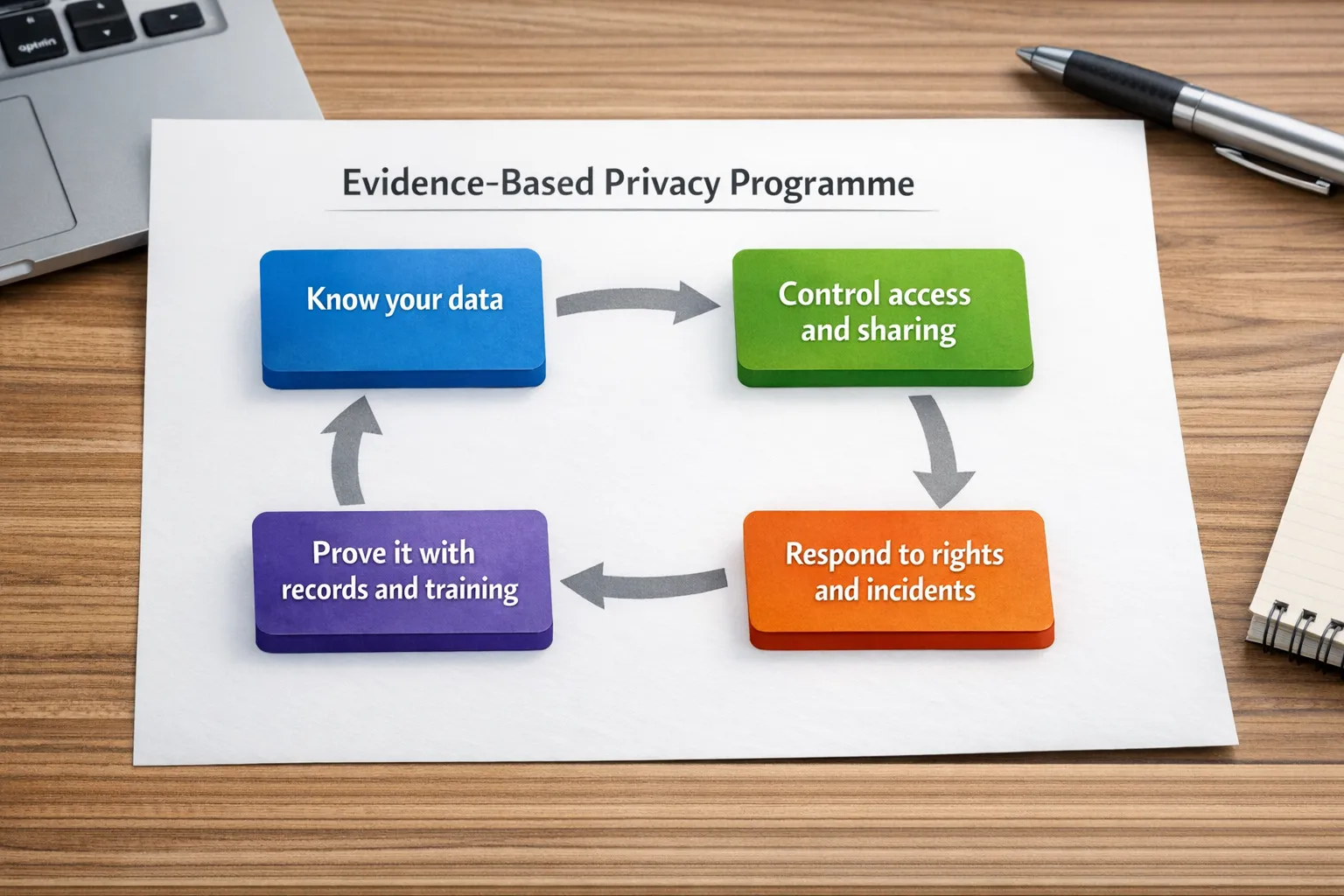

Choosing Data Privacy Services in Jamaica: What to Ask

Choosing a provider for data privacy services is not only a procurement exercise, it is a governance decision. In Jamaica, the Data Protection Act, 2020 has pushed organisations past general awareness and into operational questions like, “Do we actually know where personal data sits?”, “Can we meet access requests on time?”, and “Are our vendors doing what our contracts say they do?” The right service partner helps you answer those questions with evidence, not just policies.
This guide is designed for Jamaican organisations that are evaluating privacy consultants, privacy officers (outsourced), and broader Governance, Risk & Compliance (GRC) firms. It focuses on what to ask, what to request in a proposal, and how to spot red flags before you sign.
Start with a clear brief (so you do not buy the wrong thing)
Before you assess any provider, define what “done” means for your organisation. Many privacy engagements fail because the client asks for “compliance” and the provider responds with generic templates.
A useful brief typically answers:
Your role and risk profile: Are you primarily a controller, a processor, or both? Are you in a high-risk sector (financial services, health, education, BPO, tourism, retail with loyalty programmes)?
Your footprint: Locations, group entities, remote staff, and whether you use overseas cloud platforms.
Your priority outcomes for the next 90 to 180 days: For example, data mapping, privacy notices, vendor contract updates, incident readiness, staff training, or a board-level governance framework.
Your constraints: Budget, internal capacity, and how much change you can realistically absorb.
If your team needs a refresher on core obligations and terminology, it can help to align internally first using a practical explainer like Jamaica Data Protection Act Explained for Businesses.
What “data privacy services” should include (at minimum)
When Jamaican organisations say they need data privacy services, they are usually looking for some mix of legal interpretation, operational controls, and assurance. A serious provider should be able to support across these areas, either directly or through clearly defined partners.
Common scope components include:
Assessment and gap analysis against the Data Protection Act and your internal risk appetite
Data discovery and data mapping (systems, files, paper records, data flows, and recipients)
Governance and accountability (ownership, reporting lines, decision logs, and evidence)
Transparency and individual rights (notices, request handling, response templates, and tracking)
Vendor and cloud governance (due diligence, contract clauses, and ongoing monitoring)
Security and breach readiness (incident response roles, playbooks, tabletop exercises)
Training and awareness tailored to job roles
A fast way to pressure-test whether a provider is thinking “program” rather than “paperwork” is to compare their approach to a structured checklist like Privacy and Data Protection: A Practical Checklist.
Choosing data privacy services in Jamaica: what to ask
The questions below are grouped so you can use them in discovery calls, RFPs, and proposal evaluations. You do not need to ask every question, but you should cover every theme.

1) Local legal knowledge and practical interpretation
Jamaica-specific experience matters because your obligations are shaped by local law, local expectations, and how organisations actually operate on the island.
Ask:
How do you interpret the Jamaica Data Protection Act in day-to-day operations? Listen for practical translation into workflows (intake forms, call centre scripts, HR processes), not abstract legal summaries.
What kinds of evidence do you expect an organisation to maintain? Strong providers talk about records, decision logs, training attendance, incident test results, and vendor due diligence files.
How do you handle cross-border use cases common in Jamaica? For example, overseas parent companies, cloud hosting, offshore support desks, payment processors, and BPO arrangements.
Tip: It can help to cross-check general regulatory guidance through the Office of the Information Commissioner (Jamaica), which has responsibility for data protection regulation and guidance.
2) Methodology: do they build a working system or deliver documents?
Many firms can write policies. Fewer can build a programme that survives staff turnover and actually changes behaviour.
Ask:
What is your delivery method and timeline? Look for phased work with milestones, dependencies, and internal owners, not a single “policy pack” delivery.
How do you tailor controls to our actual operations? A credible provider will interview stakeholders, sample real processes, and test feasibility.
How will you measure progress? Expect a readiness scorecard, risk register, and clear “before vs after” evidence.
3) Data discovery and data mapping (the foundation for everything else)
If a provider cannot help you identify where personal data is collected, used, stored, and shared, everything that follows is guesswork.
Ask:
What approach do you use for data mapping? Strong answers include workshops plus validation (system review, sample checks, and follow-ups).
How do you handle informal data stores? Examples: WhatsApp messages, shared drives, paper files, USB drives, personal email use, and legacy spreadsheets.
What is the output? Look for an inventory and high-level flow views you can maintain internally, plus risk notes (unnecessary collection, over-retention, uncontrolled sharing).
4) Individual rights: can you actually fulfil requests on time?
Rights requests are a practical stress test. They touch customer service, HR, IT, legal, and records management.
Ask:
How will you design a rights request process that fits our organisation? The answer should include intake channels, identity verification, triage, assignment, and tracking.
How will you handle requests across departments and systems? A strong provider plans for searching email, chat logs, cloud platforms, CCTV footage where applicable, and paper archives.
Do you provide templates and decision support? For example, response templates, extension letters (where applicable), and refusal reasoning where permitted.
5) Vendor, processor, and cloud governance
In Jamaica, vendor risk is often where privacy programmes succeed or fail, especially with cloud adoption and outsourced services.
Ask:
How do you assess vendors that handle personal data? Look for a repeatable due diligence process, proportional to risk.
What contract terms do you recommend for processors? Expect practical clauses covering confidentiality, sub-processing, security measures, incident notification, return or deletion, and audit cooperation.
How do you handle ongoing monitoring? A strong provider will not stop at “contract signed”. They will discuss periodic reviews, assurance evidence, and triggers (new sub-processor, new geography, major system change).
6) Security and breach readiness (privacy cannot be separated from cyber risk)
The Data Protection Act obligations are tightly connected to information security practices. Even if a privacy consultant is not a cyber security firm, they should know how to work with your IT team.
Ask:
How do you assess security controls without overstepping into pure IT delivery? Look for a clear boundary: privacy requirements, risk assessment, and coordination with technical teams.
Do you help build an incident response process that includes privacy? Expect roles, escalation thresholds, internal and external communications planning, and post-incident review.
Do you run tabletop exercises? A tabletop (simulation) is often the fastest way to reveal gaps in reporting lines, decision-making, and evidence collection.
7) Training and culture: how will they change behaviour?
Privacy training should be role-based and connected to real scenarios. A one-size-fits-all slide deck rarely shifts risk.
Ask:
Do you provide role-based training? Examples: HR, customer service, IT admins, marketing teams, managers, and executives.
How do you measure training effectiveness? Look for knowledge checks, scenario discussions, and practical reminders (job aids), not just attendance.
Can you help us embed privacy into onboarding and vendor onboarding? This is where training becomes sustainable.
8) Governance: who owns what, and how does leadership get visibility?
A privacy programme needs ownership, escalation paths, and leadership reporting.
Ask:
How will you design governance so it is not dependent on one person? Look for RACI-style clarity (who is responsible, accountable, consulted, informed), steering cadence, and board or executive reporting.
Can you integrate privacy into our wider GRC work? This matters if you already manage operational risk, AML, corporate governance, or cyber security under one umbrella.
What does “audit readiness” look like in your model? Good providers think in terms of evidence packs and repeatable controls.
9) Commercials and ethics: confidentiality, independence, and conflicts
Privacy work can involve highly sensitive data and uncomfortable findings.
Ask:
What confidentiality protections do you offer? Expect NDAs, clear handling rules for any data shared, and secure collaboration practices.
Who will actually do the work? Confirm named consultants, local availability, and escalation support.
Do you have conflicts of interest? For example, if they also sell tools, check whether recommendations remain objective.
Use a simple “evidence-based” scorecard to compare providers
A practical way to avoid being swayed by polished presentations is to score proposals based on the evidence they will leave behind.
Evaluation area | What good looks like | What to ask the provider to show |
Delivery plan | Phased milestones with owners and dependencies | Sample project plan and timeline from a similar engagement |
Data mapping approach | Workshops plus validation and maintenance plan | Example data inventory structure (redacted) |
Rights handling | End-to-end workflow with tracking | Example request log format and response templates |
Vendor governance | Due diligence plus contract and monitoring approach | Sample vendor questionnaire and contract clause list |
Incident readiness | Clear escalation and decision-making model | Example incident playbook outline and tabletop agenda |
Training | Role-based, measurable outcomes | Sample training outline for two different roles |
Governance and reporting | Executive-ready reporting that drives action | Sample risk register and monthly steering report format |
If a provider cannot show redacted examples, they should at least be able to describe deliverables precisely (format, purpose, and who maintains them).
Common engagement models (and when they fit)
Not every organisation needs the same type of support. The best-fit model depends on your internal capacity.
Engagement model | Best for | Watch-outs |
One-time assessment | Organisations needing a baseline and prioritised roadmap | Risk of “shelfware” if you do not assign owners and dates |
Implementation support | Teams that have owners but need expert execution | Ensure deliverables are designed for your team to maintain |
Outsourced privacy leadership (fractional) | SMEs or fast-growing firms without in-house privacy expertise | Confirm availability, escalation support, and decision authority |
Training-only | Organisations with controls in place but weak awareness | Training must be tailored, otherwise behaviour will not change |
A strong provider can help you combine models, for example, assessment first, then targeted implementation and training.
Red flags to watch for when selecting data privacy services
These patterns often signal that you will pay for activity without getting meaningful risk reduction.
“Guaranteed compliance” promises: Compliance is not a product, it is an ongoing management system.
Template-first delivery: Templates can help, but if discovery is not central, your documents will not match your operations.
No mention of evidence and assurance: If they cannot explain how you will prove your practices, you are not getting a real programme.
Ignoring IT and security: Privacy controls fail when they are disconnected from actual system access, logs, and incident response.
Weak vendor focus: If your organisation uses cloud tools, payment providers, or outsourced services, vendor governance cannot be an afterthought.
A short, Jamaica-specific checklist for your first call
If you only have 30 minutes with a provider, focus on questions that reveal depth quickly.
Ask them to describe the first two weeks of an engagement, including who they meet and what they produce.
Ask what they need from you (people, access, documents). Serious consultants will ask for internal participation.
Ask for a sample deliverable list and which items become “business as usual” after handover.
Ask how they handle cloud and cross-border arrangements, since many Jamaican organisations depend on overseas platforms.
Where Privacy & Legal Management Consultants Ltd. (PLMC) can support
Privacy & Legal Management Consultants Ltd. is a Jamaica-based Governance, Risk, & Compliance organisation offering support that spans data protection implementation, training, cyber security services, and broader GRC integration. If you are evaluating your next steps, PLMC also offers free consultations and practical educational resources.
If you want to align internally before selecting a provider, these guides may help you clarify your scope and expectations:
To discuss what a right-sized privacy programme could look like for your organisation, you can start with a consultation via Privacy & Legal Management Consultants Ltd..