

Which Data Protection Certifications Are Worth It in 2026?
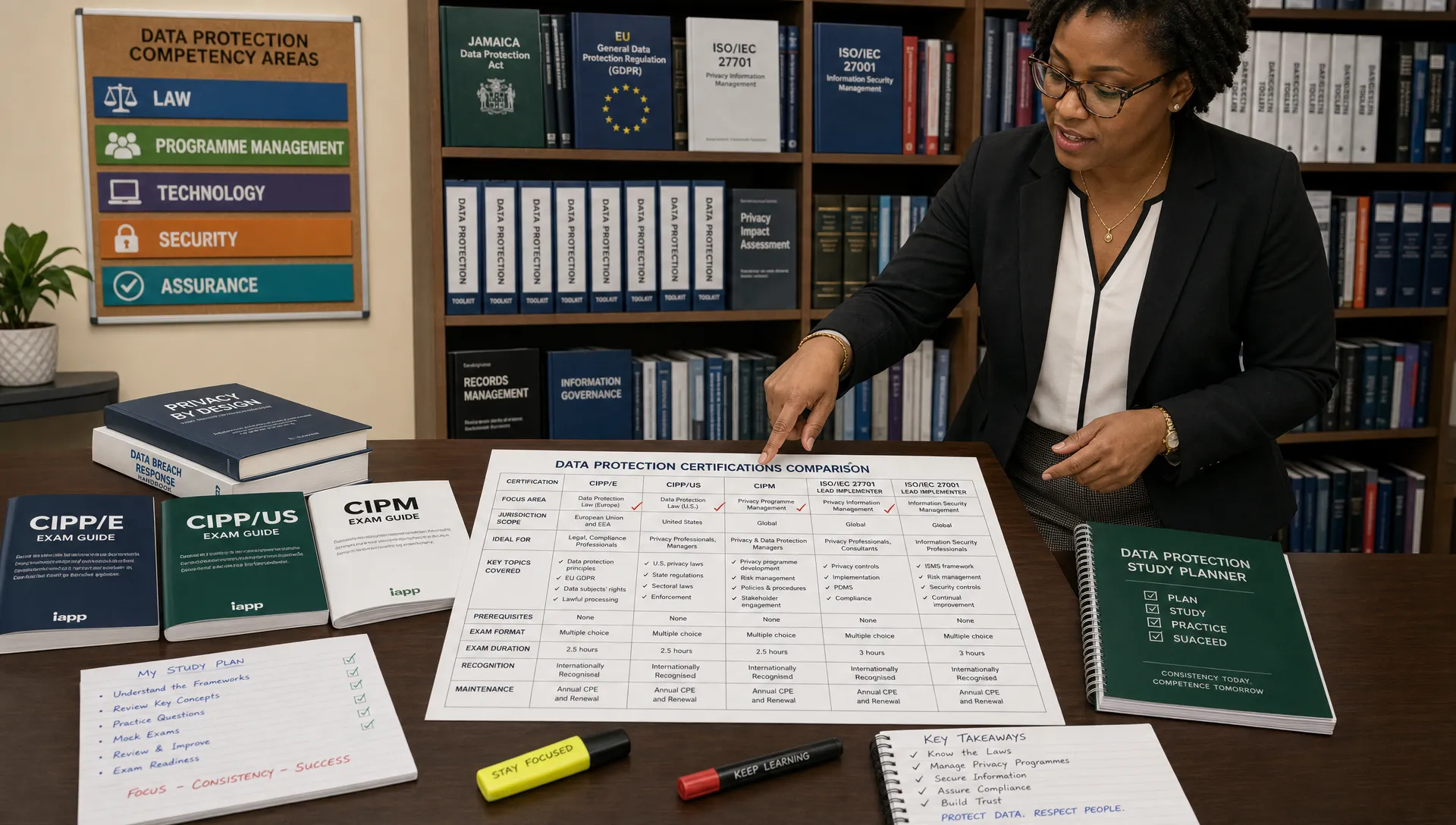
In 2026, data protection certifications are no longer just résumé boosters. For privacy officers, compliance managers, IT leaders, auditors, consultants, and directors, the right credential can help prove that you understand privacy risk, accountability, data subject rights, vendor oversight, and security controls in a way that stands up to scrutiny.
But not every certification is worth the time, cost, and study effort. Some are excellent for privacy programme management. Some are better for legal interpretation, technology teams, or audit readiness. Others sound impressive but may add little value if they do not connect to your role, your organisation’s risk profile, or Jamaica’s Data Protection Act obligations.
The practical question is not “Which certification is best?” It is “Which certification is worth it for the work I actually need to do?”
The short answer: the most worthwhile certifications by goal
If you need a quick starting point, the strongest data protection certifications in 2026 tend to fall into five categories: privacy law, privacy programme management, privacy technology, information security, and management system assurance.
Your goal | Certifications or credentials to consider | Why they may be worth it in 2026 |
Lead a privacy programme | IAPP CIPM, practical DPO training, ISO/IEC 27701 implementer training | Strong fit for privacy officers, compliance leads, and governance teams responsible for turning policy into evidence |
Understand privacy law and rights | IAPP CIPP/E, credible local data protection training | Useful where cross-border processing, contracts, consent, data subject rights, and regulatory expectations matter |
Build privacy into systems and products | IAPP CIPT, ISACA CDPSE | Valuable for IT, cyber, product, and data teams implementing privacy by design |
Strengthen security controls that support privacy | ISO/IEC 27001 Lead Implementer or Lead Auditor, CISM, CISSP | Helpful because data protection depends on confidentiality, integrity, access control, incident response, and risk management |
Demonstrate organisational maturity | ISO/IEC 27001 and ISO/IEC 27701 certification at the organisation level | Stronger evidence for clients, regulators, boards, and partners, but not a substitute for legal compliance |
For Jamaican organisations, the best path is usually a combination of global credibility and local legal relevance. A globally recognised certification can show professional competence, while Jamaica-focused training ensures the person can apply that competence to local statutory duties, sector expectations, and real operating conditions.
If you want a broader credential-by-credential overview, PLMC has also published a detailed comparison of which data protection qualifications matter most for organisations building privacy capability.
What makes a data protection certification “worth it” in 2026?
A certification is worth pursuing when it helps you make better decisions, reduce organisational risk, and produce evidence of compliance. It is less valuable when it only adds letters after your name without improving your ability to implement controls, advise stakeholders, or withstand an audit.
In 2026, the value of a certification should be judged against six criteria.
First, it must match your role. A lawyer or compliance adviser may benefit more from a privacy law certification, while an IT architect may get more value from a privacy engineering or security certification. A privacy manager responsible for policies, registers, assessments, and training needs a programme management credential more than a purely legal one.
Second, it should support accountability. Modern privacy compliance is evidence-based. Organisations need to show how they identify personal data, assess risk, train staff, handle requests, manage vendors, respond to incidents, and review controls. A useful certification teaches you how to build or evaluate those processes.
Third, it should be recognised by employers, clients, boards, or regulators. Recognition does not mean popularity alone. It means the credential has a credible body of knowledge, assessment method, continuing education requirement, or connection to accepted standards.
Fourth, it should be current. Data protection work now touches artificial intelligence, automated decision-making, cloud platforms, cyber resilience, data sharing, children’s data, biometrics, and cross-border transfers. A certification that has not evolved with these risks may be less useful.
Fifth, it should fit your jurisdiction. Jamaica’s Data Protection Act has its own legal requirements and regulatory context. A GDPR-focused credential can be very useful, but it should be paired with training or advice that explains Jamaican obligations.
Sixth, it should be applied. A certification has the most value when it leads to better data mapping, clearer privacy notices, stronger access controls, improved vendor contracts, more meaningful training, and better risk assessment records.
IAPP certifications: strong value for privacy professionals
The International Association of Privacy Professionals is one of the most recognised global bodies for privacy credentials. The IAPP certification portfolio includes several credentials that can be worthwhile, depending on your role.
CIPP/E: worth it for privacy law and cross-border context
The Certified Information Privacy Professional/Europe, commonly known as CIPP/E, remains one of the most recognised privacy law certifications. It focuses heavily on the EU GDPR, which continues to influence privacy practices around the world.
For Jamaican professionals, CIPP/E is worth considering if your organisation handles data involving European residents, works with international partners, negotiates data processing agreements, operates in outsourcing or business process services, or wants to benchmark against a mature privacy regime.
Its limitation is important: CIPP/E is not a Jamaica Data Protection Act certification. It can strengthen your understanding of privacy concepts, rights, lawful bases, accountability, security, and transfers, but it should not be treated as local legal training.
CIPM: often the best fit for privacy officers and compliance leads
The Certified Information Privacy Manager, or CIPM, is often the most practical IAPP credential for people responsible for running a privacy programme. It focuses less on memorising legal provisions and more on building, managing, and measuring privacy operations.
CIPM is particularly useful for Data Protection Officers, compliance managers, governance professionals, risk teams, internal auditors, and privacy consultants. If your daily work involves policies, procedures, privacy impact assessments, vendor reviews, training, incident processes, metrics, and reporting to leadership, CIPM may offer stronger practical value than a law-heavy credential.
For Jamaican organisations moving from awareness to demonstrable compliance, this operational focus is especially relevant. Privacy is no longer just a policy document. It is a repeatable system of decisions, controls, evidence, and accountability.
CIPT: valuable for technology, product, and cyber teams
The Certified Information Privacy Technologist, or CIPT, is designed for professionals who need to embed privacy into technology. It can be worthwhile for IT managers, security architects, developers, data engineers, product owners, and digital transformation teams.
CIPT becomes especially relevant where organisations are adopting cloud systems, customer portals, HR platforms, analytics tools, AI-enabled services, or mobile apps. These projects often create privacy risks long before legal or compliance teams are asked to review them.
If your organisation struggles to translate privacy requirements into technical controls, CIPT can help close that gap.
ISACA CDPSE: strong for the privacy and technology bridge
The Certified Data Privacy Solutions Engineer, or CDPSE, is an ISACA credential aimed at professionals who design, implement, and manage privacy solutions. It is especially useful for people working at the intersection of privacy, IT, cyber security, systems implementation, and risk.
CDPSE can be worth it if your role involves data lifecycle management, privacy architecture, technical control design, risk assessment, or implementing privacy requirements in enterprise systems.
Compared with CIPP/E, CDPSE is less focused on legal interpretation. Compared with CIPM, it is more technical. For organisations where privacy failures often come from poor system design, unclear access permissions, weak retention controls, or inadequate data inventories, CDPSE can be a practical choice.
ISO/IEC 27001 and ISO/IEC 27701: valuable for organisational assurance
Individual certifications show that a person has knowledge. ISO certifications and related implementer or auditor training help organisations build structured management systems.
ISO/IEC 27001 is the leading international standard for information security management systems. It is not a privacy certification by itself, but it is highly relevant because privacy depends on security. If personal data is not protected through access control, asset management, supplier security, incident response, and risk treatment, privacy compliance will be weak.
ISO/IEC 27701 extends the management system approach into privacy information management. It can help organisations define privacy roles, controls, records, and processes for personal data handling.
For Jamaican organisations, ISO-related training can be worth it when clients, boards, international partners, or regulated-sector expectations require stronger assurance. It is also helpful where privacy and cyber security teams need a shared operating model. PLMC’s guidance on aligning data protection standards with global best practice explores this standards-based approach in more depth.
Still, ISO certification should not be misunderstood. Being certified to a standard does not automatically prove full compliance with Jamaica’s Data Protection Act. It can provide strong evidence of governance and controls, but legal compliance still requires attention to local statutory obligations, rights, notices, lawful processing, retention, and regulatory expectations.
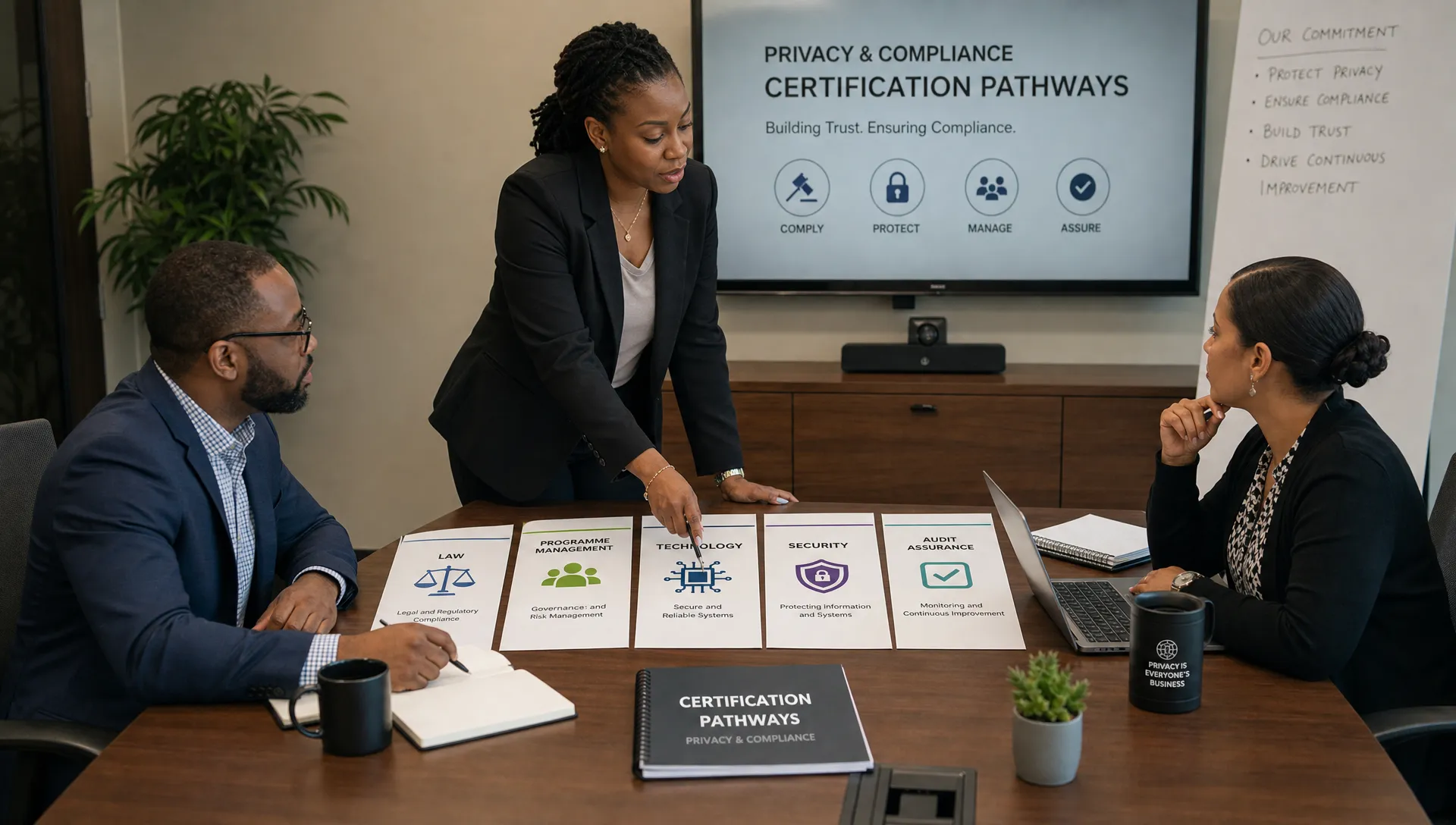
Certified DPO courses: useful only if they are practical and jurisdiction-aware
Many providers offer Certified Data Protection Officer or DPO training. Some are excellent. Others are too generic, too theoretical, or too focused on another jurisdiction.
A DPO course can be worth it if it teaches the actual work of the role: data inventories, privacy notices, consent management, data subject requests, privacy impact assessments, breach response, training, vendor reviews, reporting, and record-keeping. It is even more useful if it addresses Jamaica’s Data Protection Act directly.
Before choosing a DPO course, review the syllabus carefully. Look for scenario-based exercises, practical templates, assessment requirements, trainer credibility, and coverage of local obligations. If the course is only a short awareness session with a certificate of attendance, it may still be useful for general learning, but it should not be treated as a professional credential.
Cyber security certifications: not privacy credentials, but often worth it
Data protection and cyber security are not the same thing, but they are closely connected. A privacy programme without security controls is fragile. A security programme without privacy governance may protect systems while still mishandling personal data.
Security credentials such as ISO/IEC 27001 Lead Implementer, ISO/IEC 27001 Lead Auditor, CISM, and CISSP can be worthwhile for professionals responsible for technical and organisational controls. They are particularly relevant for incident response, access management, third-party risk, cloud security, encryption, monitoring, and governance.
However, these credentials do not replace privacy training. A security professional may know how to protect a database but still need privacy knowledge to determine whether the organisation should collect the data, how long it should keep it, who should access it, and what rights individuals have.
The strongest teams usually combine both disciplines.
NIST and other frameworks: useful, but not always certifications
Some frameworks are very valuable even though they are not certifications. The NIST Privacy Framework, for example, can help organisations structure privacy risk management, identify gaps, and align privacy with enterprise risk processes.
This distinction matters. A framework can guide implementation, while a certification validates knowledge or confirms that a management system has been assessed. Both can be useful, but they serve different purposes.
If a training provider advertises a “certification” based on a framework, check whether it is independently recognised, exam-based, accredited, or simply a course completion certificate.
Which certification should you choose by role?
The most cost-effective path depends on what you are accountable for. A certification that is perfect for one professional may be a poor investment for another.
Role or career goal | Best starting point | Strong next step |
New privacy analyst or compliance officer | Local data protection training, CIPP/E, or foundational DPO training | CIPM once you begin managing programme activities |
Data Protection Officer or privacy lead | CIPM plus Jamaica-specific Data Protection Act training | CIPP/E, ISO/IEC 27701 implementer training, or sector-specific compliance training |
Lawyer or legal adviser | CIPP/E and local privacy law training | CIPM if advising on programme implementation |
IT, cyber, or systems professional | CIPT, CDPSE, or ISO/IEC 27001 training | ISO/IEC 27701 or privacy by design training |
Internal auditor or risk professional | ISO/IEC 27001 Lead Auditor, ISO/IEC 27701 training | CIPM or privacy risk assessment training |
Board member or executive | Executive privacy governance briefing | Not usually a full technical certification unless directly responsible for oversight implementation |
Consultant | CIPM, CIPP/E, and practical DPO training | ISO/IEC 27001 or 27701 auditor or implementer training, depending on service focus |
For most organisations, it is unnecessary for everyone to be certified. A better model is to certify key privacy, risk, IT, and compliance personnel, then support the wider workforce with role-based awareness training.
How Jamaican organisations should think about certification ROI
Certification return on investment should be measured by improved capability, not just the number of certified staff. A certified person should help the organisation answer practical questions with more confidence.
Can we identify where personal data is stored? Can we explain our lawful basis or condition for processing? Can we respond to data subject requests within required timelines? Can we show training attendance and behavioural improvement? Can we assess vendor risk before sharing personal data? Can we document privacy risks before launching a high-risk project?
This is where certification connects to real compliance work. For example, a privacy lead with CIPM training may be better equipped to build a privacy programme, but the organisation still needs a working assessment process. PLMC’s guide to scoping a data protection risk assessment is a useful complement because it focuses on the evidence organisations need when processing activities create risk.
Jamaican organisations should also consider sector context. Financial services, healthcare, education, telecommunications, public bodies, outsourcing providers, and organisations handling sensitive personal data may need deeper capability than a low-risk business with limited personal data. The higher the risk, the more valuable a recognised credential becomes.
The Office of the Information Commissioner in Jamaica remains an important reference point for local regulatory information, guidance, and compliance expectations. Global credentials should be interpreted through that local lens.
When a data protection certification is not worth it
A certification may not be worth pursuing immediately if it does not align with your responsibilities or if your organisation is not ready to apply what you learn.
For example, an expensive advanced certification may be unnecessary for staff who only need to recognise personal data, avoid phishing, follow clean desk rules, escalate incidents, and handle customer information appropriately. In that case, practical awareness training is more cost-effective.
A certification is also less valuable if the person will not have time, authority, or support to implement improvements. Privacy maturity depends on governance. If leadership treats certification as a box-ticking exercise, the organisation may end up with certified employees but weak controls.
Be cautious with credentials that have unclear assessment standards, no continuing education requirement, vague course content, or exaggerated promises. A certificate of attendance is not the same as a professional certification.
A practical certification strategy for 2026
The most effective approach is to build a balanced privacy capability rather than chase every credential available.
For a small or medium-sized Jamaican organisation, a practical model may include one privacy or compliance lead with strong DPO or CIPM-style training, one IT or cyber lead with security and privacy-by-design knowledge, and role-based awareness training for staff who handle personal data.
For a larger or higher-risk organisation, the mix may include legal privacy expertise, privacy programme management, ISO-based controls, internal audit capability, vendor risk assessment skills, and specialist support for high-risk projects.
Before approving a certification budget, ask these questions:
Does the certification support our actual Data Protection Act obligations and risk profile?
Will the person use the knowledge in their current role within the next six to twelve months?
Is the credential recognised by employers, clients, regulators, or professional peers?
Does it teach practical implementation, not only theory?
Will we pair global certification with Jamaica-specific guidance?
How will we measure the impact after training or certification?
The final question is often the most important. If certification does not improve decisions, documentation, controls, or accountability, it is not delivering full value.
Frequently Asked Questions
Are data protection certifications required under Jamaica’s Data Protection Act? Jamaica’s framework focuses on compliance duties, accountability, and appropriate handling of personal data. A specific global certification is not a substitute for compliance, but recognised training and credentials can help demonstrate competence and support better implementation.
Is CIPP/E worth it for Jamaican professionals? Yes, for many professionals, especially those working with international clients, cross-border data flows, contracts, or privacy advisory work. However, it should be paired with Jamaica-specific Data Protection Act knowledge.
Is CIPM better than CIPP/E? It depends on your role. CIPM is often better for people managing privacy programmes, controls, training, risk assessments, and reporting. CIPP/E is stronger for privacy law concepts and GDPR-based analysis.
Is ISO/IEC 27701 the same as being compliant with data protection law? No. ISO/IEC 27701 can support a strong privacy information management system, but certification to a standard does not automatically prove full legal compliance in every jurisdiction.
Which certification is best for IT teams? IT teams should consider CIPT, CDPSE, ISO/IEC 27001 training, or privacy-by-design training. The right choice depends on whether the team manages systems architecture, security controls, data governance, or implementation projects.
Should every employee get certified? No. Most employees need practical, role-based awareness training rather than professional certification. Certifications are best reserved for people with privacy, compliance, IT, risk, audit, legal, or governance responsibilities.
Need help choosing the right path?
The most worthwhile data protection certifications are the ones that help your organisation reduce real risk, meet legal obligations, and produce evidence of accountability.
Privacy & Legal Management Consultants Ltd. supports Jamaican organisations with data protection implementation, governance, risk, compliance, training, cyber security alignment, and privacy awareness. If you are deciding which certifications, training, or compliance steps make sense for your team in 2026, contact PLMC to discuss a practical path forward.