
Data Protection Qualifications: Which Certifications Matter Most?

Hiring (or becoming) the person responsible for privacy is no longer a “nice to have” in Jamaica. With the Data Protection Act in force, organisations are expected to show competence, not just good intentions. That is why data protection qualifications and recognised certifications have become a practical way to prove capability to regulators, customers, and boards.
Still, the certification landscape is crowded. Some credentials signal deep knowledge of privacy law, others focus on running an operational privacy programme, and others sit closer to cyber security and audit.
This guide breaks down which data protection certifications matter most, what each one is best for, and how Jamaican organisations can choose a path that actually supports compliance.
What “data protection qualifications” should prove in 2026
A credible qualification should help you do at least one of these things well:
Interpret obligations (what the law requires and what “good” looks like)
Operationalise compliance (policies, processes, training, vendor controls, breach readiness)
Evidence accountability (risk assessments, audit trails, governance and reporting)
Reduce security and privacy risk (controls that prevent incidents and support response)
If a certification does not strengthen one of those outcomes, it may be impressive on LinkedIn but weak in real-world compliance.
Certifications vs experience: what employers should prioritise
Certifications are not a substitute for hands-on work, but they are useful signals, especially when:
You are moving into privacy from another field (legal, HR, IT, compliance)
Your organisation needs a consistent baseline across teams
You must demonstrate structured competence to clients, partners, or auditors
A strong hiring or development profile usually blends:
Practical experience (data mapping, notices, DSAR workflows, incident management)
Sector context (financial services, healthcare, education, retail)
A recognised certification aligned to the role
If you are building a privacy programme now, PLMC’s practical implementation content can help you connect qualifications to real controls, for example the Data Protection Jamaica: Compliance Roadmap for 2026 and the Privacy and Data Protection: A Practical Checklist.
The certifications that matter most (and why)
Below are the credentials that most consistently map to real privacy programme needs, including in Jamaica where many organisations also interact with UK/EU customers, platforms, and vendors.
1) IAPP certifications (privacy law, programme management, and privacy-tech)
The International Association of Privacy Professionals (IAPP) is widely recognised globally for privacy credentials. These are often the most “portable” privacy certifications across countries and industries.
Best choices depending on your role:
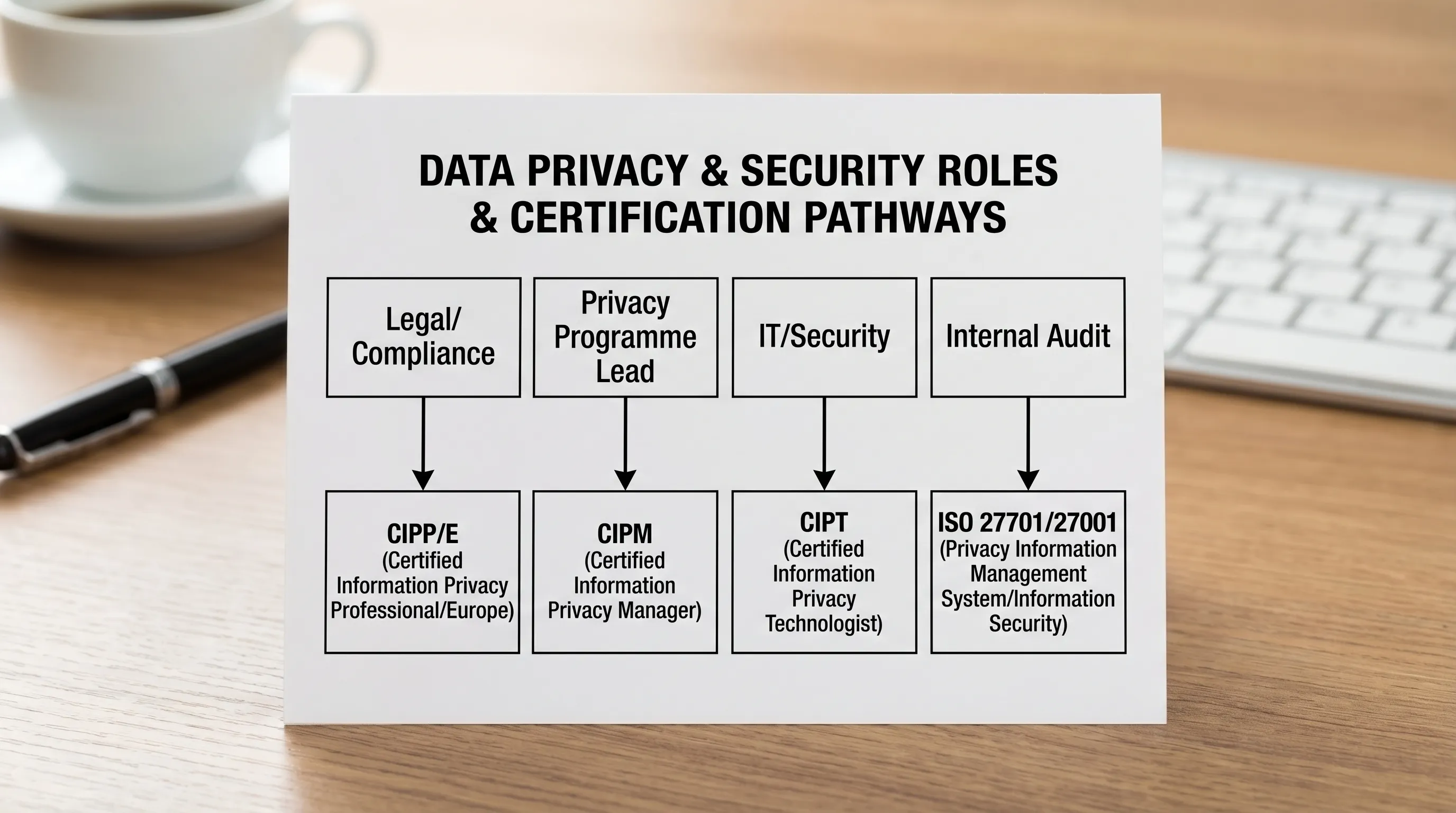
CIPP/E (Certified Information Privacy Professional, Europe): Strong for understanding GDPR-style privacy concepts. It can be valuable in Jamaica because many “best practice” privacy programmes are modelled on GDPR principles, and many Jamaican organisations do business with EU or UK-linked partners.
CIPM (Certified Information Privacy Manager): Focuses on building and running a privacy programme, governance, metrics, risk management, and accountability. This is often the most practical certification for someone leading implementation.
CIPT (Certified Information Privacy Technologist): Best for professionals working at the intersection of privacy and systems (IT, security, product, engineering, data teams).
When IAPP matters most: When you need to prove you can translate privacy requirements into a structured programme, and you want a credential that hiring managers recognise internationally.
2) ISO/IEC 27701 (privacy information management)
ISO/IEC 27701 is a privacy extension to ISO/IEC 27001 (information security management). It is particularly useful when an organisation wants privacy controls that are measurable, auditable, and integrated into an existing management system.
Two different things are often confused:
The ISO standard itself (a framework for organisations)
Training courses for individuals (implementation or lead auditor style courses delivered by various training bodies)
Why it matters in practice: ISO-based approaches are strong for governance, evidence, and audit readiness. For organisations that already think in terms of controls and audits (regulated sectors, larger enterprises, group companies), ISO 27701 can be a practical way to structure privacy.
3) ISO/IEC 27001 (information security management)
If you work in privacy, you will eventually need to answer security questions. ISO/IEC 27001 is not a privacy certification, but it is one of the most credible frameworks for information security management.
Why it matters for privacy roles: Most privacy failures become serious because of weak security controls, weak access management, poor vendor oversight, or slow incident response. A privacy lead who understands security governance can reduce risk faster.
4) Privacy training from regulators and reputable institutions (context and credibility)
In the Caribbean, many organisations benefit from structured training that is tailored to local operational realities (SME constraints, vendor-heavy ecosystems, lean IT teams, and mixed paper and digital processing).
A good programme should cover:
Core privacy principles and lawful processing
Handling rights requests (access, correction, objection, deletion where applicable)
Vendor and cross-border risk
Breach readiness and incident response coordination
Evidence packs (policies, records, logs, assessments)
If you are selecting training, prioritise courses that include implementation outputs, not just legal theory.

Quick comparison: which certification fits which job?
Use this table as a decision aid for the most common privacy roles Jamaican organisations hire for.
Certification or standard | Primary focus | Best for | What it signals to employers |
IAPP CIPP/E | Privacy law and regulatory concepts (GDPR-oriented) | Legal, compliance, privacy analysts, anyone needing strong privacy fundamentals | You can interpret privacy obligations and talk confidently with counsel and stakeholders |
IAPP CIPM | Running a privacy programme (governance, operations, accountability) | Privacy lead, project/programme managers, compliance managers | You can operationalise privacy, build processes, and report progress |
IAPP CIPT | Privacy in technology (systems, data, engineering realities) | IT, security, product, data teams, privacy engineers | You can embed privacy into systems and work credibly with technical teams |
ISO/IEC 27701 (training for implementation/audit) | Privacy management system controls and auditability | GRC teams, internal audit, compliance and security leadership | You can structure privacy controls, evidence, and assurance using a recognised framework |
ISO/IEC 27001 (training for implementation/audit) | Security management system and risk controls | Security leaders, IT managers, risk teams, privacy leads who must partner with security | You can manage security risk in a disciplined, auditable way |
Recommended learning paths (without over-collecting certificates)
A common mistake is stacking credentials that overlap. A better approach is to build a “T-shaped” profile: one strong core, plus one complementary area.
Path A: Privacy lead building a compliance programme
If you are accountable for getting an organisation to “compliant in practice,” consider:
Start with privacy foundations and Jamaican obligations (internal training plus your organisation’s policies)
Add IAPP CIPM for programme management depth
Add a security or controls lens (intro ISO 27001 concepts, or risk management training)
This path supports practical delivery: data inventory, notices, rights workflows, vendor controls, incident readiness, and evidence.
Path B: Attorney or compliance officer moving into privacy
If you interpret policy and advise decision-makers:
IAPP CIPP/E (strong legal and regulatory concepts)
Then add CIPM if you also oversee implementation across departments
Path C: IT/security professional supporting privacy compliance
If you manage systems, access, cloud tools, or incident response:
IAPP CIPT to connect privacy requirements to technical controls
Complement with ISO 27001 concepts (risk treatment, control selection, auditability)
Path D: Internal audit or risk professional assessing privacy
If you will test controls and assurance:
ISO 27701 approach (implementation and audit concepts)
Complement with CIPM concepts to understand how privacy programmes operate day-to-day
What Jamaican organisations should look for when hiring
If you are recruiting a privacy lead, do not rely on certifications alone. In interviews, ask for proof of ability to implement.
Stronger indicators than a credential name:
Can the candidate explain how they would build a data inventory (even a simple one)?
Can they describe a workable rights request process, including identity verification and timelines?
Do they understand vendor risk, including cloud services and cross-border processing?
Can they outline an incident workflow and who should be involved (IT, legal, HR, comms, management)?
Can they name the documents and logs you should be able to produce (policies, records, training evidence, assessments)?
If you need a practical baseline for what “good evidence” looks like, use PLMC’s practical checklist as a hiring and capability benchmark.
Common mistakes when choosing data protection qualifications
Choosing a certification that does not match your actual job
A privacy programme lead who only takes law-focused training may struggle with execution. A technologist who only takes legal theory may struggle to embed controls.
Treating privacy as separate from security and risk
Privacy compliance is governance plus controls plus evidence. If your learning path ignores security and risk management, you will likely miss the operational core.
Using certificates as a substitute for a programme
An organisation cannot “certify its way” to compliance. Regulators and customers look for implemented controls, training, vendor oversight, and demonstrable accountability.
Frequently Asked Questions
Which is better for data protection, CIPP/E or CIPM? CIPP/E is strongest for privacy law concepts (GDPR-oriented). CIPM is strongest for running a privacy programme. For many organisations, CIPM is the more directly practical choice.
Do I need a certification to be a privacy officer in Jamaica? A certification is not automatically required, but it is often a useful way to demonstrate competence, especially when your organisation needs credible evidence of capability.
Is ISO 27701 a personal certification? ISO/IEC 27701 is an organisational standard. Individuals typically take training courses on how to implement or audit against ISO 27701 concepts, often alongside ISO 27001.
What are the best data protection qualifications for IT professionals? Many IT and security professionals benefit from IAPP CIPT for privacy-tech alignment, and from ISO 27001 concepts to strengthen security governance and control design.
How should an organisation choose what to train staff on first? Start with role-based essentials: everyone gets privacy awareness, customer-facing and HR teams get rights-handling and records practices, IT/security gets incident and access controls, managers get governance and accountability.
Get help choosing the right qualifications and building real compliance
If you are deciding between certifications, or you need your team trained around the controls that actually matter under Jamaica’s Data Protection Act, PLMC can help you map roles to competencies, build a realistic training plan, and turn learning into implementation.
Explore PLMC’s resources, or request a free consultation at Privacy & Legal Management Consultants Ltd..