

Data Protection Standards: Aligning with Global Best Practice

Global data flows do not stop at borders, and your customers, regulators, banks, and overseas partners increasingly expect the same thing, proof that you protect personal data in a consistent, repeatable, and auditable way. That is where data protection standards come in. They help Jamaican organisations turn legal requirements into operational controls, align with international expectations, and demonstrate accountability when something goes wrong.
This article breaks down what “global best practice” looks like in practical terms, which standards matter most, and how to choose and implement the right mix alongside Jamaica’s Data Protection Act.
What “data protection standards” really mean (and why they matter)
A law tells you what you must do. A standard or framework helps you show how you do it, day to day.
For many organisations, especially those working with overseas clients, payment providers, or multinational supply chains, aligning to recognised standards can help you:
Reduce ambiguity by translating privacy principles into clear controls and procedures
Build a consistent compliance programme across departments and subsidiaries
Strengthen vendor and cross border assurance, especially for cloud services
Provide evidence of due diligence to boards, customers, and regulators
Improve incident readiness and reduce the impact of breaches
In Jamaica, this is particularly valuable because many businesses are balancing local legal compliance with international expectations from partners who reference GDPR, ISO standards, or NIST.
Global best practice starts with shared principles
Most reputable privacy and security standards are built on a common set of ideas:
Transparency and fairness (people should understand what happens to their data)
Purpose limitation and minimisation (collect only what you need for a clear purpose)
Accuracy and retention discipline (keep data correct, keep it only as long as needed)
Security (appropriate technical and organisational measures)
Accountability (being able to prove your programme works)
If your programme can consistently deliver on those principles, you are already moving toward global best practice. The standards below help you operationalise them.
The most referenced global standards and frameworks (and what each is best for)
There is no single “one standard” that fits every organisation. Many mature programmes combine a privacy focused framework with an information security management standard.
ISO/IEC 27001 (information security management)
ISO/IEC 27001 is one of the most recognised standards globally for establishing an Information Security Management System (ISMS). It focuses on confidentiality, integrity, and availability, and it is widely used for certification.
Why it matters for privacy: strong security governance and controls are foundational for protecting personal data, and ISO 27001 provides a structured, auditable way to manage them.
ISO/IEC 27701 (privacy information management)
ISO/IEC 27701 extends ISO 27001 into a Privacy Information Management System (PIMS). It helps organisations implement privacy controls, responsibilities, and documentation practices that map well to modern privacy laws.
Why it matters: if you want a management system approach to privacy (not just policies), ISO 27701 is one of the clearest global routes.
NIST Privacy Framework (privacy risk management)
The NIST Privacy Framework is widely referenced for privacy risk management, especially in organisations that want a flexible, outcomes based approach. It helps teams identify privacy risks and build controls that are proportionate to the context.
Why it matters: it supports practical conversations between legal, IT, security, and business teams, and it is useful when you need a roadmap rather than a certification.
GDPR as a global benchmark (even outside the EU)
The EU GDPR is not a “standard”, but in practice it has become a global benchmark for privacy programme design. Many multinational contracts, vendor questionnaires, and cross border assurance requirements are influenced by GDPR concepts (lawful bases, transparency, rights handling, DPIAs, accountability).
For practical guidance, the UK Information Commissioner’s Office (ICO) remains one of the most helpful regulators for plain language implementation resources, even if your organisation is not UK based. See the ICO’s guide to data protection.
OECD privacy principles (foundational guidance)
The OECD Privacy Guidelines are influential internationally and reflect many of the privacy principles seen across modern data protection laws. They are useful for leadership alignment and policy baselines.
Sector and ecosystem standards (use when applicable)
Some organisations need additional standards because of their industry or payment ecosystem. For example, PCI DSS is essential if you store, process, or transmit cardholder data. These are not replacements for a privacy programme, but they often form part of your overall assurance posture.
Quick comparison: which standard should you start with?
Standard or framework | Primary focus | Best for | Typical outputs you can show |
ISO/IEC 27001 | Security management system (ISMS) | Organisations that need auditable security governance, often for client assurance | ISMS scope, risk assessment method, Statement of Applicability, audit results |
ISO/IEC 27701 | Privacy management system (PIMS) | Organisations that want structured privacy governance aligned to security management | Privacy roles, privacy control implementation evidence, mapped privacy documentation |
NIST Privacy Framework | Privacy risk outcomes | Organisations that want a flexible roadmap without pursuing certification | Privacy risk profiles, target state roadmap, prioritised control plan |
GDPR (benchmark) | Comprehensive privacy expectations | Organisations dealing with EU or UK partners, or seeking “high bar” practices | DPIA approach, rights request process, transparency content, accountability evidence |
OECD principles | Foundational privacy principles | Boards and leadership teams building policy direction | Policy baseline, programme principles, governance expectations |
How to align your organisation with global best practice (without overbuilding)
Most programmes fail for one of two reasons: they stay too high level (policies only), or they over engineer controls that the business cannot sustain. A practical alignment approach is to choose a standard baseline, then implement it proportionately.
Set your target state (and be clear about scope)
Start by defining what “aligned” means for your organisation:
Are you aligning for customer assurance (vendor questionnaires, procurement requirements)?
Are you aligning to reduce risk and improve governance maturity?
Are you preparing for audits, funding, or expansion into new markets?
Also define scope early. Many organisations begin with the most sensitive functions (HR, customer databases, online platforms, claims, call centres) and expand over time.
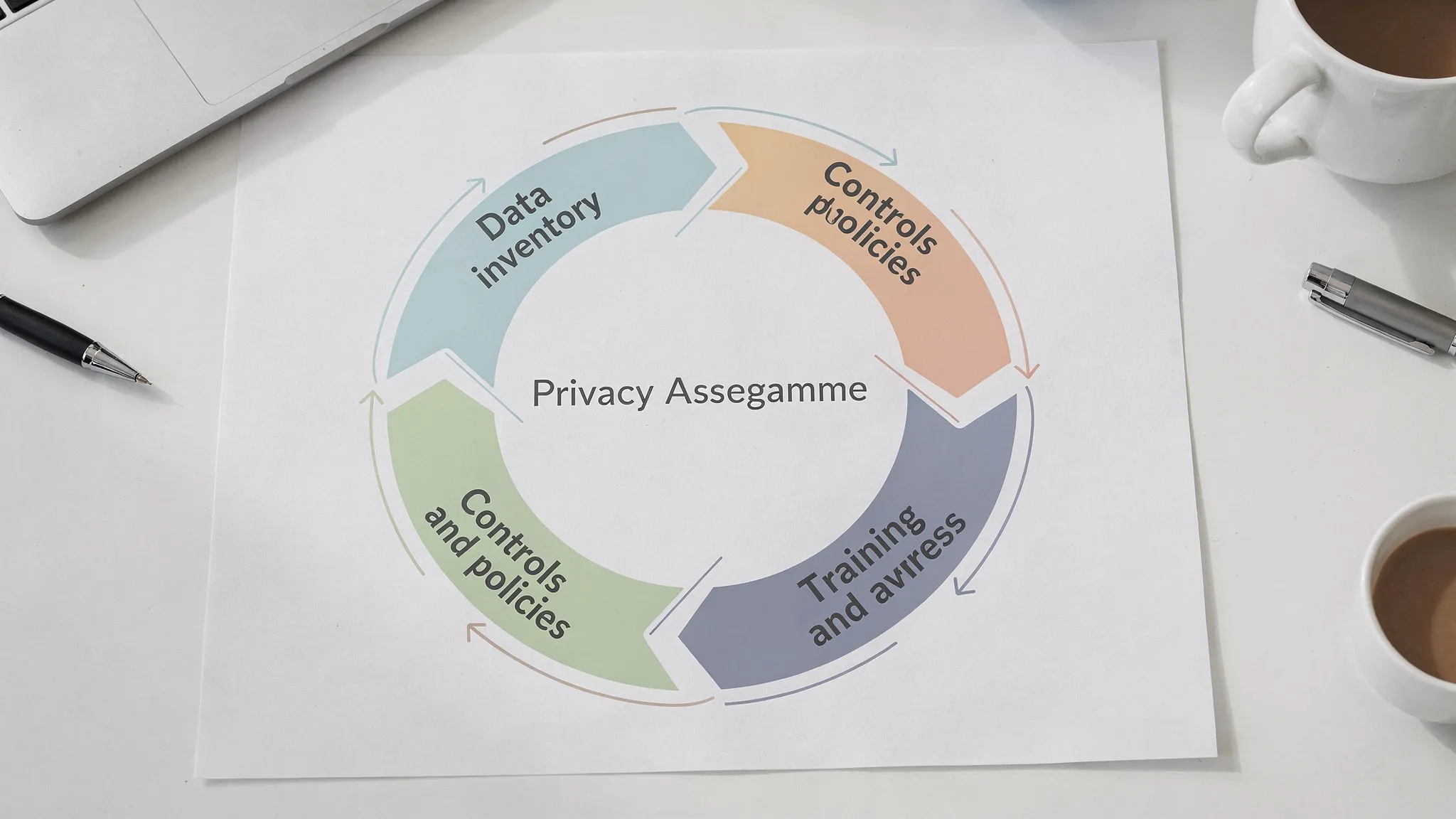
Build or refresh your data inventory (you cannot protect what you cannot see)
Global standards assume you understand your data.
At minimum, your inventory should capture:
What personal data you collect and where it lives (systems, paper, cloud tools)
Why you collect it (purpose) and the lawful basis you rely on
Who you share it with (internal teams, service providers)
How long you keep it (retention rules)
Whether it moves outside Jamaica (cross border transfers)
If you want a practical, Jamaica focused starting point, use your existing internal work alongside a structured checklist like PLMC’s Privacy and Data Protection: A Practical Checklist.
Run a gap assessment against one main framework
Choose one primary “spine” to reduce complexity:
If your biggest risk is weak security governance, start with ISO 27001 concepts.
If your biggest gap is privacy governance and documentation, consider ISO 27701 concepts.
If you need a pragmatic roadmap across teams, use the NIST Privacy Framework approach.
Then map results to your legal obligations under Jamaica’s Data Protection Act (and any contractual requirements). The goal is to produce a prioritised backlog, not a 200 page report.
Put governance in place that can survive staff turnover
Global best practice is not a one person project. It is roles, routines, and evidence.
Key governance elements typically include:
Clear ownership for privacy and security decisions (including escalation paths)
Policies that match how the business actually operates
A risk register that includes privacy risks, not only cyber risks
Training that is role based (frontline, HR, IT, management)
PLMC’s Jamaica focused guidance in Jamaica Data Protection Act Explained for Businesses can help you translate governance responsibilities into operational steps.
Make privacy risk assessment a repeatable process
A mature programme does not rely on ad hoc judgement. It uses repeatable assessment methods.
In practice, you want a documented process for:
Assessing risk when introducing new systems, vendors, or data uses
Performing deeper assessments for higher risk processing (often aligned to DPIA style thinking)
Recording decisions, mitigations, and approvals
This is where global frameworks help. ISO style management systems push consistency and auditability, while NIST style frameworks help teams talk about risk outcomes in plain language.
Align operational controls (security, rights, retention, and vendors)
Global best practice shows up in everyday operations, not only in your privacy notice.
Common alignment areas include:
Security controls: access management, logging and monitoring, secure configuration, backups, vulnerability management, encryption where appropriate
Individual rights handling: clear intake channels, identity verification, response workflows, and tracking
Retention and disposal: retention schedules that are actually implemented in systems and filing practices
Vendor governance: due diligence, contract clauses, ongoing assurance, and exit planning
If you want to organise this work across the year, PLMC’s Data Protection Jamaica: Compliance Roadmap for 2026 is a practical way to phase implementation without losing momentum.
Treat cross border data transfers as an assurance problem
Many Jamaican organisations use cloud services where data may be stored or accessed internationally. Global best practice is to treat cross border transfers as a combination of legal, technical, and vendor assurance.
That usually means:
Knowing where data is stored and who can access it (including support teams)
Ensuring contracts address confidentiality, security measures, breach notification, and subcontractors
Applying security controls that reduce exposure (strong access controls, MFA, encryption, logging)
Even when your legal basis is clear, your ability to demonstrate control and oversight is what partners often care about most.
Build an “evidence pack” (this is what good looks like)
When clients or regulators ask “Are you compliant?”, what they really mean is “Can you demonstrate it?” A lightweight evidence pack makes standards real.
Evidence area | What good evidence looks like | Why it matters |
Data inventory and records | System list, data categories, purposes, recipients, retention rules | Shows visibility and accountability |
Policies and procedures | Approved policies, version control, staff access, review dates | Proves governance is active |
Risk assessments | Documented method, completed assessments, mitigation tracking | Shows proportional decision making |
Vendor management | Due diligence records, signed agreements, periodic reviews | Demonstrates oversight of processors and suppliers |
Training and awareness | Attendance records, role based sessions, refresh schedule | Reduces human error and supports accountability |
Incident readiness | Incident response plan, test results, breach decision logs | Improves response quality under pressure |
Monitor, test, and improve (standards are not a one time project)
Best practice programmes are living systems. Build a rhythm for:
Periodic internal reviews and control testing
Metrics that leadership can understand (rights requests volumes, training completion, incident trends)
Continuous improvement actions that are tracked to completion
If you are aiming toward ISO style alignment, this “plan, do, check, act” cycle is central. Even without certification, the discipline is valuable.
Common pitfalls when “aligning to standards”
A few patterns regularly derail privacy and data protection improvement work:
Copy and paste policies that do not match your actual processes
Treating privacy as only a legal task, without IT, HR, and operations ownership
Ignoring third parties until an incident or a client audit forces the issue
Overbuilding controls that the organisation cannot maintain
A good programme is realistic, documented, and continuously improving.
Frequently Asked Questions
Do I need ISO certification to be aligned with global best practice? No. Many organisations align their controls to ISO or NIST without pursuing certification. Certification can be useful for customer assurance, but alignment can still deliver strong risk reduction and credible evidence.
Which is better for privacy, ISO 27701 or NIST Privacy Framework? They solve different problems. ISO 27701 is best when you want a management system approach that extends ISO 27001 style governance. NIST is best when you want a flexible roadmap and outcomes based risk management across teams.
How does this relate to Jamaica’s Data Protection Act? Standards help operationalise the Act’s requirements by turning principles into repeatable processes and controls, especially around accountability, security, vendor governance, and ongoing monitoring.
What is the fastest way to improve my organisation’s posture? Start with a current state gap assessment, confirm your data inventory, fix the highest risk issues first (access controls, retention, vendor contracts, incident readiness), then formalise governance and training.
What should we prepare for client privacy and security questionnaires? Maintain an evidence pack, including your data inventory, key policies, risk assessment method, vendor governance approach, incident response plan, and staff training records.
Get help aligning your privacy programme to global standards
If you want to align with global best practice without guesswork, PLMC can help you choose the right standard baseline, run a practical gap assessment, and build an evidence led programme that supports Jamaica Data Protection Act compliance.
Explore PLMC’s resources and services at Privacy & Legal Management Consultants Ltd., or request a free consultation to discuss the fastest path to a credible, sustainable privacy and data protection programme.