

Website Tracking and Cookies: Compliance Basics for 2026
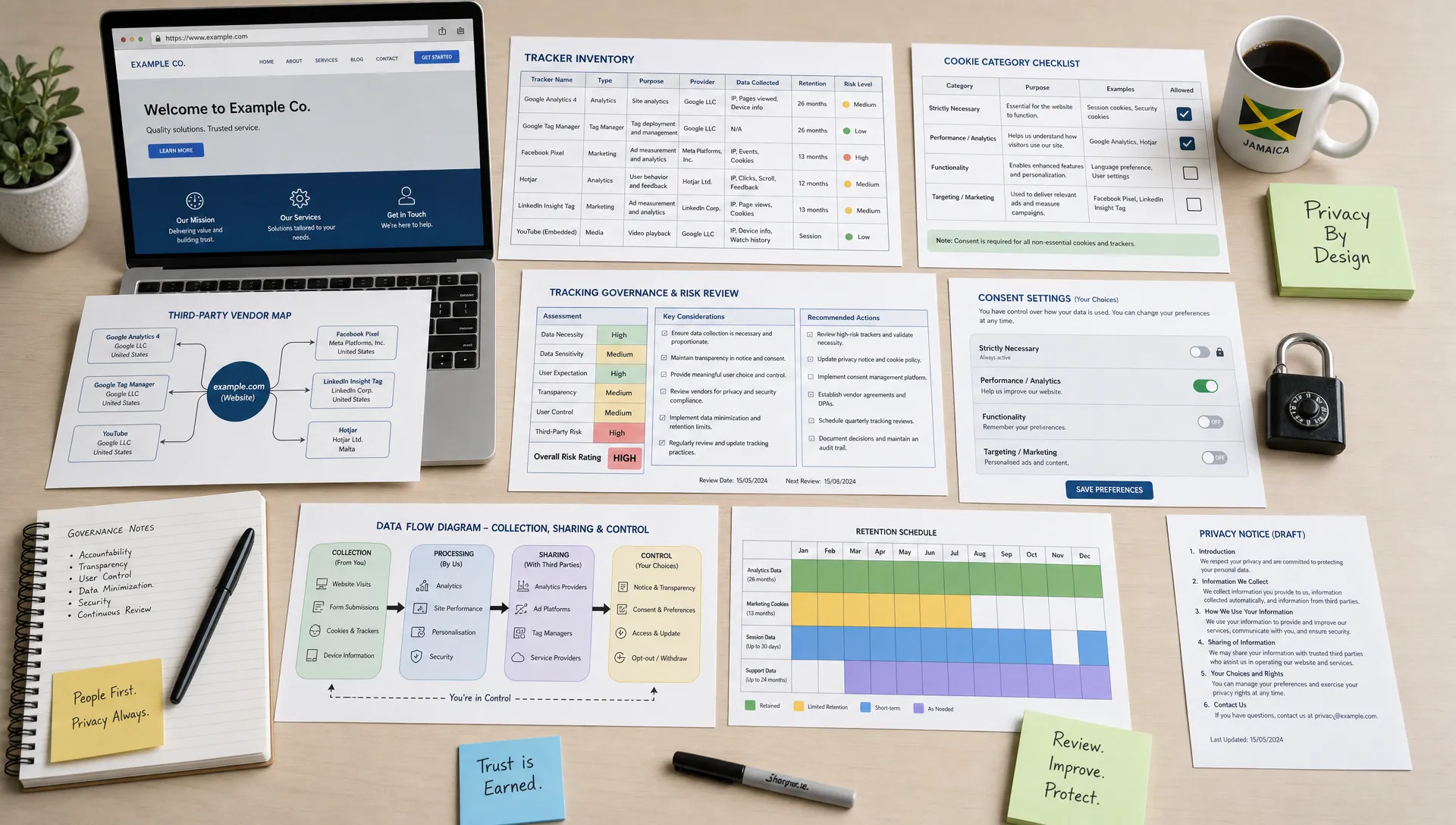
Website tracking used to be treated as a marketing or IT detail. In 2026, it is a data protection compliance issue that belongs on the governance agenda.
Most organisational websites now use analytics tags, advertising pixels, embedded forms, social media plug-ins, chat tools, payment integrations, security scripts and content delivery services. These tools can improve user experience and help teams measure campaigns, but they may also collect personal data, share it with third parties, transfer it overseas or build behavioural profiles.
For Jamaican organisations, the key point is simple: if website tracking can identify a person directly or indirectly, it must be managed under the Data Protection Act, 2020 and your wider privacy programme. The law may not read like a technical cookie manual, but the principles of fairness, transparency, purpose limitation, security, retention and accountability still apply.
This guide explains the compliance basics every organisation should review in 2026, especially if your website collects leads, processes applications, runs ads, uses analytics or serves users outside Jamaica.
What counts as website tracking in 2026?
Cookies are only one part of the tracking picture. A cookie is a small file stored on a user's browser, often used to remember preferences, maintain sessions or recognise returning visitors. Some cookies are essential for a website to work. Others support analytics, advertising, personalisation or cross-site tracking.
However, modern tracking can happen without traditional cookies. A practical website review should also consider pixels, tags, browser storage, device identifiers, server logs, embedded media, form analytics, heatmaps, session replay tools and third-party widgets.
Common tracking technologies include:
Strictly necessary cookies used for log-in sessions, shopping baskets, load balancing, security and fraud prevention.
Functional cookies used to remember language preferences, accessibility choices or saved form progress.
Analytics tools used to measure visits, traffic sources, conversions, page performance and user journeys.
Advertising and remarketing pixels used to build audiences, measure ad campaigns and retarget visitors on other platforms.
Social media plug-ins and embedded content that may allow third parties to collect data when a page loads or when a user interacts with the content.
Fingerprinting and device recognition that can identify or distinguish a browser based on technical characteristics, even without setting a cookie.
The compliance question is not only whether a cookie exists. It is what information is collected, who receives it, why it is used, how long it is kept, whether the user is clearly informed and whether the organisation can prove responsible decision-making.
Why cookies matter under Jamaica's Data Protection Act
Jamaica's Data Protection Act, 2020 is built around core data protection standards. These standards require organisations to process personal data fairly and lawfully, collect it for specified purposes, keep it accurate and secure, avoid unnecessary retention, respect data subject rights and control transfers outside Jamaica.
The Office of the Information Commissioner is the national regulator responsible for promoting compliance with the Act. For organisations operating websites, the practical issue is that many tracking tools collect data that can relate to an identifiable person, even when the website owner does not know the person's name.
Examples include IP addresses, device IDs, cookie IDs, advertising IDs, customer account IDs, form submissions, location signals and browsing behaviour linked to a unique user profile. When that information can identify someone, or can be combined with other information to identify someone, it should be treated as personal data.
This is why website tracking must connect to your broader governance framework. A cookie banner alone will not satisfy accountability if the organisation cannot explain its tracking purposes, vendor arrangements, retention periods or security controls. If your team is reviewing compliance this year, PLMC's article on the latest practical updates affecting Data Protection Act compliance provides useful context on the shift toward demonstrable compliance.
The basic compliance standard: know, tell, control and prove
A practical 2026 approach to website tracking can be reduced to four duties.
First, know what is running on your website. Many organisations are surprised to find old marketing tags, unused pixels, legacy plug-ins or analytics tools installed by former vendors. If no one owns the inventory, no one can manage the risk.
Second, tell users what is happening in plain language. A privacy notice should not hide website tracking inside vague statements such as improving services or enhancing experience. Users should understand the categories of tracking, the purposes, the third parties involved and the choices available to them.
Third, give appropriate control. Strictly necessary cookies may be required for a site to function, but analytics, advertising and profiling tools usually require a more careful approach. Depending on the tool, the purpose and the jurisdictions involved, this may mean prior consent, opt-out rights, granular preferences or a documented lawful justification.
Fourth, keep evidence. Compliance is not just a page on the website. It is the documented ability to show what was assessed, what decisions were made, who approved them, which vendors were reviewed and how user choices are honoured.
Tracking category | Typical purpose | Compliance focus |
Strictly necessary | Security, log-in, checkout, load balancing | Explain use, limit to essential functions and secure the data |
Functional | Preferences, saved settings, accessibility choices | Be transparent and avoid collecting more than needed |
Analytics | Traffic measurement, conversion reporting, content performance | Assess identifiability, retention, sharing and user choice |
Advertising | Remarketing, audience building, campaign attribution | Use clear consent where required and manage third-party sharing |
Social and embedded content | Video, maps, social feeds, sharing buttons | Check whether third parties track users when content loads |
Security and fraud prevention | Bot detection, abuse prevention, suspicious activity monitoring | Document necessity, access controls and retention limits |
Consent is not a design decoration
Cookie banners are now common, but many are poorly implemented. Some appear after trackers have already loaded. Some make it easy to accept all cookies and difficult to reject non-essential ones. Some use broad wording that does not explain advertising, profiling or third-party sharing. Others ask for consent once, then ignore the user's later preference.
Good consent design is practical, balanced and auditable. It should use clear language, avoid pre-ticked boxes, separate non-essential purposes and provide a simple way to change preferences later. If a user rejects analytics or advertising cookies, the website should technically respect that choice.
If your website attracts visitors from the European Union or the United Kingdom, you may also need to consider GDPR and ePrivacy rules. The UK Information Commissioner's Office provides detailed guidance on cookies and similar technologies that is useful for organisations with international exposure. This is especially relevant for Jamaican businesses serving tourists, overseas customers, diaspora communities, international students or foreign business clients.
For local compliance, avoid treating consent as a shortcut. Consent must be meaningful to be useful. If users have no real choice, do not understand the processing or cannot withdraw easily, the organisation may still face fairness and transparency concerns.
Your cookie notice and privacy policy must work together
A cookie notice and a privacy policy are related, but they are not the same thing.
A cookie notice should focus on website tracking. It should explain what categories of cookies and similar technologies are used, why they are used, who provides them, how long they last and how users can manage their choices.
A privacy policy is broader. It should explain the organisation's identity, categories of personal data collected, purposes of processing, lawful conditions or justifications, recipients, transfers, retention, data subject rights, security measures and contact points. If the website collects forms, newsletter sign-ups, account details or payment information, those activities must also be covered.
The two documents should be consistent. If your cookie banner says analytics are optional, your privacy policy should not imply that all analytics processing is mandatory. If your policy names certain vendors, your actual website should not silently run unrelated tracking tools. For a broader view of what modern privacy notices should contain, see PLMC's guidance on what Google and users expect from privacy policies in 2026.
Third-party trackers create vendor risk
Many website tracking risks come from third-party tools. A marketing team may install a pixel to measure ad performance. A web developer may add a plug-in for forms or chat. A content team may embed videos or maps. Each tool may collect data, set cookies, send information overseas or combine website activity with data from other services.
This means cookie compliance is also vendor management. You should know whether a third party acts as a processor, service provider, independent controller or joint participant in the processing. You should review contract terms, security commitments, sub-processors, international transfers, retention settings and breach notification obligations.
Do not assume that a well-known platform automatically makes your use compliant. The platform may offer privacy settings, consent integration or data retention controls, but your organisation remains responsible for selecting the tool appropriately, configuring it correctly and explaining its use to users.
A useful test is this: if a regulator, customer or business partner asked why a tracker is on your website, could you answer with evidence rather than guesswork?
How to audit website tracking in 2026
A website tracking audit does not need to start with complex legal theory. Start with what is actually happening on the site.
Review the website as a first-time visitor, a returning visitor and, where relevant, a logged-in user. Check what cookies are placed before consent, after acceptance and after rejection. Inspect network requests to see which third parties receive data. Compare the live site with your tag manager, plug-ins, analytics accounts and marketing platforms.
Then map each tracker to a purpose and owner. A tracker without a business owner should be challenged. A tracker without a defined purpose should usually be removed. A tracker that shares data with a third party should be reviewed by someone responsible for privacy, legal, IT security or governance.
Your audit should produce a simple evidence pack that includes the tracker inventory, screenshots of the consent journey, the current privacy and cookie notices, vendor details, retention settings, approval records and remediation actions. If your organisation is building a wider compliance file, PLMC's practical data privacy compliance checklist for 2026 can help you connect website tracking controls to broader Data Protection Act readiness.

Common cookie compliance mistakes to fix now
One of the most common mistakes is banner theatre. This happens when a website displays a cookie banner for appearances, but the underlying tools load regardless of the user's selection. This creates a gap between the promise made to users and the website's technical behaviour.
Another mistake is allowing new trackers to be added without a review process. Website teams often work quickly, especially during campaigns, product launches or seasonal promotions. A single unmanaged pixel can create new data sharing, profiling or transfer issues.
Organisations also overlook embedded content. A video, map, booking widget, customer review plug-in or social feed may trigger third-party requests when the page loads. Even if your organisation does not consider that tool to be marketing, it may still collect identifiers or usage data.
Retention is another weak point. Analytics platforms may store event-level data longer than necessary by default. Advertising platforms may retain audience lists or conversion data beyond the campaign period. If no one reviews retention settings, the organisation may keep more data than it needs.
Finally, many organisations fail to train the people who manage websites. Cookie compliance is not only for the Data Protection Officer or legal team. Marketing, communications, IT, procurement, web development and senior management all influence what tracking occurs and how risk is controlled.
A practical 2026 checklist for website tracking
Use this checklist as a starting point for internal discussions. The right approach will depend on your organisation's size, sector, website functions, customer base and risk profile.
Control area | Key question | Evidence to keep |
Tracker inventory | Do we know every cookie, tag, pixel and embedded tool on the site? | Scan results, tag manager export, plug-in list |
Purpose mapping | Can we explain why each tracker is necessary or useful? | Purpose register, business owner approval |
User notice | Do users receive clear information before or at the point of tracking? | Cookie notice, privacy policy, screenshots |
User choice | Can users accept, reject or manage non-essential tracking easily? | Consent platform settings, test records |
Technical enforcement | Does the site honour the user's choice in practice? | Before and after consent tests, network logs |
Vendor review | Do we understand third-party roles, transfers and contract terms? | Vendor contracts, privacy terms, risk notes |
Retention | Are cookie durations and platform retention settings justified? | Retention schedule, analytics settings |
Governance | Is there a process for approving new website tools? | Change approval records, policy documents |
What senior management should ask
Website tracking can affect marketing performance, customer trust, regulatory exposure and contractual risk. Senior leaders do not need to understand every technical detail, but they should ask the right governance questions.
Who owns website tracking decisions? When was the last tracker inventory completed? Which tools send data to third parties? Are advertising pixels active on sensitive pages, such as application, health, finance or complaint forms? Can users reject non-essential tracking as easily as they accept it? Are consent settings tested after every major website change?
These questions help move cookie compliance from a one-time website project to a repeatable governance process.
Frequently Asked Questions
Do Jamaican websites need a cookie banner in 2026? Not every website needs the same banner, but any Jamaican organisation using non-essential cookies, analytics, advertising pixels or similar tracking should assess transparency and user choice. If the site serves EU or UK users, stricter cookie consent rules may also apply.
Are analytics cookies personal data? They can be. If analytics tools use unique identifiers, IP addresses, device data or user profiles that can identify or single out a person, they should be treated as personal data and governed accordingly.
Can we rely on legitimate interest for analytics? It may be possible for limited, low-risk measurement in some contexts, but the organisation should document the assessment, minimise data, provide clear notice and respect objection rights where applicable. Advertising, profiling and cross-site tracking usually need a more cautious consent-based approach.
What is the difference between essential and non-essential cookies? Essential cookies are needed for the website to function, such as security, log-in sessions or checkout processes. Non-essential cookies support optional purposes such as analytics, personalisation, advertising or social media tracking.
How often should we review website trackers? Review trackers at least annually and whenever the website changes, a new campaign launches, a plug-in is added, a vendor changes terms or a new jurisdiction becomes relevant to your users.
Build trust before tracking becomes a problem
Website tracking is not automatically wrong. Organisations need analytics, security tools and digital marketing to operate effectively. The problem arises when tracking becomes invisible, unmanaged or inconsistent with what users are told.
In 2026, the strongest approach is practical governance: know what your website collects, explain it clearly, give users appropriate control, manage vendors and keep evidence of your decisions.
If your organisation needs support reviewing cookies, website tracking, privacy notices or Data Protection Act compliance, Privacy & Legal Management Consultants Ltd. can help you take a structured, risk-based approach to privacy and governance in Jamaica.