

Data Protection Act Latest Updates: What Changed and Why

If you are searching for “Data Protection Act latest updates,” you are probably not asking whether Jamaica has a data protection law. You are asking what is different now, what regulators and customers expect in 2026, and what you need to change inside your organisation to keep up.
The biggest developments most Jamaican organisations are experiencing are less about brand-new concepts, and more about a shift from awareness to demonstrable compliance. In practice, that means proving you can govern personal data across your people, processes, vendors, and systems, not just publishing a privacy notice.
What “latest updates” really means in 2026
When teams ask for the “latest updates,” they typically mean one (or more) of the following:
Legal or regulatory developments: commencement of provisions, issuance of regulations, regulator statements, or guidance.
Enforcement posture: how quickly complaints escalate, what documentation is being requested, and what “good faith” compliance looks like.
Market expectations: what your customers, banks, insurers, and overseas partners now treat as standard (for example, vendor due diligence and incident readiness).
Even where the black-letter law has not dramatically changed, the operating environment has. Cyber incidents, outsourcing, and cloud usage continue to raise the stakes for privacy governance, and organisations are being pushed to show their working.
What changed in practice (and why it matters)
Below are the most common “this feels new” changes organisations report, and the reason they tend to surface now.
1) Accountability moved from a principle to a proof exercise
Many teams understand the principles (fairness, purpose limitation, minimisation, security, retention, and so on). The update is that organisations are increasingly expected to evidence those principles with documents and repeatable processes.
What that looks like in practice:
A documented privacy governance structure (ownership, reporting lines, escalation paths).
A personal data inventory that is actually used, not a one-time spreadsheet.
Decisions recorded for retention, access control, and lawful processing.
Why now: It is difficult to investigate a complaint, respond to a rights request, or manage a breach without a reliable view of what data you have, where it lives, and who touches it.
2) Rights requests are becoming operational work, not hypothetical
Data subject rights are no longer an abstract compliance topic. More organisations are seeing real-world requests from employees, customers, students, and patients.
Common pressure points:
No standard intake route (email, web form, or in-person requests handled inconsistently).
No verification process (risk of disclosing data to the wrong person).
No consistent method to locate data across email, HR systems, shared drives, and vendor platforms.
Why now: Public awareness of privacy rights is rising, and organisations are also more digitised, which increases the volume and traceability of personal data.
3) Vendor and outsourcing risk is getting the attention it deserves
A major practical update for many Jamaican organisations is how much data processing happens outside the organisation, including payroll providers, hosted HR platforms, learning management systems, call centres, cloud hosting, marketing tools, and managed IT.
The expectation is moving toward:
Written contracts that define processing instructions, confidentiality, security expectations, and incident notification.
Vendor due diligence that goes beyond “they are reputable.”
Ongoing oversight for high-risk processors.
Why now: Breaches and misuse frequently occur through third parties. Strong vendor governance is one of the quickest ways to reduce exposure.
4) Incident response is being tested against privacy, not only IT
Many organisations have an IT incident playbook but lack a privacy-ready breach workflow. The practical change is recognising that breach response needs cross-functional coordination (legal, HR, communications, customer service, and operations), plus decision-making that is documented.
Privacy-ready breach handling typically includes:
Clear internal triggers for escalation (what counts as a suspected personal data breach).
Rapid scoping procedures (what data, whose data, what systems, what vendors).
A notification decision record (what was considered, what actions were taken).
Why now: Organisations are facing more phishing, ransomware, misdirected emails, lost devices, and misconfigured cloud storage. These are not rare events anymore.
5) Cross-border processing has become routine, and therefore scrutinised
Even local entities frequently store or access personal data outside Jamaica through cloud services, overseas parent companies, regional support teams, or foreign vendors.
The operational update is that cross-border transfers should be treated as a normal compliance topic, with a documented approach to:
Understanding where data is hosted and accessed.
Assessing whether protection is comparable.
Putting appropriate contractual and security safeguards in place.
Why now: Cloud adoption and regional operating models are accelerating. What was once “special case” is now business as usual.
A practical view: what to update inside your organisation
The most useful way to interpret “latest updates” is to ask: if someone challenges us tomorrow (a regulator inquiry, a customer complaint, or a breach), what would we need to show?
The table below summarises high-impact updates that strengthen defensibility quickly.
Area | What changed in 2026 expectations (practically) | What you should be able to produce on request |
Governance | Privacy ownership must be explicit and active | Assigned roles, reporting cadence, decision logs |
Data inventory | Data mapping must be kept current and usable | Systems list, categories of data, purposes, retention, access |
Transparency | Notices must match real processing | Updated privacy notices, point-of-collection scripts, HR notices |
Rights handling | Requests must be repeatable and trackable | SOPs, verification steps, response templates, case log |
Vendor control | Contracts and oversight are expected | Processor clauses, due diligence records, vendor risk ratings |
Security alignment | Technical controls must match data sensitivity | Access control policy, MFA coverage, encryption posture, audits |
Breach readiness | Response must include privacy decisions | Incident runbook, tabletop test evidence, notification decision record |
Training | Role-based training is valued over generic slides | Training plan, attendance logs, role-specific modules |
None of these are “nice-to-haves” if your organisation relies on personal data to operate, which is almost everyone.
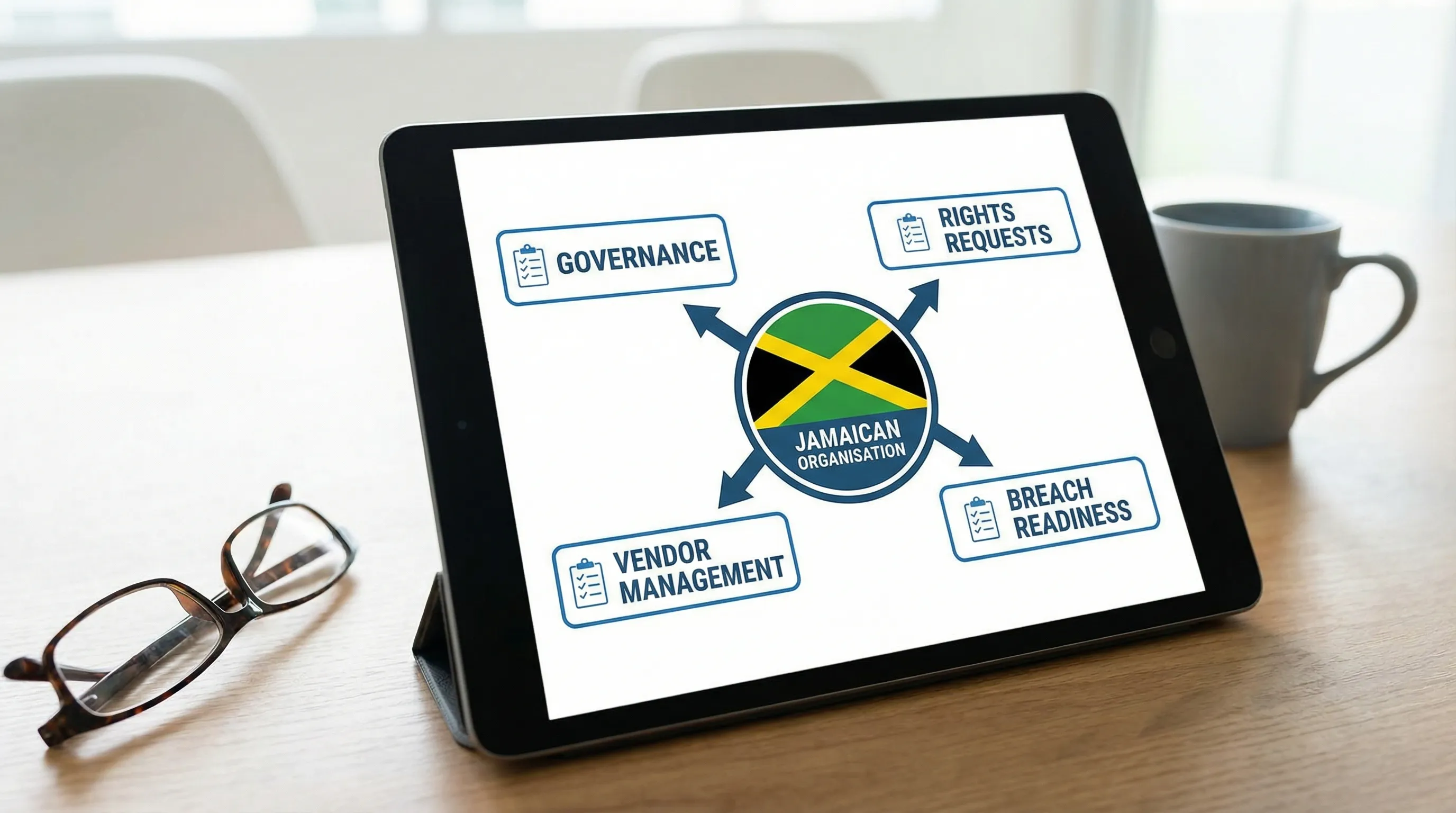
What changed for leadership teams (boards, CEOs, and senior management)
One of the most significant updates is how privacy risk is being treated at leadership level. Data protection is increasingly viewed as:
A corporate governance issue (decision-making, oversight, accountability).
A financial risk (incident costs, operational disruption, lost business).
A reputation and trust issue (public confidence and customer churn).
This is why organisations that previously delegated privacy entirely to IT are now pulling in HR, legal, procurement, compliance, and operations.
Why these changes are happening now
Several trends are converging:
Rising incident frequency and cost
Globally, the cost of a breach remains high, and the operational burden is often greater than the fine. IBM’s annual breach research continues to show multi-million dollar impacts for many organisations, driven by downtime, response costs, and lost business (see the IBM Cost of a Data Breach Report). Even when Jamaica-specific figures are not published, the same drivers apply locally.
More data, more systems, more vendors
Digital transformation has expanded the attack surface and increased the number of places personal data sits (shared drives, SaaS tools, messaging apps, outsourced providers). That makes “we will find it when asked” unrealistic.
Customers and partners expect alignment with international norms
Many Jamaican organisations do business with diaspora markets, tourism partners, overseas payment providers, and multinational supply chains. Those relationships increasingly demand evidence of privacy controls and vendor governance, not only a policy.
What to do next: a focused 45-day update plan
If you want to respond to the “latest updates” without launching a never-ending project, focus on a short set of changes that improve readiness fast.
Week 1 to 2: Get control of the basics you will be asked for
Prioritise:
Confirm who is accountable for privacy programme ownership (and who can make decisions).
Refresh your data inventory for the highest-risk areas first (HR, customer databases, payments, CCTV, health data).
Identify your top 10 vendors who touch personal data.
If you need a structured starting point, PLMC’s practical guide can help you validate coverage without overcomplicating it: Privacy and Data Protection: A Practical Checklist.
Week 3 to 4: Make rights requests and incidents operational
Implement:
A single intake channel for rights requests and a tracking log.
A verification checklist before disclosure.
A breach workflow that includes privacy decisions, not only technical containment.
If your programme is still being built out, it helps to align actions to a calendar. See: Data Protection Jamaica: Compliance Roadmap for 2026.
Week 5 to 6: Vendor controls and training that match real risk
Close gaps by:
Updating vendor templates (processor clauses, incident notification, subcontractor controls).
Introducing a lightweight vendor risk review for new tools (especially cloud and marketing platforms).
Delivering short, role-based training (HR, customer service, IT admins, finance, front desk).
For teams that need a refresher on core terms and obligations, this explainer is a useful reference point: Jamaica Data Protection Act Explained for Businesses.
The bottom line: what changed and why
The simplest summary of the “Data Protection Act latest updates” question is this:
What changed: The expectation moved from knowing the law to proving compliance through evidence, operational processes, and vendor and incident controls.
Why it changed: More digital data, more outsourcing, and more incidents mean privacy failures have become frequent, measurable, and publicly damaging.
If you treat 2026 as the year to tighten proof, not just policies, you will be in a far stronger position when a complaint, breach, audit, or partner due diligence request lands.
If you want an outside view on where your biggest gaps are, PLMC provides free consultations, risk assessment tools, and training to help Jamaican organisations implement practical data protection programmes. You can start by contacting us via Privacy & Legal Management Consultants Ltd..