

The Best Way to Start a Data Mapping Project
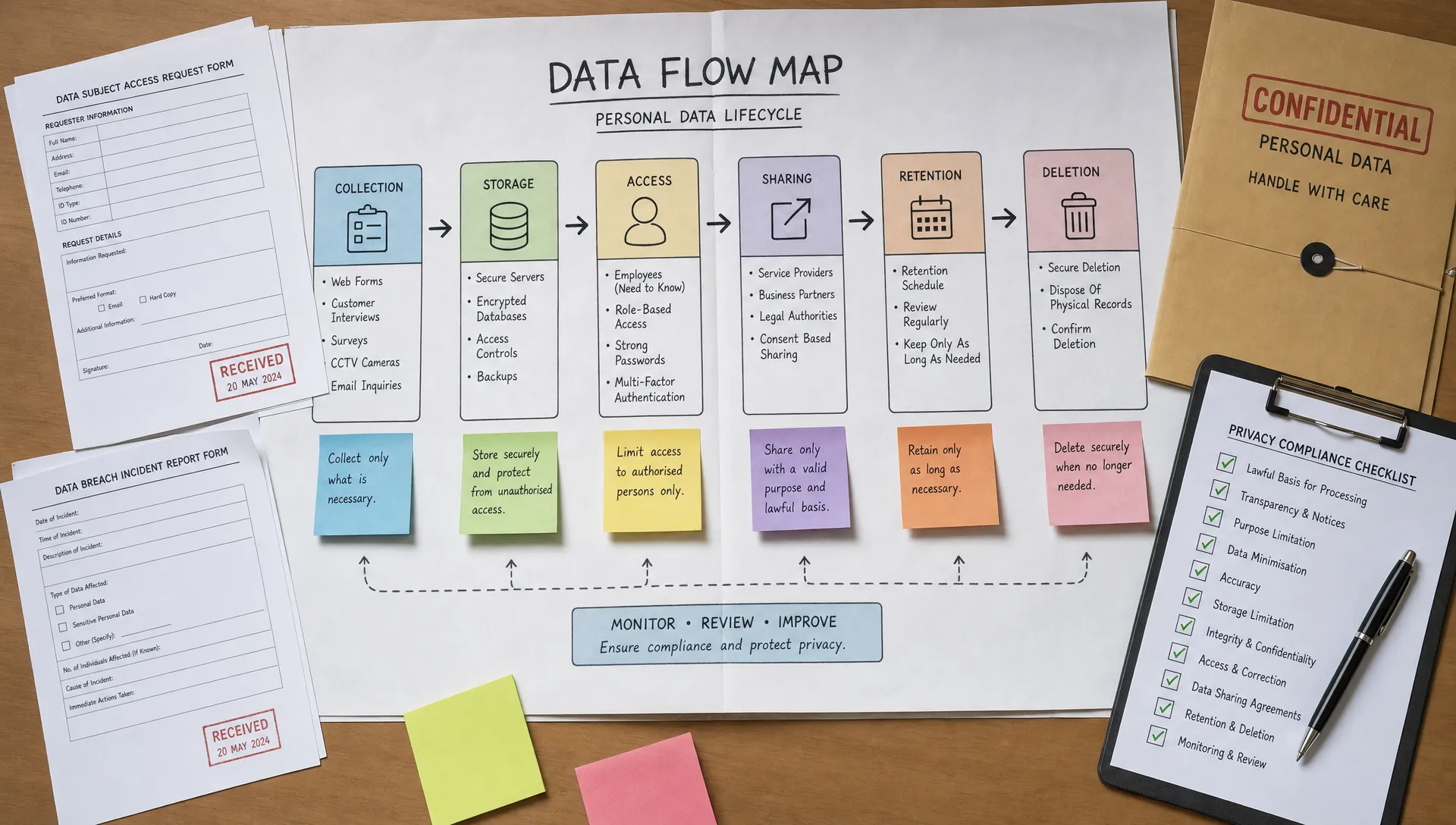
A data mapping project is one of the most practical places to begin a privacy and compliance programme. It tells you what personal data your organisation collects, where it goes, who has access to it, how long it is kept, and which risks need attention first.
The best way to start is not to send a massive spreadsheet to every department and hope it comes back complete. Start smaller, with one priority process, clear owners, and a template that captures the information needed to make decisions.
For Jamaican organisations working under the Data Protection Act, 2020, data mapping supports the fundamentals of fair processing, purpose limitation, security, retention, accountability, and transparency. It also helps when updating privacy notices, handling data subject requests, reviewing vendors, preparing for incidents, or deciding whether a higher-risk activity needs specialist review.
What data mapping should actually achieve
A useful data map is not just an inventory of software systems. It is a picture of how personal data moves through the organisation from collection to deletion.
At minimum, a data map should help you answer questions such as: What personal data do we collect? Why do we collect it? Whose data is it? Where is it stored? Who receives it? Is it transferred outside Jamaica? How is it protected? When is it deleted or anonymised?
The Office of the Information Commissioner in Jamaica is the key local reference point for data protection oversight. In practice, a strong data map gives your organisation the evidence it needs to show that privacy obligations are being managed rather than guessed.
A good data map should support action. If it does not help you improve notices, reduce unnecessary collection, tighten access, review contracts, or set retention rules, it is probably too abstract.
Start with one business process, not the whole organisation
The most effective first move is to choose one process that is important enough to matter, but narrow enough to complete. This creates a working model that can later be repeated across other departments.
Good starting points include customer onboarding, employee recruitment, payroll, marketing sign-ups, vendor onboarding, member registration, credit applications, case management, or complaints handling. These processes usually involve multiple people, forms, systems, documents, and sometimes external service providers, making them useful for learning how data flows in real life.
Avoid beginning with a broad scope such as “map all HR data” or “map every customer system.” That may sound comprehensive, but it often leads to delays, inconsistent answers, and stakeholder fatigue.
Starting scope | Why it works | Risk if ignored |
One defined process, such as recruitment or customer onboarding | Easy to identify forms, systems, owners, and outputs | The project becomes too broad to finish |
One accountable business owner | Speeds up decisions and validation | IT or compliance may make assumptions about business use |
One standard template | Creates consistency before scaling | Each department describes data differently |
One risk-based action plan | Turns mapping into improvement | The map becomes a static document |
If your organisation is building a wider privacy programme, data mapping should fit into a larger implementation sequence. PLMC’s guide to a step-by-step roadmap for implementing Jamaica’s Data Protection Act explains how discovery, design, build, embed, and assurance activities can work together.
Define the decisions your data map must support
Before you interview staff or open a spreadsheet, decide what the map will be used for. This keeps the project focused and prevents unnecessary data collection.
For example, if your immediate concern is privacy notice accuracy, you need to know what data is collected, the purpose of processing, who receives it, and whether it is shared outside the organisation. If your concern is vendor risk, you need to identify processors, contracts, transfer locations, and security expectations. If your concern is retention, you need to identify storage locations, legal or business retention reasons, and deletion triggers.
Compliance decision | Data mapping information needed |
Updating privacy notices | Categories of data, purposes, sources, recipients, retention periods, individual rights information |
Reviewing vendor risk | External recipients, processor roles, contracts, locations, security controls, service purpose |
Improving retention | Record type, storage location, retention reason, deletion trigger, owner |
Supporting data subject requests | Systems holding relevant data, responsible teams, retrieval process, exemptions to consider |
Assessing high-risk processing | Sensitive data, vulnerable individuals, profiling, automated decisions, large-scale processing, transfers |
This decision-first approach is especially useful for boards, executives, and senior managers. It shows that data mapping is not an administrative exercise. It is a governance tool.
Appoint the right people before collecting data
A data mapping project needs a clear owner, but it should not belong to one department alone. Privacy, legal, compliance, IT, cybersecurity, records management, procurement, HR, finance, and operational teams may all hold part of the picture.
The project owner should coordinate the work, maintain the template, document assumptions, and follow up on gaps. Business process owners should explain what actually happens day to day. IT and cybersecurity should confirm systems, access, hosting, integrations, backups, and security controls. Procurement or vendor management should confirm service providers and contracts.
Senior sponsorship matters. Without it, departments may treat mapping as optional or delay responses. A short message from management explaining why the project matters can improve cooperation significantly.
For teams that need alignment before discovery begins, a facilitated working session can help. A practical data protection workshop with clear outcomes and templates can bring the right stakeholders into the same room and create agreement on scope, terminology, and next steps.
Build a minimum viable data map template
Your first template should be complete enough to support compliance decisions, but simple enough for business teams to understand. If the template is too technical, staff will either avoid it or fill it with vague answers.
Use plain language wherever possible. Instead of asking for “data processing taxonomy,” ask “what personal data is collected?” Instead of “recipient category,” ask “who receives or can access the data?” You can refine the terminology later when the privacy or compliance team validates the results.
A starter template should usually include these fields:
Field | What to capture | Why it matters |
Business process | The activity being mapped, such as onboarding or payroll | Keeps the map process-based rather than system-only |
Process owner | The accountable department or person | Creates responsibility for accuracy and updates |
Individuals affected | Customers, employees, applicants, vendors, visitors, members, or other groups | Clarifies whose rights may be affected |
Personal data collected | Names, contact details, ID numbers, financial data, health data, employment data, images, or other data types | Identifies sensitivity and minimisation issues |
Purpose | Why the data is used | Supports fairness, transparency, and purpose limitation |
Source | Directly from the individual, another department, a third party, a public source, or a system | Helps explain collection and notice obligations |
Systems and storage | Applications, databases, shared drives, email folders, paper files, archives, or cloud platforms | Shows where data must be protected and retrieved |
Internal access | Roles, teams, administrators, approvers, or managers with access | Supports confidentiality and access control review |
External sharing | Vendors, regulators, banks, insurers, auditors, affiliates, or other recipients | Supports vendor management and transparency |
Cross-border transfers | Any storage, access, support, or processing outside Jamaica | Highlights transfer and contract considerations |
Retention | How long the data is kept and what triggers deletion | Supports storage limitation and records management |
Security controls | Access controls, encryption, logging, physical security, backups, or other safeguards | Connects privacy and cybersecurity |
Issues and actions | Gaps, uncertainties, required fixes, and responsible owners | Turns the map into a compliance improvement plan |
Do not wait for a perfect tool. A well-designed spreadsheet can work for a first pilot if it is controlled, reviewed, and kept up to date. Software may become useful later when the organisation has many processes, frequent changes, or complex reporting needs.
Trace the process from collection to deletion
Once the template is ready, walk through the selected process step by step with the people who perform it. Ask them to describe what happens in practice, not what the written policy says should happen.
For example, in an employee recruitment process, data may begin with an online application, move into email, be reviewed by HR and hiring managers, be stored in an applicant tracking system or shared folder, be shared with background screening providers, then be retained or deleted after the recruitment period. Each movement creates questions about purpose, access, retention, security, and external sharing.
The same applies to customer onboarding. A customer may submit identification, contact information, financial details, signatures, and supporting documents. The information may be verified, entered into a core system, shared with compliance or finance teams, stored in paper files, backed up, reported to regulators, or sent to a service provider. A proper data map follows the data through each of those points.
This is where many organisations discover hidden data stores: email attachments, WhatsApp messages, scanned documents, old shared drives, exported reports, backup copies, and filing cabinets. These locations matter because individuals’ rights and security obligations apply beyond the main system of record.
Validate the map with evidence
Interviews are useful, but they are not enough. People often forget workarounds, legacy files, reporting exports, or informal sharing arrangements. Validation makes the map reliable.
Request samples of the documents and artefacts that prove how the process works. These may include forms, privacy notices, system screenshots, access lists, vendor contracts, retention schedules, standard operating procedures, report templates, consent wording, email templates, and data sharing agreements.
This does not mean copying sensitive data into the mapping file. The goal is to confirm the existence and flow of data, not to create another risky repository. Where possible, use blank templates, redacted samples, or descriptions rather than live personal data.

Prioritise gaps instead of trying to fix everything at once
A first data mapping project will almost always reveal more issues than expected. That is normal. The value comes from prioritising what matters most.
Focus first on gaps that create legal, security, reputational, or operational risk. These often include unclear purposes, unnecessary data collection, excessive access, missing retention rules, undocumented vendors, incomplete privacy notices, unapproved cross-border transfers, or weak controls around sensitive personal data.
Finding from the data map | Why it matters | Practical first response |
Data is collected “just in case” | May conflict with minimisation principles | Remove unnecessary fields or document a clear purpose |
No clear retention period | Data may be kept longer than needed | Set retention rules and assign deletion responsibility |
Vendor access is not documented | Processor and security risks may be unmanaged | Review contracts, service scope, access, and transfer location |
Too many staff can access records | Increases breach and misuse risk | Move toward role-based access and periodic access reviews |
Privacy notice does not match actual processing | Individuals may not receive accurate information | Update notices based on validated data flows |
Paper files are excluded from the map | Physical records may be overlooked | Include filing cabinets, archives, scanning, and disposal processes |
The output should be an action register with owners and deadlines. A data map without an action plan may look impressive, but it will not improve compliance.
Use the first map to create a repeatable method
The first process is your pilot. When it is complete, review what worked and what caused confusion. Adjust the template, improve the questions, and document the method before expanding to other areas.
A practical 30-day starter plan could look like this:
Timeline | Focus | Output |
Week 1 | Confirm sponsor, scope, process owner, and template | Approved project scope and mapping template |
Week 2 | Hold discovery workshop and collect initial information | Draft process map and list of evidence needed |
Week 3 | Validate systems, vendors, access, documents, and retention | Updated map with confirmed flows and open questions |
Week 4 | Identify risks, agree actions, and plan next processes | Action register and repeatable mapping method |
This plan will not map the entire organisation in a month, and it should not try to. The goal is to prove a disciplined method, demonstrate value, and create momentum.
Once the pilot works, expand by risk priority. Processes involving sensitive data, vulnerable individuals, high transaction volumes, regulatory reporting, third-party processors, or cross-border access should usually move higher on the list.
Common mistakes when starting a data mapping project
One common mistake is treating data mapping as an IT exercise. IT can confirm systems, storage, access, and security, but business teams know why data is collected and how it is used. Privacy compliance requires both perspectives.
Another mistake is mapping systems instead of processes. A system inventory may tell you that the organisation uses a payroll platform, CRM, document repository, or cloud storage service. It does not necessarily explain why data enters the system, who uses it, where reports go, or when records should be deleted.
Organisations also overlook unstructured data. Email, spreadsheets, shared folders, paper documents, scanned IDs, chat messages, and exported reports often contain some of the riskiest personal data because they are harder to control.
Finally, many projects fail because the first version of the map is treated as final. Data mapping is a living activity. New vendors, systems, forms, campaigns, regulations, and business processes can all change the answer.
How data mapping strengthens wider compliance
A reliable data map becomes the foundation for many privacy and governance activities. It helps your organisation respond faster to data subject requests because you know where data is held. It improves breach response because you can identify affected systems, individuals, and recipients more quickly. It supports training because staff can see real examples from their own work.
It also supports corporate governance. Boards and senior leaders cannot oversee data protection effectively if they do not know what personal data the organisation holds or where the major risks sit. A clear map turns privacy from a legal concept into operational information that management can act on.
For organisations moving beyond the first project, data mapping should become part of business-as-usual change management. New systems, new vendors, new forms, new analytics, and new marketing initiatives should trigger a review of the relevant map. That is how mapping becomes a living compliance control rather than a one-time exercise.
If your organisation is ready to move from discovery to a sustainable operating model, PLMC’s guidance on how to build a data compliance programme that works in day-to-day operations offers a useful next step.
Frequently Asked Questions
What is data mapping in data protection? Data mapping is the process of documenting how personal data is collected, used, stored, shared, transferred, protected, and deleted across a business process or organisation.
What is the best way to start a data mapping project? Start with one clearly defined business process, appoint a process owner, use a simple template, trace the data from collection to deletion, validate the flow with evidence, and create a risk-based action plan.
Does a small organisation in Jamaica need data mapping? Yes, if it collects or uses personal data. A small organisation may not need a complex tool, but it still needs to understand what data it holds, why it holds it, who can access it, and how long it is kept.
Is data mapping the same as a data protection impact assessment? No. Data mapping documents the flow and use of personal data. A data protection impact assessment evaluates the risks of a particular activity, especially where processing may be high risk. A good data map often provides the information needed for that assessment.
Should data mapping include paper records? Yes. Paper forms, archived files, printed reports, visitor logs, signed contracts, and scanned documents can all contain personal data and should be included where they form part of the process.
How often should a data map be updated? Review it whenever a process, vendor, system, purpose, data category, transfer arrangement, or retention rule changes. At minimum, key maps should be reviewed periodically as part of the organisation’s privacy governance cycle.
Need support starting your data mapping project?
A strong data mapping project gives your organisation clarity, control, and a practical route to data protection compliance. The key is to start with a focused scope, involve the right people, and turn findings into action.
Privacy & Legal Management Consultants Ltd. supports organisations in Jamaica with data protection implementation, privacy training, risk assessment, GRC integration, cybersecurity, and compliance readiness. To discuss a practical starting point for your organisation, visit Privacy & Legal Management Consultants Ltd..