

Short Data Protection Awareness Training for Busy Teams
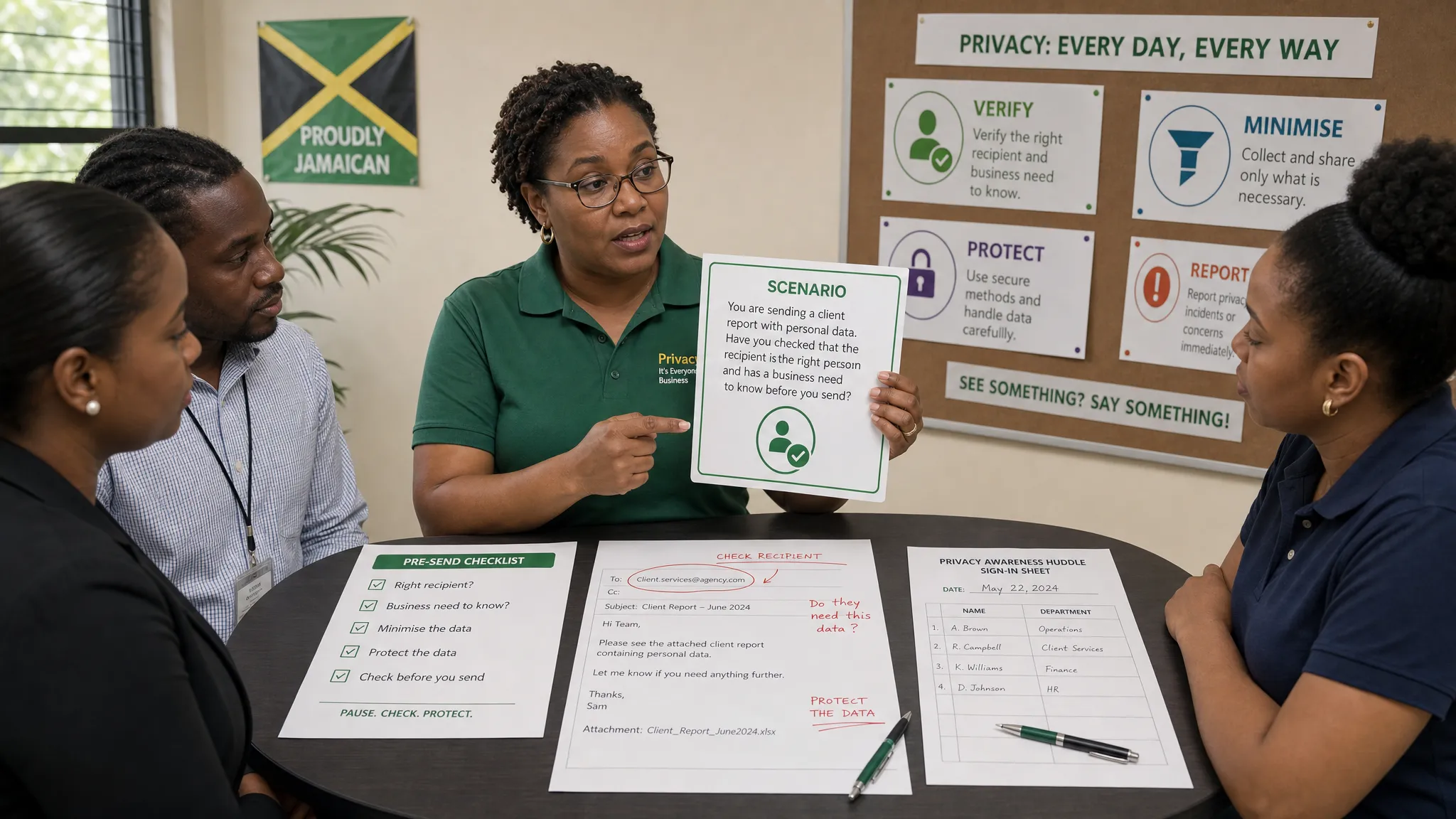
Busy teams do not need another long compliance lecture. They need short, practical data protection awareness training that helps them make better decisions during real work, when they are answering customers, sending documents, handling HR records, updating spreadsheets, or responding to urgent requests.
For Jamaican organisations, this matters because data protection is no longer a “nice to have” policy topic. The Data Protection Act, 2020 places obligations on organisations that collect, use, store, share, or dispose of personal data. Staff do not need to become privacy lawyers, but they do need to recognise risky moments and know what to do next.
The good news is that effective awareness training can be short. A 10-minute team huddle, a 15-minute scenario discussion, or a 30-minute refresher can reinforce the habits that prevent common mistakes. The key is to make the session focused, role-aware, and easy to apply immediately.
Short does not mean superficial
Short training fails when it tries to compress a full legal course into a few slides. Employees leave with definitions, but not behaviours. They may remember that personal data is important, but still send an attachment to the wrong person, leave printed records unattended, or answer a caller without verifying identity.
A short session works best when it has one clear purpose. For example, a short data protection awareness training session might focus only on secure email sharing, recognising personal data, reporting a suspected breach, or collecting only the information needed for a task.
That is especially useful for departments that cannot pause operations for half a day. Customer service teams, clinics, schools, financial services staff, retailers, HR teams, and operations teams often need training that fits into the working day without disrupting service delivery.
A short session should answer three questions:
What privacy risk are we trying to reduce?
What should staff do differently after this session?
How will managers know the message was understood?
If those questions are answered, even a 15-minute training can improve day-to-day compliance.
Why busy teams need privacy reminders more often
The biggest privacy risks often happen during routine work, not during major projects. A staff member forwards an email thread without checking attachments. A supervisor stores employee medical information in a shared folder. A team member discusses a customer issue where others can overhear. A WhatsApp message includes more information than necessary.
These are not always malicious acts. They are often the result of pressure, unclear processes, or habits formed before data protection became a stronger compliance priority.
The Office of the Information Commissioner in Jamaica provides guidance and resources around the country’s data protection framework, but awareness inside the organisation depends on how well policies are translated into daily behaviour. This is where short training becomes valuable. It turns privacy from a document into a repeatable workplace habit.
Short reminders also reflect how people learn. Staff are more likely to retain a specific instruction practised in context than a broad policy statement delivered once per year. If your organisation already conducts annual training, short sessions can support it by keeping important behaviours visible between formal refreshers.
For a deeper view on training frequency, PLMC’s guide on how often staff should get data protection awareness training explains why onboarding, annual refreshers, and trigger-based sessions work best together.
The five behaviours every short session should reinforce
A short data protection awareness training programme should not try to cover everything at once. Instead, build sessions around a small set of behaviours that apply across most teams.
Behaviour | What staff should learn | Example workplace prompt |
Recognise personal data | Personal data can include names, contact details, ID numbers, financial records, health details, employment records, images, and any information that can identify a person. | “Could this information identify someone directly or indirectly?” |
Use the minimum necessary | Collect, view, and share only what is needed for the task. | “Do I need all of this information to complete the request?” |
Check before sharing | Confirm the recipient, purpose, attachment, and method before sending personal data. | “Is this the right person, right file, and right channel?” |
Protect access | Keep records secure, use approved systems, and avoid leaving personal data exposed. | “Who else can see or access this?” |
Report concerns quickly | Escalate suspected breaches or mistakes promptly, even if the facts are not complete. | “Who do I tell if something seems wrong?” |
These behaviours are simple enough for short sessions, but powerful enough to reduce real risk. They also help employees understand that privacy is not only about avoiding penalties. It is about trust, professionalism, and responsible handling of information.
Practical short training formats for busy teams
The best format depends on the team’s work pattern. A branch team may prefer a morning huddle. A remote team may need a short virtual session. A management team may benefit from a focused scenario discussion before approving a new process.
Here are practical formats that work well without overwhelming staff.
Format | Best for | Suggested duration | What to cover |
Privacy huddle | Frontline or operational teams | 10 minutes | One risk, one example, one action |
Scenario discussion | Teams handling customer, employee, or client data | 15 to 20 minutes | A realistic incident and what staff should do |
Micro-refresher | Teams that completed formal training already | 5 to 10 minutes | One reminder, such as checking attachments before sending |
Role-based mini-session | HR, IT, finance, customer service, or management | 20 to 30 minutes | Risks specific to that department |
Post-incident learning session | Teams affected by a near miss or error | 15 to 30 minutes | What happened, what to change, how to report sooner |
A useful principle is to train at the point of risk. If a team is about to launch a customer survey, run a short session on fair collection and minimisation. If HR is preparing performance review files, run a reminder on restricted access and secure storage. If staff are using new software, include a privacy check before the rollout.
A ready-to-use 15-minute training agenda
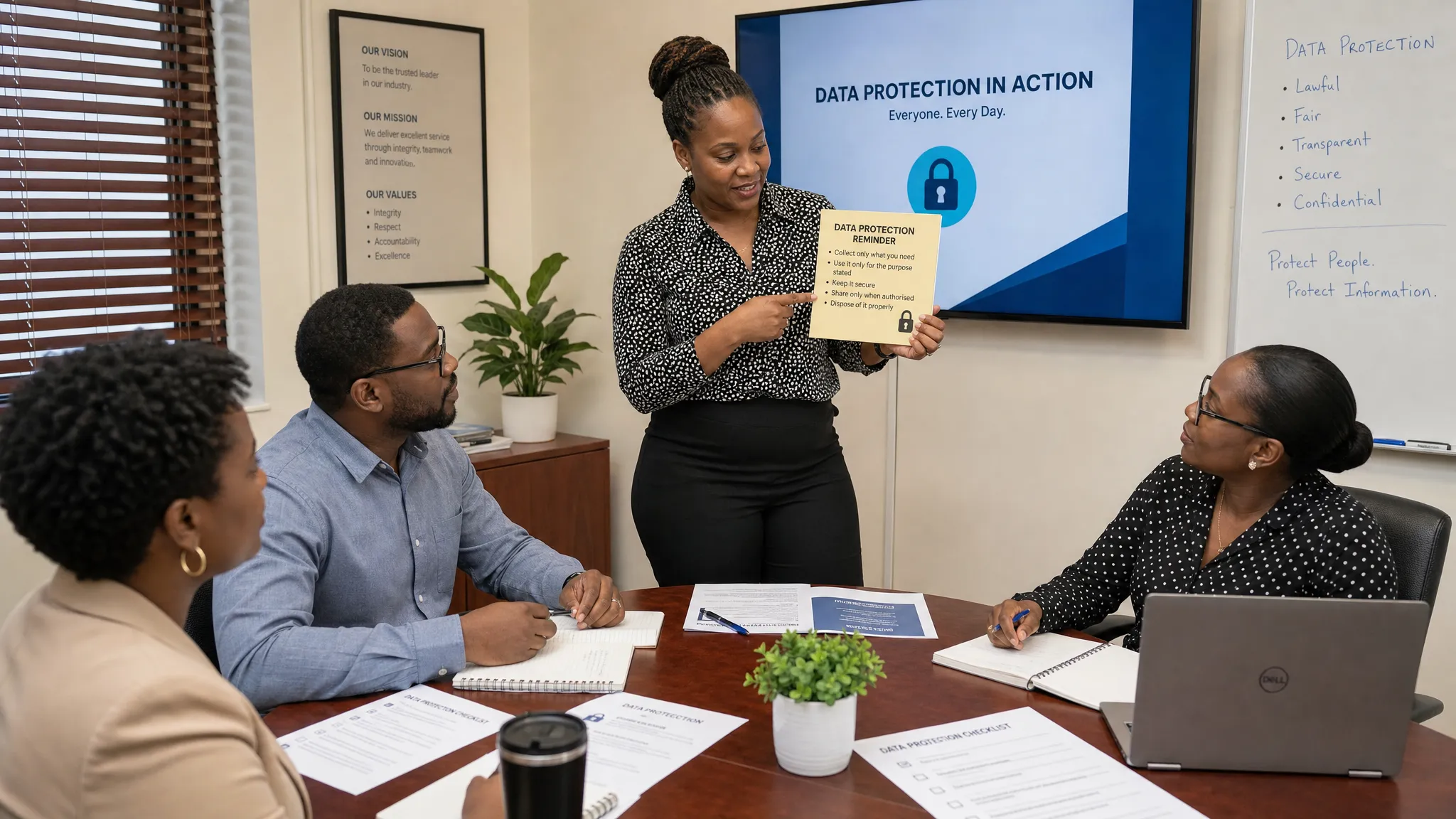
If your team has only 15 minutes, resist the urge to cover the whole Data Protection Act. Focus on one behaviour and make it memorable.
Here is a simple structure your managers can use.
Time | Activity | Purpose |
0 to 2 minutes | State the risk | Explain one common mistake, such as sending personal data to the wrong recipient. |
2 to 5 minutes | Give a realistic example | Use a short scenario from the team’s actual work. |
5 to 10 minutes | Ask staff what they would do | Let the team identify safe and unsafe actions. |
10 to 13 minutes | Confirm the correct process | Explain the approved way to handle the situation. |
13 to 15 minutes | End with one commitment | Ask staff to adopt one action immediately. |
For example, a customer service team might discuss this scenario:
A caller says they are contacting the organisation on behalf of a relative and asks for account information urgently. They sound upset and know some basic details. What should the staff member do before sharing anything?
In 15 minutes, the team can discuss identity verification, authority to act, minimum disclosure, call notes, and escalation. That is far more useful than asking staff to memorise legal terminology.
PLMC has also published guidance on how to build data protection awareness training around real scenarios, which is a strong approach when teams struggle to connect policy with daily decisions.
What to include in a 30-minute session
A 30-minute session gives you enough time to cover a small topic properly. This is ideal for teams that handle higher-risk personal data or departments that need more context.
A good 30-minute session might include the following flow:
Start with one practical privacy principle: For example, “only use personal data for the purpose it was collected” or “share personal data only with authorised persons.”
Explain why it matters in Jamaica: Connect the principle to organisational obligations under the Data Protection Act, 2020 and to customer, employee, or stakeholder trust.
Use one realistic scenario: Choose a situation staff recognise, such as an email attachment error, an access request, a lost document, or an unauthorised disclosure.
Ask the team to decide: Let employees identify what they would do, what they would avoid, and when they would escalate.
Close with a checklist: Give staff a short decision tool they can use immediately after the session.
The goal is not to make staff anxious. The goal is to make the right action obvious.
For instance, before sharing personal data, staff can be taught to pause and ask:
Am I allowed to share this information?
Is the recipient authorised to receive it?
Have I checked the attachment or file?
Am I using the approved channel?
Is there a record of what was shared and why?
That short checklist can prevent many everyday errors.
How to tailor short training by role
Generic training is efficient, but it is not always effective. Different teams create different privacy risks, so short sessions should reflect the work being done.
HR teams need practical reminders about employee records, medical certificates, disciplinary documents, references, recruitment data, and retention. IT teams need to understand access controls, user permissions, logs, system changes, and incident escalation. Customer-facing teams need training on verification, disclosure, call handling, complaints, and secure communication.
Managers need a different focus. They should understand how privacy risks arise from decisions about processes, vendors, forms, reports, and staff access. A manager who requests unnecessary data or stores reports in the wrong place can create risk even if frontline employees are careful.
The table below shows how short training topics can be adapted.
Team | Short training topic | Practical outcome |
HR | Protecting employee records | Staff limit access and store sensitive records securely. |
IT | Access control basics | Staff review permissions and remove unnecessary access. |
Customer service | Verifying identity before disclosure | Staff avoid giving personal data to unauthorised callers. |
Finance | Handling payment and account information | Staff reduce unnecessary sharing and improve secure storage. |
Management | Privacy checks before new initiatives | Leaders consider data protection before launching processes. |
If your organisation needs more detailed role guidance, PLMC’s article on data protection training for HR, IT, and customer teams explains how to make training more relevant by department.
Keeping short training compliant and useful
Short sessions should still be documented. This helps show that the organisation is taking privacy awareness seriously and gives managers a way to improve future training.
At minimum, keep a simple record of:
Date of the session
Topic covered
Team or department trained
Trainer or facilitator
Attendance
Scenario or key message used
Follow-up actions agreed
Documentation does not need to be complicated. A simple training log is often enough for internal accountability, especially when paired with annual training records, policy acknowledgements, and evidence of follow-up actions.
You should also collect feedback. Ask staff what situations they find confusing. Their answers may reveal where policies are unclear, systems are inconvenient, or managers need to adjust workflows. In that way, short training becomes more than awareness. It becomes a source of risk intelligence.
Common mistakes to avoid
Short data protection awareness training can lose impact if it is treated as a rushed tick-box exercise. The most common mistake is trying to say too much. A 10-minute session should not include legal history, every data protection standard, a full breach response procedure, and a quiz.
Another mistake is using examples that do not match the team’s work. A warehouse team, HR team, school office, medical office, and call centre should not all receive the same scenario. The privacy principles may be similar, but the risk moments are different.
A third mistake is making training sound punitive. Staff should know that careless behaviour has consequences, but fear alone does not create good judgement. Employees are more likely to report mistakes quickly when they understand the process and believe early reporting is expected.
Finally, do not rely only on slides. A short discussion, checklist, role-play, or “what would you do?” question is usually more memorable than another presentation.
A simple monthly microlearning plan
If you want to build consistency, use a monthly plan. Each month, choose one topic and deliver it in 10 to 20 minutes. Over time, staff receive repeated exposure without feeling overloaded.
Month | Topic | Suggested activity |
January | What counts as personal data | Team identifies examples from its own work. |
February | Secure email and attachments | Staff practise a pre-send checklist. |
March | Identity verification | Team discusses a caller or visitor scenario. |
April | Clean desk and secure storage | Manager leads a workspace privacy check. |
May | Data minimisation | Staff review one form or report for unnecessary fields. |
June | Breach reporting | Team walks through who to contact and when. |
This kind of plan works because it is manageable. It also gives compliance leaders a structure for reinforcing privacy throughout the year, rather than waiting for annual training.
How PLMC can support busy teams
Many Jamaican organisations know they need data protection training, but struggle to find the time, structure, and internal confidence to deliver it well. Privacy & Legal Management Consultants Ltd. supports organisations with data protection implementation, governance, compliance, training, and related risk management services.
A good short training programme should fit your organisation’s actual operations. That may mean developing role-specific scenarios, training managers to facilitate huddles, reviewing existing policies, or aligning awareness sessions with the Data Protection Act, 2020.
Short training is most effective when it is part of a wider privacy programme. Staff awareness, policies, governance, records management, cyber security, vendor controls, and breach response all work together. But awareness is often the place where daily behaviour changes first.
Frequently Asked Questions
Can data protection awareness training really be done in 10 or 15 minutes? Yes, if the session focuses on one specific behaviour. Short sessions work well for reminders, scenarios, and practical checklists. They should complement, not replace, more complete training where required.
What should busy teams learn first? Start with the behaviours that reduce the most common risks: recognising personal data, checking before sharing, using only necessary information, protecting access, and reporting concerns quickly.
Is short training enough for Data Protection Act compliance in Jamaica? Short training can support compliance, but it should form part of a wider programme that includes policies, governance, risk assessments, appropriate safeguards, and documented procedures.
How often should short awareness sessions be delivered? Many organisations benefit from short monthly or quarterly refreshers, especially for teams that handle personal data frequently. New employees should also receive privacy training during onboarding.
Should managers or compliance staff deliver the sessions? Either can work. Compliance staff may design the content, while managers can reinforce it in team meetings. The best approach is often a partnership, with clear messages and practical examples.
Make privacy training easier to apply
If your team is too busy for long sessions, that does not mean awareness should be postponed. Short, focused data protection awareness training can help staff recognise personal data, avoid common mistakes, and respond quickly when something goes wrong.
Privacy & Legal Management Consultants Ltd. can help your organisation design practical training that fits your teams, risks, and compliance obligations in Jamaica. To discuss your needs, visit PLMC’s website and explore how a structured privacy and compliance programme can support your organisation.