

How Often Should Staff Get Data Protection Awareness Training?
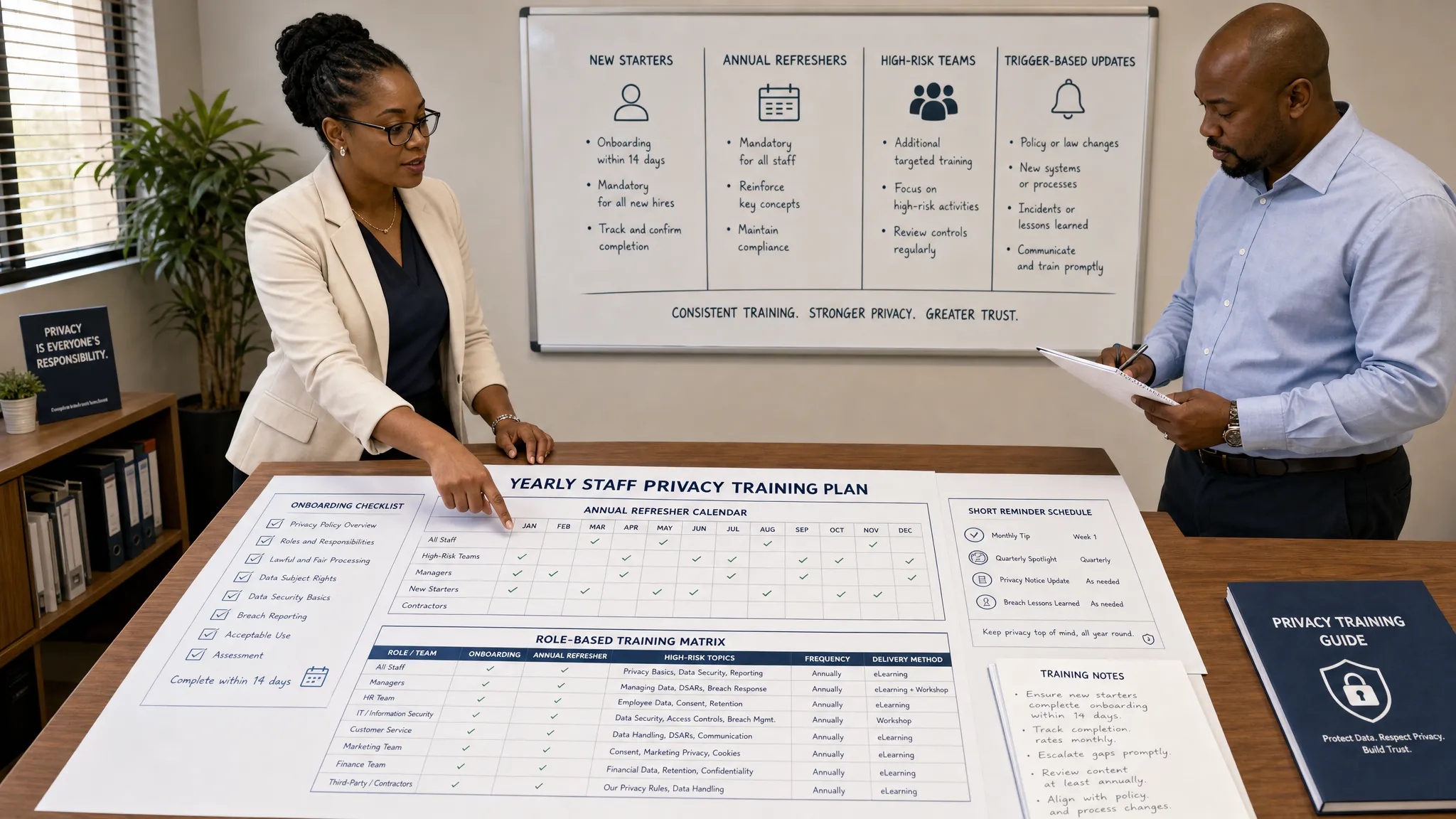
The safest practical answer is this: staff should receive data protection awareness training when they join, at least once every year, and more often when their role, systems, risks, or legal obligations change.
For many Jamaican organisations, an annual session is the minimum baseline, not the full programme. Data protection awareness fades quickly when employees only hear about it once a year, especially in teams that handle customer records, employee files, health information, financial data, complaints, CCTV footage, marketing lists, or identity documents every day.
A better approach is to think in layers: onboarding training, annual refresher training, short reminders throughout the year, and targeted sessions for higher-risk teams. This gives staff enough repetition to remember what to do without overwhelming them with long compliance lectures.
The short answer: a practical training cadence
There is no single training interval that suits every organisation. A small professional services firm, a bank, a school, a healthcare provider, a retailer, and a public body will all have different privacy risks. However, the following cadence works well as a starting point for data protection compliance planning.
Training type | Recommended frequency | Who should attend | Main purpose |
New staff onboarding | Before or shortly after access to personal data | All employees, contractors, interns, temporary workers | Explain basic privacy duties before risky habits form |
Annual refresher | At least once every 12 months | All staff | Reinforce core rules, policy updates, and common mistakes |
Role-based training | Every 6 to 12 months, depending on risk | HR, IT, finance, customer service, marketing, records teams, managers | Address the specific personal data each team handles |
Micro-awareness reminders | Monthly or quarterly | All staff or targeted groups | Keep good habits visible between formal sessions |
Trigger-based training | As soon as possible after a change or incident | Affected teams | Respond to new risks, new systems, breaches, complaints, or process changes |
Leadership and governance briefings | At least annually, and when major risks change | Board, executives, senior managers | Support oversight, accountability, and resource decisions |
If your organisation wants a simple rule, use this: annual training for everyone, semi-annual training for high-risk teams, and short quarterly reminders across the business.
Why annual training alone is usually not enough
Annual training is useful because it creates a formal record that employees were reminded of their responsibilities. It also gives the organisation a predictable point in the year to refresh policies, confirm attendance, test understanding, and close knowledge gaps.
But annual training by itself rarely changes behaviour. Staff forget abstract rules, especially if the training is generic, too legalistic, or disconnected from their daily tasks. The real privacy risks often happen in small moments: sending an email to the wrong recipient, leaving a file visible on a desk, discussing a customer matter in a public area, reusing weak passwords, forwarding a spreadsheet without checking the recipients, or collecting more information than necessary.
Human behaviour remains one of the biggest factors in security and privacy incidents. Verizon's 2024 Data Breach Investigations Report found that a large share of breaches involved a human element, including errors, misuse, or social engineering. Data protection awareness training should therefore be treated as an ongoing risk control, not a once-a-year administrative task.
For Jamaican organisations working under the Data Protection Act, 2020, this matters because compliance is not only about having policies. Staff need to understand how to apply privacy principles when collecting, using, storing, sharing, securing, and deleting personal data.
What should trigger extra data protection awareness training?
Some training should be scheduled in advance. Other training should happen because something changed. Trigger-based training is often the difference between a paper compliance programme and a practical one.
You should consider additional staff training when:
A new system, app, portal, HR platform, CRM, payment tool, or cloud service is introduced
A department starts collecting a new category of personal data
Staff begin working with sensitive or high-volume personal information
A data breach, near miss, complaint, or internal audit finding occurs
A policy, consent form, privacy notice, retention schedule, or access procedure changes
New vendors, processors, or outsourcing arrangements are introduced
Remote work, hybrid work, mobile device use, or file sharing practices change
Employees move into roles with broader access to personal data
This kind of training does not always need to be long. A 20-minute focused briefing after a near miss can be more valuable than a two-hour generic presentation months later.
Match the frequency to the risk of the role
Not every staff member needs the same depth of training at the same frequency. Everyone should understand the basics, but some teams need more frequent and more practical guidance because their decisions create more privacy risk.
HR teams handle employee records, medical notes, disciplinary files, recruitment documents, payroll information, and identification documents. Customer service teams may verify identities, respond to data requests, record complaints, and discuss personal matters by phone or email. IT teams manage access, security controls, backups, logs, user permissions, and incident response. Marketing teams may work with consent, mailing lists, campaign tools, and third-party platforms.
That is why role-based training is usually more effective than one generic session for the entire organisation. If you need help separating these needs, PLMC has a useful guide on data protection training for HR, IT, and customer teams that explains why each group should be trained differently.
Staff group | Suggested frequency | What to emphasise |
All staff | Onboarding, annual refresher, quarterly reminders | Recognising personal data, secure handling, reporting incidents, email discipline |
HR and payroll | Onboarding, annual refresher, 6-month role-based refresh | Employee confidentiality, retention, access restrictions, sensitive records |
IT and cyber teams | Onboarding, annual refresher, quarterly technical refresh | Access control, breach response, logging, vendor risk, secure configuration |
Customer-facing teams | Onboarding, annual refresher, 6-month scenario training | Identity verification, disclosure risks, complaints, data subject requests |
Managers and supervisors | Annual governance briefing plus targeted updates | Accountability, staff oversight, escalation, privacy by design in processes |
Board and senior leaders | Annual briefing and updates after major changes | Strategic risk, compliance obligations, incident oversight, resourcing |
The goal is not to train everyone more for the sake of it. The goal is to train the right people often enough to prevent the most likely mistakes.

How often should new staff be trained?
New staff should receive basic data protection awareness training before they are given meaningful access to personal data, or as soon as possible after they start. This includes permanent employees, temporary workers, interns, consultants, contractors, and anyone else who may view, collect, process, transmit, store, or discuss personal information.
The first session should not try to teach everything. It should focus on the behaviours the person needs from day one, such as:
What counts as personal data in your workplace
What information the person is allowed to access
How to verify identity before disclosing information
How to use email, shared drives, messaging apps, and devices safely
How to report a suspected breach, lost file, wrong email, or suspicious request
Where to find internal privacy policies and who to ask for help
If new employees are trained only during a large annual session months after joining, the organisation accepts unnecessary risk during the period when the person is still learning systems, people, shortcuts, and workplace norms.
How often should refresher training happen?
For most organisations, formal refresher training should happen every year. This is the easiest baseline to plan, budget, document, and defend. Annual refreshers should not simply repeat last year's slides. They should be updated with current risks, recent incidents, internal audit findings, new systems, changes in law or guidance, and examples from the organisation's real work.
A strong annual refresher usually includes:
A short review of the organisation's data protection obligations
Practical examples of good and bad handling of personal data
Common errors from the past year, anonymised where appropriate
A reminder of breach reporting channels and escalation steps
Role-specific breakouts or examples for higher-risk teams
A brief knowledge check to confirm understanding
For staff who handle large volumes of personal data, sensitive data, or high-risk processes, annual refreshers should be supported by shorter sessions every six months or every quarter.
If you are planning a full programme rather than a one-off session, this guide on how to plan data protection training that staff will apply can help you connect training to actual workplace behaviour.
Microlearning: the missing layer between formal sessions
The best data protection awareness programmes do not depend only on classroom or webinar sessions. They use frequent, short reminders to keep privacy visible.
Microlearning can include a five-minute team discussion, a monthly privacy tip, a quick quiz, a poster near printers, a short email about phishing and personal data, or a scenario at the start of a departmental meeting. These reminders work because they are small enough to repeat and specific enough to remember.
For example, a quarterly reminder could focus on one behaviour at a time:
Quarter | Suggested focus | Example behaviour |
Q1 | Email and file sharing | Check recipients and attachments before sending |
Q2 | Clean desk and clear screen habits | Lock screens and store paper records securely |
Q3 | Data subject requests and complaints | Escalate requests quickly to the right person |
Q4 | Breach reporting | Report mistakes immediately, even if unsure |
This approach also reduces training fatigue. Staff are more likely to remember one practical behaviour repeated often than twenty legal principles mentioned once.
For more ideas on making repeat training memorable, see these practical data protection awareness training ideas that actually stick.
What records should you keep?
Training frequency is important, but evidence matters too. If your organisation cannot show who was trained, when they were trained, what they covered, and whether they understood it, the programme will be harder to defend.
At minimum, keep records of:
Training dates and delivery method
Attendee names, departments, and roles
Training topics and materials used
Versions of policies or procedures referenced
Quiz results, completion confirmations, or acknowledgements
Follow-up actions for staff who missed training
Additional sessions delivered after incidents or process changes
These records can support governance, internal audits, board reporting, and compliance reviews. They also help you identify departments that need extra support.
Signs your staff need training more often
If you are seeing repeated privacy problems, the answer is usually not just another annual lecture. It may be a sign that training is too infrequent, too generic, or not linked to the way staff actually work.
Warning signs include:
Employees are unsure what counts as personal data
Staff do not know how to report a suspected breach
Managers delay escalation because they are uncertain who owns the issue
Emails or documents are regularly sent to the wrong recipients
Teams collect more personal data than they need
Staff disclose information without properly verifying identity
Privacy questions only arise after a complaint or incident
Employees treat data protection as an IT issue rather than a shared responsibility
When these patterns appear, increase the frequency of targeted reminders and scenario-based practice. The aim is not to blame staff. It is to make the correct behaviour easier, clearer, and more familiar.
A simple annual schedule for Jamaican organisations
Here is a practical model that many organisations can adapt:
Month or period | Activity | Audience |
January to March | Annual refresher and policy acknowledgement | All staff |
April to June | Role-based session for higher-risk teams | HR, IT, finance, customer service, marketing, managers |
July to September | Microlearning campaign on one key risk | All staff |
October to December | Incident response reminder and year-end compliance review | All staff, leadership, privacy team |
Ongoing | New starter training and trigger-based sessions | New staff and affected departments |
This schedule is simple enough to maintain but strong enough to show that awareness is active throughout the year. It can also be adjusted around industry cycles, audit periods, school terms, financial reporting deadlines, or peak customer activity.
The best frequency is the one your organisation can sustain
A data protection training programme should be realistic. If the schedule is too ambitious, it may collapse after one or two cycles. If it is too light, staff will forget what matters and risky habits will return.
The most sustainable model is usually a combination of:
One structured onboarding session for every new worker
One formal annual refresher for all staff
Additional 6-month or quarterly sessions for higher-risk roles
Short reminders throughout the year
Immediate training after incidents, new systems, or major process changes
This gives organisations a defensible baseline while allowing flexibility based on actual risk.
Frequently Asked Questions
Is annual data protection awareness training enough? Annual training is a useful minimum for all staff, but it is not enough for high-risk teams or organisations with frequent process, system, or staffing changes. Annual training should be supported by shorter reminders and role-based refreshers.
Does Jamaica's Data Protection Act, 2020 say exactly how often staff must be trained? The Act does not provide a universal training timetable for every organisation. However, staff awareness supports responsible data protection compliance, accountability, and good governance. Organisations should set a frequency based on the volume, sensitivity, and risk of the personal data they handle.
Should contractors and temporary workers receive training? Yes. Anyone who may access or handle personal data should receive appropriate training before or shortly after that access begins. This includes contractors, interns, consultants, temporary staff, and outsourced personnel where relevant.
How long should a refresher session be? It depends on risk and role. A general refresher may take 45 to 90 minutes, while a targeted briefing after a process change may take 15 to 30 minutes. The priority is practical understanding, not length.
Who is responsible for making sure staff are trained? Responsibility is usually shared among senior leadership, HR, compliance, legal, IT, department heads, and the person or team responsible for data protection. Managers should also make sure staff apply the training in daily work.
Need help setting the right training frequency?
Privacy & Legal Management Consultants Ltd. helps organisations in Jamaica strengthen data protection, privacy awareness, governance, risk, and compliance practices. If you are unsure whether your current training schedule is enough, PLMC can help you assess your risks, design practical staff sessions, and align awareness activities with your data protection compliance programme.
You can start by exploring PLMC's data protection and compliance resources at Privacy & Legal Management Consultants Ltd. or requesting guidance on a training approach that fits your organisation's roles, risks, and obligations.