

Sanctions Screening and Privacy: A Compliance Balancing Act
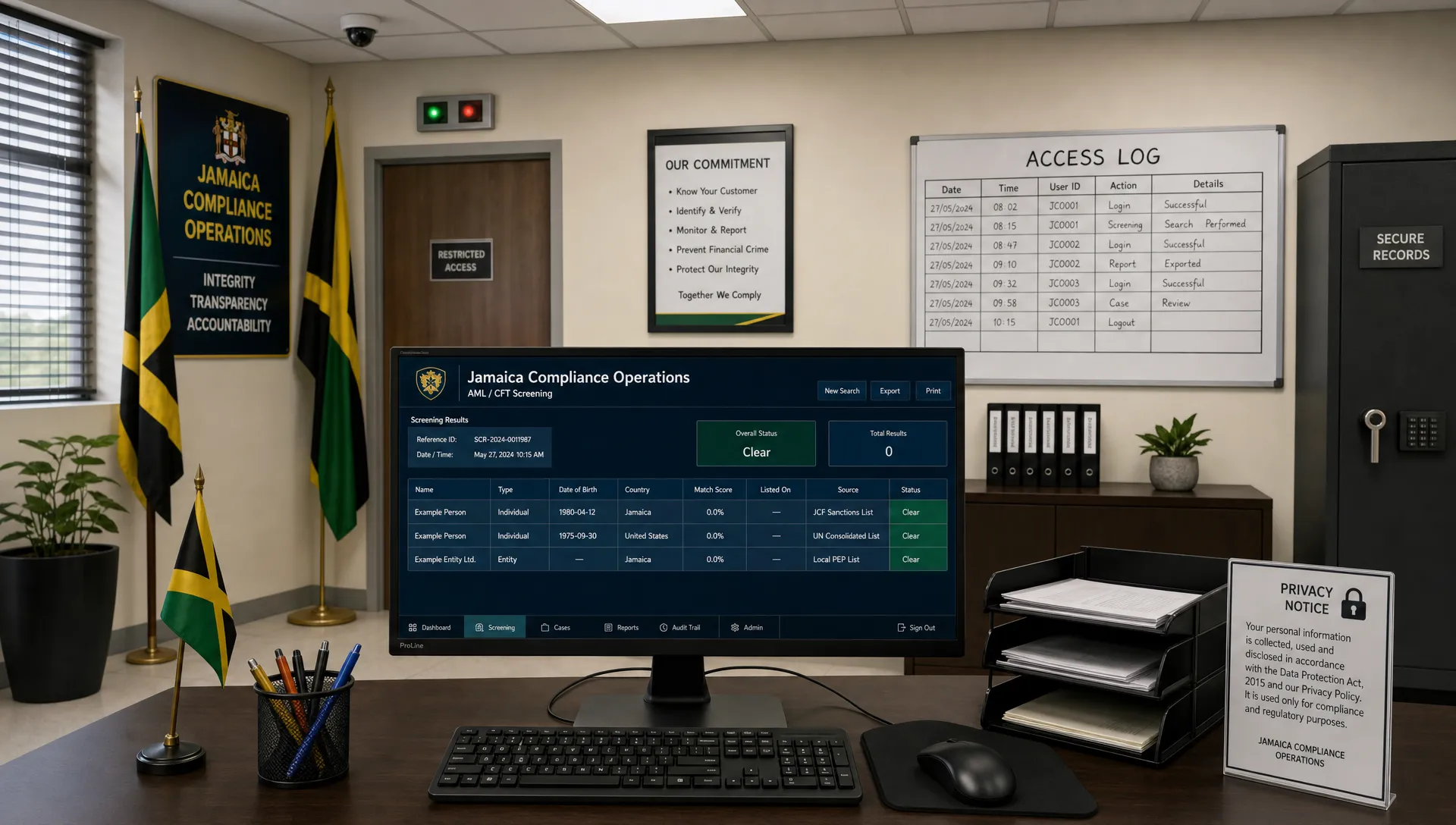
Sanctions screening is often treated as a back office anti-money laundering control: run the name, clear the alert, keep the evidence. In practice, it is also a privacy control. Every search uses personal data, every alert can affect a person or business relationship and every record you keep must be justified.
For Jamaican organisations, this balancing act is now more visible. The Data Protection Act, 2020 requires organisations to process personal data fairly, lawfully and proportionately. At the same time, financial institutions, designated non-financial businesses and many companies with cross-border payments face sanctions, anti-money laundering and counter-terrorism financing expectations.
The challenge is not whether sanctions screening and privacy can coexist. They can. The real question is whether your screening programme is targeted enough to meet compliance duties without becoming excessive, opaque or unnecessarily intrusive.
Why sanctions screening is not just an AML task
Sanctions screening checks whether a person, company, vessel, beneficial owner, director, signatory, employee, vendor or transaction counterparty appears on a sanctions list or is connected to a designated person or entity. The lists may include United Nations sanctions, national sanctions lists and commercial databases that compile aliases, identifiers and related parties.
The FATF Recommendations set international standards for targeted financial sanctions, including measures linked to terrorism, terrorist financing and proliferation financing. The UN Security Council Consolidated List is one of the core sources many screening programmes use.
A true match can have serious consequences. An organisation may need to block a transaction, freeze assets, refuse onboarding, exit a relationship or report to the relevant authority. Those outcomes make screening a compliance priority.
But the privacy impact can also be serious. A false match may delay salary, suspend access to services or cause internal escalation involving sensitive allegations. Even when no match is found, the organisation has still collected, searched, stored and sometimes shared personal data. That is why sanctions screening belongs in both the AML compliance programme and the privacy governance framework.
The privacy risks hidden inside screening
Sanctions screening creates privacy risk because it often involves large-scale comparison, ongoing monitoring and third party data sources. The risk is not limited to the customer onboarding team. It can also affect procurement, HR, finance, legal, security and governance functions.
Screening activity | Privacy risk | Practical control |
Collecting identifiers such as name, date of birth, nationality and address | Excessive data collection if fields are not needed for reliable matching | Define minimum data fields by screening purpose and risk level |
Screening against commercial watchlists | Inaccurate or outdated information may create false positives | Use reputable sources, review list update frequency and document quality checks |
Ongoing monitoring of customers or vendors | Processing may continue longer than expected or beyond the original purpose | Explain monitoring in privacy notices and define review intervals |
Sharing alerts with internal teams | Sensitive allegations may be seen by staff without a need to know | Restrict access to trained compliance personnel and keep audit logs |
Using overseas screening platforms | Personal data may be transferred or accessed outside Jamaica | Assess transfer safeguards, contracts, security and vendor controls |
Keeping screening evidence indefinitely | Retention may exceed legal or operational need | Align retention with AML, sanctions, litigation and data protection requirements |
The biggest privacy mistakes usually come from overcorrection. A company wants to avoid sanctions exposure, so it screens too many people, collects too many identifiers or gives too many employees access to alerts. That can create a separate data protection compliance problem.
The Jamaican compliance lens
Under Jamaica’s Data Protection Act, 2020, organisations that decide why and how personal data is processed must comply with core data protection standards. By 2026, the transition period has passed, so privacy controls should be part of day-to-day operations rather than a future project.
Sanctions screening can usually be justified where it is necessary for a legal obligation, regulatory expectation, contractual duty or legitimate risk management purpose. However, a lawful purpose does not remove the need for proportionality. A compliance team must still ask whether the data collected is adequate, relevant and not excessive.
Data protection standard | What it means for sanctions screening |
Fair and lawful processing | Tell individuals, where appropriate, that screening may occur and document the legal or compliance purpose |
Purpose limitation | Use screening data for sanctions, AML and related compliance purposes, not unrelated profiling |
Data minimisation | Collect identifiers that improve match quality, not every possible field by default |
Accuracy | Verify potential matches before taking adverse action and keep list sources current |
Retention limitation | Keep evidence long enough to meet compliance duties, then securely delete or archive under policy |
Rights of individuals | Handle access, correction and objection requests carefully, subject to applicable legal limits |
Security | Limit access, encrypt data where appropriate and monitor use of screening systems |
International transfers | Assess overseas access or hosting by screening vendors and document safeguards |
This is where AML and privacy teams need a shared language. If they work separately, one team may push for maximum data collection while the other pushes for minimum processing. The better answer is a documented, risk based screening model. For a wider discussion of the same tension, PLMC has also covered how AML and data privacy rules intersect in practice.
Build a defensible screening programme
A balanced sanctions screening programme should be able to answer five basic questions: who is screened, why they are screened, what data is used, who sees the results and how long the evidence is kept. If those questions cannot be answered consistently, the organisation may be relying too heavily on the screening tool and not enough on governance.
Define who is in scope
Not everyone connected to an organisation needs the same level of screening. Customers, beneficial owners, directors, authorised signatories, payment beneficiaries, vendors and employees may all be relevant in different circumstances, but the reason for screening should be clear.
A financial institution may need robust onboarding and ongoing customer screening. A non-financial business may need screening for high value transactions, overseas counterparties or higher risk vendors. An employer may screen for specific regulated roles, not every casual interaction. The scope should reflect legal duties, sector guidance, contractual requirements and the organisation’s actual exposure.
Use enough data to reduce false matches
Data minimisation does not mean using only a name. Name-only screening often produces poor results, especially where common names, spelling variations or aliases are involved. Poor data quality can increase false positives and create more privacy intrusion because more people become subject to unnecessary review.
A better approach is to define a minimum reliable set of identifiers. For an individual, that may include full legal name, date of birth, nationality, address and government issued identification where justified. For a company, it may include registered name, registration number, country of incorporation, directors, beneficial owners and trading names.
The privacy principle is simple: collect what materially improves the accuracy of the screening decision and avoid fields that do not serve that purpose.
Review screening vendors before sharing data
Many organisations use third party screening platforms. That can improve list coverage and workflow control, but it also creates vendor risk. The provider may host data overseas, use subcontractors, retain search histories or combine customer data with its own datasets.
Before using a screening vendor, ask how lists are sourced, how often they are refreshed, where data is stored, who can access it, how long search records are retained and whether the provider uses submitted data for any purpose beyond delivering the service. These questions should form part of wider vendor due diligence for privacy and compliance teams, especially where sensitive personal data or cross-border processing is involved.

Keep human review in the process
Sanctions screening software can identify potential matches, but it should not be the final decision maker in cases that affect a person’s rights, access to services or business relationship. Human review is essential because names can be similar, dates of birth may be missing and list entries may contain aliases or partial identifiers.
A defensible review process compares available identifiers, documents the reasoning, escalates uncertain cases and separates false positives from likely or confirmed matches. Staff should avoid casual language in notes. An alert record may later be reviewed by auditors, regulators, legal counsel or the affected individual, subject to lawful restrictions.
Restrict access to alerts
A sanctions alert can imply serious allegations, even before it is verified. Access should therefore be limited to staff who need the information to perform compliance, legal, risk or operational duties. Frontline staff may need a simple instruction that a transaction is under review, but they do not always need the full alert details.
Good access control also protects the organisation. If too many employees can view or download alerts, the risk of leaks, gossip, discrimination and inconsistent decisions rises. Role based access, audit logs and periodic access reviews are practical controls that support both privacy and AML compliance.
A practical workflow for balancing screening and privacy
A screening workflow does not need to be complicated, but it does need to be consistent. The table below shows how a privacy-aware process can work across the lifecycle.
Stage | Compliance objective | Privacy safeguard |
Onboarding or new relationship | Identify whether the person or entity must be screened | Collect only the identifiers needed for reliable matching |
Initial screening | Check against relevant sanctions lists and watchlists | Use approved tools and prevent unnecessary staff access |
Potential match | Determine whether the alert relates to the same person or entity | Conduct human review before adverse action is taken |
Escalation | Involve compliance, legal or senior management where risk remains | Share details on a need-to-know basis and record decisions carefully |
Confirmed or likely true match | Follow applicable freezing, reporting and non-disclosure obligations | Preserve evidence securely and avoid unnecessary disclosure |
False positive | Clear the alert and allow the relationship or transaction to proceed | Retain only the evidence needed to justify the decision |
Periodic review | Re-screen as required by law, risk level or policy | Review whether continued monitoring remains proportionate |
This structure also helps when regulators, auditors or business partners ask how screening decisions are made. The organisation can show that it is not blindly relying on a system score. It is applying controls that support lawful compliance and fair treatment.
Handling false positives fairly
False positives are one of the main points where sanctions screening and privacy collide. A false positive occurs when a person or entity is flagged because of a similar name, partial identifier or weak match, but is not the sanctioned party.
The privacy concern is not only inconvenience. If mishandled, a false positive can lead to reputational harm, unfair denial of services, unnecessary internal disclosure or inaccurate records. Common names across Jamaica and the wider Caribbean can also increase the chance of mismatches if a system relies too heavily on name similarity.
A fair false positive process should include clear match criteria, documented reviewer notes, escalation rules and a way to suppress repeat false positives where appropriate. Suppression should be controlled, not casual. The organisation should not permanently ignore future risk, but it can record that a specific person has already been distinguished from a listed person using reliable identifiers.
Communication also matters. If a transaction is delayed, staff should use neutral wording unless legal advice permits a fuller explanation. In some AML and sanctions contexts, disclosure may be restricted. Privacy transparency does not mean revealing information in a way that undermines a lawful investigation or breaches another legal duty.
Screening employees, vendors and business partners
Customer screening often receives the most attention, but privacy risks can be just as important in HR and procurement.
Employee screening should be tied to role, risk and legal necessity. Screening all employees continuously without a defined purpose may be difficult to justify. Higher risk roles, regulated functions, finance positions or staff with access to sensitive systems may require more structured checks. Employees should also receive appropriate privacy notices explaining the purpose and nature of compliance screening.
Vendor screening should focus on the legal entity, beneficial owners, directors and relevant controlling parties where the risk justifies it. Requesting full employee lists from a vendor for routine screening may be excessive unless there is a specific legal, contractual or risk reason. If vendor information includes personal data, it should be handled under the same privacy controls as customer data.
Cross-border relationships add another layer. A Jamaican company using an overseas platform, serving EU clients or dealing with international payment flows may need to consider GDPR, UK GDPR, contractual transfer clauses or client-specific compliance requirements. The phrase GDPR Jamaica often appears in business discussions because Jamaican firms may be locally regulated under the Data Protection Act while also facing foreign privacy expectations through contracts or overseas customers.
What to document before a problem arises
Sanctions screening decisions can be challenged. A customer may ask why onboarding was delayed. An auditor may request evidence of monitoring. A regulator may ask whether screening data was excessive. The best time to prepare for those questions is before the first serious alert.
A practical documentation pack should include:
A sanctions screening policy that defines scope, purpose, roles and escalation routes
A data map showing what personal data is collected, where it is stored and who can access it
A list of screening sources, tools and vendor platforms used by the organisation
Match handling procedures for false positives, possible matches and confirmed matches
Retention rules for searches, alerts, reviewer notes and reports
Privacy notices for customers, employees, vendors or other affected groups
Training records for staff who collect data, run searches or review alerts
Periodic quality assurance results, including sample reviews and access checks
A full-scale privacy impact assessment may not be required for every simple screening process, but higher risk programmes should be assessed. If your organisation needs a lightweight starting point, a data privacy assessment that avoids overcomplication can help identify the key evidence, risks and controls without turning the exercise into a paperwork burden.
Frequently Asked Questions
Is sanctions screening allowed under Jamaica’s Data Protection Act, 2020? Yes, sanctions screening can be lawful where it is necessary for legal compliance, regulatory expectations or legitimate risk management. The organisation must still process personal data fairly, use proportionate data fields, protect the information and keep records only as long as needed.
Do we need to tell customers that sanctions screening is taking place? In most cases, privacy notices should explain that personal data may be used for AML, sanctions, fraud prevention and compliance checks. The notice does not need to reveal sensitive operational details or information that would breach another legal obligation.
Can we rely entirely on automated screening results? Screening tools are useful for identifying potential matches, but human review is important before taking adverse action. A reviewer should compare identifiers, assess match quality, document the decision and escalate uncertain cases.
How long should sanctions screening records be kept? Retention should align with AML, sanctions, regulatory, contractual and legal defence needs. Keeping records forever is rarely defensible. A written retention schedule should explain how long searches, alerts, notes and reports are kept and when they are securely deleted or archived.
Does a foreign screening provider create a privacy risk? Yes. If a provider stores, accesses or processes personal data outside Jamaica, the organisation should assess international transfer requirements, security controls, subcontractors, retention terms and whether the vendor uses the data for its own purposes.
Need a privacy-ready sanctions screening programme?
Sanctions screening should protect your organisation without creating avoidable privacy exposure. The strongest programmes bring AML, data protection, vendor governance, training and records management into one practical framework.
If your organisation is reviewing its sanctions screening process under Jamaica’s Data Protection Act, 2020, Privacy & Legal Management Consultants Ltd. can support data protection implementation, AML compliance, training and GRC integration. A practical review now can reduce regulatory risk and make screening decisions easier to defend later.