

How AML and Data Privacy Rules Intersect in Practice
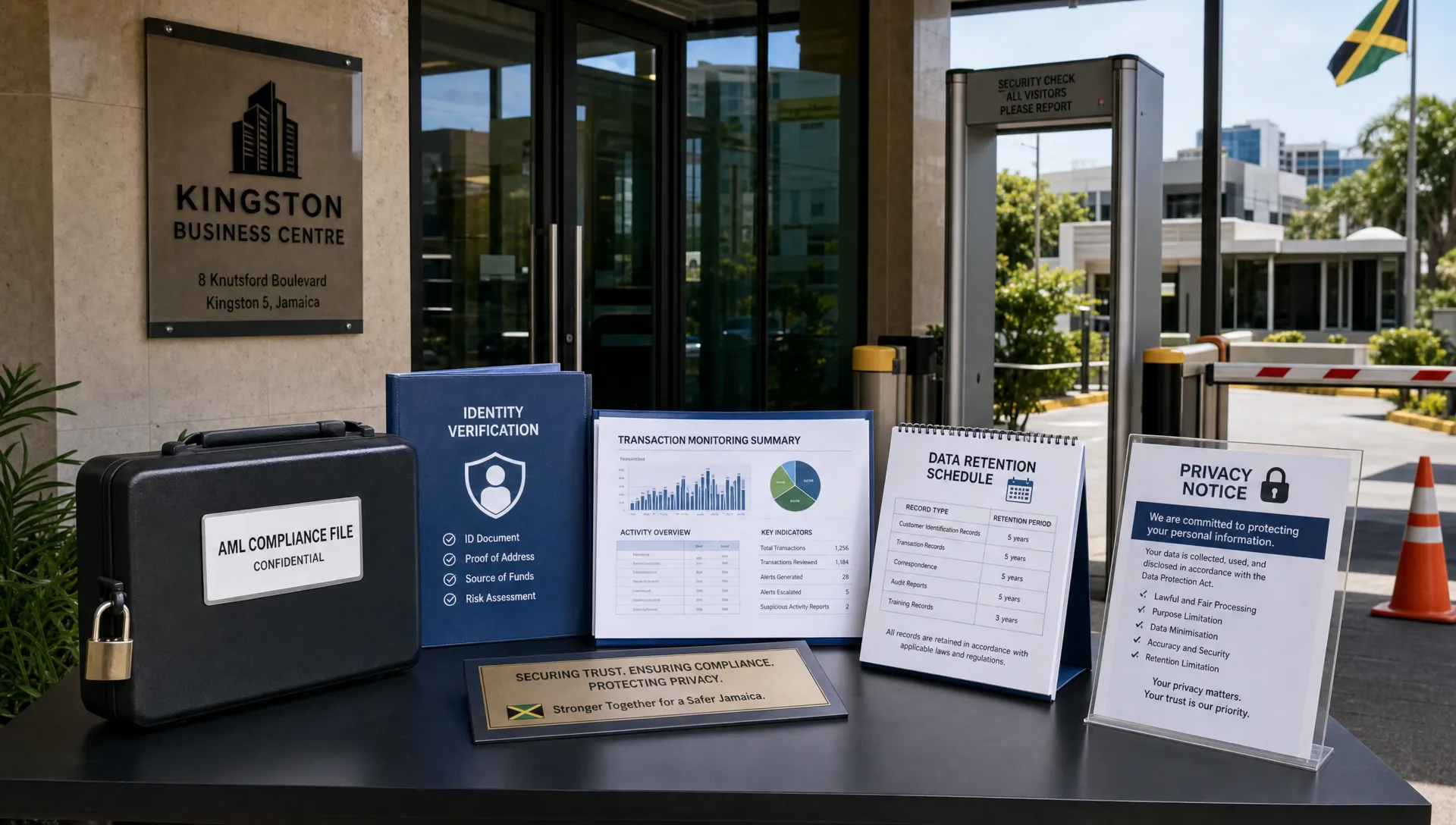
In practice, anti-money laundering compliance and data privacy compliance meet at the same desk. The AML team asks for identification, beneficial ownership details, proof of address, source of funds, transaction records, sanctions screening results, and sometimes adverse media checks. The privacy team asks why the information is needed, how long it will be kept, who can access it, and whether the customer was told what would happen to it.
Both teams are right.
For Jamaican organisations, the challenge is not choosing between AML and data privacy rules. The challenge is building a compliance programme where both sets of obligations work together. AML laws require regulated businesses to know their customers, monitor risk, and report suspicious activity. Data protection rules require organisations to handle personal information lawfully, fairly, securely, and proportionately.
The practical answer is simple in principle but demanding in execution: collect what AML law genuinely requires, use it only for legitimate compliance purposes, secure it carefully, retain it for the correct period, and govern access with discipline.
Why AML and data privacy overlap so often
AML compliance is data-intensive by design. A regulated entity cannot assess money laundering risk without collecting and analysing information about customers, beneficial owners, directors, authorised signatories, transactions, counterparties, and sometimes connected persons.
Data privacy, on the other hand, is concerned with how personal information is collected, used, shared, stored, retained, and deleted. In Jamaica, the Data Protection Act, 2020 places obligations on data controllers and processors, while AML obligations arise from frameworks such as the Proceeds of Crime Act, related regulations, the Terrorism Prevention Act, sector guidance, and supervisory expectations.
That means a bank, credit union, securities dealer, real estate professional, attorney, accountant, casino operator, trust and company service provider, or other regulated business may be subject to both regimes at the same time.
A useful way to frame the intersection is this: AML rules often answer the question, “What must we know and report to prevent financial crime?” Data privacy rules answer the question, “How do we handle that information lawfully and responsibly?”
If either question is ignored, the organisation is exposed. Weak AML controls can lead to regulatory action, criminal risk, reputational harm, and exposure to financial crime. Weak privacy controls can lead to data breaches, complaints, enforcement action, customer distrust, and unnecessary internal risk.
For a broader view of how multiple legal frameworks shape local risk, PLMC has also outlined key obligations in its article on data laws that affect Jamaican businesses.
The core tension: collect enough, but not too much
AML teams are trained to be cautious. If a customer appears high risk, they may want more documents, more explanations, more screening, and more records. That caution is often appropriate, especially where enhanced due diligence is required.
Privacy rules, however, push against unnecessary collection. Organisations should not collect personal data simply because it might be useful one day. They should be able to explain the purpose of collection, the legal or regulatory basis, the category of data being collected, and the operational reason the data is necessary.
This tension is most visible during customer onboarding. A business may need to verify identity, confirm beneficial ownership, understand the nature of a customer’s activities, and assess source of funds or source of wealth. But it should still avoid vague, open-ended collection practices such as requesting excessive bank statements, retaining unnecessary copies, or asking for sensitive details that do not support a documented risk assessment.
Good practice is to define customer due diligence requirements by risk level. Low-risk customers should not be subjected to the same level of data collection as genuinely high-risk customers unless the law or regulator requires it. High-risk customers may justify deeper checks, but the file should show why those checks were necessary.
Lawful processing: AML compliance is a strong reason, not a blank cheque
In many AML situations, personal data is processed because the organisation has a legal or regulatory obligation. That is a strong basis for collecting and using information. However, it is not a blank cheque.
A lawful basis does not remove the need for privacy discipline. The organisation still needs to provide appropriate privacy information, restrict use to legitimate purposes, protect the data, keep it accurate, and ensure it is not retained indefinitely without justification.
This is where many organisations make a practical mistake. They assume that because AML rules require KYC records, all internal use of that data is automatically permitted. That is risky. Information collected for customer due diligence should not casually be repurposed for marketing, profiling, unrelated investigations, or internal curiosity.
A better approach is purpose mapping. When a data field is collected, the organisation should know why it is collected, which rule or risk control supports the collection, who uses it, where it is stored, and when it should be reviewed or deleted.
AML activity | Privacy implication | Practical control |
Customer identification | Collection of identity documents and contact details | Use a defined KYC checklist and avoid extra documents unless justified |
Beneficial ownership checks | Processing data about individuals behind legal entities | Explain the purpose and restrict access to staff with a compliance need |
Sanctions and PEP screening | Use of external databases and possible matching errors | Apply quality checks, document decisions, and allow review of false positives |
Transaction monitoring | Analysis of customer behaviour over time | Limit monitoring to legitimate AML purposes and secure monitoring outputs |
Suspicious transaction reporting | Highly confidential compliance reporting | Separate STR/SAR files, restrict access, and follow tipping-off controls |
Record retention | Longer storage of personal data than normal business use | Use a retention schedule based on AML rules and privacy requirements |
Transparency has limits, especially around suspicious activity
Privacy compliance usually requires transparency. Customers should generally be told what personal data is collected, the purposes for processing, the categories of recipients, and the organisation’s retention approach.
AML compliance introduces an important limit: suspicious activity reporting cannot be handled like an ordinary customer service issue. Where a suspicious transaction report or similar filing is being considered or has been made, the organisation must be careful not to disclose information in a way that could amount to tipping off or compromise an investigation.
This creates a practical challenge when a customer asks, “Why are you asking me these questions?” or “Do you suspect me of something?” Staff need approved scripts and escalation routes. They should be able to explain that the organisation is required to conduct routine compliance checks, but they should not disclose internal suspicion, monitoring triggers, or whether a report has been made.
The same issue can arise with data subject access requests. If a customer requests all personal data held by the organisation, compliance, legal, and privacy teams should review whether any information is restricted from disclosure because of AML confidentiality obligations, legal privilege, investigation risk, or other applicable exemptions.
This is one of the strongest arguments for integrating AML and privacy governance. A frontline employee should not have to decide alone whether a request could create a tipping-off risk. There should be a written process that routes sensitive requests to the right internal reviewers.
Accuracy matters because AML data can harm real people
Data privacy rules often emphasise accuracy, and AML compliance depends on it. Inaccurate AML data can produce serious consequences. A customer may be wrongly classified as high risk, incorrectly matched to a sanctions or politically exposed person database, delayed in opening an account, or subjected to enhanced scrutiny without proper justification.
Screening tools are useful, but they are not perfect. Names may be common. Dates of birth may be missing. Transliteration and spelling differences can create false positives. Adverse media may be outdated, incomplete, or unfairly reported.
Good practice is to treat AML outputs as decision-support information, not unquestionable truth. Where screening produces a possible match, staff should review the match, document the reasoning, and distinguish between confirmed matches and false positives. The higher the impact on the individual, the more important human review becomes.
This is also where staff training becomes essential. Employees need to understand both the AML risk and the privacy risk. Mishandling a false positive can create customer harm, reputational damage, and unnecessary regulatory exposure.

Retention: AML recordkeeping does not mean keeping everything forever
AML rules commonly require regulated entities to retain customer due diligence and transaction records for a defined period after the end of a relationship or completion of a transaction. The exact retention period and trigger should be confirmed against the applicable Jamaican law, sector rules, and supervisory guidance for the organisation.
Privacy rules add a complementary requirement: personal data should not be kept longer than necessary for the purpose for which it is processed, unless another lawful reason justifies retention.
These two positions are not inconsistent. AML may justify keeping certain records for a statutory period. Privacy requires the organisation to define that period, apply it consistently, and delete or anonymise records when there is no longer a lawful need to keep them.
Problems arise when organisations keep all AML-related data indefinitely “just in case.” That increases breach impact, storage cost, discovery risk, and internal misuse risk. A better retention schedule should separate categories such as active customer files, closed customer files, transaction records, screening logs, internal investigations, suspicious transaction reports, training records, and audit evidence.
Retention should also be practical. If the AML system, customer relationship management platform, shared drive, email archive, and external vendor portal all hold copies of the same personal information, deletion from one location will not be enough. Data mapping is essential.
PLMC’s discussion of privacy governance tools that actually work explains why inventories, workflows, and retention controls are not paperwork exercises. They are the operating system for defensible compliance.
Data sharing: regulators, group companies, vendors, and foreign systems
AML compliance often requires data sharing. A regulated entity may need to provide information to competent authorities, respond to regulator requests, use external screening databases, rely on outsourced compliance tools, or share information within a financial group.
Each sharing arrangement should be assessed through a privacy lens. The organisation should ask what data is being shared, why it is necessary, whether the recipient is a controller or processor, what contractual protections apply, whether the data will leave Jamaica, and how access will be monitored.
Cross-border transfers deserve particular care. Many AML tools are cloud-based and may involve data processing in other jurisdictions. Group compliance functions may also centralise monitoring outside Jamaica. This does not automatically make the arrangement unlawful, but it does require governance.
The Financial Action Task Force Recommendations set global expectations for AML/CFT controls, while local privacy requirements still govern how personal information is handled. Organisations should avoid treating global AML standards and local privacy law as separate universes. In practice, both must be reflected in contracts, policies, access controls, and audit rights.
Where vendors process AML data, contracts should clearly address confidentiality, security, breach notification, subcontracting, deletion or return of data, audit cooperation, and limits on secondary use. If a vendor uses customer data to train models, enrich third-party databases, or improve unrelated products, that should be identified and assessed before approval.
Security controls must match the sensitivity of AML files
AML files can contain passports, national identification details, tax information, addresses, financial transactions, corporate ownership structures, internal suspicion notes, law enforcement correspondence, and reports to authorities. That makes them highly sensitive from a privacy and cyber security perspective.
Basic access controls are not enough. Organisations should apply role-based access, strong authentication, encryption where appropriate, secure file transfer methods, audit logs, and periodic access reviews. Shared inboxes and general-purpose folders are especially risky if they contain suspicious activity material or identity documents.
Staff should also be trained not to discuss AML concerns casually by email or messaging platforms. A poorly worded internal message can create confidentiality issues, prejudice an investigation, or be misinterpreted if later reviewed.
This is where data protection compliance and cyber security meet. Security protects the systems and records. Privacy governs whether the information should be there, who should see it, and what should happen to it over time. For a practical explanation of this distinction, see PLMC’s article on data security and data privacy in daily business operations.
Practical controls that make AML and privacy work together
The organisations that manage this intersection best usually do not run AML and privacy as isolated compliance silos. They create common governance routines so that both perspectives are considered when systems, policies, vendors, and procedures change.
A practical operating model should include the following controls:
A documented data map for AML-related personal information, including systems, vendors, storage locations, and cross-border flows.
A KYC and enhanced due diligence checklist that is tied to risk levels and legal requirements, rather than informal staff preference.
Privacy notices that explain AML-related processing in clear language without compromising suspicious activity controls.
Restricted access to AML files, especially suspicious activity reports, investigation notes, and screening results.
A retention schedule that reflects AML recordkeeping rules and privacy deletion principles.
A process for handling access, correction, deletion, and complaint requests where AML confidentiality may be relevant.
Vendor due diligence for screening tools, transaction monitoring platforms, cloud storage, and outsourced compliance support.
Joint training for AML, privacy, cyber security, legal, and frontline teams.
These controls should be tested. A policy that says access is restricted means little if dozens of employees can open the AML folder. A retention schedule means little if archived files are never deleted. A privacy notice means little if frontline staff cannot explain routine due diligence questions without alarming customers.
How to handle conflicts between AML and privacy requirements
Real conflicts do occur, but many apparent conflicts are actually governance gaps. If AML asks for more data and privacy asks for less, the solution is not for one team to overrule the other. The solution is to document the reason for collection and apply proportional safeguards.
A useful decision path is to ask four questions. First, is there a legal or regulatory requirement to collect, use, retain, or disclose the data? Second, if not strictly required, is the data necessary for a documented risk-based AML control? Third, can the same objective be achieved with less data, shorter retention, or narrower access? Fourth, what safeguards are needed because of the sensitivity or impact of the processing?
This approach helps organisations avoid two extremes. One extreme is under-collecting, where privacy is misunderstood as a reason not to perform proper due diligence. The other is over-collecting, where AML is used as a blanket justification for unnecessary surveillance or indefinite retention.
The correct balance is defensible, risk-based, documented, and regularly reviewed.
What Jamaican boards and senior management should ask
AML and data privacy both require senior-level attention. They affect legal risk, customer trust, operational resilience, regulatory relationships, and reputation. Boards and executives do not need to manage every KYC file, but they should ask informed questions about the control environment.
Useful board-level questions include:
Do we know where AML-related personal data is stored and who has access to it?
Are our KYC requirements risk-based and documented?
Do our privacy notices explain compliance processing clearly?
Can we respond safely to a data subject request involving suspicious activity material?
Are AML vendors reviewed for privacy, cyber security, and cross-border transfer risk?
Do we have a retention schedule that is actually implemented?
Are AML and privacy incidents reported through the right governance channels?
These questions help move compliance from paper to practice. They also support a stronger governance, risk, and compliance culture, where teams understand that financial crime prevention and privacy protection are both part of responsible business.
Frequently Asked Questions
Do data privacy rules prevent AML checks? No. Data privacy rules do not prevent lawful AML checks. They require organisations to collect and use AML information fairly, securely, proportionately, and for legitimate purposes.
Can a business tell a customer that a suspicious transaction report was filed? Generally, staff should not disclose whether a suspicious report has been made or is being considered, because that may create tipping-off risk. Sensitive questions should be escalated to compliance or legal reviewers.
How much customer data should be collected for KYC? The amount should be based on legal requirements and the customer’s risk profile. Enhanced due diligence may justify more information, but unnecessary or poorly documented collection creates privacy risk.
Can AML records be kept longer than ordinary customer records? Yes, where AML law or regulatory obligations require retention. However, the organisation should define the retention period, secure the records, and delete or anonymise them when there is no lawful reason to keep them.
Who should own the AML and privacy overlap? Ownership should be shared through governance. The AML officer, data protection lead, legal team, cyber security function, and senior management should coordinate rather than treat the issue as belonging to one department only.
Build a joined-up compliance programme
AML and data privacy rules intersect wherever organisations identify customers, monitor transactions, assess risk, share information, and retain compliance records. The goal is not to weaken AML controls or slow down business. The goal is to make the handling of personal information lawful, secure, proportionate, and auditable.
Privacy & Legal Management Consultants Ltd. supports organisations in Jamaica with data protection implementation, AML compliance, cyber security, corporate governance, training, and integrated GRC support. If your organisation needs to align AML obligations with data protection compliance, visit Privacy & Legal Management Consultants Ltd. to explore practical support and request a consultation.