
Data Security vs Privacy in Daily Business Operations

In daily business operations, data security and privacy often look like the same job because they both deal with information. In practice, they answer different questions.
Data security asks: How do we protect information from unauthorised access, loss, alteration, disclosure, or disruption?
Data privacy asks: Should we collect, use, share, retain, or disclose this personal information in the first place, and are we doing so lawfully, fairly, and transparently?
That distinction matters for Jamaican organisations because compliance is not achieved by installing stronger passwords alone. A business can have excellent firewalls and still misuse personal data. It can also have a well-written privacy notice but weak access controls that expose customer or employee records. Sound governance requires both.
This article explains how data security vs privacy shows up in everyday work, from onboarding customers and managing staff records to using cloud tools, WhatsApp groups, email marketing, and third-party service providers.
Data security vs privacy in plain business language
Data security is mainly about protection. It focuses on the safeguards that keep data confidential, accurate, available, and resilient. These safeguards may include access controls, encryption, secure backups, endpoint protection, cyber security monitoring, incident response plans, and staff awareness training.
Data privacy is mainly about appropriate use. It focuses on the rights and expectations of people whose personal data your organisation handles. Privacy asks whether the organisation has a valid reason to collect the information, whether individuals understand what will happen to it, whether the data is limited to what is necessary, and whether it is retained only for as long as needed.
A simple way to separate them is this: security protects the data, privacy protects the person behind the data.
For a broader conceptual breakdown, PLMC has also explained the practical difference between data privacy and data security. In daily operations, however, the real test is whether staff can apply that difference when serving customers, hiring employees, managing vendors, and responding to incidents.
Why the difference matters in Jamaica
Jamaica’s Data Protection Act creates obligations around the handling of personal data. Organisations that determine why and how personal data is processed are generally expected to manage that data responsibly, including through lawful processing, transparency, data minimisation, security safeguards, and respect for individuals’ rights.
The Office of the Information Commissioner of Jamaica provides guidance and regulatory oversight for the data protection framework. For businesses, this means data privacy is not just a public relations issue. It is part of governance, risk, and compliance.
Cyber security also continues to grow in importance as organisations rely more heavily on digital platforms, cloud services, remote work, mobile devices, and online transactions. The NIST Cybersecurity Framework is one recognised reference point for managing cyber risk, but even a strong cyber security framework must be connected to privacy requirements.
If these two functions are disconnected, a business may become technically secure but operationally non-compliant.
How data security and privacy differ in daily operations
The table below shows how the distinction appears in common business activities.
Daily operation | Data security focus | Data privacy focus |
Customer onboarding | Verify user access, secure forms, protect uploaded IDs | Collect only necessary information and explain why it is needed |
HR records | Restrict access to payroll, medical, and disciplinary files | Use employee data fairly and retain it only for valid purposes |
Email marketing | Protect mailing lists from unauthorised access | Ensure contacts were collected properly and can opt out where required |
Vendor management | Confirm that suppliers use secure systems | Ensure data sharing is lawful, documented, and limited |
Cloud storage | Use strong authentication, backups, and permissions | Decide what data should be stored, where, and for how long |
Incident response | Contain, investigate, and recover from a breach | Assess impact on individuals and meet notification obligations where applicable |
Records retention | Prevent accidental deletion or unauthorised access | Delete or anonymise data when there is no lawful reason to keep it |
This is why data security and privacy should not compete for attention. They should operate together, with clear ownership and practical workflows.
Example 1: Collecting customer information
Imagine a financial services firm, medical office, retailer, school, or membership organisation collecting personal information from customers. From a security standpoint, the organisation needs to make sure the online form is protected, staff access is limited, and records are stored safely.
From a privacy standpoint, the organisation must ask different questions. What information is genuinely necessary? Is a copy of an ID required, or would a reference number be enough? Has the customer been told how the information will be used? Will it be shared with third parties? How long will it be kept?
The privacy risk is not only that someone might hack the system. The risk may also be that the organisation collects too much data, uses it for an unexpected purpose, or keeps it indefinitely.
A secure form can still create a privacy problem if it asks for information the business does not need.
Example 2: Employee records and workplace monitoring
Human resources departments handle some of the most sensitive personal data in a business, including identification documents, banking details, performance reviews, sick leave records, disciplinary notes, emergency contacts, and sometimes medical information.
Security controls are essential. Payroll files should not be open to the whole organisation. HR folders should not be shared through unsecured personal email accounts. Devices used for HR work should be protected, patched, and backed up.
Privacy adds another layer. Employees should understand what data is being collected and why. Workplace monitoring, attendance systems, CCTV, productivity tools, and biometric systems should be assessed carefully because they can affect employee dignity, trust, and expectations.
The operational question is not only, “Can we secure this monitoring tool?” It is also, “Is this monitoring necessary, proportionate, transparent, and aligned with our legal obligations?”
Example 3: WhatsApp, email, and everyday communication
Many Jamaican organisations rely on WhatsApp, email, shared drives, and collaboration tools for speed and convenience. These channels can support productivity, but they can also blur the line between informal communication and formal data processing.
A manager sending a customer ID, employee medical note, or confidential complaint through an unsecured chat may create both a security and privacy issue. The security issue is that the information may be exposed to the wrong people or stored outside approved systems. The privacy issue is that personal data may be shared in a way the individual did not expect and the organisation cannot properly control.
Good daily practice includes setting clear rules for what types of information can be shared through each channel. Staff should know when to use approved systems, when to redact information, when to avoid forwarding messages, and when to escalate a privacy concern.
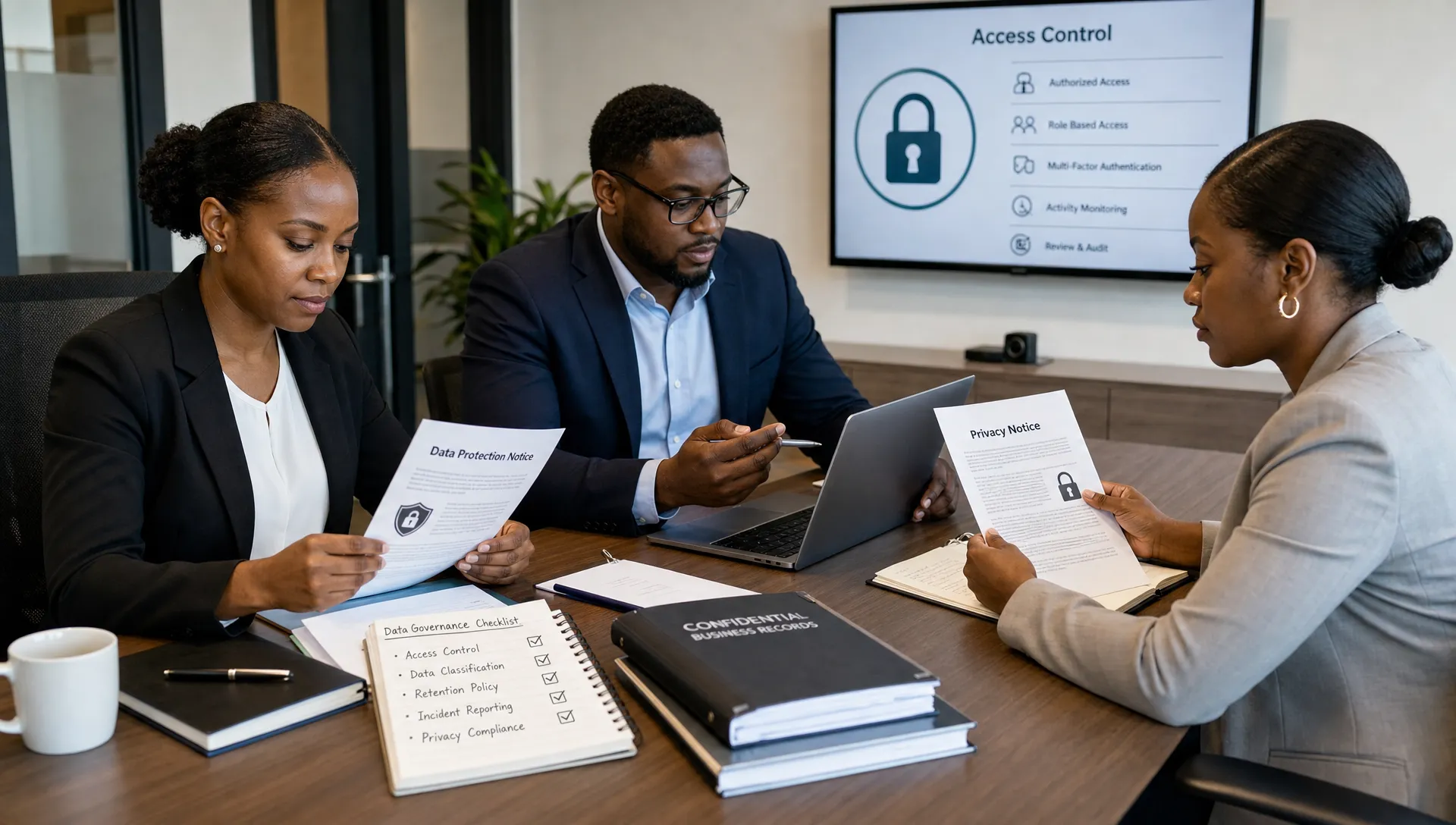
Example 4: Using third-party service providers
Many businesses outsource functions such as payroll, IT support, cloud hosting, marketing, accounting, payment processing, debt collection, delivery, and customer relationship management. These vendors may need access to personal data to perform their services.
Security teams often ask whether the vendor has appropriate technical controls. That is important, but privacy requires more. The organisation should understand what data is being shared, why the vendor needs it, whether the vendor may use it for its own purposes, where it may be stored, and what happens when the contract ends.
A vendor can be secure but still unsuitable from a privacy perspective if the data use is unclear, excessive, or poorly documented.
Practical vendor due diligence should therefore combine cyber security review with privacy review. This may include contractual safeguards, confidentiality obligations, data processing terms, access limitations, breach reporting expectations, and return or deletion requirements.
Example 5: Data retention and deletion
Retention is one of the most common areas where security and privacy are confused.
From a security perspective, a business may want to preserve records for backup, continuity, audit, or investigation purposes. From a privacy perspective, keeping personal data forever increases risk and may conflict with the principle that data should not be retained longer than necessary.
This does not mean organisations should delete records randomly. Some data must be retained for legal, tax, contractual, regulatory, employment, or operational reasons. The goal is to define retention periods and apply them consistently.
A practical retention schedule should answer:
What type of record is being kept?
Why is the record needed?
Who owns the record internally?
How long should it be retained?
How should it be securely deleted, anonymised, or archived?
Security makes sure the record is protected while it exists. Privacy makes sure there is a valid reason for it to exist.
Where security ends and privacy begins
In daily business operations, the handoff between security and privacy is not always obvious. For example, if an employee accidentally emails a spreadsheet of customer data to the wrong recipient, security may investigate what happened, contain the exposure, and improve controls. Privacy must assess what personal data was involved, how individuals may be affected, whether notification is required, and what corrective action is needed.
If a new customer app is being launched, cyber security may test vulnerabilities and access controls. Privacy should review the data fields, consent flows, notices, analytics, third-party integrations, and retention settings.
If the organisation is introducing a biometric attendance system, security may focus on storage and authentication. Privacy should assess necessity, proportionality, employee transparency, alternatives, and risk to individuals.
This is why many organisations benefit from separating duties while keeping coordination strong. PLMC has discussed this governance issue in more detail in its article on separate duties for data security and data privacy.
A practical checklist for daily business operations
The best privacy and security programmes do not live only in policies. They show up in everyday habits. Managers, frontline staff, HR teams, IT teams, compliance officers, finance teams, and executives all influence how personal data is handled.
Use the following checklist to test whether your operations are covering both sides.
Operational question | Mostly security | Mostly privacy | Why it matters |
Who can access this data? | Yes | Yes | Access must be controlled and limited to legitimate business needs |
Why are we collecting this data? | No | Yes | Collection should be lawful, fair, and necessary |
How is this data protected? | Yes | Yes | Weak safeguards can create legal, operational, and reputational harm |
Did we tell the individual how the data will be used? | No | Yes | Transparency supports trust and compliance |
Can this data be shared with this vendor? | Yes | Yes | Sharing requires secure transfer and a valid purpose |
How long should we keep this data? | Yes | Yes | Retention affects risk, accountability, and compliance |
What happens if something goes wrong? | Yes | Yes | Incidents require technical response and privacy impact assessment |
The most important lesson is that privacy decisions should be built into operational planning, not added after systems and processes are already live.
Common mistakes that create avoidable risk
Many organisations do not ignore privacy and security on purpose. Problems usually develop because everyday processes evolve faster than governance.
Common mistakes include collecting the same information in multiple departments, storing copies of IDs in shared folders, using personal devices for business records, giving staff broad access “just in case,” failing to remove access when employees leave, sending personal data through informal messaging apps, and keeping old records because no one owns deletion.
Another common mistake is treating privacy as a legal document only. A privacy notice is important, but it is not enough if staff do not understand how to handle personal data in real situations.
Similarly, cyber security tools are important, but they cannot decide whether a data collection practice is fair, necessary, or transparent. Tools must support governance, not replace it.
How to build both into daily workflows
A practical approach starts with mapping where personal data enters, moves through, and leaves the organisation. This does not need to be overly complicated at the beginning. The goal is to understand key processes, such as customer onboarding, HR management, vendor sharing, marketing, complaints, payments, and record retention.
Once those processes are visible, the organisation can assign responsibilities. IT may own technical safeguards. Compliance or data protection leadership may own privacy governance. Business unit managers may own the accuracy of daily processes. Senior leadership should ensure accountability, resources, and culture.
Training is also essential. Staff should be able to recognise personal data, understand approved channels, report incidents quickly, and challenge unnecessary collection. In small and medium-sized organisations, simple guidance and regular reminders often make a significant difference. PLMC’s guidance for Jamaican SMEs managing data privacy and data protection may be useful for organisations building their programme step by step.
Finally, privacy and security should be reviewed when operations change. New software, new vendors, new marketing campaigns, new employee monitoring tools, and new customer data fields should trigger questions before launch, not after a complaint or breach.
What leadership should take away
Data security vs privacy is not a technical debate for specialists only. It is a daily management issue.
Executives and managers should expect their organisations to answer both sets of questions. Are systems secure? Are staff trained? Are vendors assessed? Are access rights controlled? Are individuals informed? Are data uses lawful and fair? Are records deleted when no longer needed? Are incidents handled with both technical and privacy impact in mind?
When those questions become part of normal operations, compliance becomes more sustainable. Customers, employees, regulators, and business partners are more likely to trust an organisation that can show it protects both information and the people connected to it.
Frequently Asked Questions
What is the main difference between data security and privacy? Data security focuses on protecting information from unauthorised access, loss, alteration, or disclosure. Data privacy focuses on whether personal information is collected, used, shared, and retained lawfully, fairly, and transparently.
Can a business have data security without data privacy? Yes. A business may protect data with strong technical controls but still collect too much personal information, use it for unclear purposes, or retain it longer than necessary. That would be a privacy problem even if the system is secure.
Can a business have data privacy without data security? Not effectively. Privacy commitments depend on security safeguards. If personal data is not protected, the organisation may fail to meet privacy expectations and legal obligations.
Who is responsible for data security and privacy in an organisation? Responsibility is usually shared. IT or cyber security teams often manage technical safeguards, while compliance, legal, data protection, HR, and business leaders help govern lawful and fair use. Senior management should ensure clear accountability.
Why is this important for Jamaican businesses? Jamaican organisations handling personal data must consider obligations under the Data Protection Act and related governance expectations. Strong privacy and security practices also reduce risk, improve trust, and support better business operations.
Need help aligning privacy and security in your operations?
Privacy & Legal Management Consultants Ltd. supports organisations in Jamaica with data protection implementation, corporate governance, cyber security, anti-money laundering compliance, GRC integration, training, risk assessment tools, educational resources, and consultations.
If your organisation is reviewing its daily handling of customer, employee, vendor, or operational data, a practical privacy and security assessment can help identify gaps before they become compliance, reputational, or operational problems. Visit Privacy & Legal Management Consultants Ltd. to learn more or request guidance tailored to your organisation’s needs.