
The Role of Data Laws in Vendor and Cloud Decisions
Choosing a payroll platform, customer relationship management system, cloud storage provider or outsourced IT partner can look like a technical or commercial decision. The team compares price, uptime, integrations, service levels and user experience. But once personal data is involved, the decision also becomes a legal and governance decision.
For Jamaican organisations, data laws now play a direct role in whether a vendor should be used, how a cloud service should be configured, what contract terms are required and who remains accountable if something goes wrong. Outsourcing a function does not outsource responsibility. If a vendor mishandles employee files, customer records, health information, financial data or identity documents, the organisation that selected and instructed that vendor may still have serious obligations under Jamaica's Data Protection Act, 2020 and related governance duties.
The practical question is no longer simply whether a cloud service works. The better question is whether the service can be used lawfully, securely and transparently for the specific data, purpose and risk profile of your organisation.
Why data laws belong in procurement conversations
Data protection compliance is often treated as a legal review that happens after a vendor has already been selected. That is too late. By that point, the organisation may already be committed to a platform that stores data in unsuitable locations, gives broad access to sub-processors, lacks deletion controls or cannot support data subject rights requests.
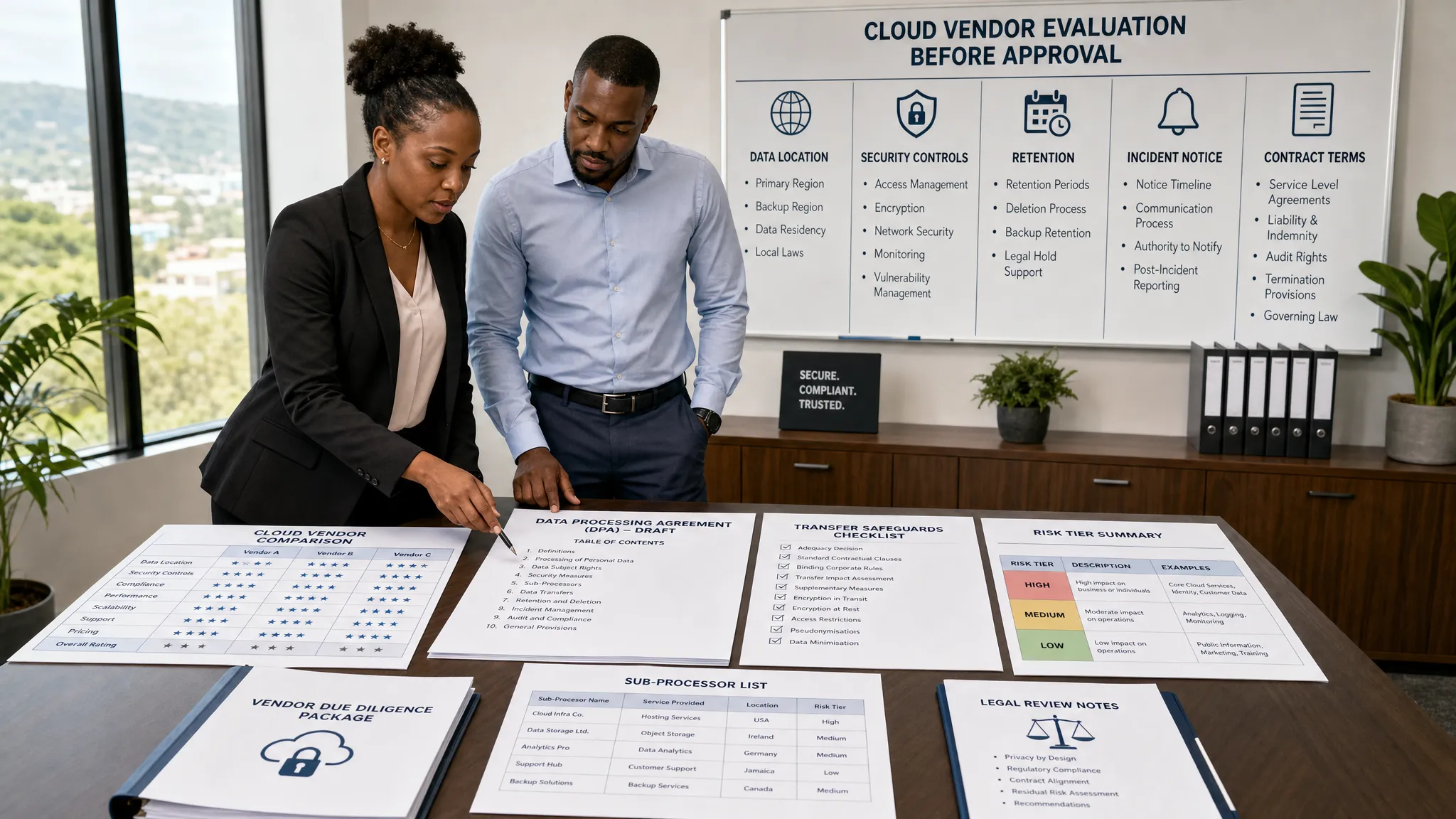
Data laws should shape vendor decisions before a contract is signed because they affect core procurement questions:
What personal data will the vendor access, store, transmit or analyse?
Is the vendor acting only on your instructions, or does it use the data for its own purposes?
Where will the data be hosted, backed up and accessed from?
What technical and organisational measures are in place?
How quickly will the vendor notify you of a breach or security incident?
Can the vendor return or delete data at the end of the relationship?
These are not abstract compliance questions. They influence operational resilience, customer trust, board accountability and regulatory exposure. They also affect negotiations. A vendor that cannot answer basic privacy and security questions may be creating a risk that no discount can justify.
The controller and vendor relationship matters
Under data protection principles, an organisation that decides why and how personal data is processed is generally treated as the controller. A vendor that processes personal data on behalf of that organisation is often functioning as a processor or service provider. The labels matter because they affect contractual duties, decision rights and accountability.
If a Jamaican company hires a cloud HR system to manage staff records, the company will usually decide why the data is collected and how long it is needed. The vendor provides the platform and processes the data according to agreed instructions. That relationship should be reflected in a written agreement that sets boundaries on use, access, retention, confidentiality, security and onward sharing.
If the vendor uses the data for its own analytics, marketing, product training or independent decision-making, the relationship becomes more complicated. The vendor may no longer be acting only on your instructions. That can change the risk profile and the contractual protections required.
For a deeper discussion of how responsibility is assigned, PLMC's article on duties of controllers and vendors under Jamaica's data protection framework is a useful companion to this vendor selection discussion.
What data laws require you to know before choosing a cloud vendor
A cloud vendor review should start with the data, not the software. A low-cost application used for anonymous scheduling is very different from a platform holding customer identification documents, medical records, transaction histories or employee disciplinary records.
Jamaica's Data Protection Act is built around familiar protection standards, including fair and lawful processing, purpose limitation, data minimisation, accuracy, retention control, rights of individuals, security safeguards and restrictions on international transfers where adequate protection is not present. The Office of the Information Commissioner is a key reference point for organisations seeking to understand the local regulatory environment.
Those standards translate into practical vendor questions.
Legal or governance issue | Vendor and cloud decision question | Evidence to request |
Purpose limitation | Will the vendor use the data only to deliver the contracted service? | Processing terms, privacy notice, data use restrictions |
Data minimisation | Can the system limit fields, access and data collection to what is necessary? | Configuration guide, role-based access controls, sample data fields |
Security safeguards | Are appropriate technical and organisational measures in place? | Security overview, penetration test summary, certifications, incident process |
Retention | Can data be archived, deleted or anonymised according to your schedule? | Retention settings, deletion workflow, backup policy |
Individual rights | Can the vendor support access, correction, deletion or objection requests? | Export tools, correction process, response support commitments |
International transfers | Where is data hosted, backed up and accessed by support teams? | Data location list, sub-processor list, transfer terms |
Accountability | Can your organisation demonstrate due diligence and ongoing oversight? | Completed questionnaire, risk assessment, contract review record |
The goal is not to make every procurement exercise slow or legalistic. The goal is to match the level of review to the level of risk. A cloud system that stores sensitive personal data, supports a critical business process or involves cross-border access deserves more scrutiny than a low-risk tool with limited personal data.
Cloud does not remove accountability
Cloud services can improve security and resilience when they are properly selected and configured. Many cloud providers invest heavily in infrastructure, monitoring and continuity. However, cloud adoption also introduces shared responsibility.
The provider may secure the underlying platform, but your organisation may still be responsible for user access, password policies, administrator privileges, data classification, retention rules, configuration choices and employee training. A secure cloud service can still become risky if the organisation grants excessive access, stores unnecessary data or fails to monitor vendor changes.
This is where privacy and security must work together. Privacy asks whether personal data should be collected, used, shared and retained for a lawful purpose. Security asks how that data is protected from unauthorised access, loss or misuse. The two duties overlap, but they are not identical. PLMC explores this distinction in its article on separating data privacy and data security responsibilities.
The NIST Cybersecurity Framework is also a useful reference for thinking about identify, protect, detect, respond and recover functions. While it is not a substitute for Jamaican legal compliance, it can help structure security discussions with vendors and internal teams.
Cross-border hosting and support access need special attention
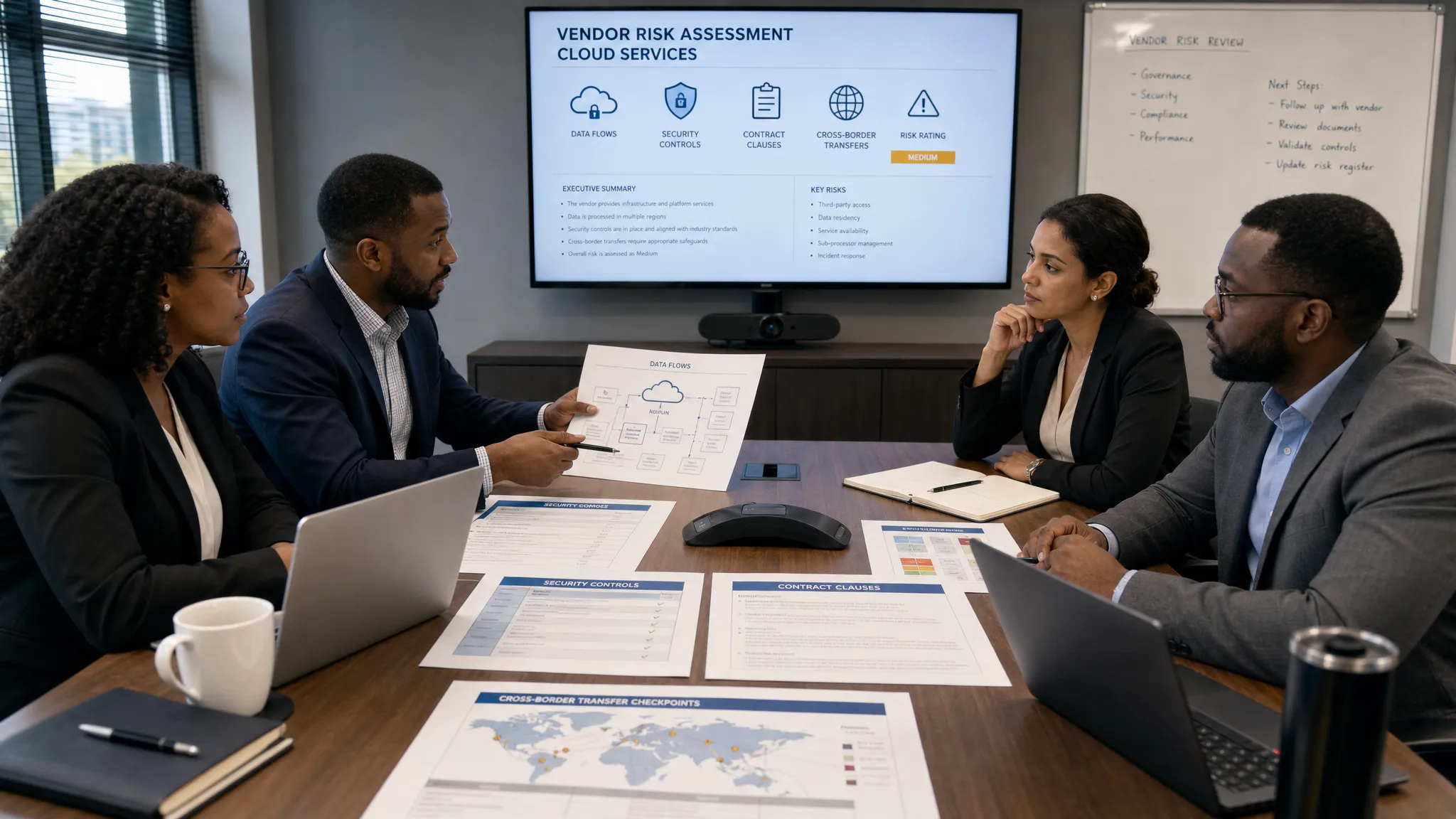
Many cloud services used in Jamaica are hosted outside Jamaica. That is not automatically prohibited, but it does require careful analysis. Data laws often place conditions on transfers of personal data to another country, especially where the destination may not provide an adequate level of protection.
When reviewing a cloud provider, do not stop at the location of the main data centre. Ask about backups, disaster recovery, support access, subcontractors and remote administration. A vendor may state that data is hosted in one region, while support teams or sub-processors in other jurisdictions can still access personal data.
The review should also consider whether the vendor can give you contractual commitments around transfer safeguards, confidentiality and onward disclosure. If your organisation operates internationally, handles EU residents' data or serves overseas clients, GDPR may also enter the analysis. A vendor's GDPR posture can be helpful, but GDPR Jamaica alignment should not be assumed. Local obligations under Jamaica's Data Protection Act still need to be assessed on their own terms.
Contract clauses should reflect real operational risk
A vendor contract should not only describe services and fees. It should also document how personal data will be handled. The strongest commercial terms will not protect an organisation if the agreement is silent on breach notification, data return, sub-processors or audit rights.
Important vendor and cloud contract topics include:
Clear description of the personal data and processing purposes
Requirement to process data only on documented instructions
Confidentiality obligations for vendor personnel
Security controls appropriate to the sensitivity of the data
Limits on subcontracting and notice of sub-processor changes
Breach and incident notification timelines
Support for data subject rights requests
Rules for international transfers and remote access
Data return, deletion and certification at contract end
Audit, assurance or reporting rights proportionate to risk
The wording should match the service. A vendor that processes a small mailing list does not need the same contract schedule as a cloud platform used for national customer onboarding. But even low-risk vendors should not be given open-ended rights to use personal data however they wish.
Data laws help identify vendor red flags
A privacy-led procurement process can reveal issues that would otherwise appear only after implementation. Some red flags are obvious, such as a refusal to sign data protection terms. Others are more subtle.
Be cautious where a vendor cannot explain where data is stored, will not identify sub-processors, reserves broad rights to reuse customer data, provides vague breach notification language or lacks a practical process for deleting data. The same caution applies where the sales team promises strong security but cannot provide documentation from technical or compliance teams.
Another red flag is a mismatch between the vendor's standard terms and the sensitivity of the data. A generic software agreement may be acceptable for a low-risk productivity tool, but it is rarely enough for systems handling identity documents, customer financial data, health information, children's data or employee records.
A practical risk-tiering approach for Jamaican organisations
Not every vendor needs the same level of review. A risk-tiering model helps procurement, IT, legal, compliance and business teams focus effort where it matters most.
Vendor risk tier | Typical example | Recommended review level |
Low | Tool with limited business contact data and no sensitive information | Basic privacy questionnaire, contract check, access review |
Medium | SaaS platform holding customer, employee or supplier records | Vendor due diligence, security review, data processing clauses, retention check |
High | Cloud system processing sensitive data, high volumes, financial records or critical services | Formal risk assessment, legal and security review, transfer analysis, senior approval |
Critical | Vendor essential to core operations or regulatory obligations | Enhanced due diligence, incident response integration, continuity review, periodic assurance |
This model also supports corporate governance. Boards and senior management do not need to approve every software purchase, but they should expect a defensible framework for high-risk vendors and cloud decisions. In regulated sectors, including financial services and businesses with anti-money laundering obligations, vendor oversight can also affect recordkeeping, monitoring, confidentiality and audit readiness.
Vendor decisions should connect to your privacy governance programme
A strong vendor review is not a one-time checklist. Vendors change their terms, add sub-processors, move hosting regions, release new AI features and modify security practices. Your organisation may also expand how it uses the tool over time. A platform first adopted for basic communication may later hold customer complaints, identity data or transaction records.
That is why vendor oversight should connect to a broader privacy governance programme. Useful building blocks include a data inventory, vendor register, risk assessment workflow, approved contract clauses, incident response plan and periodic review calendar. PLMC's guide to privacy governance tools that actually work explains how these tools help organisations move from policy statements to operational control.
Training is also important. Procurement teams should know when to flag privacy risk. IT teams should understand shared responsibility in cloud environments. Business owners should know that they cannot upload personal data into any new tool without review. Legal and compliance teams should be involved early enough to influence the decision, not simply asked to approve it after the fact.
How to bring data law into the vendor selection process
The most effective approach is to embed privacy and data protection into procurement rather than treating it as a separate approval hurdle. Before shortlisting vendors, define what data will be processed and why. During evaluation, request evidence that matches the risk tier. Before signing, ensure the contract includes the required data protection terms. After implementation, monitor access, retention, incidents and vendor changes.
A simple internal rule can help: if a vendor will access personal data, the organisation must complete a documented privacy and security review before the vendor goes live. That review does not need to be long in every case, but it should be consistent, repeatable and stored as evidence of due diligence.
For existing vendors, start with the systems that create the highest exposure. These usually include HR platforms, payroll vendors, customer databases, accounting systems, cloud storage, email and collaboration tools, outsourced IT support, marketing platforms and any vendor involved in identity verification or financial monitoring.
Frequently Asked Questions
Do Jamaican organisations need to review overseas cloud vendors under the Data Protection Act? Yes. If the cloud vendor processes personal data for a Jamaican organisation, the organisation should assess hosting locations, support access, sub-processors, transfer safeguards, security measures and contractual protections. Overseas hosting does not remove local accountability.
Is a vendor's security certification enough for data protection compliance? No. Certifications can be useful evidence, but they do not answer every privacy question. You still need to assess purpose limitation, data minimisation, retention, individual rights support, sub-processors, breach notification and contract terms.
Who should own vendor privacy risk internally? Ownership should be shared but clearly assigned. Procurement manages the purchasing process, IT assesses technical risk, legal and compliance review obligations, and the business owner remains responsible for how the tool is used. Senior management should oversee the framework for higher-risk vendors.
Should small businesses apply the same process as large companies? Small businesses should scale the process to their size and risk. A short questionnaire and contract check may be enough for low-risk tools, while sensitive data or critical cloud systems require deeper review regardless of company size.
How often should vendors be reviewed after onboarding? Review frequency should depend on risk. High-risk and critical vendors should be reviewed periodically and whenever there is a major change, such as new sub-processors, new features, a hosting change, a breach or expanded data use.
Make vendor and cloud choices defensible
Data laws are not designed to block innovation. They are designed to make sure organisations choose, configure and monitor technology responsibly. The right vendor can strengthen efficiency and resilience, but only if the legal, privacy and security implications are understood before the data starts flowing.
If your organisation is selecting a new cloud platform, reviewing existing vendors or building a privacy governance programme, Privacy & Legal Management Consultants Ltd. can help you assess risk, strengthen contracts, improve internal awareness and align decisions with Jamaica's data protection expectations. For specific vendor or cloud decisions, seek tailored legal and compliance advice before implementation.