

Risk Management Data Protection Priorities for Boards
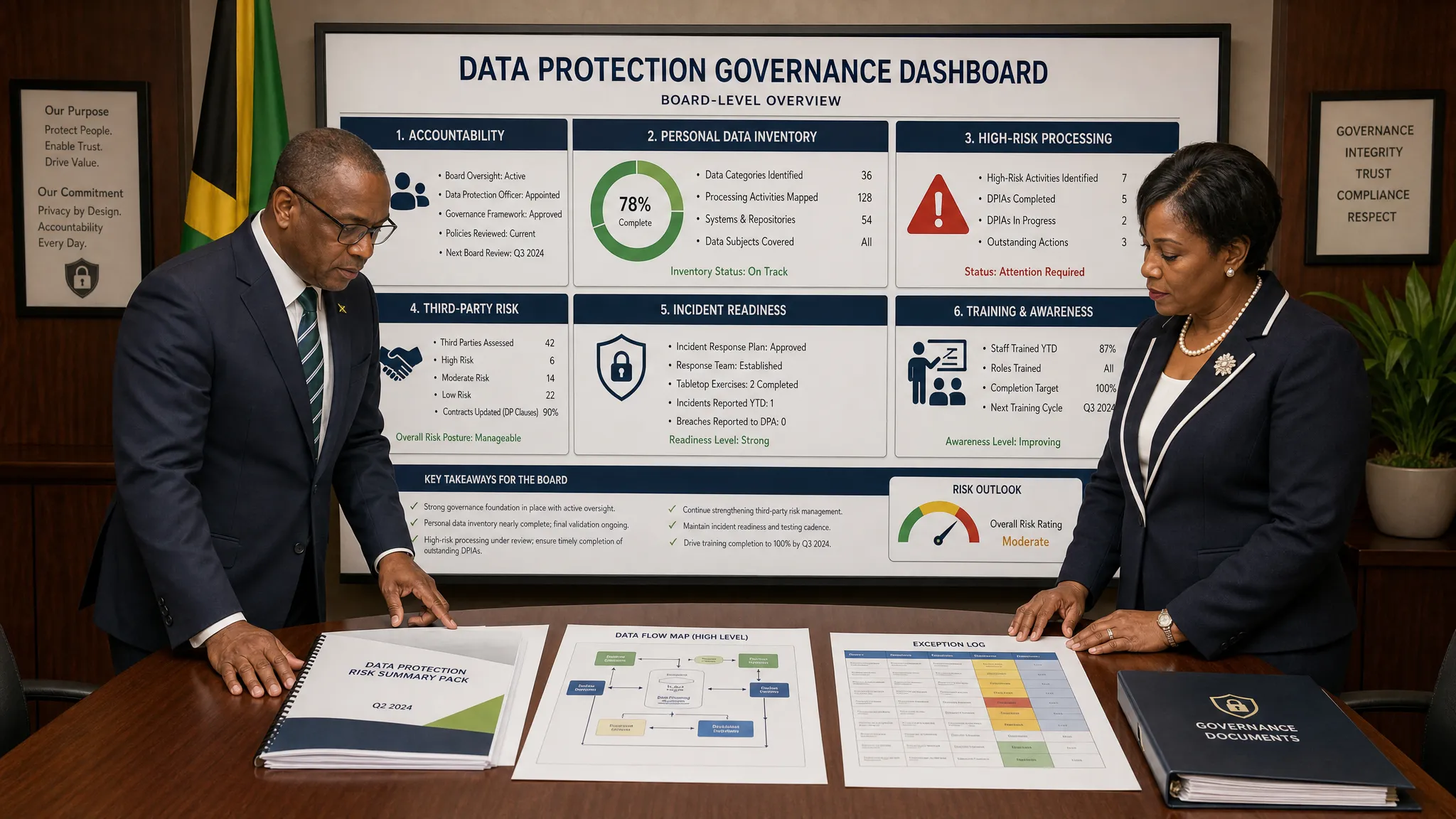
Boards are increasingly expected to treat data protection as a core risk management issue, not a narrow compliance task delegated to legal or IT. In Jamaica, the Data Protection Act, 2020 has made that expectation more urgent. Personal data now sits at the intersection of regulatory exposure, cyber resilience, customer trust, operational continuity, and corporate governance.
For directors, the question is not whether the organisation has a privacy policy on its website. The stronger question is whether the board can see, challenge, and evidence how personal data risks are being identified, assessed, treated, and monitored across the business.
That requires a practical set of priorities. Boards do not need to run the data protection programme day to day. They do need to ensure management has the right governance, controls, reporting, and accountability in place, especially where personal data is used in high-impact processes such as customer onboarding, employee management, digital marketing, health services, education, financial services, and anti-money laundering compliance.
Why data protection belongs on the board risk agenda
Data protection failures rarely stay contained inside one department. A breach involving customer records can trigger regulator engagement, litigation risk, contract disputes, reputational harm, operational disruption, and loss of public confidence. A poorly governed marketing database can create consent and transparency problems. An unmanaged vendor relationship can expose sensitive data even when the organisation’s internal systems appear secure.
The Office of the Information Commissioner in Jamaica is responsible for key regulatory functions under the data protection framework, and organisations are expected to understand their obligations as data controllers or processors. For boards, this means privacy risk should be visible in the same way as financial risk, cyber risk, AML risk, and business continuity risk.
Good oversight begins with a simple governance principle: management owns execution, but the board owns oversight. Directors should ask whether the organisation’s privacy risks are known, whether controls are proportionate, and whether management can provide evidence when challenged by regulators, customers, partners, auditors, or the board itself.
Priority 1: Define ownership, accountability, and risk appetite
The first data protection priority for boards is clarity. If no one can explain who owns privacy risk, who approves exceptions, who handles incidents, and who reports to the board, the programme is already exposed.
Boards should ensure that management has assigned clear roles for data protection governance. This may include a data protection officer or privacy lead where required or appropriate, plus accountable executives in legal, compliance, IT, HR, operations, marketing, procurement, and information security. The aim is not to create a privacy silo. The aim is to make sure every function that collects, uses, shares, stores, or deletes personal data understands its responsibilities.
Risk appetite is equally important. A board-approved risk appetite statement helps management decide when a data use is acceptable, when it needs additional safeguards, and when it should be stopped. For example, the board may have very low tolerance for unapproved use of sensitive personal data, unmanaged overseas vendors, incomplete incident reporting, or high-risk projects launched without assessment.
A useful board-level privacy risk appetite should be specific enough to guide decisions. “We comply with the law” is not enough. Better statements address acceptable residual risk, escalation thresholds, and consequences for exceptions.
Priority 2: Know what personal data the organisation holds
No board can oversee what management cannot see. A reliable personal data inventory is the foundation for risk management data protection work. It should show what categories of personal data the organisation holds, why it is collected, where it is stored, who has access, which third parties receive it, how long it is retained, and what legal or business purpose supports its use.
This is especially important for organisations that have grown through new systems, outsourced service providers, legacy databases, spreadsheets, cloud applications, and informal departmental practices. These environments often create “hidden” privacy risks, such as duplicate records, excessive retention, unclear consent history, or access rights that were never removed when employees changed roles.
Boards should expect management to identify the most important data flows, not just produce a one-time spreadsheet. Data mapping should be maintained as systems, vendors, products, and business processes change. Where the organisation handles sensitive personal data, customer financial information, employee records, health data, children’s data, or identification documents, the board should ask for stronger assurance that these data sets are mapped and controlled.
For practical implementation, a structured data protection risk assessment helps management connect data inventories to evidence, controls, and remediation priorities.
Priority 3: Focus attention on high-risk processing
Boards should not treat all personal data risks as equal. A newsletter mailing list, a payroll system, a loan application platform, and a biometric access system do not carry the same level of risk. The board’s role is to ensure the organisation can identify which processing activities are most likely to affect individuals, trigger regulatory scrutiny, or damage the business if controls fail.
High-risk processing often includes large volumes of personal data, sensitive categories of information, automated decision-making, profiling, employee monitoring, CCTV, biometric data, children’s data, health information, financial records, and data used for fraud detection or AML checks. New digital products, mergers, outsourcing arrangements, and system migrations should also be treated as risk triggers.
For each high-risk activity, directors should ask whether management has assessed the privacy impact before launch, documented the lawful purpose, considered less intrusive alternatives, applied appropriate security controls, and planned how individuals can exercise their rights. The board does not need to review every assessment in detail, but it should know how many high-risk activities exist, how many have been assessed, and which unresolved risks remain outside appetite.
Priority 4: Strengthen third-party and cross-border risk management
Many serious privacy failures happen through vendors, processors, consultants, cloud providers, payroll providers, marketing platforms, managed IT services, and other third parties. Outsourcing a process does not remove the need for board oversight. If personal data is mishandled by a third party, the organisation may still face regulatory, contractual, and reputational consequences.
Boards should require management to maintain a third-party data risk register. This should identify which vendors process personal data, what types of data they receive, where the data is hosted or accessed, whether sub-processors are involved, and what contractual safeguards exist. Higher-risk vendors should receive stronger due diligence before onboarding and periodic review after onboarding.
Cross-border exposure deserves particular attention. Jamaican organisations may use overseas cloud platforms, regional service providers, international group companies, or vendors that support GDPR-aligned customers. Where personal data moves across borders, directors should ask whether management has considered applicable legal requirements, contractual safeguards, security controls, and incident notification obligations.

Priority 5: Align cybersecurity controls with privacy outcomes
Cybersecurity and data protection are closely connected, but they are not identical. Cybersecurity protects systems, networks, and information assets. Data protection focuses on lawful, fair, secure, and accountable use of personal data. Boards should ensure both disciplines work together around the same risk priorities.
The strongest cybersecurity programme can still leave privacy gaps if the organisation collects too much data, keeps it too long, lacks a lawful basis, or gives too many people access. Likewise, a well-written privacy policy is not enough if personal data is exposed through weak access controls, poor patching, insecure backups, or unmanaged endpoints.
The board should ask management to explain which cybersecurity controls reduce the greatest privacy risks. Useful controls often include multi-factor authentication, role-based access, encryption, vulnerability management, endpoint protection, secure backups, logging and monitoring, vendor security reviews, and tested incident response procedures. Frameworks such as the NIST Cybersecurity Framework can help organisations structure cyber risk management, but boards should still connect those controls to the personal data that matters most.
A helpful test is this: if a control fails, which individuals could be harmed, which data sets could be exposed, and how quickly would management know? That question turns cybersecurity reporting into data protection risk reporting.
For a deeper control perspective, directors can review how specific cyber security controls reduce real data protection risk in practice.
Priority 6: Prepare for incidents before they happen
Every board should assume that privacy incidents are possible. The priority is not perfection. The priority is readiness, speed, accuracy, and evidence.
Management should maintain a documented incident response process that covers suspected personal data breaches, internal escalation, investigation, containment, legal assessment, regulator engagement where required, communication with affected individuals where appropriate, and post-incident remediation. The process should be tested through tabletop exercises, not left unread in a policy folder.
Boards should pay close attention to escalation thresholds. If frontline employees, IT teams, or vendors do not know when and how to report a suspected incident, valuable time can be lost. Directors should also ask whether management can preserve evidence, reconstruct timelines, identify affected data, and explain decisions after the incident.
Incident response should be linked to crisis communications, cyber insurance where relevant, business continuity, legal privilege considerations, and customer management. A slow or confused response can create as much reputational damage as the incident itself.
Priority 7: Make privacy training role-based and measurable
Privacy culture is built through repeated decisions by employees, contractors, managers, and executives. Generic annual training is a starting point, but it is rarely enough for meaningful risk reduction.
Boards should expect management to provide role-based data privacy training in Jamaica that reflects how different teams use personal data. HR teams need to understand employee records and confidentiality. Marketing teams need to understand consent, transparency, and preference management. Customer service teams need to verify identities and handle requests appropriately. IT teams need to apply security controls with privacy impact in mind. Senior executives need to understand accountability and escalation.
Training should also be measurable. Completion rates are useful, but boards should look beyond attendance. Better indicators include incident trends, phishing test results where applicable, policy exceptions, access review findings, data subject request performance, and the number of high-risk projects reviewed before launch.
A culture metric is most valuable when it shows behaviour change. If training completion is 100 percent but employees still send personal data to personal email accounts, retain records indefinitely, or bypass approved systems, the board should challenge whether training is working.
Priority 8: Embed privacy into enterprise risk management
Data protection should not sit outside the organisation’s existing governance structure. It should be integrated into enterprise risk management, internal audit, compliance monitoring, procurement, project governance, corporate governance reporting, AML compliance, and cyber risk oversight.
This integration is particularly important for regulated sectors and organisations that perform customer due diligence, KYC, sanctions screening, transaction monitoring, or other anti-money laundering activities. AML compliance often requires the collection and retention of sensitive identity and financial information. Boards should ensure these obligations are balanced with data minimisation, security, retention controls, access management, and transparency.
The board pack should translate privacy work into decision-ready information. Directors do not need pages of operational detail. They need a clear view of risk trends, open issues, decisions required, and exceptions that exceed appetite. If your board is refining its reporting format, it may be useful to align privacy oversight with practical data protection reporting KPIs and KRIs.
Board priority | Evidence directors should expect | Oversight question |
Accountability and ownership | Approved governance structure, named accountable owners, escalation routes | Who is responsible for privacy risk across the organisation? |
Personal data visibility | Data inventory, system maps, retention schedules, vendor data flows | Do we know what personal data we hold and why? |
High-risk processing | Risk assessments, impact assessments, documented approvals, open remediation items | Which processing activities are outside appetite? |
Third-party management | Vendor register, due diligence records, contract clauses, review schedule | Which vendors create the greatest data protection exposure? |
Cybersecurity alignment | Access reviews, MFA coverage, vulnerability status, backup testing, incident metrics | Which cyber controls protect our highest-risk personal data? |
Incident readiness | Response plan, tabletop results, breach logs, lessons learned | Can management respond quickly and evidence decisions? |
Training and culture | Role-based training, completion data, behaviour metrics, policy exception trends | Are employees changing how they handle personal data? |
A practical 90-day board agenda
Boards that are unsure where to begin can use a 90-day approach to create momentum without overwhelming management.
First 30 days: establish visibility
Ask management to present the current state of the data protection programme, including governance structure, major personal data assets, known high-risk processing, open compliance gaps, incident history, and the current status of Data Protection Act readiness. The aim is to identify what is known, what is unknown, and where the greatest exposure sits.
Days 31 to 60: test accountability and controls
Require management to validate the highest-risk data flows, review key vendors, test incident escalation, and confirm whether access controls and retention practices are operating as intended. This phase should produce a short list of priority remediation actions, owners, target dates, and resource needs.
Days 61 to 90: embed reporting and board challenge
Agree the privacy risk metrics that will appear in future board or committee packs. These should include risk indicators, not just activity updates. Directors should be able to see whether risk is increasing or decreasing, whether management is closing gaps on time, and whether unresolved issues require board decisions.
This 90-day agenda does not replace a full compliance programme. It gives the board a disciplined starting point for oversight and helps management move from policy writing to risk reduction.
Questions directors should ask at the next board meeting
A board discussion on data protection does not need to become technical. The most effective questions are often direct and evidence-based.
What are our top five personal data risks today, and why?
Which systems or vendors hold our most sensitive personal data?
Which high-risk processing activities have not yet been assessed?
What privacy risks sit outside our approved risk appetite?
How quickly would we detect and escalate a suspected personal data breach?
What evidence would we provide to a regulator, customer, or auditor if challenged?
Are privacy risks included in enterprise risk management, internal audit, and procurement decisions?
These questions help directors move beyond reassurance and toward verifiable oversight.
Frequently Asked Questions
What are the main data protection priorities for boards in Jamaica? Boards should prioritise accountability, personal data visibility, high-risk processing assessments, third-party governance, cybersecurity alignment, incident readiness, training, and privacy risk reporting under the Data Protection Act, 2020.
Is data protection a legal issue or an IT issue? It is both, but it is also a governance and risk management issue. Legal teams help interpret obligations, IT teams help secure systems, and the board ensures the organisation has effective oversight, accountability, and resources.
How often should boards review data protection risk? Boards should receive regular privacy risk reporting, usually quarterly for most organisations, with immediate escalation for serious incidents, high-risk projects, major vendor changes, or risks outside appetite.
How does data protection connect with anti-money laundering compliance? AML processes often involve identity documents, financial records, screening data, and other sensitive information. Boards should ensure AML obligations are met while maintaining appropriate privacy, security, retention, and access controls.
What evidence should management provide to the board? Useful evidence includes data inventories, risk assessments, vendor reviews, incident logs, training metrics, access review results, remediation plans, and KPIs or KRIs that show whether privacy risk is improving or worsening.
Strengthen board oversight of data protection risk
Data protection is now a board-level governance issue for Jamaican organisations. Directors do not need to become privacy technicians, but they do need to insist on clear ownership, reliable evidence, and risk-based reporting.
Privacy & Legal Management Consultants Ltd. supports organisations with data protection implementation, corporate governance, AML compliance, cyber security services, GRC integration, training, and practical risk assessment support. If your board wants to turn these priorities into a workable oversight plan, start with a consultation with Privacy & Legal Management Consultants Ltd..