

Governance Data Protection: Board Reporting and KPIs to Use

Boards in Jamaica are increasingly being asked a simple question by regulators, customers, partners, and insurers: Can you prove you govern personal data, not just “do privacy”?
Governance data protection is about turning legal obligations under Jamaica’s Data Protection Act into consistent oversight, decision-making, and evidence. The most practical way to do that at board level is through clear reporting and a small set of KPIs and KRIs (key risk indicators) that show whether the organisation is in control.
This guide explains what to report to the board, which KPIs to use (and why), and how to build a reporting pack that supports real decisions, not box-ticking.
What the board should expect from data protection reporting
A board report on data protection should do three things:
Confirm accountability: Who owns privacy risk, how it is managed, and how issues are escalated.
Show control effectiveness: Whether the organisation’s privacy controls are operating as intended.
Enable decisions: Where investment, policy changes, or risk acceptance is needed.
Good board reporting is not a long legal memo. It is a risk and performance view of how personal data is governed across the enterprise.
From an international good-practice perspective, regulators consistently emphasise accountability and demonstrable governance. For example, the UK ICO’s resources on the accountability principle align well with what boards need: defined ownership, evidence, and continuous improvement.
Board reporting vs management reporting (keep them different)
A common failure mode is sending the board operational detail (too granular), or sending management a board-level dashboard (too vague). Separate them.
Board-level reporting should answer
Are we meeting our legal and contractual privacy obligations?
Where are the top privacy risks (and are they trending up or down)?
Are incidents increasing, and are we responding well?
Are third parties and cross-border processing controlled?
Do we have gaps that require funding or a policy decision?
Management reporting should include
Team-level workload, ticket queues, root cause detail
System-by-system control findings
Detailed audit test results
The core sections of an effective data protection board pack
A practical board pack typically fits into 4 to 6 pages (plus an appendix if needed):
1) Executive summary (one page)
Overall privacy posture: improving, stable, deteriorating
Top 3 risks and what changed since last report
Decisions required from the board (if any)
2) Compliance and accountability status
Programme maturity (policy coverage, assigned owners, reporting lines)
Major compliance deliverables completed (or overdue)
If your organisation is still building its programme, align reporting to a roadmap. PLMC’s Jamaica-focused roadmap can help structure quarterly priorities: Data Protection Jamaica: Compliance Roadmap for 2026.
3) Risk, incidents, and control effectiveness
Incidents and near misses
Status of remediation plans
Results of testing (access reviews, retention checks, vendor reviews)
4) People and culture
Training completion and role-based coverage
Awareness indicators (phishing resilience, policy attestations)
5) Third-party and cross-border exposure
High-risk vendors, contract gaps, outstanding assessments
International transfer risks and mitigations (where applicable)
KPIs vs KRIs: use both (and label them clearly)
Boards often get a dashboard of “green” activity metrics (training completed, policies published). Useful, but incomplete.
KPIs show performance (are we doing what we said we would do?).
KRIs show risk exposure (how likely is harm or non-compliance?).
A balanced board dashboard includes leading indicators (preventative) and lagging indicators (outcomes).
Governance data protection KPIs to use (with board-friendly definitions)
The best KPIs are:
Few in number (typically 8 to 15)
Clearly defined (no debate about how they are measured)
Evidence-backed (traceable to logs, registers, or audit results)
Actionable (a change in the metric triggers a decision)
Below is a practical set you can adapt.
KPI / KRI | What it measures (plain English) | Why the board cares | Typical cadence | Evidence source |
Rights requests closed on time (KPI) | % of access, correction, objection, deletion requests closed within your internal SLA | Demonstrates legal compliance and customer trust | Monthly / quarterly | DSAR log, case management records |
Average time to close rights requests (KPI) | Days from request receipt to closure | Highlights resourcing or process bottlenecks | Monthly / quarterly | DSAR log |
Privacy notice and transparency coverage (KPI) | % of products / channels with current privacy notices | Reduces regulatory and reputational risk | Quarterly | Notice register, website/app review checklist |
Data inventory coverage (KPI) | % of business units / systems mapped in the data inventory | Boards need assurance that the organisation knows where data is | Quarterly | Data map, RoPA-style register |
High-risk processing assessed (KPI) | % of high-risk activities with a completed assessment (for example, privacy impact style assessments) | Indicates proactive risk management | Quarterly | Assessment register |
Open high-risk findings past due (KRI) | Count of overdue remediation items rated high risk | Overdue high-risk actions are a governance failure signal | Monthly / quarterly | Audit tracker, risk register |
Security and privacy incidents (KRI) | Number of incidents involving personal data (including near misses) | Incident trends drive investment and accountability | Monthly / quarterly | Incident register, SOC reports |
Time to contain personal data incidents (KPI) | Time from detection to containment | Faster containment reduces harm and cost | Monthly / quarterly | Incident timeline, IR tickets |
Vendor privacy due diligence coverage (KPI) | % of critical vendors assessed (and re-assessed on schedule) | Third parties are a major source of privacy risk | Quarterly | Vendor register, due diligence files |
Contracts with data protection clauses (KPI) | % of vendor contracts meeting your minimum privacy terms | Strengthens enforceability and reduces exposure | Quarterly | Contract repository review |
Role-based privacy training completion (KPI) | Completion rate for staff in high-risk roles (HR, IT, marketing, customer service) | Shows culture and operational readiness | Quarterly | LMS reports, attendance logs |
Policy attestation rate (KPI) | % of staff who acknowledged key policies (acceptable use, retention, incident reporting) | Indicates adoption, not just publication | Quarterly | Attestation platform logs |
How many KPIs should you show the board?
In most organisations, 10 to 12 metrics is enough. If you have more, group them in an appendix and bring only exceptions to the board.
Suggested KPI targets (without guessing your business)
Targets should reflect your size, risk profile, and operational reality. Rather than universal numbers, use risk-based thresholds:
Green: on track and stable
Amber: trending worse or minor breach of internal SLA
Red: legal, customer, or high-impact risk, requires executive action
A practical approach is to baseline for 1 to 2 quarters, then set targets that reflect improved performance and control effectiveness.
A simple data protection dashboard layout that boards actually use
A board dashboard works best when it combines status, trend, and actions.
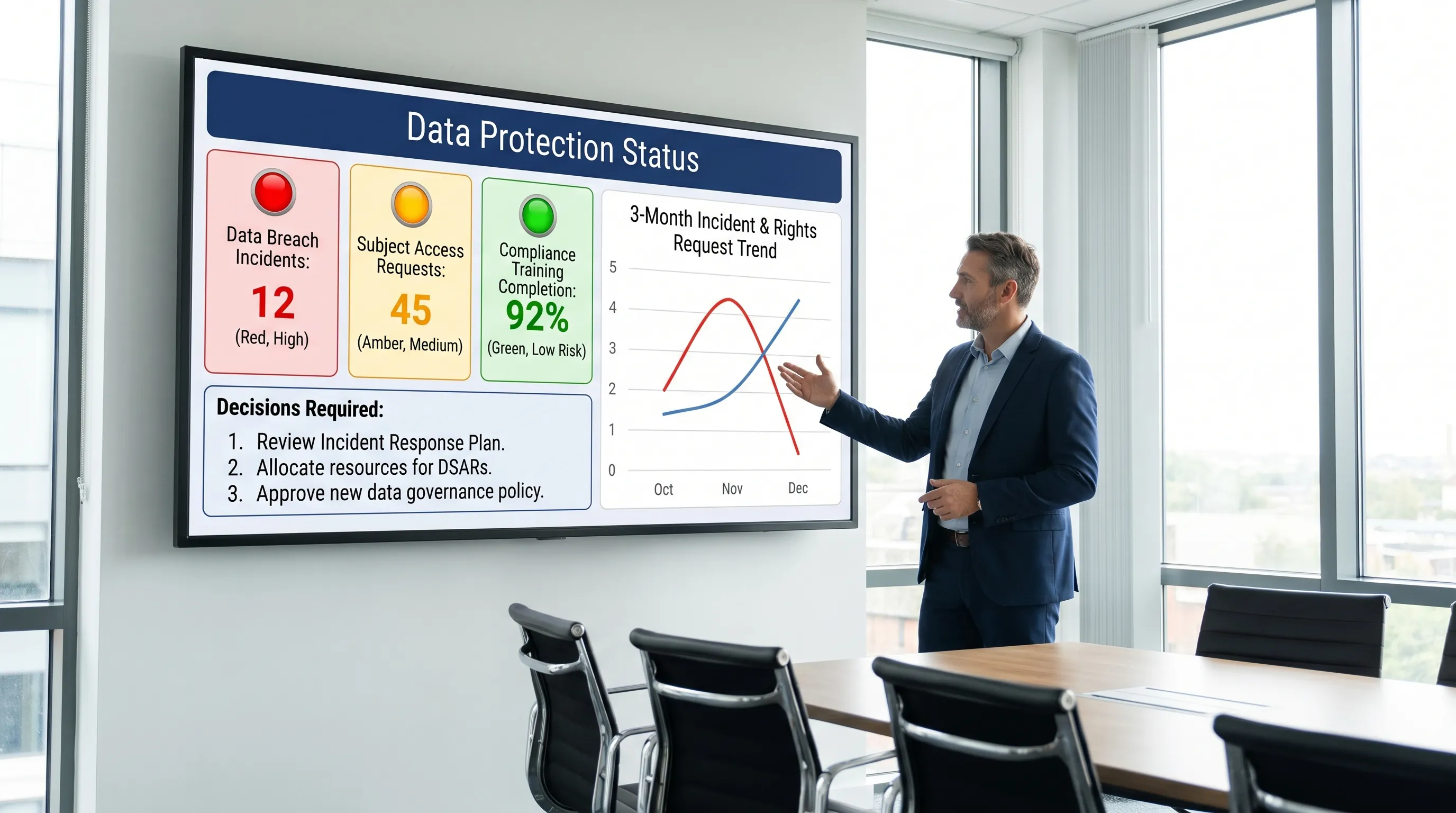
Include:
RAG status for each KPI
Trend over at least 3 reporting periods
Narrative only for exceptions (amber/red)
Top risks mapped to owners and due dates
Decisions required (funding, risk acceptance, policy approval)
The KPIs boards often ask for (and how to answer confidently)
“Are we compliant with the Data Protection Act?”
Avoid a vague yes/no. Use evidence:
% coverage of data inventory and transparency
Rights request performance
Status of high-risk processing assessments
Overdue high-risk remediation
If you need a structured way to confirm foundational elements, use a checklist-based approach like: Privacy and Data Protection: A Practical Checklist.
“How exposed are we if something goes wrong?”
Use KRIs that translate exposure:
Number of high-risk findings overdue
Incidents involving personal data and time to contain
Critical vendors not assessed or with contract gaps
It can also be helpful to anchor the financial risk conversation. IBM’s annual research consistently shows breaches are expensive and disruptive, even before fines and lawsuits. See the IBM Cost of a Data Breach Report for global benchmarking.
“Is the programme improving, or just busy?”
Activity does not equal risk reduction. Pair activity metrics with outcomes:
Training completion (activity) plus incident reporting quality and reduction of repeat issues (outcome)
Vendor assessments completed (activity) plus reduction in vendor contract gaps and improved remediation closure rate (outcome)
Common mistakes that weaken governance data protection reporting
Reporting only training completion
Training matters, but boards need to know whether behaviour and controls improved. Add at least one control effectiveness indicator (for example, access review exceptions, incident containment time, overdue high-risk items).
Using undefined metrics
If different teams calculate “incident” or “data inventory coverage” differently, dashboards become debates. Define each KPI once and keep it consistent.
Hiding bad news in an appendix
If a metric is red, surface it with:
the root cause in one paragraph
the remediation plan
what support or decision you need from leadership
How to implement board reporting in 30 days (practical approach)
Week 1: Confirm ownership and the reporting route
Assign an executive owner for privacy risk (and a working owner for delivery)
Agree the board committee that receives the report (often audit, risk, or governance)
Week 2: Define your first dashboard (keep it small)
Pick 10 to 12 KPIs/KRIs
Define calculation rules and owners
Identify the evidence sources (logs, registers, reports)
Week 3: Build your registers
Most organisations need three basic registers to report credibly:
Rights requests log
Incident register
Vendor register (with risk tiering)
If you are still building your programme foundations, it may help to align with a structured explainer and roadmap such as: Jamaica Data Protection Act Explained for Businesses.
Week 4: Pilot the board pack and refine
Run it with management first
Remove noise, add trend views
Agree thresholds for red/amber/green
Frequently Asked Questions
What are the best governance data protection KPIs for a board? The most useful board KPIs cover rights requests, incident trends and containment time, overdue high-risk findings, vendor oversight, and programme coverage (data inventory and transparency).
How often should data protection be reported to the board? Many organisations report quarterly, with monthly internal reporting for management. If incident frequency or regulatory pressure is high, boards may request more frequent updates.
Should boards see KPIs or KRIs for data protection? Both. KPIs show performance against commitments (like closing rights requests on time), while KRIs show exposure (like overdue high-risk findings and incident trends).
How do we set targets for privacy KPIs without guessing? Baseline your current performance for 1 to 2 quarters, then set risk-based thresholds (green/amber/red) that reflect your risk appetite, resources, and legal obligations.
Need a board-ready privacy reporting pack for your organisation?
PLMC supports Jamaican organisations with governance, risk, and compliance approaches to data protection, including programme implementation, training, and practical reporting structures aligned to the Data Protection Act.
If you want help selecting KPIs, defining thresholds, and building a board pack that stands up to scrutiny, request a free consultation via Privacy & Legal Management Consultants Ltd..