

Retention Schedules That Reduce Privacy Exposure
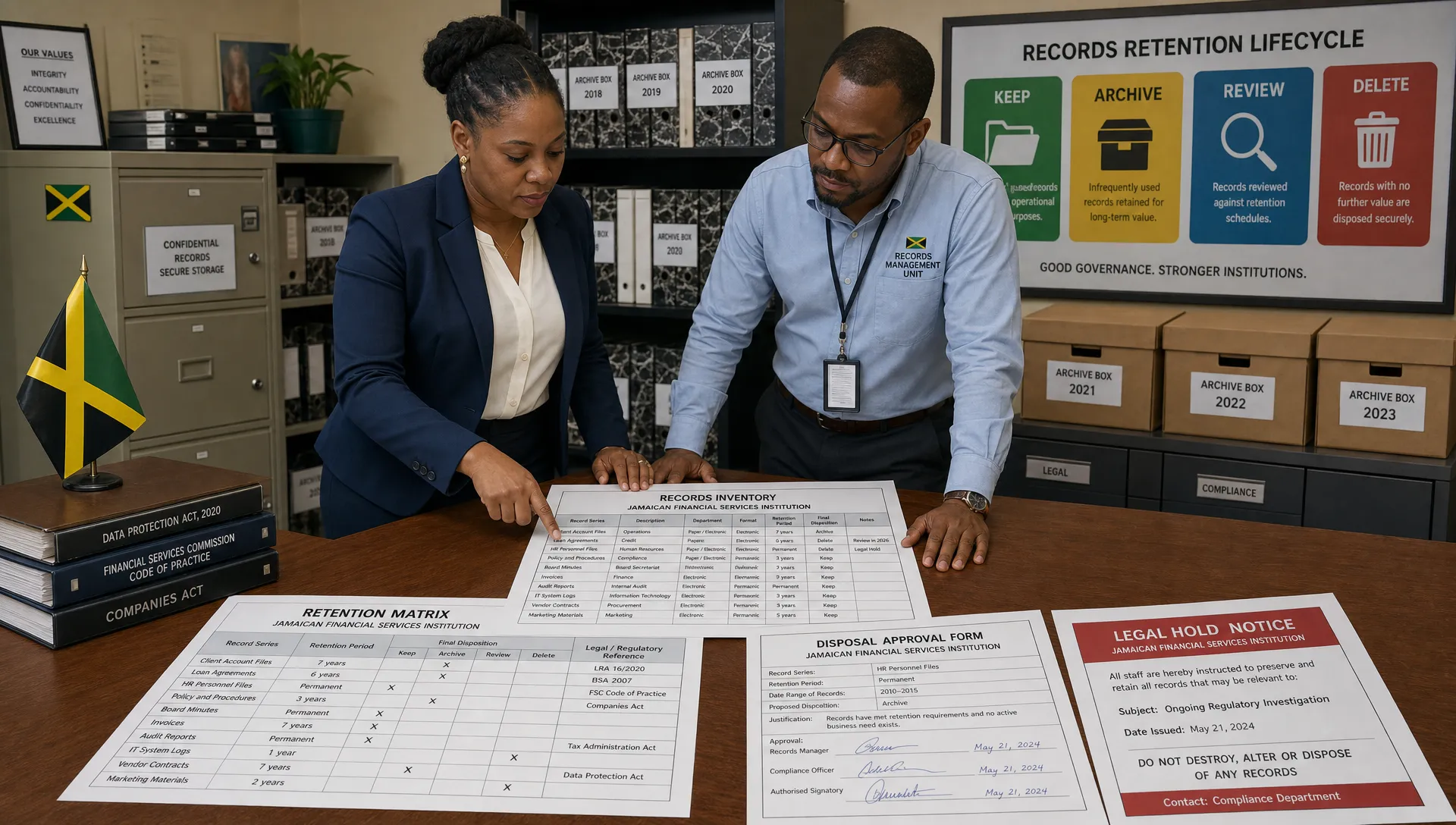
Keeping information “just in case” can feel like a safe business habit. In reality, every record kept beyond its useful life becomes an asset the organisation must secure, search, explain, and potentially disclose if something goes wrong.
A retention schedule turns that problem into a managed control. It tells staff what information should be kept, why it is being kept, who owns it, how long it should remain, and when it must be securely deleted, archived, or transferred. For Jamaican organisations working under the Data Protection Act, 2020, this is not just good housekeeping. It is a practical way to reduce privacy exposure while supporting governance, compliance, and operational efficiency.
Why retention schedules matter for privacy exposure
Privacy exposure grows when organisations keep more personal data than they need. Old customer files, outdated employee documents, duplicate spreadsheets, historic identification copies, call recordings, CCTV footage, emails, and inactive system accounts can all contain personal information. If these records are forgotten, they are often poorly protected.
A good retention schedule supports the principle that personal data should not be kept longer than necessary for the purpose for which it was collected. It also helps organisations show that retention decisions are based on business needs, legal obligations, and risk, rather than habit.
Retention is also connected to breach impact. If a cyber incident affects a shared drive containing ten years of unnecessary records, the harm is larger than if that same drive only contains current, justified information. The same logic applies to accidental email sharing, unauthorised access, lost devices, and vendor incidents.
For organisations already working on practical privacy protection, retention schedules sit naturally alongside data minimisation, access control, and secure disposal. If you are reviewing your broader exposure management practices, PLMC’s guide to simple steps to reduce privacy risk is a useful companion to this topic.
What a retention schedule should actually include
A retention schedule should be more than a spreadsheet of dates. It should be a decision tool that staff can understand and apply. At minimum, it should identify the category of information, the reason for keeping it, the retention trigger, the approved period, the owner, and the disposal method.
The retention trigger is especially important. Many organisations write “keep for seven years” or “keep for three years” without saying when the clock starts. Is it from the date of collection, the end of the customer relationship, the end of employment, the close of an investigation, the expiry of a contract, or the final transaction? Without a trigger, staff cannot apply the rule consistently.
Retention schedule field | What it answers | Why it reduces exposure |
Record category | What type of information is this? | Prevents vague rules that staff cannot apply |
Business purpose | Why do we need it? | Links retention to a legitimate operational need |
Legal or regulatory basis | Is there a minimum legal requirement? | Avoids deleting records too early or keeping them without justification |
Retention trigger | When does the retention clock start? | Creates consistency across teams and systems |
Retention period | How long should it be kept? | Limits unnecessary storage of personal data |
Record owner | Who is accountable? | Prevents orphaned records and unmanaged archives |
Disposal method | How should it be deleted or destroyed? | Reduces risk from insecure disposal |
Exceptions and holds | When should disposal be paused? | Protects evidence during audits, claims, investigations, or litigation |
This structure also supports accountability. If a regulator, auditor, board member, or data subject asks why certain information is still held, the organisation can point to a documented rule rather than relying on memory.
Start with records, not individual files
A common mistake is trying to catalogue every document one by one. That approach quickly becomes unmanageable. A better starting point is to group records by business process and information type.
For example, Human Resources may have recruitment records, employee files, payroll records, disciplinary records, benefits information, training records, and exit documentation. Sales may have leads, contracts, customer correspondence, call notes, proposals, and marketing consent records. Finance may have invoices, payment records, tax documentation, supplier records, and audit files.
Once records are grouped, the organisation can assess each category using a few practical questions:
What personal information does this category contain?
Who uses it and for what purpose?
Is the information sensitive, confidential, or high risk?
Is there a legal, regulatory, contractual, or operational reason to keep it?
Where is it stored, including email, cloud platforms, paper files, backup systems, and third-party systems?
What would happen if it were deleted too early, kept too long, or accessed by the wrong person?
This record-category approach makes the schedule easier to maintain. It also helps privacy, legal, compliance, IT, and business teams speak the same language.
Match retention periods to purpose and legal requirements
Retention periods should not be copied blindly from another organisation. The right period depends on the type of record, the jurisdiction, the sector, the purpose of processing, and any applicable legal or regulatory requirement.
In Jamaica, organisations may need to consider the Data Protection Act, 2020, employment obligations, tax and accounting rules, sector-specific requirements, contractual obligations, anti-money laundering obligations, audit needs, and limitation periods for legal claims. Regulated entities may also need to align with supervisory expectations from their industry.
The key is to distinguish between three types of retention needs.
First, some records must be kept because the law or a regulator requires it. These periods should be verified by legal, compliance, or qualified advisers. Second, some records are needed for legitimate business reasons, such as managing an active customer relationship or resolving service disputes. Third, some records are kept only because nobody has challenged the practice. That third category is where privacy exposure often hides.
A defensible retention period should be long enough to meet legal and business needs, but not so long that it becomes a privacy liability. Where uncertainty exists, document the reasoning and review it periodically.
Use risk to prioritise the schedule
Not every record category creates the same level of exposure. A file containing names and business email addresses is not the same as one containing national identification numbers, health details, financial information, disciplinary records, or copies of identity documents.
A risk-based retention schedule gives priority to records that are sensitive, high volume, widely shared, difficult to secure, or subject to regulatory scrutiny. This prevents the organisation from spending months debating low-risk administrative documents while high-risk archives remain unmanaged.
Record category | Retention approach | Exposure reduced |
Recruitment records for unsuccessful applicants | Keep only for the justified recruitment, complaint, or legal risk period, then delete securely | Reduces unnecessary storage of applicant personal data |
CCTV footage | Keep for a short, defined operational security period unless an incident requires preservation | Limits surveillance data exposure |
Customer identity verification records | Retain for the applicable legal, regulatory, or AML period, then dispose securely unless a hold applies | Reduces risk from copies of identity documents |
Marketing contact lists | Retain while there is a valid purpose and appropriate consent or other lawful basis | Reduces unwanted contact and outdated profiling |
Employee disciplinary records | Keep according to HR, legal, and fairness requirements, with access tightly limited | Reduces harm from sensitive employment information |
Board and governance records | Retain according to corporate governance, legal, and audit requirements | Preserves accountability without mixing unnecessary personal data into archives |
The goal is not to delete everything quickly. The goal is to keep what the organisation can justify and protect what it must retain.
Build secure disposal into the process
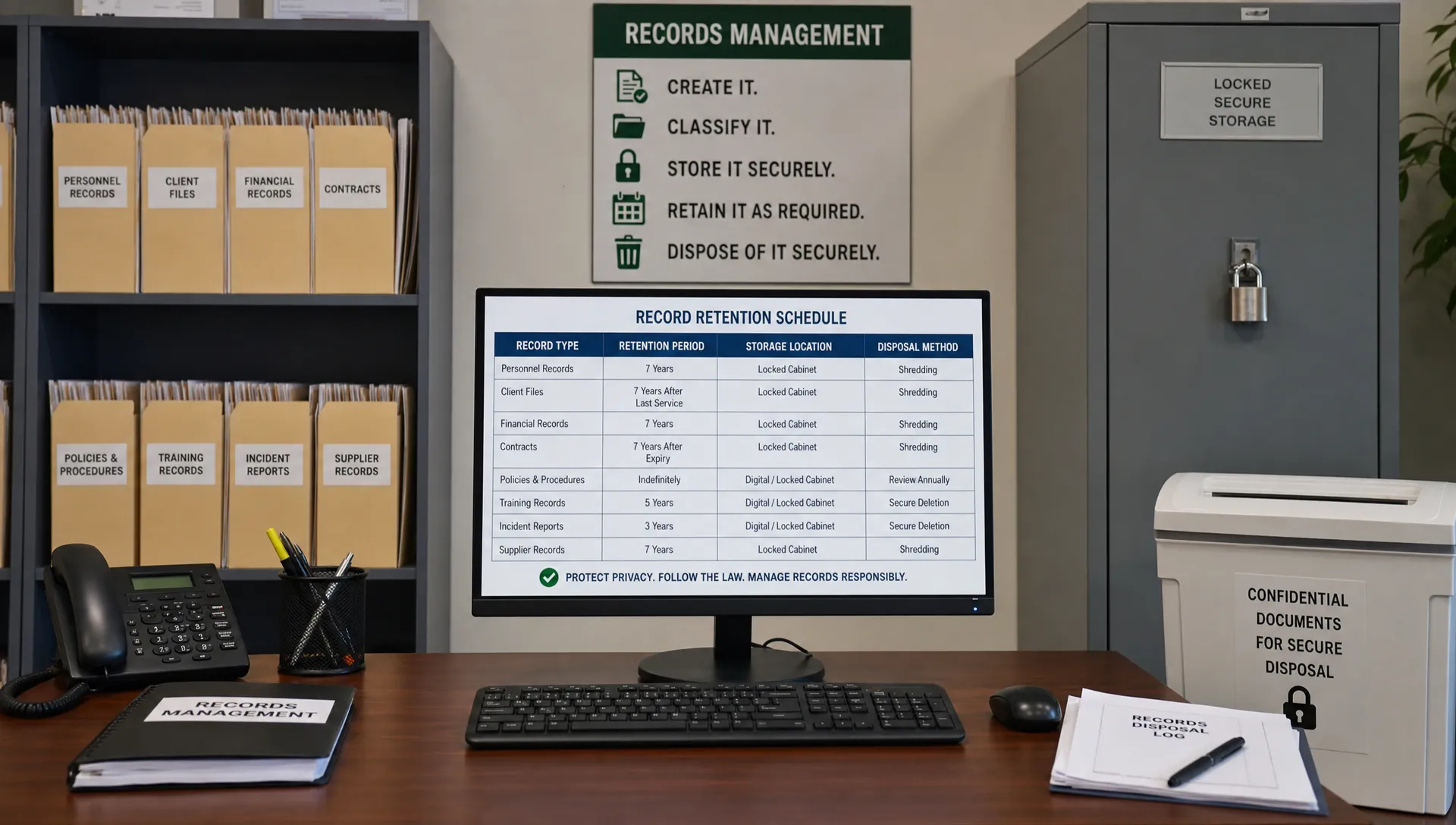
A retention schedule is incomplete if it says when records expire but not what happens next. Disposal must be secure, documented, and appropriate to the format of the information.
For paper records, secure shredding or certified destruction may be required, especially for confidential or sensitive personal data. For electronic records, deletion should address live systems, shared drives, document management systems, email repositories, removable media, and where feasible, backups according to the organisation’s backup architecture and recovery needs.
Disposal also needs evidence. A simple disposal log can record the record category, date range, owner approval, disposal date, method used, and any destruction certificate or IT confirmation. This log should not recreate the personal data being deleted. It should prove that disposal occurred.
Secure disposal is closely linked to everyday handling rules. Staff who understand how to classify, store, share, and dispose of information are less likely to create unmanaged copies. PLMC’s article on confidentiality and data handling rules every team should know offers practical guidance that complements a retention programme.
Do not forget legal holds and investigations
Retention schedules should allow deletion, but they must also know when to pause deletion. If records may be relevant to litigation, regulatory inquiries, audits, complaints, internal investigations, insurance claims, or law enforcement requests, a legal hold or preservation instruction may be necessary.
A legal hold should be clear and controlled. It should identify the affected records, the reason for the hold, the people or systems involved, the person authorised to issue and lift the hold, and the review date. Without this process, staff may either delete records that should be preserved or keep entire archives indefinitely because they are afraid to delete anything.
The best retention schedules balance both risks. They prevent premature destruction where records are genuinely needed, and they prevent indefinite retention where records have no continuing purpose.
Assign ownership across the organisation
Retention is not only a legal or IT issue. Each department creates and uses information differently, so each department must participate.
A practical ownership model may include Human Resources for employee records, Finance for accounting and payment records, Compliance for AML and regulatory files, Legal for contracts and legal holds, IT for system deletion and backups, and business unit leaders for operational records. Privacy or compliance teams can coordinate the policy, but they should not be expected to know every record in every workflow without input from the business.
Senior leadership and boards also have a role. Retention affects corporate governance, risk management, cybersecurity, litigation readiness, and regulatory accountability. A periodic board or executive review can focus on high-risk record categories, overdue disposal, legacy systems, and exceptions. For more on making privacy a standing governance issue, see PLMC’s discussion of privacy risk reviews every board should schedule.
Make the schedule usable for busy staff
A retention schedule fails when it is too complex for everyday use. Staff need clear rules in plain language, especially for common records such as customer correspondence, application forms, identification documents, reports, meeting notes, contracts, spreadsheets, and email attachments.
The schedule should be supported by short procedures and reminders. For example, staff should know where approved storage locations are, when not to save local copies, how to name files, when to escalate uncertainty, and how to request a disposal approval. If employees are expected to manually clean up records, give them a calendar, a checklist, and a defined owner.
Automation can also help, but it should not replace governance. Document management systems, HR platforms, CRM tools, email retention settings, and backup policies may be configured to support retention rules. However, automated deletion must be carefully tested, approved, and monitored to avoid deleting records that are still required.
Common retention schedule mistakes to avoid
Many organisations have a retention policy on paper but still carry unnecessary privacy exposure. The problem is often execution.
Common mistakes include using “permanent” as the default, failing to define retention triggers, ignoring emails and shared drives, keeping duplicate copies across departments, forgetting paper archives, applying one rule to very different records, overlooking third-party processors, and failing to review retention after new laws, systems, or business processes are introduced.
Another frequent issue is treating backups as archives. Backups are usually designed for recovery, not long-term recordkeeping. If expired records remain easily searchable or restorable for years because of backup practices, the organisation may still be carrying exposure. IT, privacy, and legal teams should agree on how retention applies to backup cycles, recovery environments, and disaster recovery processes.
How to measure whether retention is working
A retention schedule should produce measurable improvement. If the organisation cannot tell whether old records are being deleted, archived, or retained under approved exceptions, the schedule is not yet operating as a control.
Useful measures include the percentage of record categories with approved retention rules, the number of systems mapped to the schedule, the volume of expired records disposed of, the number of overdue disposal actions, the number of legal holds open, the percentage of departments trained, and the number of third-party contracts reviewed for retention and return or deletion obligations.
Metrics do not need to be complicated. Even a quarterly report showing high-risk records reviewed, expired records disposed of, and unresolved exceptions can help management understand whether privacy exposure is increasing or decreasing.
A practical implementation roadmap
Start small, but start where the risk is real. An organisation does not need a perfect enterprise-wide schedule before it can reduce exposure. It can begin with the highest-risk departments and record types, then expand.
A workable roadmap includes defining retention governance, mapping major record categories, identifying legal and regulatory requirements, approving retention rules, implementing secure disposal, training staff, reviewing third-party processors, and scheduling periodic updates. The most important step is to move from informal habits to documented, repeatable decisions.
Retention schedules also need maintenance. New systems, new services, mergers, regulatory changes, new marketing channels, and new reporting obligations can all change retention needs. A schedule that is not reviewed becomes outdated quickly.
Frequently Asked Questions
What is a retention schedule? A retention schedule is a documented set of rules that explains what records an organisation keeps, why it keeps them, how long they should be kept, who owns them, and how they should be disposed of when no longer needed.
How does a retention schedule reduce privacy exposure? It reduces the amount of unnecessary personal data held by the organisation. This lowers breach impact, limits unauthorised access risk, simplifies data subject requests, and helps the organisation demonstrate accountable data protection compliance.
Should every record have the same retention period? No. Retention should depend on the purpose of the record, the sensitivity of the information, legal or regulatory requirements, business needs, and the risk of keeping it longer than necessary.
Can we delete records as soon as they are no longer useful? Not always. Some records must be kept for legal, regulatory, audit, contractual, or claims-related reasons. Before deletion, organisations should confirm whether a minimum retention requirement or legal hold applies.
How often should a retention schedule be reviewed? Many organisations review retention schedules at least annually, and sooner when laws, systems, services, regulators, or business processes change. High-risk areas may need more frequent review.
Who should own the retention schedule? Ownership should be shared. Privacy, legal, compliance, IT, and business teams all have roles. Each department should own its record categories, while a central governance function coordinates standards, approvals, monitoring, and review.
Reduce privacy exposure before old records become a problem
A retention schedule is one of the most practical privacy controls an organisation can implement. It helps teams keep information for the right reasons, for the right length of time, under the right controls. It also supports data protection compliance, corporate governance, cybersecurity, and defensible decision-making.
Privacy & Legal Management Consultants Ltd. supports organisations in Jamaica with data protection implementation, governance, compliance, training, risk assessment, and practical privacy programme development. If your organisation needs help building or improving a retention schedule, you can contact Privacy & Legal Management Consultants Ltd. to discuss a practical way forward.