

Privacy Risk Reviews Every Board Should Schedule

Boards do not need to manage every privacy control day to day. They do, however, need a reliable rhythm for asking the right questions, receiving evidence, and holding management accountable when privacy risk moves outside appetite.
In Jamaica, this discipline is no longer optional. The Data Protection Act, 2020 has made data protection compliance a board-level governance issue for organisations that collect, use, store, share, or destroy personal data. Privacy failures can now affect regulatory exposure, customer trust, cyber resilience, contracts, and corporate reputation.
The practical solution is to schedule privacy risk reviews before problems surface. A board that waits for a breach, complaint, audit finding, or regulator query is already behind. A board that reviews privacy risk on a planned calendar can see weak signals earlier and direct resources where they matter most.
Why boards should schedule privacy risk reviews, not just request updates
A privacy update tells the board what happened. A privacy risk review tests whether the organisation’s controls are still suitable for what is changing.
That distinction matters. Business models shift, vendors change, staff adopt new tools, marketing teams launch new campaigns, and cyber threats evolve. A data inventory that was accurate last year may not reflect a new cloud platform, outsourced payroll process, customer portal, CCTV system, or analytics tool.
Scheduled reviews also help directors demonstrate oversight. The board is not expected to draft every privacy notice or inspect every database, but it should be able to show that privacy risk is considered regularly, assigned to accountable owners, tracked through governance forums, and escalated when needed.
For Jamaican organisations, the Office of the Information Commissioner is the key regulator for the Data Protection Act, 2020. The OIC’s public guidance and communications are useful reference points for boards monitoring evolving expectations around compliance and accountability through the Office of the Information Commissioner.
A practical privacy review calendar for the board
The right cadence depends on the organisation’s size, sector, data volume, risk profile, and regulatory environment. A financial institution, healthcare provider, telecoms company, school, charity, public body, or technology platform will not all need the same level of detail. Still, every board should expect management to schedule recurring reviews in the following areas.
Privacy risk review | Core board question | Suggested board cadence | Evidence the board should expect |
Data inventory and processing purposes | Do we know what personal data we hold and why? | Quarterly summary, annual deep dive | Updated data map, processing register, change log |
Lawful processing and transparency | Are people clearly told how their data is used? | Quarterly or when major changes occur | Privacy notices, consent records, lawful basis analysis |
High-risk processing | Are new projects creating unacceptable privacy risks? | At project approval and quarterly risk review | Data protection risk assessments, mitigation plans |
Third-party and cross-border data sharing | Are vendors and partners protecting data properly? | Quarterly for critical vendors | Processor contracts, due diligence reports, transfer review |
Cyber and breach readiness | Could we detect, contain, assess, and report an incident? | Quarterly, with periodic simulation | Incident response plan, breach log, tabletop results |
Individual rights and complaints | Are requests and complaints handled on time and fairly? | Quarterly | Rights request metrics, complaint trends, root-cause actions |
Retention and disposal | Are we keeping data longer than necessary? | Twice yearly, with annual assurance | Retention schedule, deletion evidence, archive review |
Training and awareness | Do staff understand their privacy responsibilities? | Quarterly progress, annual effectiveness review | Training completion, test results, awareness campaign data |
Governance and accountability | Is privacy risk owned, funded, and reported properly? | Every board or audit committee cycle | Risk register entries, KPIs, KRIs, management attestations |
This calendar is not meant to create bureaucracy for its own sake. It helps the board avoid the common trap of treating data protection as a one-time compliance project rather than a continuous governance function.
1. Data inventory and processing purpose review
A board cannot oversee privacy risk if the organisation cannot explain what personal data it holds. The first scheduled review should therefore focus on the data inventory, also called a data map or record of processing activities in some governance frameworks.
This review should cover customer data, employee records, supplier contacts, financial information, identification documents, CCTV footage, marketing lists, online forms, call recordings, device logs, and any sensitive or special category data the organisation handles. It should also identify where the data is stored, who has access, which vendors support the process, how long the data is kept, and why it is needed.
The board does not need a technical catalogue of every field in every system. It needs assurance that management understands the organisation’s data estate and that new processing activities are captured when they begin. A useful board question is simple: “What personal data did we start collecting, sharing, or analysing since the last review?”
2. Lawful processing, privacy notices, and consent review
The Data Protection Act, 2020 is built around standards that require personal data to be processed fairly, lawfully, and transparently. A scheduled review should test whether the organisation has identified appropriate grounds for processing and whether individuals receive clear, accurate information about how their data is used.
This is especially important when teams rely on consent for marketing, collect data through websites, introduce customer loyalty programmes, use photographs or video, or process employee data for monitoring and security. Consent should not be treated as a shortcut if another lawful basis is more appropriate, and privacy notices should not be buried in legal language that ordinary users cannot understand.
For boards, the key issue is whether privacy information reflects actual practice. If the privacy notice says data is used only for service delivery, but analytics, profiling, cross-selling, or external sharing are taking place, the organisation has a governance gap.
3. High-risk processing and data protection risk assessments
Not every privacy risk requires the same level of board attention. The board should insist, however, that high-risk processing is identified before launch and escalated when residual risk remains significant.
High-risk processing may include large-scale use of sensitive data, employee monitoring, automated decision-making, biometric systems, profiling, children’s data, extensive CCTV coverage, new customer portals, data migration projects, or major outsourcing arrangements. These activities deserve structured assessment because they can affect individual rights, security exposure, and public trust.
A strong review asks three questions: what could go wrong for the individual, what could go wrong for the organisation, and what controls reduce that risk to an acceptable level? Management should be able to show risk scoring, mitigation actions, decision records, and evidence that privacy was considered before implementation, not after procurement or deployment.
If your organisation needs a practical method for scoping and documenting this work, PLMC’s guide to a data protection risk assessment explains the evidence boards and management teams should expect.
4. Third-party processor and data sharing review
Many privacy incidents start outside the organisation’s walls. Payroll providers, cloud platforms, IT support firms, marketing agencies, payment processors, consultants, document storage companies, and offshore service providers may all handle personal data on the organisation’s behalf.
A board-level review should identify critical processors and data-sharing partners, confirm that due diligence has been performed, and ensure contracts contain appropriate data protection obligations. The review should also consider whether data is transferred outside Jamaica and whether the organisation has assessed the legal and operational risks of those transfers.
This is where privacy, procurement, legal, cyber security, and business ownership must work together. A vendor may be commercially attractive but still create unacceptable risk if it lacks appropriate security controls, subcontractor transparency, breach notification commitments, or audit rights.
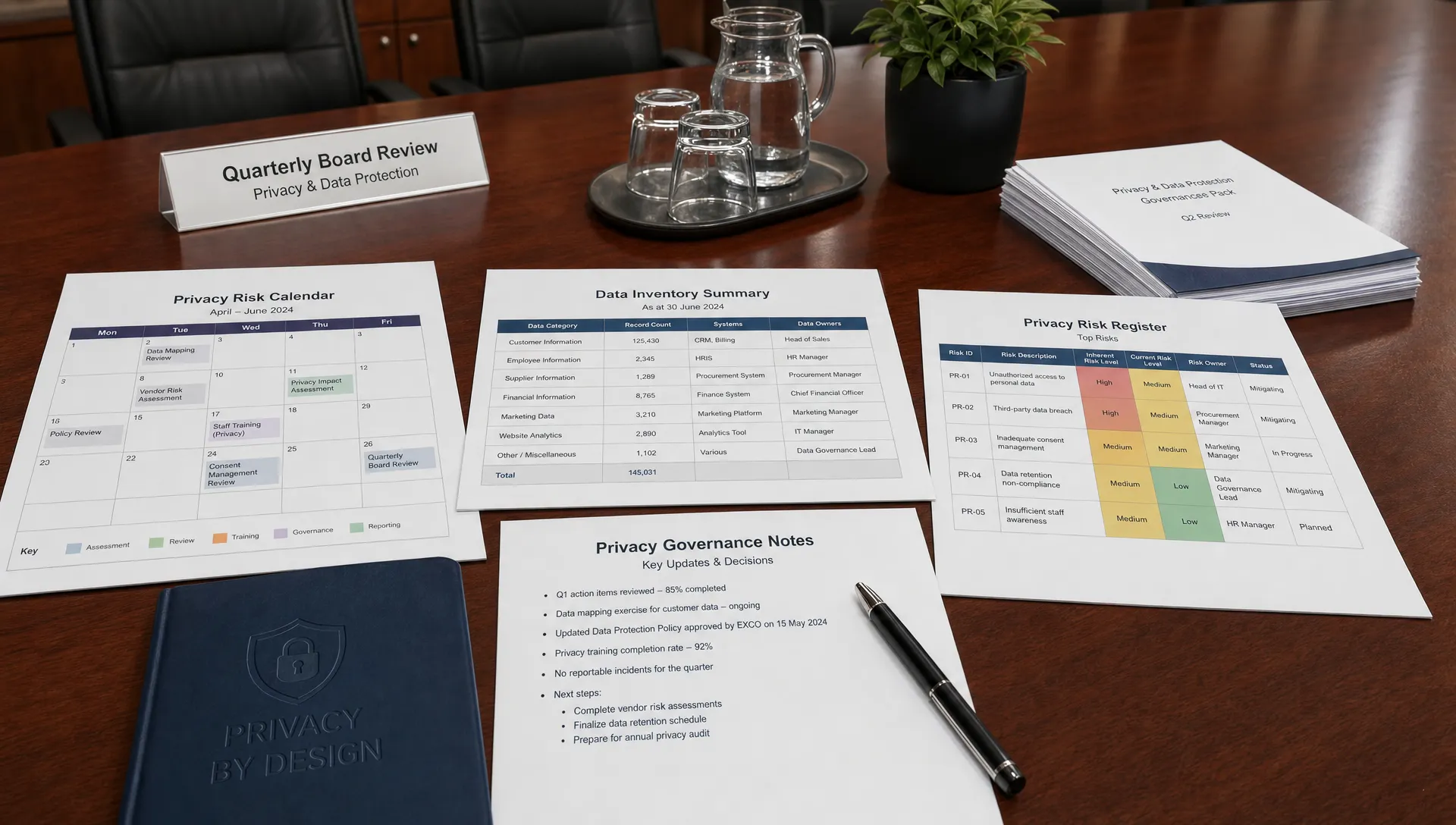
5. Cyber security and breach readiness review
Privacy risk and cyber risk are closely connected, but they are not the same. Cyber security focuses on protecting systems and information from threats. Privacy focuses on whether personal data is collected, used, shared, retained, and protected in line with legal and ethical expectations. A cyber incident becomes a privacy incident when personal data is compromised, misused, lost, altered, accessed without authority, or disclosed improperly.
Boards should schedule regular breach readiness reviews. These reviews should test whether the organisation can identify an incident quickly, preserve evidence, assess whether personal data is involved, determine who must be notified, communicate clearly, and prevent recurrence.
Useful evidence includes an incident response plan, breach assessment template, escalation matrix, contact list, legal review process, communication draft templates, and records of tabletop exercises. The board should also ask whether lessons from near misses, phishing attempts, misdirected emails, lost devices, or access control failures are being converted into better controls.
The NIST Cybersecurity Framework is a recognised reference point for structuring cyber risk conversations, particularly around identifying, protecting, detecting, responding, and recovering. Boards can use it as a useful lens while still ensuring that data protection obligations under Jamaican law are addressed separately.
6. Individual rights, complaints, and customer trust review
Privacy governance is not only about preventing breaches. It is also about how the organisation treats people when they ask questions, challenge processing, request access, seek correction, or complain about misuse of their data.
A scheduled board review should examine the number of individual rights requests received, average response times, overdue matters, complaint themes, and root causes. For example, repeated complaints about unexpected marketing could point to weak consent management. Frequent correction requests may reveal poor data quality. Delays in responding to access requests may indicate that systems are too fragmented to retrieve information efficiently.
Boards should look beyond volume. A low number of complaints is not always a sign of low risk. It may mean individuals do not know how to exercise their rights, privacy notices are unclear, or frontline staff are not recognising requests when they arrive.
7. Retention, deletion, and records management review
One of the simplest ways to reduce privacy risk is to stop keeping personal data that no longer serves a lawful purpose. Excessive retention increases the amount of data exposed in a breach, raises discovery and audit burdens, and makes it harder to respond accurately to individual rights requests.
A retention review should confirm that the organisation has a documented retention schedule, that business units understand it, and that deletion or anonymisation actually happens. This review should include paper records, shared drives, email archives, backup environments, legacy systems, personal devices used for work, and third-party platforms.
Boards should be particularly alert to “just in case” retention. Keeping data indefinitely because it might be useful someday is not a sound data protection strategy. The better approach is to define retention periods based on legal obligations, operational need, limitation periods, contractual requirements, and documented business justification.
8. Privacy in corporate governance and strategic change review
Privacy risk should be reviewed whenever the organisation makes strategic decisions. New products, mergers, acquisitions, digital transformation projects, customer analytics, outsourcing, artificial intelligence tools, workplace monitoring, and new market expansion can all change the privacy risk profile.
A board should ask whether privacy review is built into project approval, procurement, change management, and internal audit. If privacy is considered only after a new system goes live, the organisation may face expensive remediation, contract renegotiation, customer dissatisfaction, or regulatory scrutiny.
This is where corporate governance becomes practical. Privacy should have an accountable executive owner, a clear reporting line, budget consideration, and a route for escalating unresolved risk. For more structured oversight, boards can align privacy reporting with the organisation’s wider GRC approach and use clear measures such as outstanding remediation actions, overdue assessments, critical vendor status, training completion, and unresolved incidents. PLMC’s article on data protection board reporting KPIs explores how those measures can be presented without overwhelming directors.
9. Anti-money laundering and privacy review
For regulated entities, privacy risk also intersects with anti-money laundering obligations. Customer due diligence, transaction monitoring, sanctions screening, suspicious activity reporting, and record retention can require organisations to collect and retain sensitive identity and financial information.
The board should schedule a review that asks whether AML compliance and data protection compliance are working together rather than pulling in different directions. The organisation may have a legal duty to collect certain information, but it still needs appropriate access controls, retention rules, secure storage, staff confidentiality, and clear explanations to customers where disclosure is appropriate.
This review is especially important where KYC files are shared across departments, copied into email, stored in unstructured folders, or accessed by staff who do not need them. Strong AML compliance should not become a reason for uncontrolled data handling.
How to make board privacy reviews effective
A scheduled review is only useful if it drives decisions. Boards should avoid privacy reports that are too vague, too technical, or too optimistic. The board pack should clearly state what has changed, what remains unresolved, what decisions are needed, and whether risk is inside or outside appetite.
A practical board privacy review should include:
A short executive summary of material privacy risks and changes since the last review
Status of key remediation actions, owners, due dates, and overdue items
Metrics and trends for incidents, complaints, rights requests, training, and vendor reviews
Decisions required from the board, including funding, risk acceptance, policy approval, or escalation
Evidence of assurance, such as internal audit findings, testing results, assessments, and management attestations
The board should also ensure privacy risks are recorded in the enterprise risk register, not left in a separate compliance spreadsheet that never reaches senior decision-makers. If privacy risk is not written clearly, rated consistently, and owned at the right level, it will be difficult to monitor. PLMC has also outlined how to add data protection to your risk register in a way that supports enterprise-wide governance.
A simple annual schedule boards can adopt
Boards can adjust the following schedule to fit their meeting cycle, but the principle is to spread privacy oversight across the year rather than trying to cover everything in one meeting.
Period | Suggested board focus | Key outcome |
Quarter 1 | Governance, registration status, data inventory, annual privacy plan | Confirm accountability and annual priorities |
Quarter 2 | Lawful processing, transparency, individual rights, training | Test whether people are informed and staff are prepared |
Quarter 3 | Third-party risk, cross-border transfers, cyber and breach readiness | Strengthen resilience and vendor assurance |
Quarter 4 | Retention, internal audit results, risk register, next-year budget | Close gaps and approve the next improvement cycle |
This structure keeps privacy visible without turning every board meeting into a compliance workshop. It also helps committees coordinate. The audit and risk committee may review evidence in detail, while the full board receives material risks, decisions, and assurance summaries.
Frequently Asked Questions
How often should a board review privacy risk? Most boards should receive a privacy risk update at least quarterly, with deeper reviews scheduled across the year. High-risk organisations or those handling sensitive data may need more frequent committee-level review.
Is privacy risk only a legal or IT issue? No. Privacy risk involves legal compliance, cyber security, operations, procurement, HR, marketing, customer service, records management, and corporate governance. The board should treat it as an enterprise risk.
What should directors ask management about data protection compliance? Directors should ask what personal data the organisation holds, what has changed since the last review, which high-risk processing activities exist, whether vendors are controlled, whether incidents are tested, and what evidence proves controls are working.
Do Jamaican organisations need to consider GDPR as well as the Data Protection Act, 2020? Some Jamaican organisations may need to consider GDPR if they offer goods or services to people in the EU or monitor their behaviour. However, GDPR Jamaica discussions should not distract from local obligations under Jamaica’s Data Protection Act, 2020.
What is the biggest mistake boards make with privacy reviews? The biggest mistake is treating privacy as a one-time compliance exercise. Privacy risk changes whenever systems, vendors, staff practices, customer interactions, or legal requirements change.
Strengthen your board’s privacy oversight
Privacy risk reviews are most effective when they are scheduled, evidence-based, and connected to wider governance. They help directors see where personal data creates operational, legal, reputational, and cyber risk before those risks become public problems.
Privacy & Legal Management Consultants Ltd. supports Jamaican organisations with data protection implementation, corporate governance, anti-money laundering compliance, cyber security services, GRC integration, training, and practical risk assessment support. If your board wants to move from occasional privacy updates to a structured oversight calendar, schedule a consultation with PLMC and start building a review process that stands up to scrutiny.