

Privacy Protection: Simple Steps to Reduce Risk

Most privacy incidents are not the result of sophisticated hackers. They come from everyday operations: an email sent to the wrong recipient, a shared folder left open to “anyone with the link,” an old spreadsheet copied from one device to another, or a vendor who has more access than they need.
For Jamaican organisations, privacy protection is also a compliance and governance issue under the Data Protection Act. But beyond the legal angle, it is a practical risk question: What is the most likely way personal data could be exposed in our environment this month, and what can we do quickly to reduce that risk?
This article focuses on simple, high-impact steps that reduce risk without requiring a full programme rebuild.
Privacy protection starts with reducing “avoidable exposure”
A useful mindset is to stop treating privacy as a set of documents and start treating it as exposure management.
Exposure is created when:
You collect more personal data than you truly need
You keep it longer than necessary
Too many people can access it
You cannot easily see where it is stored or shared
Third parties can process it without tight boundaries
Staff are unsure what to do in real scenarios
If you can lower those exposures, you reduce breach likelihood and reduce the harm if something goes wrong.
The most common risk patterns we see (and why they keep happening)
Even mature organisations can get caught by a few recurring patterns:
1) Convenience sharing becomes uncontrolled sharing
Teams collaborate quickly through shared drives, messaging apps, personal email, and screenshots. Over time, sensitive personal data spreads into places with weaker controls.
2) “Everyone needs access” is rarely true
Access tends to expand, not shrink. When staff change roles (or leave), access rights often remain.
3) Vendor tools multiply faster than oversight
Cloud services, payroll processors, marketing platforms, IT support providers, and outsourced call centres may process personal data. If contracts and access boundaries are vague, accountability becomes difficult.
4) Training is too generic
When training is mostly policy reading, staff may pass a quiz but still hesitate when faced with real decisions (for example, confirming a customer’s identity, responding to a right-to-access request, or spotting a social engineering attempt).
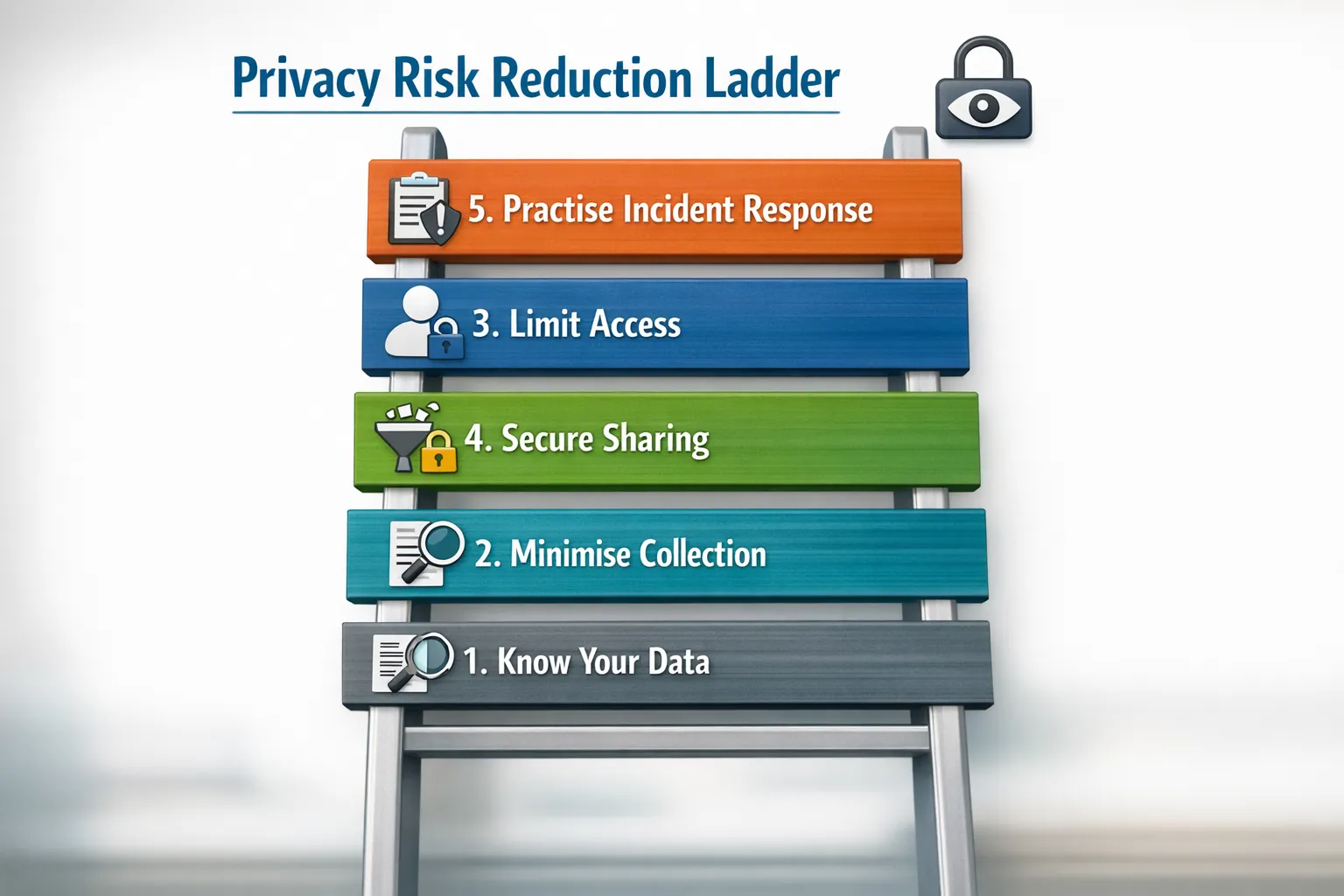
Simple steps to reduce privacy risk (without overengineering)
Step 1: Assign clear ownership for privacy decisions
Risk drops when people know who decides, who approves, and who escalates.
At minimum, define:
A privacy lead (not necessarily full-time) who coordinates actions and evidence
A decision path for new data uses (new marketing initiative, new HR tool, new CCTV placement)
A simple escalation path for incidents (lost device, suspected phishing, misdirected email)
This is a low-cost step with high value, because “no owner” is one of the fastest ways for risk to linger.
Step 2: Reduce what you collect and keep (data minimisation + retention)
If you only make one structural change, make it this: stop storing personal data you do not need.
Practical ways to do this quickly:
Remove optional fields from forms unless there is a business reason
Separate “nice to have” data from “need to operate” data
Apply retention limits to shared drives (especially HR, customer support, and finance exports)
Stop email inboxes from becoming long-term storage for attachments containing personal data
A shorter retention window limits blast radius. If data is not there, it cannot be leaked.
If you want a more detailed implementation checklist to support these actions, PLMC has a practical guide here: Privacy and Data Protection: A Practical Checklist.
Step 3: Enforce least-privilege access (and prove it)
Access control is one of the most reliable privacy risk reducers, especially for SMEs.
Focus on three controls first:
MFA everywhere possible, starting with email, file storage, and admin accounts
Role-based access for shared folders and systems (limit “all staff” permissions)
Regular access reviews, especially for HR data, customer data, and finance data
Also decide what “proof” looks like. For example, a short monthly export of user access lists for key systems, reviewed and signed off by a manager, becomes powerful evidence during audits and investigations.
Step 4: Fix email and document-sharing habits (the everyday breach vector)
Misdirected emails and uncontrolled links are frequent causes of privacy incidents.
Simple controls that work:
Add an “external recipient” warning banner on email
Disable “anyone with the link” as a default for document sharing
Require expiry dates for shared links where possible
Encourage secure portals for exchanging documents with customers instead of attachments
These changes reduce risk without changing your business model.
Step 5: Strengthen vendor boundaries (before the next renewal)
Privacy risk often sits in vendor relationships, not in your own servers.
Start with a short vendor pass:
Identify which vendors process personal data (payroll, benefits, CRM, marketing, IT support)
Confirm what data they access, where it is stored, and who can access it
Ensure contracts include confidentiality, security expectations, breach notification obligations, and deletion/return of data at end of service
Even if you cannot renegotiate every contract immediately, you can tighten practical boundaries now (for example, reduce vendor access levels or require named accounts, not shared logins).
Step 6: Make incident response “real”, not theoretical
A privacy incident response plan should not be a document that is never tested.
Keep it simple:
Define what staff must report (lost device, suspicious email, wrong recipient, unauthorised access)
Define how they report it (a specific inbox, number, or ticket type)
Define what the first responder does in the first hour (containment steps, evidence preservation, internal notification)
Then run a short tabletop exercise quarterly using your own scenarios.
If you need a structured approach for 2026 planning, PLMC’s roadmap can help you sequence the work: Data Protection Jamaica: Compliance Roadmap for 2026.
Step 7: Upgrade training from “policy awareness” to “decision practice”
Many incidents involve a human element (for example, social engineering, mistakes, misdelivery). The Verizon Data Breach Investigations Report has repeatedly highlighted how frequently human factors show up in breaches and security incidents across industries.
The practical goal is not just awareness, it is decision-making under pressure:
How to verify identity before releasing personal data
How to handle a customer who is angry and pushing for “quick exceptions”
How to respond when a manager requests employee information informally
How to spot a payment diversion attempt or urgent “CEO request” email
One effective method is scenario practice. Tools such as AI roleplay training from Scenario IQ can help teams rehearse realistic service and communication scenarios with feedback, which is useful when you want training to translate into safer day-to-day behaviour.
Step 8: Build a small “evidence pack” to demonstrate accountability
Privacy protection is easier to sustain when you can show what you do, not just describe it.
A simple evidence pack might include:
Risk-reduction step | What it prevents | What you can keep as evidence |
Retention limits for shared drives | Large-scale exposure from old files | Retention policy, deletion logs, folder review notes |
MFA on key accounts | Credential takeover | MFA enforcement screenshots/config export |
Access reviews for sensitive folders | Unnecessary internal access | Monthly access review sign-off |
Vendor list with data types and owners | Unmanaged third-party processing | Vendor register, key contract clauses |
Incident reporting workflow | Delays and confusion during an incident | Playbook, report template, tabletop notes |
This does not need to be complex. The point is to make privacy defensible and repeatable.
A 30-day “privacy protection” sprint you can actually finish
If you want a realistic way to start, aim for outcomes, not perfection:
Week 1: name owners, identify your top 3 data sets (usually HR, customer, finance)
Week 2: tighten access and sharing defaults for those areas
Week 3: confirm retention rules and remove obvious unnecessary data stores
Week 4: run one incident tabletop and one short scenario-based training session
By the end of the month, you should be able to say: we reduced exposure, we limited access, we improved behaviour, and we can prove it.
When “simple steps” are not enough
If your organisation has any of the following, your baseline steps should be paired with a more formal risk assessment:
High volumes of sensitive personal data
Multiple locations or frequent data transfers
Heavy reliance on vendors for core operations
Regular public-facing requests for personal information
A history of incidents, near-misses, or customer complaints
That is where a structured governance, risk, and compliance approach pays off, so privacy controls stay aligned with operational reality.
Getting support in Jamaica
If you want help turning these steps into a working privacy protection programme aligned with Jamaica’s Data Protection Act, Privacy & Legal Management Consultants Ltd. (PLMC) supports organisations with data protection implementation, training, risk assessment tools, and governance-focused compliance support. If you are not sure where to start, a short consultation can help you identify the fastest risk reductions based on your specific data and workflows.