
Records Management Habits That Strengthen Compliance
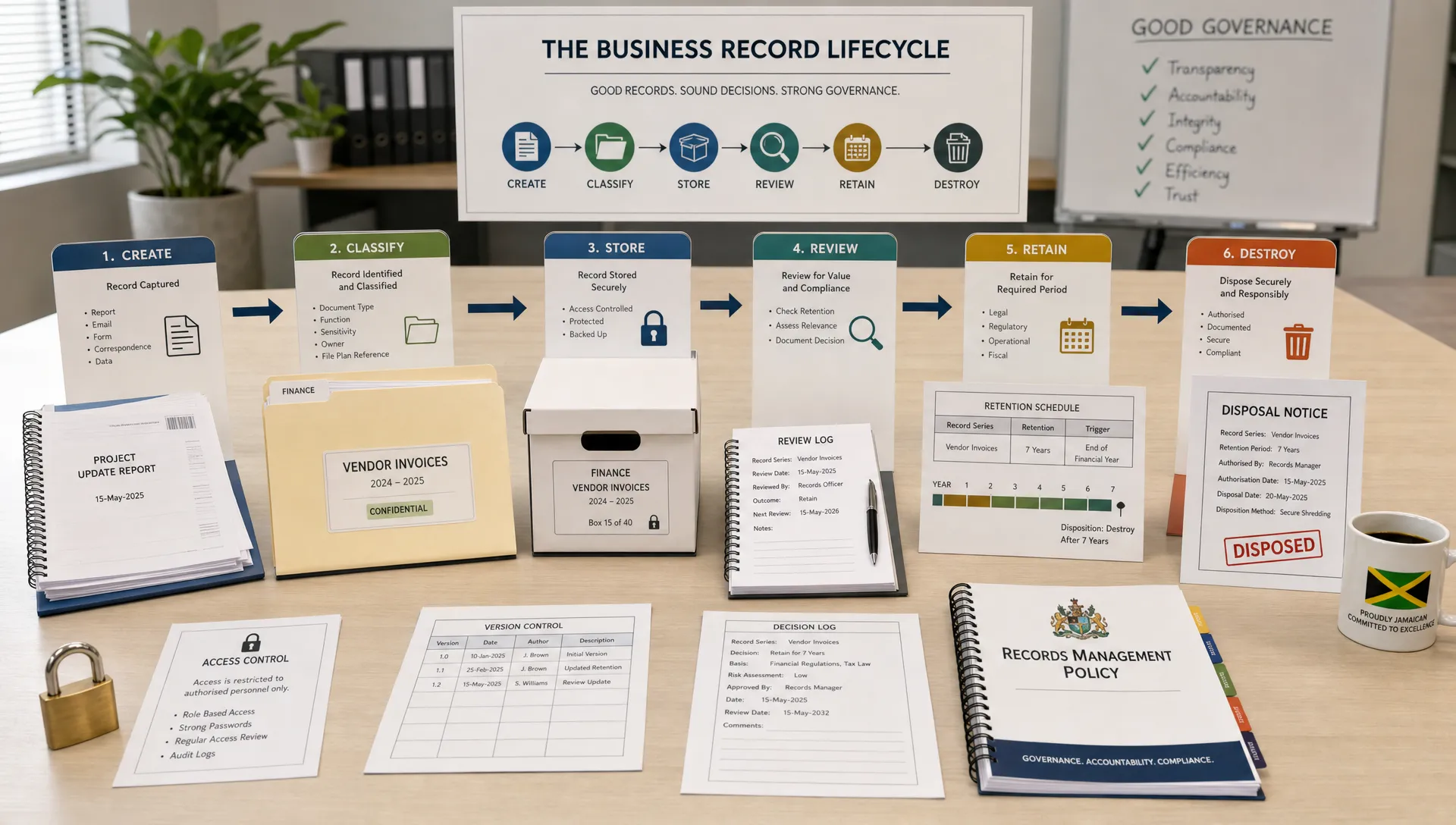
Records management is one of the quietest parts of compliance, until an audit, data subject request, investigation, cyber incident, or board query exposes gaps. By then, the problem is rarely that the organisation had no policy. The problem is usually that everyday habits did not support the policy.
For Jamaican organisations, strong records management helps connect privacy, corporate governance, anti-money laundering controls, cybersecurity, and operational accountability. It gives leaders evidence of what happened, who approved it, where personal data is stored, how long it should be kept, and when it should be securely disposed of.
The goal is not to keep more records. It is to keep the right records, in the right place, for the right period, with the right level of protection.
Why records management is a compliance control
Records management is often treated as administration, but it is a core compliance control. Under Jamaica's Data Protection Act, 2020, organisations that process personal data need practical controls for lawful use, security, accuracy, retention, and accountability. Poor filing habits can make those obligations harder to demonstrate, even when staff had good intentions.
Records also matter beyond privacy. Board minutes, policies, approvals, AML due diligence files, vendor assessments, incident logs, and training attendance records all help prove that governance processes are working. If records are incomplete, scattered, duplicated, or retained too long, the organisation carries unnecessary legal, operational, and reputational risk.
Compliance pressure | What weak records look like | Habit that strengthens compliance |
Privacy and data protection | Personal data stored in email, downloads, and unmanaged folders | Save records in approved repositories with clear classification |
Corporate governance | Key decisions buried in chats or informal messages | Record decisions, approvals, dates, and accountable owners |
Anti-money laundering | Customer due diligence documents saved inconsistently | Maintain structured case files with review dates and access controls |
Cybersecurity | Unknown users can access old files | Review permissions and remove unnecessary access regularly |
Audit readiness | Staff cannot locate evidence quickly | Use consistent naming, indexing, and retention rules |
Good records management habits make compliance easier because they reduce guesswork. They allow the organisation to answer simple but important questions: What do we have? Why do we have it? Who can access it? How long must we keep it? Can we prove what we did?
Habit 1: Define what counts as an official record
Not every document is an official record. Drafts, temporary notes, duplicate exports, and working copies may be useful for a short time, but they should not become permanent clutter. A record is information that needs to be kept because it proves a decision, transaction, obligation, communication, or compliance activity.
Examples include contracts, consent records, privacy notices, board minutes, employee files, customer due diligence documents, incident reports, vendor assessments, complaint records, data subject request correspondence, training attendance logs, and policy approvals.
The habit to build is simple: before saving or forwarding a document, staff should know whether it is temporary working material or an official record. This distinction prevents both under-retention and over-retention. Under-retention creates evidence gaps. Over-retention increases privacy exposure and discovery risk.
A practical rule is to assign each key business process a record owner. The owner does not have to create every record, but they should be accountable for ensuring the record is complete, stored correctly, and managed according to the organisation's retention rules.
Habit 2: Classify records at the point of creation
Classification should happen when the record is created or received, not months later during a clean-up exercise. Once records begin circulating without labels, staff make their own assumptions about how sensitive they are.
A simple classification model may include public, internal, confidential, and restricted categories. The exact labels matter less than consistent use. What matters is that staff understand which records contain personal data, financial information, employee information, sensitive business information, regulated information, or privileged material.
Classification supports better decisions about storage, sharing, encryption, printing, retention, and disposal. It also helps staff avoid common mistakes, such as sending sensitive records through unapproved channels or keeping personal data in personal cloud accounts.
Simple labels also make day-to-day handling rules easier to apply. For example, teams can pair each classification level with clear instructions for storage, access, sharing, and disposal, similar to the behaviours outlined in PLMC's guidance on confidentiality data handling rules every team should know.
Habit 3: Use consistent naming and useful metadata
A record that cannot be found when needed is almost as risky as a record that does not exist. Consistent naming reduces search time, improves audit readiness, and prevents staff from creating unnecessary duplicates.
A good naming convention usually includes the date, subject, record type, version or status, and business unit or party where relevant. For example, a vendor agreement might be named 2026-02-15_Vendor-Data-Processing-Agreement_ACME_Final. The format is less important than consistency.
Metadata also matters. Records should be associated with information such as owner, department, retention category, classification, approval status, and review date. This does not need to be complex. Even a well-maintained register or structured folder system is better than a shared drive full of vague file names like scan001 or final final approved.
The habit to reinforce is this: name and describe records for the person who will need to find them later, not only for the person saving them today.
Habit 4: Store records in approved locations only
Email inboxes, personal desktops, messaging apps, and downloads folders are not reliable records repositories. They are easy to lose, difficult to search consistently, and hard to protect with standard access controls.
Approved storage locations should be known, documented, and reinforced during onboarding and team meetings. For digital records, this may include a controlled document management system, secure shared workspace, or approved cloud environment. For physical records, it may include locked cabinets, controlled archive rooms, sign-out logs, and secure scanning procedures.
This habit is especially important where staff work remotely or move between offices. If every team uses a different storage method, compliance staff cannot reliably confirm where personal data is located. That creates problems when responding to access requests, deletion requests, investigations, audits, and incidents.
A useful test is to ask: if the record owner left tomorrow, could another authorised person locate the complete record within a reasonable time? If the answer is no, the storage habit needs improvement.
Habit 5: Connect every record type to a retention rule
Retention is one of the most important links between records management and privacy compliance. Keeping records too briefly can undermine legal defence, governance, AML obligations, and operational continuity. Keeping records too long can increase exposure if there is a breach, complaint, or access request.
Each record type should have a retention rule that explains how long it is kept, what triggers the retention period, who owns it, and how disposal is approved. Some records may need to be retained because of statutory, contractual, regulatory, or business requirements. Others should be deleted or destroyed once their purpose has expired.
This is where many organisations struggle, not because they lack awareness, but because retention rules are not built into daily work. Teams save records indefinitely because deletion feels risky. In reality, unmanaged retention is also risky.
For a deeper look at retention structure, ownership, triggers, and secure disposal, PLMC's article on retention schedules that reduce privacy exposure is a useful companion resource.
Habit 6: Review access before it becomes a problem
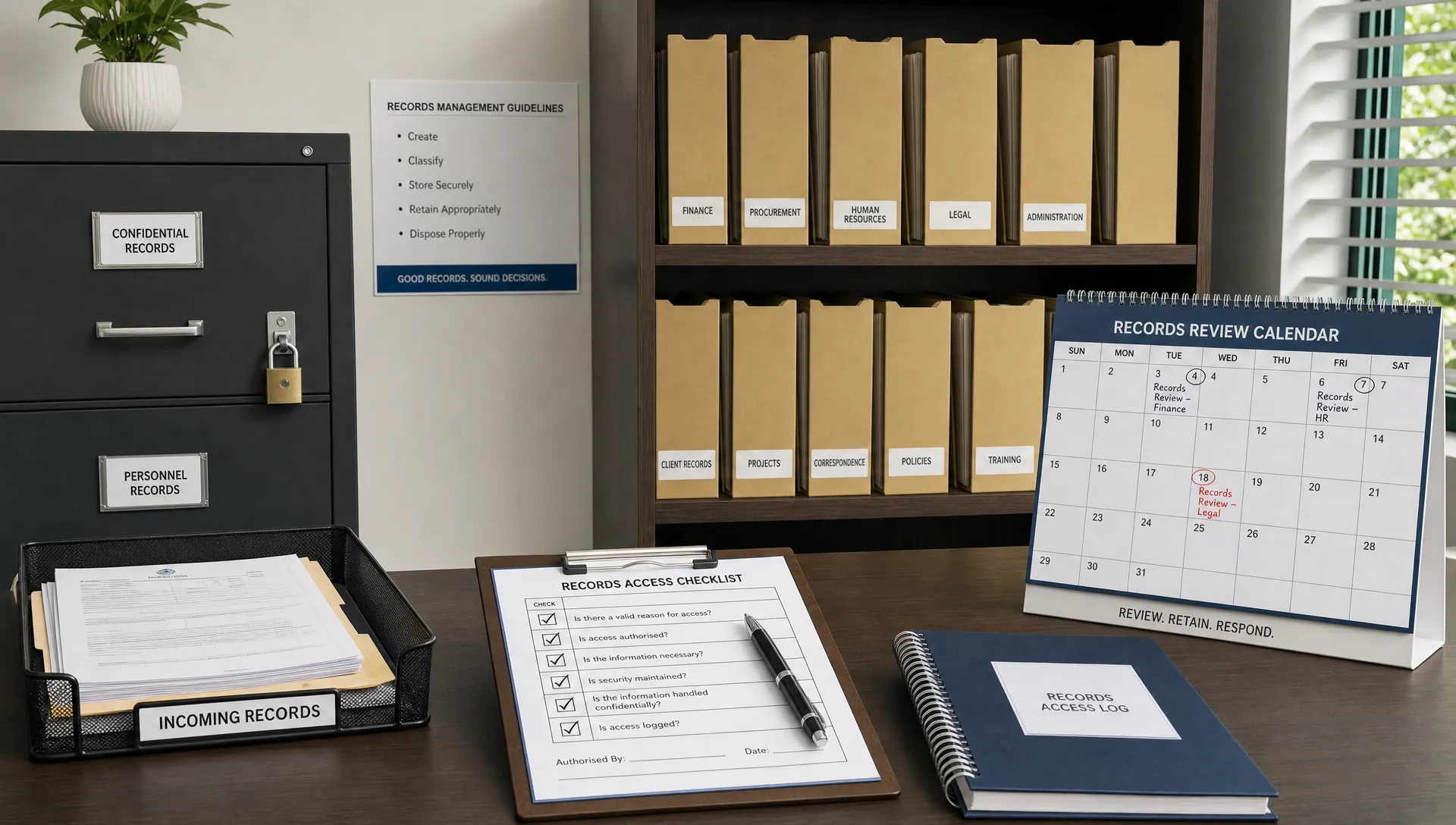
Access control is not a one-time IT task. It is a records management habit. People change roles, projects end, vendors complete their work, and temporary access becomes permanent unless someone reviews it.
High-risk record categories should have periodic access reviews. This includes employee records, customer due diligence files, board documents, legal records, payroll records, incident reports, and folders containing sensitive personal data. The review should confirm whether each user still needs access, whether external sharing links remain appropriate, and whether leavers or transferred staff have been removed.
The review does not need to be complicated. A short monthly or quarterly check for sensitive repositories can prevent serious audit findings. The key is to make the business owner and IT or security team work together. Business owners know who should access the record. IT can confirm what access actually exists.
Habit 7: Control versions and approvals
Version confusion weakens compliance. If staff cannot identify the approved policy, signed contract, final board paper, or current procedure, they may act on outdated information.
Good version control habits include identifying the official master record, keeping drafts separate from approved records, recording approval dates, and limiting who can change final versions. Where possible, systems should preserve version history so changes can be reviewed without creating uncontrolled copies.
This matters for privacy notices, consent wording, policies, procedures, contracts, training materials, risk assessments, and regulatory submissions. If a complaint or audit arises, the organisation may need to prove which version was in effect at a specific time.
A practical habit is to add status labels such as draft, under review, approved, superseded, or archived. Once a record is superseded, it should not remain in active working folders where staff may use it by mistake.
Habit 8: Record decisions, not just documents
Compliance depends on decisions. Why was data collected? Why was access granted? Why was a vendor approved? Why was a suspicious transaction escalated or not escalated? Why was a data subject request handled in a certain way?
Too often, the final document is retained but the reasoning is missing. This creates problems when leaders need to demonstrate accountability. A decision record should capture the issue, date, participants or approver, evidence considered, decision made, rationale, next step, and review date where relevant.
This habit is valuable across governance, risk, and compliance. It supports board accountability, AML oversight, privacy risk assessments, incident response, vendor management, and employee disciplinary processes. It also helps prevent repeated debates because future teams can see what was decided and why.
The guiding principle is straightforward: if a decision affects rights, obligations, risk, money, security, or compliance, record the decision in a way that an independent reviewer can understand.
Habit 9: Build disposal into routine operations
Secure disposal should not be an occasional archive project. It should be part of the normal records lifecycle. When retention periods expire, records should be reviewed, placed on hold if needed, or securely destroyed according to the organisation's procedure.
Disposal habits should cover both digital and physical records. Digital disposal may require deletion from active repositories, backup considerations, and confirmation that duplicates have not been retained elsewhere. Physical disposal may require shredding, secure bins, destruction certificates, and supervision for highly sensitive records.
Legal holds are equally important. If records relate to litigation, investigation, regulatory inquiry, complaint, audit, or active request, routine disposal should pause until the hold is lifted. Staff should know who can issue a hold and how it is communicated.
A disposal log is useful because it proves that records were not deleted casually. It should show what was disposed of, when, under which retention rule, who approved it, and how disposal occurred.
Habit 10: Train staff on records scenarios they actually face
Policies are necessary, but habits come from repetition. Staff need to see how records management applies to the work they do every day. A finance officer, HR manager, compliance analyst, customer service representative, board secretary, and IT administrator will each face different records risks.
Training should be practical and role-based. Instead of only explaining definitions, use scenarios: a customer requests a copy of their file, a manager wants to email payroll data, a vendor asks for access to a folder, an employee leaves with project files on a laptop, or a team discovers old customer records in a shared drive.
Short refreshers work well when they focus on one behaviour at a time, such as naming files properly, saving records in approved locations, checking classification labels, or escalating disposal questions. For broader planning, PLMC's guide on how to plan data protection training that staff will apply offers a helpful framework.
A practical rhythm for stronger records compliance
The best records management habits are repeatable. They should fit into daily work rather than depend on annual clean-up campaigns. A simple rhythm can help teams stay consistent.
Frequency | Records management habit | Compliance value |
Daily | Save official records in approved locations and classify them | Reduces scattered data and improves security |
Weekly | Clear temporary downloads, drafts, and unnecessary duplicates | Limits clutter and privacy exposure |
Monthly | Sample folder naming, metadata, and access permissions | Detects drift before audits or incidents |
Quarterly | Review high-risk records, disposal queues, and external access | Strengthens governance and accountability |
Annually | Refresh retention rules, record owners, and training scenarios | Keeps the programme aligned with legal and operational changes |
This rhythm can be adjusted based on risk. A small organisation may start with monthly checks for its most sensitive records. A regulated business may need more frequent monitoring for AML files, employee records, customer data, and board documentation.
The point is not perfection. The point is consistency. Compliance becomes stronger when the organisation can show that records are actively managed, not simply accumulated.
Frequently Asked Questions
What is records management in compliance? Records management is the structured control of records from creation to disposal. In compliance, it helps prove decisions, protect personal data, support audits, manage retention, and show accountability.
How does records management support data protection compliance in Jamaica? It helps organisations know what personal data they hold, where it is stored, who can access it, why it is retained, and when it should be securely disposed of. These controls support practical compliance with Jamaica data privacy obligations.
Should organisations keep every record just in case there is an audit? No. Keeping everything can increase privacy, security, and legal risk. Organisations should keep records based on defined retention rules, legal obligations, business needs, and documented disposal procedures.
Who should own records management? Ownership should be shared. Senior leadership should set expectations, compliance or legal teams should define rules, IT should support secure systems, and business units should manage records created through their processes.
How often should access to records be reviewed? Access should be reviewed on a risk-based schedule. Sensitive records, such as HR files, AML documents, board records, and customer personal data, should be checked more frequently than low-risk administrative records.
Strengthen compliance by improving daily records habits
Records management is not only about filing. It is about evidence, accountability, privacy protection, and trust. When teams classify records, store them properly, control access, apply retention rules, and document decisions, compliance becomes easier to prove and easier to maintain.
Privacy & Legal Management Consultants Ltd. supports Jamaican organisations with data protection implementation, corporate governance, AML compliance, cybersecurity services, GRC integration, training, and risk-focused compliance support. If your organisation wants to strengthen records management habits as part of a wider compliance programme, start by connecting with Privacy & Legal Management Consultants Ltd..