

Privacy Risks When Using Global Cloud Providers

Using Microsoft Azure, Amazon Web Services, Google Cloud or another global provider can improve resilience, scalability and productivity. It can also create privacy risks that are easy to underestimate. For Jamaican organisations subject to the Data Protection Act 2020, the core question is not whether cloud is allowed. The better question is whether the organisation understands where personal data goes, who can access it, what contract terms apply and how accountability is maintained after the system is live.
Cloud services are now part of normal business operations, from customer relationship management and payroll to document storage, analytics and outsourced support. The privacy risk is not the brand name of the provider. It is the gap between what the organisation assumes the provider is doing and what the contract, configuration and operating model actually allow.
Privacy risks when using global cloud providers: what changes?
A global cloud provider can host data across regions, rely on sub-processors, use centralised support teams and operate under legal regimes outside Jamaica. That does not make the provider unsafe by default, but it changes the governance work required from the Jamaican business that collects or controls the personal data.
The NIST definition of cloud computing highlights characteristics such as broad network access, resource pooling and rapid elasticity. Those features explain why cloud is useful, but they also show why privacy teams need visibility. Data can be copied, backed up, logged, analysed, transferred or accessed in ways that are not obvious to business users.
For Jamaica data privacy programmes, the main shift is accountability. Even when processing is outsourced to a cloud provider, the organisation using the service generally remains responsible for deciding why the data is processed, what data is collected and how long it is retained. The cloud provider may handle infrastructure and service delivery, but the customer must still manage lawful use, data minimisation, access control, retention and vendor oversight.
The main cloud privacy risks to assess
Most cloud privacy failures do not come from one dramatic decision. They come from small assumptions: assuming data stays in one country, assuming the provider deletes everything when the account closes, assuming encryption is automatically configured correctly or assuming the vendor will notify every incident immediately.
The following table summarises common risks and the practical question each organisation should ask before adopting or renewing a global cloud service.
Risk area | What can go wrong | Practical question to ask |
Data location | Personal data may be stored, backed up or supported from several countries | Which regions are used for storage, backup, support and disaster recovery? |
Cross-border transfers | Data may move outside Jamaica without a documented transfer assessment | What legal and contractual protections apply to overseas transfers? |
Sub-processors | The main provider may rely on affiliates and third parties | Who else processes the data and how are changes communicated? |
Misconfiguration | Incorrect access, sharing or logging settings can expose personal data | Who configures privacy and security settings before launch and after updates? |
Retention and deletion | Data may remain in backups, archives or logs longer than expected | How is deletion handled across active systems, backups and support records? |
Incident response | Breach notices may be delayed or lack the details needed for local obligations | What notification timeline and cooperation duties are in the contract? |
Support access | Provider personnel may access data for troubleshooting or maintenance | Is access logged, limited, approved and restricted to trained personnel? |
Vendor lock-in | Data may be hard to export or verify after termination | Can the organisation retrieve data in a usable format and confirm deletion? |
This type of review should happen before procurement, not only when there is a breach, audit or client complaint.
Why Jamaican organisations remain accountable
The Data Protection Act 2020 places responsibility on organisations that determine the purposes and manner of processing personal data. In cloud arrangements, this usually means the Jamaican customer must be able to explain why data is being processed, what categories of data are involved, what safeguards are in place and how individuals can exercise their rights.
This matters for private companies, charities, professional services firms, schools, healthcare providers, financial institutions and public bodies. It also matters for organisations handling anti-money laundering records, customer identification documents, employee files, health data or information belonging to overseas clients.
A cloud provider may provide strong technical security, but that does not automatically solve data protection compliance. For example, a storage bucket can be highly secure by design yet exposed by poor customer configuration. A collaboration platform can offer granular access permissions, but a team may still share sensitive files with the wrong external partner. A SaaS system can support retention rules, but the organisation must decide what those rules should be.
This is why cloud privacy risk belongs in corporate governance, not only IT administration. Boards and senior management do not need to approve every system setting, but they should expect evidence that high-risk cloud services are assessed, contracts are reviewed and business owners know their responsibilities.
Cross-border data transfers and foreign legal exposure
One of the most important privacy risks when using global cloud providers is cross-border data movement. A service may allow the customer to select a primary region, but that does not always mean every support ticket, log, backup, diagnostic record or sub-processor activity remains in that region.
Jamaican organisations should pay close attention to transfer clauses and the provider's documentation on data residency. The issue is not just geography. It is whether the receiving country, contractual commitments and organisational safeguards provide appropriate protection for the personal data.
Foreign legal access is another consideration. Global providers may be subject to lawful government requests in jurisdictions where they operate. Reputable providers often publish transparency reports and have processes for challenging overbroad requests, but customers still need to understand the residual risk, especially for sensitive data, regulated records or information belonging to clients in other countries.
For organisations serving international clients, GDPR Jamaica considerations may also arise in practice. A Jamaican service provider handling personal data for a European client may face contractual GDPR obligations even if the organisation is primarily governed locally. In those cases, cloud provider selection and transfer documentation become part of the client assurance process.
Shared responsibility is often misunderstood
Major cloud providers make clear that security and compliance operate under a shared responsibility model. For example, AWS explains that AWS is responsible for security of the cloud, while customers are responsible for security in the cloud. The exact split differs by service type, but the principle is consistent across the industry.
In privacy terms, shared responsibility means the provider may secure the infrastructure while the customer remains responsible for choices such as user access, data classification, retention settings, records uploaded by staff, consent language, notices and lawful use. A managed SaaS platform may reduce infrastructure work, but it does not remove governance duties.
A practical way to test understanding is to ask one question: if personal data is exposed tomorrow, which parts of the incident would the cloud provider investigate and which parts would your organisation need to explain? If the answer is unclear, the cloud arrangement is not yet governed well enough.
Vendor due diligence before adopting a cloud service
Before personal data is uploaded to a global platform, the organisation should complete a risk-based vendor privacy review. The depth of review should match the sensitivity and volume of the data. A cloud tool used for public marketing files does not require the same scrutiny as a platform used for payroll, health records or customer due diligence.
Useful due diligence questions include:
What categories of personal data will be stored or processed in the service?
Will special category, financial, identity or child-related data be involved?
In which countries will data be hosted, accessed, backed up or supported?
Does the provider use sub-processors and how are changes announced?
What security certifications, audit reports or compliance documentation are available?
What breach notification, deletion and assistance terms are included in the contract?
Can the organisation export data in a usable format at the end of the relationship?
If your team needs a practical starting point, PLMC's guide on how to run a simple vendor privacy assessment explains how to tier vendors by risk and focus questions where they matter most. For SaaS purchases specifically, it is also worth reviewing the privacy questions to ask before using a new SaaS platform.
Contract controls that reduce cloud privacy risk
A cloud contract should do more than confirm price and service availability. It should define privacy roles, permitted processing, confidentiality, security commitments, sub-processor controls, incident cooperation and exit rights.
The most useful contract terms are specific enough to be enforceable, but flexible enough to work with a global service model. Generic statements about using “reasonable security” are rarely enough for sensitive or regulated data. The organisation should understand what the provider commits to and what remains the customer's responsibility.
Contract topic | Why it matters |
Processing instructions | Limits the provider's use of personal data to agreed purposes |
Confidentiality | Requires personnel and sub-processors to protect customer data |
Security measures | Sets expectations for encryption, access control, logging and monitoring |
Sub-processor notice | Gives visibility when additional providers are involved |
Breach notification | Supports timely investigation and regulatory decision-making |
Data subject assistance | Helps respond to access, correction or deletion requests |
Audit or assurance rights | Provides evidence through reports, certifications or assessments |
Return and deletion | Reduces risk when the contract ends or the system is replaced |
Exit terms are especially important because risk increases during migration, archiving and decommissioning. PLMC has a separate guide on cloud exit planning and protecting data when changing vendors that covers this stage in more detail.
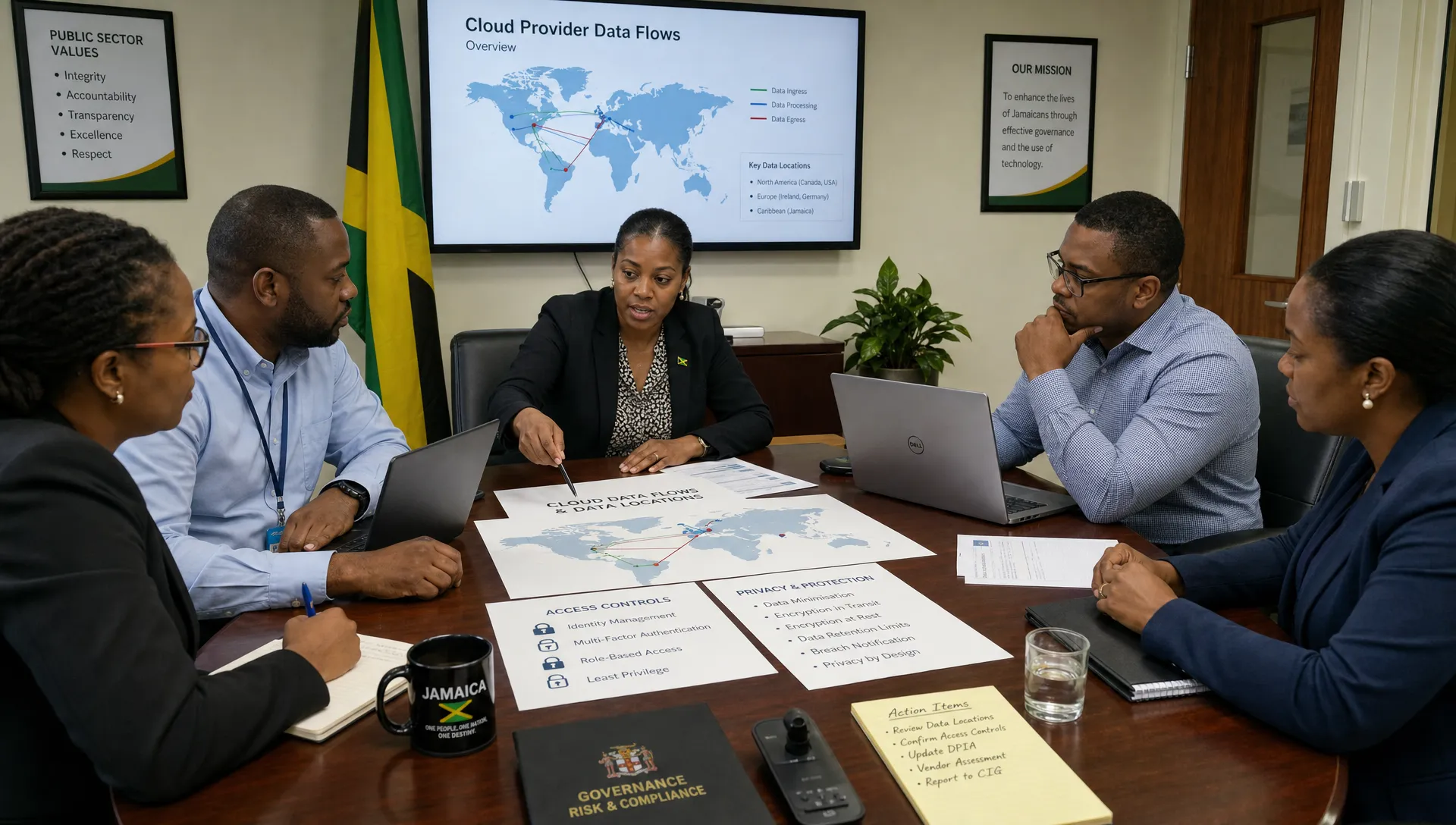
Operational controls after the cloud service goes live
Cloud privacy management is not complete when the contract is signed. Many of the highest risks appear after deployment, when users create new folders, connect integrations, invite external collaborators, change retention settings or begin uploading more sensitive data than originally planned.
Access control should be reviewed regularly. Privileged accounts need stronger protection, including multi-factor authentication and prompt removal when staff leave or roles change. Shared accounts should be avoided because they make investigation and accountability difficult.
Data classification is also essential. Teams should know which information can be stored in approved cloud systems, which information requires additional approval and which information should not be uploaded at all. This is particularly important for identity documents, medical information, disciplinary records, customer financial data and anti-money laundering files.
Retention settings should reflect business and legal requirements, not the default settings of the platform. Keeping data indefinitely increases exposure and makes it harder to respond to access or deletion requests. The organisation should know how retention applies to active records, backups, audit logs and archives.
Finally, cloud services should be monitored when the provider changes features or terms. Many global platforms now include artificial intelligence features, automated analytics or expanded integrations. Before enabling these functions, organisations should confirm whether personal data will be used for model training, profiling, analytics or new processing purposes that were not covered in the original assessment.
When the risk level is higher
Some cloud projects deserve deeper review before approval. High-risk indicators include large volumes of personal data, sensitive personal data, financial crime records, biometric identifiers, children's data, employee monitoring, automated decision-making or services that integrate many separate data sources.
In these cases, a privacy impact assessment or similar risk assessment is a sensible governance step. The review should document the purpose of the processing, the data involved, the necessity of using the cloud service, the transfer risks, the security controls and the measures chosen to reduce harm to individuals.
Regulated organisations should also consider sector expectations. Financial services, insurance, healthcare and professional services firms may need stronger evidence of vendor oversight because their records carry higher confidentiality and reputational risk. For these organisations, privacy, cyber security, business continuity and anti-money laundering compliance often overlap in the same cloud environment.
Practical checklist for safer cloud adoption
A simple checklist can help business and IT teams make better decisions before they commit to a provider. The goal is not to block cloud adoption. The goal is to use global services with clear accountability and documented safeguards.
Before approving a cloud provider, confirm the following:
The business purpose for using the platform is documented.
The categories of personal data and data subjects are identified.
Data hosting, backup, support and transfer locations are understood.
The provider's role, sub-processors and contract terms are reviewed.
Security settings, access controls and retention rules are configured before launch.
Breach notification and investigation responsibilities are clear.
Staff receive guidance on what may and may not be uploaded.
Exit, data export and deletion steps are agreed before the service is terminated.
This checklist should sit inside a wider data protection compliance programme, supported by policies, training, periodic audits and senior management reporting.
Frequently Asked Questions
Are global cloud providers allowed under Jamaica's Data Protection Act 2020? Yes, cloud providers can be used, but the organisation must assess the privacy risk, document appropriate safeguards and ensure personal data is handled in line with applicable obligations. Cross-border transfers, security, retention and contract terms should be reviewed before use.
Does choosing a well-known provider automatically make the cloud service compliant? No. Large providers often offer strong security tools and compliance documentation, but the customer still controls many privacy-critical decisions. Poor configuration, excessive data collection, weak access management or unclear retention rules can still create risk.
What is the biggest privacy risk with global cloud providers? The biggest risk is usually lack of visibility. If the organisation does not know where data is processed, who can access it, which sub-processors are involved or how deletion works, it cannot properly manage privacy risk.
Should Jamaican SMEs complete a vendor assessment for every cloud tool? A risk-based approach is better. Low-risk tools may need a lighter review, while platforms handling customer records, employee data, financial information, health data or identity documents should receive a deeper assessment.
How often should cloud privacy controls be reviewed? Reviews should happen before adoption, when the provider changes material terms or features, when new categories of data are added and at regular intervals based on risk. High-risk systems should be reviewed more frequently than low-risk tools.
Need help assessing cloud privacy risk?
Global cloud services can support growth, resilience and efficiency, but they need to be governed with the same discipline as any other high-value business process. Jamaican organisations should treat cloud adoption as a privacy, security and corporate governance decision, not only a technology purchase.
Privacy & Legal Management Consultants Ltd. supports organisations in Jamaica with data protection implementation, risk assessment, cyber security services, training and broader GRC integration. If your organisation is reviewing a cloud provider, preparing for data protection compliance or strengthening privacy awareness, contact PLMC to discuss a practical next step.