
Privacy Questions to Ask Before Using a New SaaS Platform
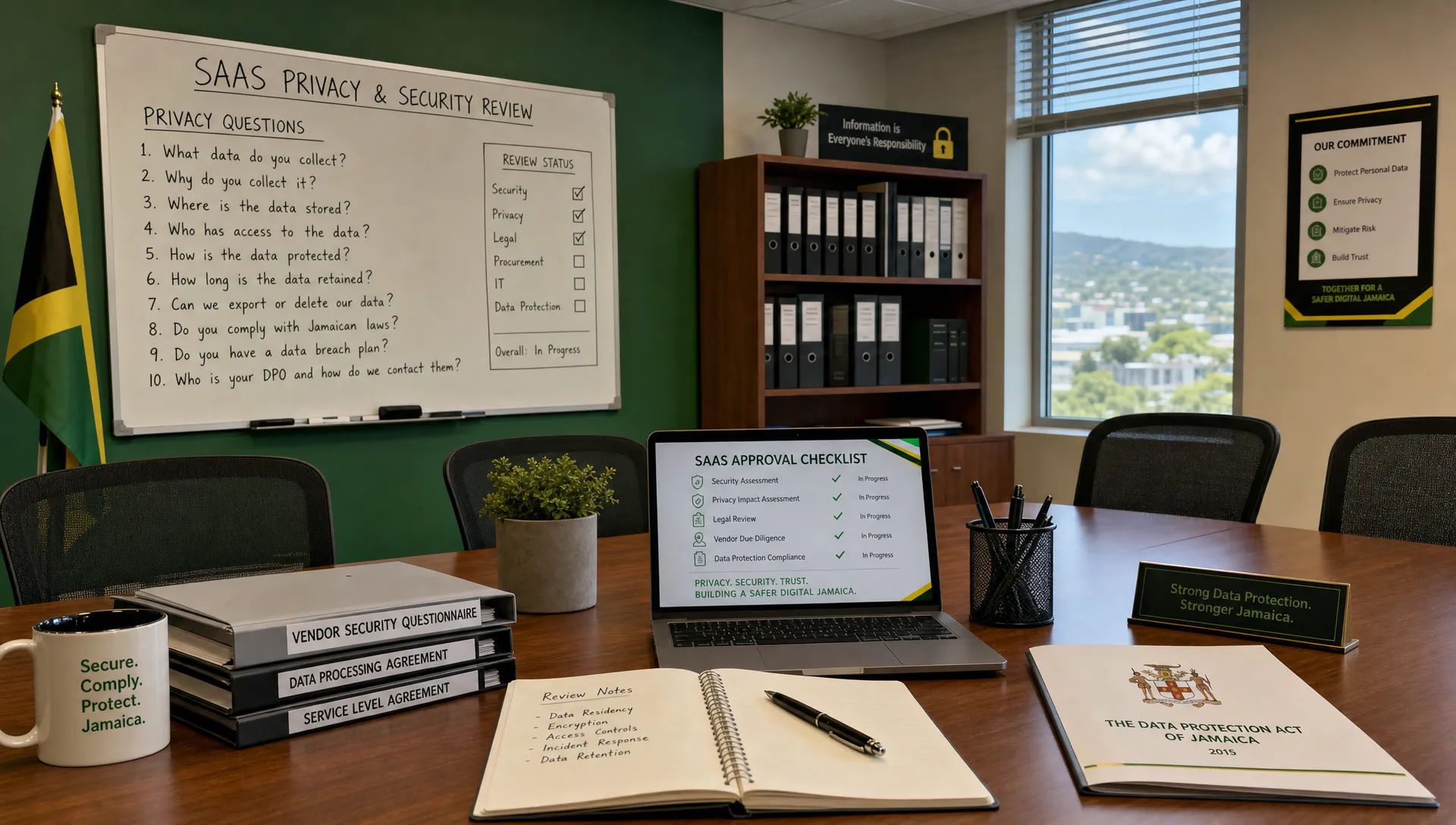
A new SaaS platform can look harmless at first: a project management tool, CRM add-on, HR portal, chatbot, analytics dashboard or shared workspace. The risk starts when real customer, employee, supplier or patient information is uploaded before anyone has checked what the vendor will do with it.
For Jamaican organisations, this is not only an IT issue. Under Jamaica's Data Protection Act, 2020, an organisation that decides why and how personal data is processed remains responsible for handling that data lawfully, fairly and securely. Outsourcing to a cloud vendor does not outsource accountability.
The goal is not to slow down every useful technology purchase. The goal is to ask the right privacy questions before the trial becomes the system of record, before staff create workarounds and before the vendor's standard terms become difficult to change.
Why privacy questions should come before SaaS approval
SaaS adoption often happens quickly. A department finds a tool, signs up for a demo, uploads sample data and invites colleagues. By the time procurement, legal, compliance or information security gets involved, the organisation may already have personal data in the platform.
That creates avoidable risk. If the SaaS vendor has weak security, unclear subcontractors, broad rights to reuse data or poor deletion processes, your organisation may face operational disruption, regulatory exposure and reputational damage. The Office of the Information Commissioner in Jamaica provides guidance and oversight for data protection compliance, but each organisation still needs its own practical review process.
A simple privacy review helps you decide whether to approve the platform, approve it with conditions, restrict the data that may be uploaded or reject it. If your organisation already performs supplier checks, these questions can fit naturally into a broader process to run a simple vendor privacy assessment.
Start with the data, not the software
Before asking about encryption, certifications or contract clauses, clarify what information the SaaS platform will handle. Privacy risk depends heavily on the type of data, the number of people affected and the consequences if the data is misused, lost or exposed.
Privacy question | Why it matters | Evidence to request |
What business problem will the platform solve? | A clear purpose helps prevent unnecessary collection and function creep. | Business case, process map or approval request |
What personal data will be uploaded, viewed or generated? | Names, contact details, IDs, financial records and employee data do not carry the same risk. | Data fields list or sample data template with fake data |
Who does the data relate to? | Customers, employees, children, patients and vulnerable individuals may require different safeguards. | Data subject category list |
Can the purpose be achieved with less data? | Data minimisation reduces breach impact and compliance burden. | Reduced field list or configuration plan |
Will real data be used during testing? | Trial environments are often less controlled than production systems. | Testing plan using dummy or anonymised data where possible |
Will the platform create new data about users? | Logs, behavioural analytics, scoring and AI outputs can become personal data. | Product documentation and analytics settings |
One practical rule is to avoid uploading full customer or employee files during a trial. If the vendor needs a test dataset, use dummy data or a small, approved sample with unnecessary fields removed.
Ask what legal role the SaaS provider plays
Not every SaaS vendor has the same privacy role. In many cases, your organisation is the data controller because it decides the purpose of processing, while the SaaS provider acts as a data processor by hosting or managing the data on your behalf. In other cases, the vendor may act as an independent controller for some activities, such as its own billing, platform security analytics or product improvement.
Ask the vendor to explain its role in plain language. The answer should match the contract, privacy notice and product behaviour. If the vendor says it is only a processor but also reserves broad rights to analyse, sell, combine or reuse your data for its own purposes, that inconsistency needs attention.
Key questions include:
Does the vendor act as a processor, controller or both for different parts of the service?
Does the contract include data protection obligations that match the vendor's role?
Can the vendor use your organisation's data for product improvement, AI training, benchmarking or marketing?
Does the vendor require documented instructions before processing personal data on your behalf?
What assistance will the vendor provide if individuals exercise privacy rights?
This is also where procurement should be involved. SaaS privacy risk is part of third-party risk, so it helps when sourcing teams ask privacy and security questions before selecting a preferred vendor. PLMC has also outlined broader third-party risk questions procurement teams should ask when onboarding suppliers.
Review the contract before the data moves
A SaaS contract should do more than describe pricing and uptime. It should make clear what the vendor can and cannot do with personal data. Standard online terms often favour the vendor, especially for low-cost tools, so read them before employees upload data.
At minimum, review whether the agreement covers confidentiality, processing instructions, security controls, breach notification, subcontractors, international transfers, audit rights, data return and deletion. If the vendor provides a separate data processing agreement, check that it is actually incorporated into the contract and applies to the services your organisation will use.
Contract area | Question to ask before signing |
Processing instructions | Will the vendor process personal data only as instructed by your organisation? |
Confidentiality | Are vendor staff and contractors bound by confidentiality obligations? |
Subcontractors | Does the vendor disclose subprocessors and notify you before material changes? |
Security | Are minimum security controls described clearly, not just as commercially reasonable efforts? |
Breach notification | How quickly must the vendor notify you of a suspected or confirmed incident? |
Audit and assurance | Can you request security reports, certifications or reasonable audit information? |
Deletion | What happens to live data, backups and logs when the contract ends? |
Liability | Are privacy, confidentiality and security breaches treated appropriately in limitation clauses? |
Avoid relying only on a sales deck. Sales materials can be useful, but the contract is what will matter when there is a dispute, breach or termination.
Ask where the data is stored and accessed
Cloud platforms often move data across borders. A vendor may be incorporated in one country, host data in another and provide technical support from several others. That matters because Jamaica's Data Protection Act, 2020 places obligations on organisations when personal data is transferred or made accessible outside Jamaica.
If a vendor says it is GDPR compliant, that may be helpful evidence of maturity, but GDPR Jamaica alignment is not automatic compliance with your local obligations. You still need to understand the actual data flows and safeguards.
Ask these questions before approval:
In which countries will personal data be stored, backed up or replicated?
From which countries can vendor staff, support teams or subcontractors access the data?
Does the vendor offer data residency options that match your risk profile?
What legal and contractual safeguards apply to cross-border transfers?
Will the vendor notify your organisation before adding a new subprocessor or support location?
Can your organisation restrict support access, remote access or administrative access?
Cross-border access is easy to miss because no one may be physically transferring a file. If a support engineer outside Jamaica can log into a customer record or employee profile, that access still needs to be considered.
Ask how access and security are controlled
Privacy and cyber security are closely connected. A SaaS platform that stores personal data should help your organisation enforce least privilege, monitor activity and respond to suspicious behaviour. The NIST Cybersecurity Framework is a useful reference point because it organises cyber risk management around identifying, protecting, detecting, responding and recovering.
For SaaS review, focus on controls your organisation can actually configure and verify. A vendor may have strong infrastructure controls, but your risk remains high if every user is an administrator or if login logs are unavailable.
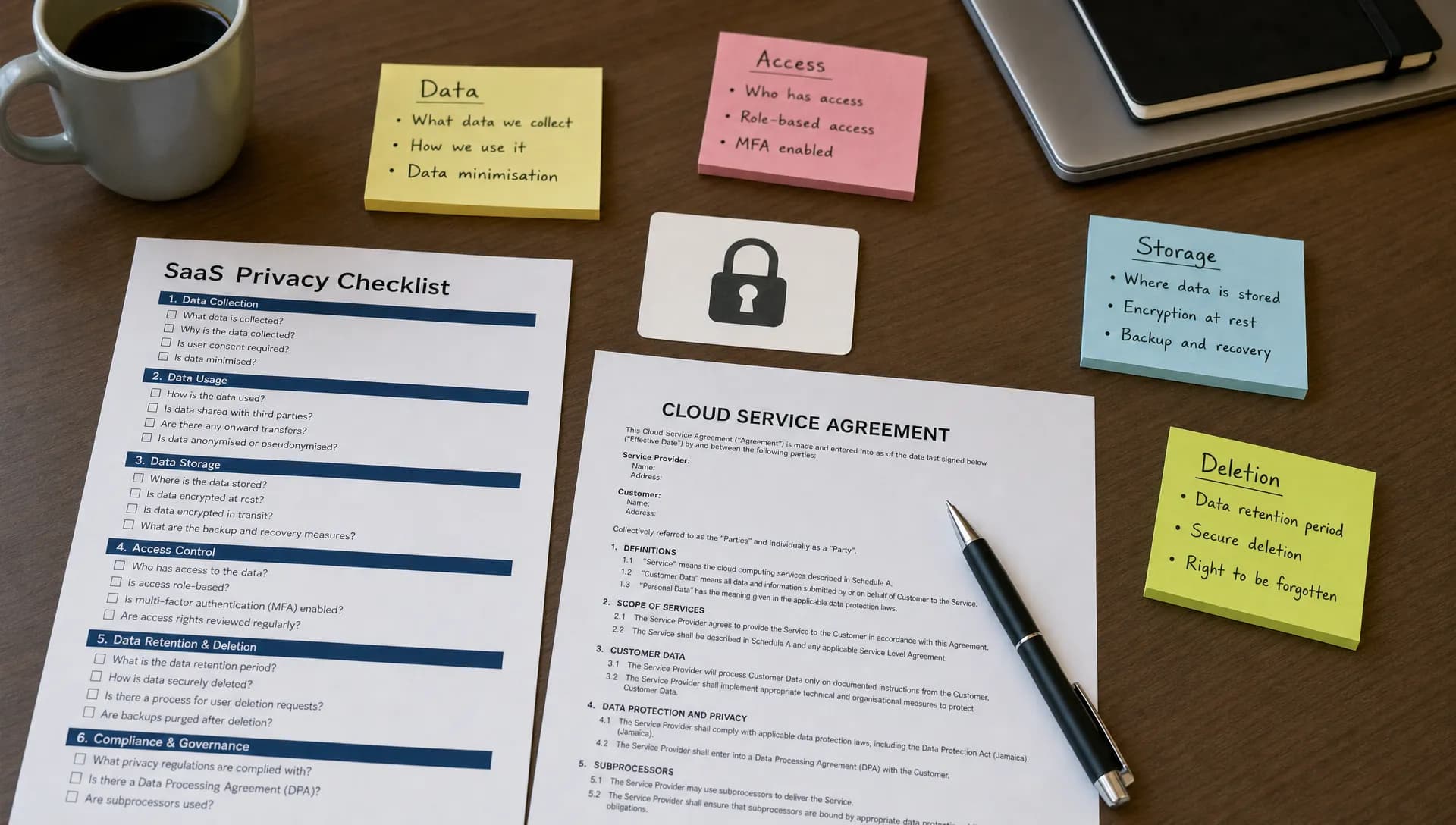
Security area | Privacy questions to ask |
Authentication | Does the platform support multi-factor authentication, single sign-on or strong password controls? |
User permissions | Can access be limited by role, team, location or function? |
Administrator access | Can admin privileges be separated, reviewed and removed quickly? |
Encryption | Is data encrypted in transit and at rest? |
Activity logging | Are login, export, admin and data change events logged? |
Data exports | Can bulk downloads be restricted, monitored or disabled? |
APIs and integrations | Are API keys, webhooks and integrations controlled and auditable? |
Vulnerability management | Does the vendor test for vulnerabilities and fix critical issues within defined timelines? |
Tenant separation | How does the vendor prevent one customer's data from being accessed by another customer? |
Do not accept vague answers such as industry-standard security without detail. Ask for security documentation, independent assurance reports or a completed security questionnaire where the risk level justifies it.
Ask what happens if there is a breach
A privacy incident involving a SaaS platform can unfold quickly. Your organisation may need to understand what happened, contain the exposure, notify stakeholders, preserve evidence and decide whether regulatory notification is required. If the vendor controls the logs and infrastructure, your response depends on the vendor's cooperation.
Ask the vendor:
What counts as a security incident or personal data breach under the contract?
What is the notification timeframe after the vendor becomes aware of an incident?
Who will be notified and through what channel?
What information will the vendor provide about affected data, affected individuals, root cause and containment?
Will the vendor preserve logs and evidence?
Will the vendor assist with regulatory, customer or employee communications if needed?
Has the vendor tested its incident response process?
The breach clause should be operational, not symbolic. A statement that the vendor will notify you as required by law may not be enough if your organisation needs fast, factual information to meet its own obligations.
Ask about retention, deletion and exit before you sign
Exit planning is a privacy issue. If the platform becomes difficult to leave, your organisation may keep personal data longer than necessary or lose control over records during migration. This is especially important for HR, finance, customer portals, case management, marketing automation and any platform holding regulated or sensitive information.
Before using the SaaS platform, define what happens when the contract ends, when a user leaves, when a record reaches the end of its retention period or when a customer requests deletion. PLMC has covered this issue in more depth in its guidance on cloud exit planning and protecting data when changing vendors.
Exit scenario | Questions to ask |
Contract termination | Can all data be exported in a usable format before access is removed? |
Deletion request | Can specific records be deleted without deleting unrelated records? |
Backup retention | How long does data remain in backups after deletion from the live system? |
Account closure | Will the vendor certify deletion or provide written confirmation? |
Migration | Does the vendor provide reasonable support to transfer data to another system? |
Legal hold | Can deletion be paused where your organisation has a lawful reason to retain records? |
A good exit plan should be written before the first upload, not during a dispute with the vendor.
Match the review depth to the risk
Not every SaaS platform needs the same level of review. A tool that stores public event photos has a different risk profile from a platform that processes payroll, health data, identity documents or customer complaints. Use a risk-based approach so that reviews are efficient but defensible.
SaaS risk level | Typical example | Suggested privacy review |
Low | Tool with no personal data or only business contact details | Basic data mapping, terms review and access controls |
Medium | CRM, marketing tool, learning platform or internal collaboration system | Vendor questionnaire, contract review, security review and retention check |
High | HR, finance, health, identity, children, large customer datasets or AI profiling | Detailed due diligence, legal review, security assurance, transfer assessment and senior approval |
Risk can also increase because of volume. A basic contact field may be low risk in one record but significant when the platform holds hundreds of thousands of customer profiles.
Watch for SaaS privacy red flags
Some warning signs do not automatically mean you must reject a vendor, but they should trigger closer review or negotiation.
The vendor refuses to sign any data protection terms.
The privacy policy is vague about data sharing, retention or international transfers.
The vendor claims ownership over customer data or broad rights to reuse it.
There is no clear subprocessor list.
Breach notification language is weak or missing.
The platform lacks multi-factor authentication for administrative users.
Users can export large datasets without logging or approval.
The vendor cannot explain deletion from backups.
Support staff can access customer data without controls or approval.
The vendor's answers conflict with its contract or privacy notice.
When a red flag appears, document the issue and decide whether it can be fixed through configuration, contract wording, reduced data use or an alternative platform.
Keep an approval record
A SaaS privacy review should leave a record that someone else can understand later. This protects the organisation if questions arise during an audit, incident, renewal or regulatory inquiry.
Your approval record should capture the platform name, business owner, purpose, data categories, data subject groups, vendor role, storage locations, subprocessors, key contract documents, security controls reviewed, residual risks, required conditions and approval date. It should also name the person responsible for reviewing the platform at renewal or when the vendor changes its terms.
The review does not need to be complicated. It needs to be clear, proportionate and repeatable.
Frequently Asked Questions
Do we need to review a SaaS platform if we only use it for a free trial? Yes, if real personal data will be uploaded, viewed or generated during the trial. A free trial can still create data protection risk, especially if staff upload customer lists, employee files or live support tickets.
Is a GDPR-compliant SaaS vendor automatically acceptable for a Jamaican organisation? No. GDPR compliance may indicate useful controls, but your organisation must still assess the platform under Jamaica's Data Protection Act, 2020, your own policies and the actual data flows involved.
Who should ask these SaaS privacy questions? The business owner should explain the purpose and data use, IT or security should review technical controls, legal or compliance should review privacy terms and procurement should manage supplier risk. For higher-risk platforms, senior approval may be appropriate.
What if the vendor will not answer privacy or security questions? Treat that as a risk factor. Depending on the data involved, you may need to limit the data used, seek stronger contract terms, require alternative controls or choose another vendor.
How often should an approved SaaS platform be reviewed? Review it at renewal, when the vendor changes its terms, when new data categories are added, when integrations change or when the platform is used for a new purpose. High-risk platforms should be reviewed more frequently.
Need support with SaaS privacy review?
If your organisation is adopting a new SaaS platform, PLMC can help you assess the privacy, governance and compliance risks before personal data is shared. Privacy & Legal Management Consultants Ltd. supports Jamaican organisations with data protection implementation, corporate governance, cyber security alignment, training and compliance readiness.
To discuss a practical review process for your next cloud tool, visit Privacy & Legal Management Consultants Ltd. and request guidance before the platform goes live.