
Privacy Risks in Customer Call Recording
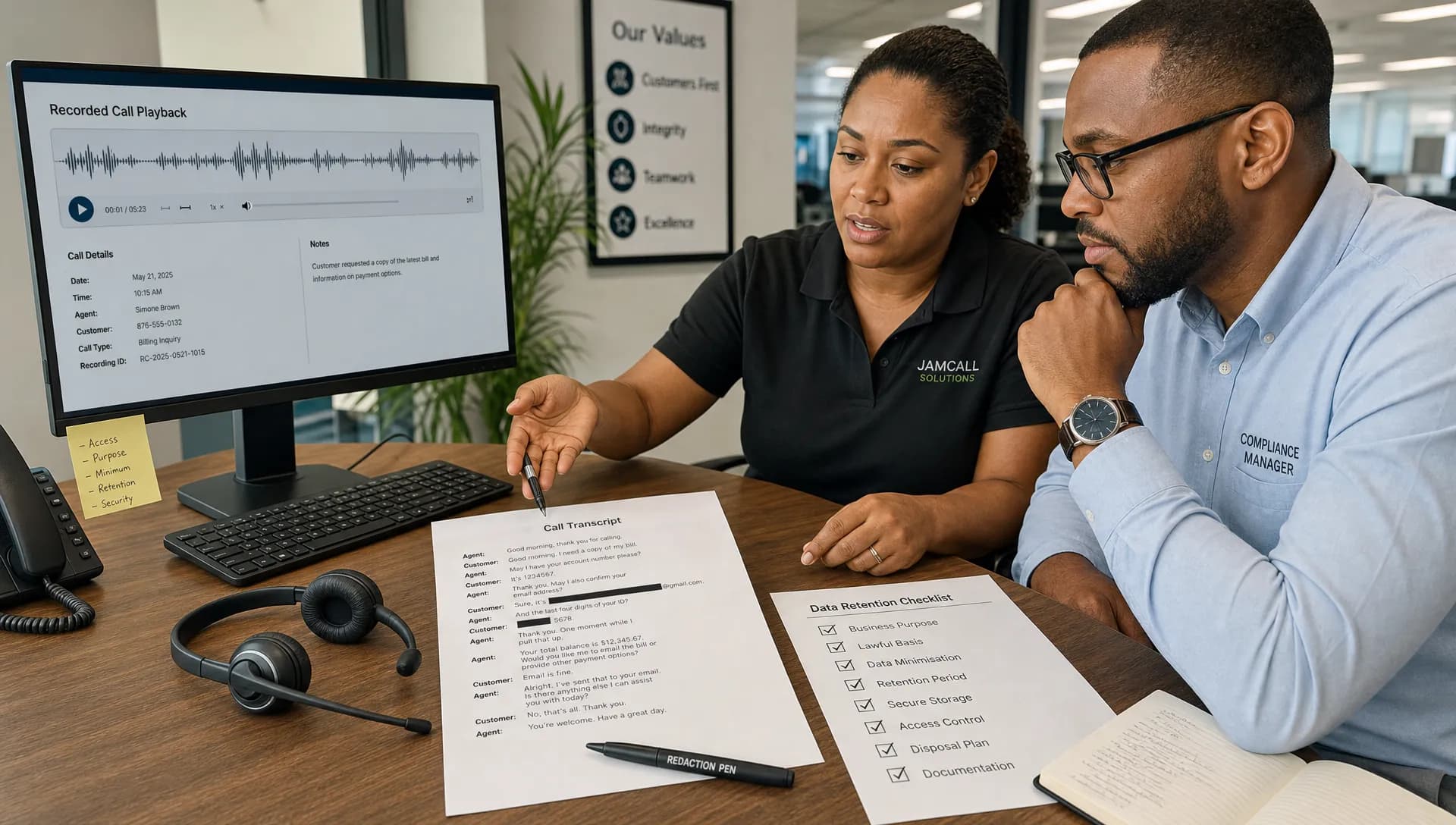
Customer call recording is useful for quality assurance, dispute handling, fraud review and training. In regulated sectors such as financial services, insurance, healthcare, utilities, telecommunications and business process outsourcing, recordings can also help verify instructions and investigate complaints. The privacy risk is that a recorded call is rarely just a recording of a service interaction. It may contain names, account numbers, contact details, payment information, health information, complaints, family details, employee voices and background conversations.
For Jamaican organisations, that means call recordings must be treated as personal data when an identifiable customer, employee or third party can be linked to the audio. Under Jamaica's Data Protection Act, 2020, organisations are expected to process personal data fairly, use it for clear purposes, keep it secure and avoid retaining it longer than necessary. The Office of the Information Commissioner is the local authority organisations should monitor for guidance and compliance updates.
The practical challenge is balancing business value with privacy obligations. A call centre may want every call available for coaching. A compliance team may want recordings for audit evidence. A customer service manager may want to review complaints quickly. None of those goals are wrong, but they can create serious exposure if the organisation records more than it needs, stores recordings indefinitely or allows too many people to access them.
Why call recordings carry higher privacy risk than many records
Call recordings are often more revealing than structured customer records. A database field may show a name, telephone number and account status. A call recording may reveal tone of voice, emotional state, home circumstances, financial stress, health concerns or the identity of a family member who spoke in the background.
Audio is also harder to search, classify and redact than written data. If a customer mentions a medical condition halfway through a 30 minute call, the organisation may not notice that sensitive information entered the recording unless the call is reviewed or transcribed. If the recording is later shared for training, complaint handling or legal review, that sensitive information travels with it.
This is why call recording should not be treated as a routine operational convenience. It should sit inside the wider customer data lifecycle. If your organisation is reviewing how customer information is collected, stored, used and disposed of, PLMC's guidance on how to protect customer data end-to-end is a useful companion to this call recording review.
Common privacy risks in customer call recording
Vague notice or no meaningful notice
Many organisations rely on a short message such as, This call may be recorded for quality and training purposes. That may be better than saying nothing, but it is often incomplete. If recordings are also used for fraud detection, dispute resolution, staff performance monitoring, compliance investigations or speech analytics, customers should not be left guessing.
A fair call recording notice should be clear before recording begins, or as early as practical. It should explain that the call is recorded, identify the main purposes and point customers to the organisation's privacy notice for more detail. Where an alternative channel is available, such as email, branch service or secure portal messaging, the organisation should consider how to communicate that option.
The risk increases when teams record outbound calls, WhatsApp calls or video calls without adapting the notice. Each channel needs a consistent approach, not a script that only works for inbound telephone calls.
Recording more information than the organisation needs
Over-collection is one of the most common call recording risks. Agents may ask customers to repeat full account numbers, national identification details, dates of birth, addresses or payment card information even when partial verification would be enough. Some systems record the entire call even during payment capture. Others keep the recording running while a customer searches for documents, speaks to a relative or reads out unrelated information.
The control is not only technical. It is also procedural. Call scripts should tell agents what not to ask for, how to verify identity with the minimum necessary information and when recording should be paused or stopped. If payment card data is taken over the phone, organisations should consider their obligations under the PCI Security Standards Council requirements and avoid storing sensitive authentication data in call recordings.
Indefinite retention of recordings
Call recordings can become a privacy liability when they are kept for years without a clear business reason. The longer an organisation stores recordings, the longer it must protect them, search them for access requests, review them during incidents and explain why they are still needed.
A retention period should be tied to purpose. Quality assurance samples may only be needed for a limited coaching cycle. Complaint recordings may need to be kept until the complaint period and related dispute window have passed. Recordings linked to legal claims, fraud investigations or anti-money laundering reviews may require separate handling, but that should be documented rather than left to habit.
A practical retention schedule helps teams avoid keeping recordings simply because storage is cheap. PLMC has also outlined how retention schedules reduce privacy exposure, which is especially relevant for high volume contact centres.
Excessive internal access
Call recordings are valuable to customer service, compliance, legal, audit, IT and management teams. That does not mean every team needs broad access. Excessive access creates the risk of curiosity browsing, inappropriate sharing, unauthorised downloads or recordings being used for purposes customers were not told about.
Access should be role-based and reviewed periodically. Supervisors may need access to calls handled by their team. Compliance may need access to flagged calls. IT may need administrative access to maintain the platform, but not routine playback access to customer conversations. Where possible, systems should log playback, downloads, exports, deletions and administrative changes.
Weak handling of transcripts and analytics
Many organisations now use transcription, keyword search, sentiment analysis or AI-supported call review. These tools can improve complaint resolution and training, but they create additional privacy questions. A transcript is another personal data record. It may be easier to copy, email, search and expose than the original audio file.
If analytics tools are used, the organisation should know what data is processed, where it is hosted, whether the vendor uses the data to improve its own models, how long transcripts are kept and whether human reviewers outside the organisation can access calls. These points should be addressed in vendor due diligence and contract terms.
Third-party vendor and cloud platform risk
Many call recording environments depend on cloud contact centre platforms, telecom providers, outsourced call centres, storage vendors or analytics providers. Outsourcing does not remove responsibility from the organisation that decides why recordings are collected and how they are used.
Vendor contracts should cover confidentiality, security controls, breach notification, sub-processors, access restrictions, return or deletion of recordings and support for data subject rights. If recordings are stored or accessed outside Jamaica, organisations should assess whether the transfer is permitted and whether the destination provides appropriate protection.
Employee privacy and workplace monitoring
Customer calls record employees too. Agents' voices, conduct, performance, mistakes and interactions with customers are captured. If recordings are used for coaching, disciplinary action, productivity review or automated scoring, staff should receive clear notice about those uses.
Employee monitoring should be proportionate. Recording every call may be justified in some high risk environments, but the organisation should be able to explain why that level of monitoring is necessary. Staff should also be trained on confidentiality expectations, since call recordings often expose both customer and employee information. Practical confidentiality data handling rules help reduce the risk of recordings being misused after they are created.
Biometric and voice authentication concerns
A normal customer service recording is not always biometric data. The risk changes when the organisation uses voiceprints or voice authentication to identify a person. In that case, the voice data may be used as a unique identifier and should be treated with heightened care.
Voice authentication projects should go through a privacy review before launch. The organisation should assess necessity, consent or other lawful justification, enrolment procedures, false acceptance risk, false rejection risk, security of voice templates, retention and deletion. It should also decide what happens when a customer does not want to enrol or later wants to withdraw.
A practical risk and control view
The table below summarises common call recording privacy risks and practical controls Jamaican organisations can adapt to their own environment.
Privacy risk | What can go wrong | Practical control |
Inadequate notice | Customers do not know calls are recorded or how recordings are used | Use a clear call recording notice and align it with the privacy notice |
Over-collection | Agents capture unnecessary identifiers, payment data or sensitive information | Update scripts, reduce verification data and pause recording where needed |
Long retention | Recordings are stored after the business need has ended | Set purpose-based retention periods and automate deletion where possible |
Excessive access | Staff replay, download or share recordings without a need to know | Apply role-based access, logging and periodic access reviews |
Vendor exposure | Cloud or outsourced providers mishandle recordings | Conduct vendor due diligence and include privacy clauses in contracts |
Analytics misuse | Transcripts and AI outputs are reused beyond the original purpose | Review analytics tools, model use, retention and human access |
Employee monitoring | Recordings are used for staff performance in unexpected ways | Give staff clear notice and keep monitoring proportionate |
Weak incident response | Breached recordings are not identified or contained quickly | Include call recordings in breach response plans and data maps |
How to reduce privacy risk without losing business value
The goal is not necessarily to stop recording calls. The goal is to record deliberately. Organisations can reduce exposure by designing the recording process around purpose, transparency, access control and retention.
Start with a data map. Identify which lines are recorded, which departments use recordings, where the files are stored, who can access them, whether transcripts are created and which vendors are involved. Many privacy failures come from gaps between what leadership thinks is happening and what the call centre process actually does.
Next, define the approved purposes. Quality assurance, complaint management, fraud investigation, legal evidence, regulatory compliance and staff training are different purposes. Each purpose may require different access rules and retention periods. If a new purpose is introduced, such as AI sentiment analysis, it should be reviewed before the recordings are repurposed.
Then review the customer and employee notices. The wording should be plain enough for customers to understand. It should avoid vague language and should not suggest that recordings are only used for training if they are also used for investigations or compliance reviews. Staff notices should explain how recordings affect coaching, supervision and disciplinary processes.
Security controls should match the sensitivity of the recordings. At a minimum, organisations should consider encryption, strong authentication, role-based permissions, logging, secure deletion, download restrictions and periodic access reviews. Where recordings include financial, health or identity information, stronger controls may be needed.
Training is also essential. Agents should know how to avoid unnecessary collection, how to handle callers who object to recording, how to pause recording during sensitive moments and how to escalate privacy concerns. Supervisors should know when it is appropriate to share a recording, when redaction is needed and when legal or privacy advice should be sought.
Finally, include call recording in the risk register. If call recording is high volume, outsourced, cloud-based or linked to sensitive data, it should not be hidden inside a generic IT risk. A clear privacy risk statement can help management track the issue, assign ownership and fund the right controls. PLMC's article on how to add data protection to your risk register gives a practical structure for doing this.
Call recording privacy checklist
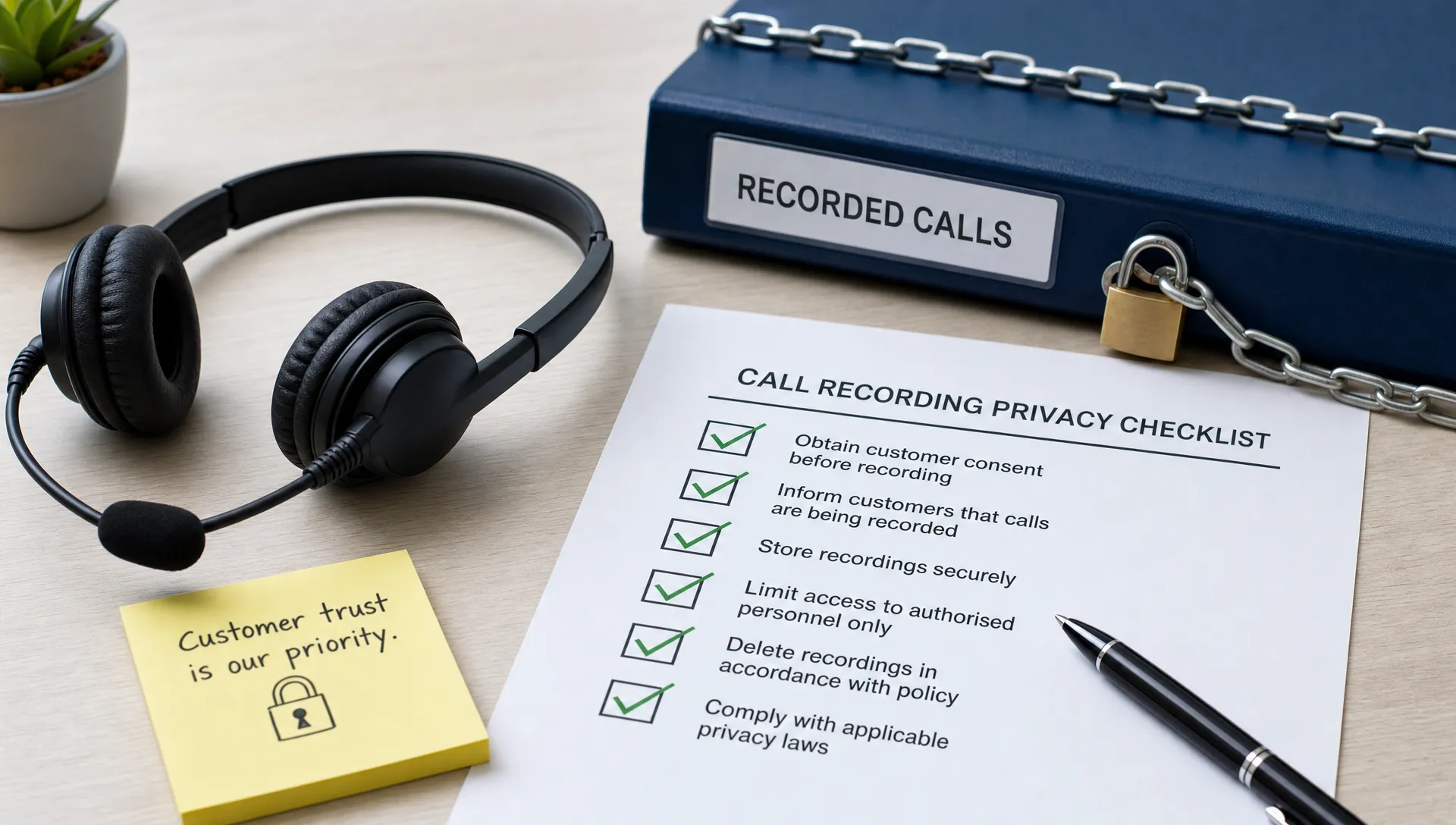
Use this checklist as a starting point for an internal review. It is not a substitute for legal advice, but it can help identify obvious gaps.
Confirm which inbound, outbound and digital voice channels are recorded.
Document each approved purpose for recording and who owns that purpose.
Check that customer notices match the real uses of recordings.
Review call scripts to reduce unnecessary collection of identifiers and sensitive data.
Test pause and resume controls for payment or highly sensitive conversations.
Apply role-based access and review playback or download logs.
Set retention periods by purpose and confirm deletion actually happens.
Review vendor contracts, hosting locations and support access.
Train agents, supervisors and compliance teams on recording rules.
Include call recordings in breach response, data subject request and risk register processes.
When a privacy impact assessment may be needed
A privacy impact assessment is particularly useful when the recording activity is new, high volume, sensitive or technologically complex. Examples include launching a new cloud contact centre, recording all calls for the first time, introducing AI transcription, using recordings for automated staff scoring or implementing voice authentication.
The assessment should examine necessity, proportionality, risks to customers and employees, security controls, third-party access, retention and alternatives. It should also capture decisions made by the business, privacy, legal, compliance, HR, IT and customer service teams. This creates evidence that the organisation considered privacy before deployment, not after an incident.
For organisations operating across borders, the assessment should also consider whether GDPR, overseas client requirements or sector-specific rules apply alongside Jamaica data privacy obligations. This is especially relevant for BPOs, financial institutions and service providers handling customer calls on behalf of international clients.
Frequently Asked Questions
Do Jamaican organisations need to tell customers that calls are recorded? Yes. A clear notice supports fair processing and helps customers understand how their personal data will be used. The notice should reflect the real purposes of recording, not only quality assurance if recordings are also used for disputes, compliance or investigations.
Can a business record calls for training purposes? Recording for training may be appropriate where it is necessary, transparent and proportionate. The organisation should limit access, avoid using more information than needed and set a retention period for training recordings.
How long should customer call recordings be kept? There is no single retention period that fits every organisation. The period should depend on the purpose of the recording, legal or regulatory needs, complaint timelines and business risk. Keeping all recordings indefinitely creates avoidable privacy exposure.
Are call transcripts subject to the same privacy rules as audio recordings? Yes. If a transcript identifies a customer, employee or other person, it should be treated as personal data. Transcripts often need the same or stronger access controls because they are easy to search, copy and share.
What should organisations do if payment card information is captured in a recording? The organisation should assess whether the recording violates internal policy or payment security requirements, restrict access, delete or redact the sensitive portion where possible and fix the process that allowed the capture to happen.
Does using a cloud call recording provider transfer the privacy responsibility to the vendor? No. The organisation that determines why and how calls are recorded remains responsible for ensuring appropriate controls, contracts and oversight are in place.
Build safer call recording practices
Call recording can support better service, stronger evidence and more effective compliance. It can also create a large store of sensitive personal data if privacy is not built into the process from the start.
Privacy & Legal Management Consultants Ltd. helps Jamaican organisations strengthen data protection implementation, privacy training, risk assessments and GRC integration. If your organisation records customer calls or plans to introduce new call centre technology, consider arranging a privacy review or consultation through PLMC before the risk becomes an incident.