

Privacy Due Diligence for Mergers and Acquisitions

Most M&A diligence asks whether the target owns assets, pays taxes, manages contracts and reports its liabilities accurately. Privacy due diligence asks a different question: can the buyer lawfully, securely and commercially use the personal data it is about to acquire?
That question now belongs near the centre of any transaction involving customer records, employee files, health information, payment data, marketing databases, surveillance footage, KYC files or platform analytics. A company may look profitable on paper, yet carry privacy risks that affect valuation, regulatory exposure, integration timelines and even the buyer's ability to use acquired data after closing.
For Jamaican organisations, this review should be grounded in the Data Protection Act, 2020 as well as any sector obligations, cross-border requirements and contractual commitments made to customers or partners. The Office of the Information Commissioner is the key regulator for data protection in Jamaica, and the direction of travel is clear: privacy governance is now part of sound corporate governance.
Why privacy due diligence matters in mergers and acquisitions
Privacy due diligence for mergers and acquisitions is not just a legal checklist. It is a risk and value exercise. Buyers need to know whether the target's data practices support the deal thesis or undermine it.
If the value of the target depends on customer insight, digital channels, data-driven marketing, SaaS usage data, call centre records or client onboarding files, the buyer must confirm that the data was collected lawfully, protected properly and can be used for the planned purpose. If not, the buyer may inherit a dataset that is commercially attractive but legally restricted.
Privacy failures can affect a transaction in several ways. A serious security incident can trigger investigation costs and customer notifications. Weak consent records can reduce the value of a marketing database. Poor vendor controls can create third-party exposure. Unclear retention practices can leave the business holding years of unnecessary personal data. Missing privacy notices can make post-close integration harder, especially when customer accounts or employee systems are being consolidated.
Boards should also treat privacy diligence as part of wider governance oversight. If directors are already reviewing legal, cyber and compliance risks, privacy belongs in the same conversation. PLMC's article on privacy legal risks boards should review is a useful companion for framing these issues at board level.
Start before the data room opens
The diligence process itself can create privacy risk. A seller may be tempted to upload employee lists, customer contracts, complaints, medical records or KYC documents into a virtual data room without filtering the personal data inside. That can expose the seller, the buyer and their advisers before the main transaction has even begun.
Before the data room opens, the deal team should decide what personal data is truly needed for diligence and what can be aggregated, anonymised, sampled or redacted. Buyers rarely need full employee addresses, national identification numbers, customer dates of birth or bank details to assess the quality of the business. In many cases, summaries and controlled samples are enough.
The NDA should also address personal data. It should restrict access to deal purposes, limit onward sharing, set confidentiality standards, define return or deletion obligations and require appropriate security. For higher-risk deals, a clean team can review sensitive data and provide conclusions to the wider buyer team without disclosing unnecessary details.
This is more than courtesy. Under data protection principles, personal data should be processed fairly, lawfully, securely and only for appropriate purposes. A careless data room can become the first privacy failure of the transaction.
Core areas to review during privacy due diligence
A strong review starts with the target's data reality, not with policy documents alone. Policies matter, but they may not reflect how the business actually collects, stores, shares and deletes personal data.
Data inventory and processing purposes
The buyer should identify what categories of personal data the target holds, whose data it is, where it sits and why it is being used. This includes customer data, employee data, supplier contacts, website analytics, CCTV, call recordings, complaint files and legacy databases.
A living data inventory helps answer practical deal questions. Can customer data be migrated into the buyer's CRM? Can the buyer use historical marketing lists? Are there sensitive categories of data that need stronger controls? Are there old databases that should be deleted before or soon after closing?
Where the target has never mapped its processing, the buyer may need to run a rapid assessment. The approach in PLMC's guide to a data privacy risk assessment can help teams structure that review without turning diligence into an open-ended project.
Lawful processing, notices and consent
The buyer should review privacy notices, customer terms, employee notices, website notices, cookie practices and consent records. The aim is to determine whether individuals were told how their data would be used and whether the target has a valid basis for each major processing activity.
Consent deserves careful attention. If the target relies on consent for marketing, health data, children-related services or data sharing, the buyer should test whether consent was properly collected, recorded and capable of withdrawal. Weak consent records may limit the buyer's ability to use the data after closing.
A privacy notice that says data will be used only by one named company may also create integration challenges. If the buyer wants to combine databases, centralise support or transfer records to a regional group company, the legal team should confirm whether further notice, consent or contractual steps are needed.
Cybersecurity and incident history
Privacy diligence and cyber diligence overlap, but they are not identical. Cyber diligence examines technical resilience. Privacy diligence asks whether personal data is protected in line with legal duties, customer promises and reasonable expectations.
The buyer should review access controls, encryption practices, backup processes, endpoint management, incident response plans, penetration test summaries, audit logs and security training records. It should also ask for a register of security incidents, complaints, near misses and regulatory correspondence.
Even if no breach has been reported, the buyer should look for warning signs: shared administrator accounts, former employees with active access, unpatched systems, unmanaged cloud storage, weak vendor controls or a lack of incident response testing. These issues may justify remediation conditions, indemnities, price adjustments or a post-close cyber improvement plan.
Vendors, processors and outsourced operations
Many privacy risks sit outside the target's direct control. Payroll providers, cloud platforms, call centres, payment processors, marketing agencies, IT support firms and document storage providers may all handle personal data for the target.
The buyer should review vendor contracts, data processing clauses, service levels, breach notification commitments, subcontracting rules, audit rights and exit provisions. If the target cannot identify which vendors process personal data, the buyer should treat that as a governance gap.
For a deeper review of third-party controls, PLMC's guidance on vendor due diligence for privacy and compliance teams is directly relevant to the M&A context.
Diligence area | Documents or evidence to request | Deal relevance |
Data inventory | Data maps, system lists, records of processing, business process summaries | Shows what data is being acquired and where it sits |
Privacy governance | Policies, ownership charts, training records, board or committee reports | Reveals whether privacy is actively managed |
Notices and consent | Privacy notices, consent forms, website notices, customer terms | Confirms whether data can be used for planned purposes |
Security controls | Incident logs, access control evidence, cyber policies, test summaries | Helps assess breach risk and remediation costs |
Vendor management | Processor contracts, vendor lists, audit reports, exit terms | Identifies third-party exposure and integration constraints |
Cross-border transfers | Hosting locations, group transfer arrangements, overseas processor details | Flags transfer restrictions and foreign law issues |
Retention and deletion | Retention schedules, deletion logs, archive rules, litigation hold procedures | Reduces exposure from unnecessary legacy data |
Complaints and disputes | Data subject requests, privacy complaints, regulator letters, claims | Shows historical friction and possible liabilities |
Red flags that can affect valuation or closing
Not every privacy gap should threaten a deal. Some issues can be handled through post-close remediation. Others may affect the economics of the transaction or require specific contractual protection.
A practical diligence report should separate low-level housekeeping issues from material risks. It should also connect each privacy finding to a business impact, such as loss of data utility, regulatory exposure, cyber remediation cost, customer trust risk or integration delay.
Red flag | Why it matters | Possible deal response |
No reliable data inventory | The buyer cannot confirm what personal data is being acquired | Require a pre-close mapping exercise or post-close remediation plan |
Unlawful or unclear marketing consent | Customer databases may be less valuable than expected | Adjust valuation, exclude certain data or require re-permissioning |
Prior breach with weak remediation | The buyer may inherit unresolved exposure | Request forensic reports, indemnities or closing conditions |
Key vendors without data clauses | The target may lack control over outsourced processing | Require contract remediation or vendor replacement plan |
Excessive legacy data | Old data increases breach and discovery risk | Require deletion, archiving or retention controls |
Cross-border data flows with no safeguards | Transfers may breach applicable privacy requirements | Pause transfers, add safeguards or restructure hosting |
Privacy promises inconsistent with integration plans | The buyer may not be able to combine or repurpose data | Update notices, obtain consents or limit post-close use |
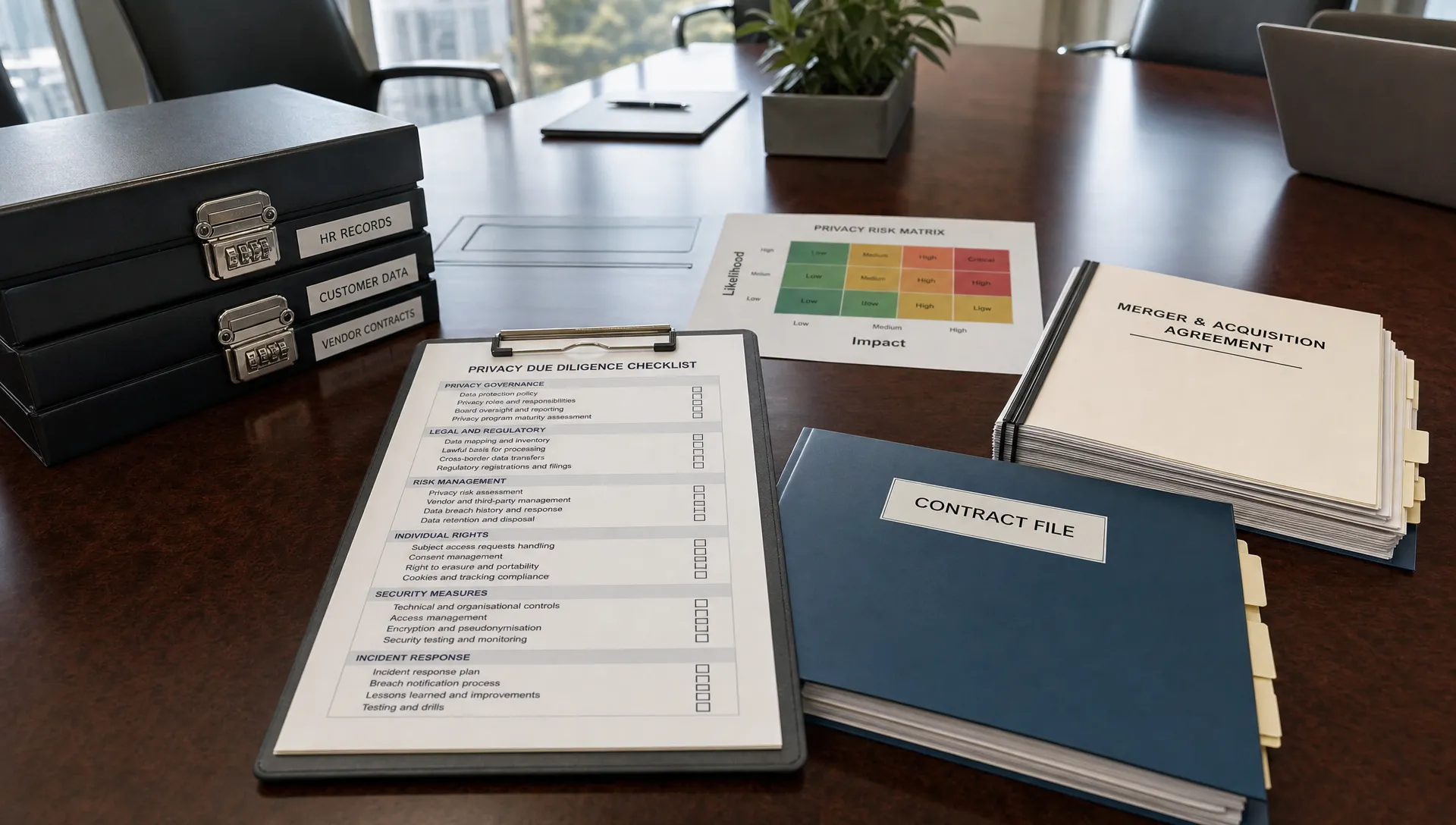
Running a focused privacy diligence workstream
M&A timelines are tight, so privacy diligence must be risk-based. The goal is not to ask every possible question. The goal is to find the issues that could affect signing, closing, valuation or integration.
A useful approach is to phase the work. Early diligence should focus on material data assets, regulatory exposure and obvious red flags. Deeper review can follow once exclusivity is in place or once the buyer confirms that data is central to the transaction value.
Deal stage | Privacy focus | Typical output |
Pre-NDA and initial screening | Identify whether the target holds high-risk personal data | Initial risk profile and data room rules |
Data room setup | Control what personal data is disclosed to bidders | Redaction plan, access controls and clean team process |
Confirmatory diligence | Test policies, systems, vendors, incidents and notices | Privacy diligence report with risk ratings |
Signing | Convert key findings into contractual protections | Warranties, covenants, indemnities or closing conditions |
Pre-close planning | Prepare for lawful transfer and operational continuity | Integration checklist and priority remediation plan |
Post-close integration | Fix gaps and align governance | Updated notices, vendor contracts, controls and training |
The diligence team should include legal, compliance, IT security, HR and business owners. If the acquisition involves regulated sectors such as financial services, healthcare, telecoms, education, insurance, BPO or e-commerce, sector expertise should be added early.
A good diligence report should be short enough for decision-makers to use. It should state what was reviewed, what was not reviewed, the key assumptions, the material findings, the risk level and the recommended deal response. Long legal memos have their place, but transaction teams need clear consequences.
Jamaican and cross-border issues to consider
For Jamaica data privacy compliance, the Data Protection Act, 2020 sets the baseline for how personal data should be handled. A transaction involving a Jamaican target should review whether the target has built practical controls around fair processing, data security, retention, data subject rights, accountability and third-party processing.
Cross-border issues often arise in Jamaican deals. A target may host data in the United States, use Caribbean or North American service providers, serve EU customers, manage overseas employees or belong to a multinational group. If EU personal data is involved, GDPR considerations may apply even where the buyer or target is based in Jamaica. If US consumers are involved, federal and state privacy, cybersecurity or consumer protection requirements may also become relevant.
The buyer should ask where personal data is stored, who can access it, whether group companies receive it and which law governs the relevant contracts. Cloud hosting locations and support access can matter as much as formal data exports.
Anti-money laundering obligations can also complicate privacy diligence. Financial institutions, designated non-financial businesses and other regulated organisations may need to collect and retain KYC records, beneficial ownership information and transaction monitoring data. The buyer should confirm that AML retention and access practices are balanced with privacy duties, especially where sensitive identity documents are stored. PLMC's article on how AML and data privacy rules intersect in practice explains this overlap in more detail.
What to fix after closing
Closing does not cure unlawful collection, poor security or weak governance. If anything, the first months after closing are when privacy risks become more visible. Systems are connected, user access is expanded, vendors are rationalised and data is migrated into new environments.
The buyer should have a post-close privacy plan ready before completion. The first priority is control: confirm who owns privacy governance, freeze unnecessary data transfers, secure access to sensitive systems and preserve evidence relating to prior incidents or complaints.
Next, the buyer should validate the data inventory and update notices where needed. Employees and customers may need to understand who now controls their data, how it will be used and whom they can contact. Vendor contracts should be reviewed and updated where processing roles or systems change.
The buyer should also review retention. M&A integration often reveals old archives, duplicate databases and abandoned applications. Keeping everything may feel safer, but excessive retention increases breach impact and makes future data subject requests harder to manage.
Training is another early win. Employees of the acquired business may be used to different rules, reporting lines or informal practices. Short, role-specific data privacy training can reduce accidental misuse during integration.
Practical questions buyers should ask
A buyer does not need a hundred questions to find the main risks. The following questions usually reveal whether deeper review is required:
What personal data does the target hold, and which datasets drive the value of the deal?
Was the data collected with proper notice, consent or another lawful basis?
Can the buyer use the data for the planned post-close purpose?
Has the target received privacy complaints, data subject requests, cyber claims or regulator correspondence?
Which vendors process personal data, and do their contracts contain appropriate privacy and security terms?
Where is personal data stored, and which countries can access it?
What sensitive personal data is held, including health, financial, biometric, identification or children-related data?
What privacy remediation costs should be included in the integration budget?
The strongest answers include evidence. A target that can show current policies, data maps, contracts, training records, incident logs and management reporting will inspire more confidence than one that relies on verbal assurances.
Frequently Asked Questions
What is privacy due diligence in mergers and acquisitions? Privacy due diligence is the review of how a target company collects, uses, stores, shares, protects and deletes personal data. In M&A, it helps the buyer assess legal risk, cyber exposure, data value and post-close integration issues.
When should privacy due diligence start? It should start before detailed personal data is placed in the data room. Early planning helps the seller redact or aggregate sensitive data, set access controls and avoid creating privacy risk during the transaction itself.
Is privacy due diligence required under Jamaica's Data Protection Act, 2020? The Act does not create a specific M&A checklist, but its obligations apply to the processing of personal data. A transaction that transfers, shares, reviews or integrates personal data should be assessed against those obligations.
What privacy documents should a buyer request? Common requests include privacy notices, consent records, data maps, retention schedules, vendor contracts, security policies, incident logs, data subject request records, training materials and any regulator correspondence.
How can privacy findings affect the deal terms? Material findings can lead to price adjustments, warranties, indemnities, closing conditions, remediation covenants or exclusions for certain datasets. Lower-risk issues may be handled through the post-close integration plan.
How does GDPR affect a Jamaican acquisition? GDPR may matter if the target processes EU personal data, offers goods or services to individuals in the EU or is part of a group with EU operations. The buyer should check data transfer, notice, lawful basis and processor obligations where EU data is involved.
Need support with privacy due diligence?
Privacy due diligence works best when legal, compliance, cyber and governance issues are reviewed together. Privacy & Legal Management Consultants Ltd. supports organisations in Jamaica with data protection implementation, corporate governance, AML compliance, cyber security, training and broader GRC integration.
If your organisation is buying, selling or integrating a business, contact PLMC to discuss a practical privacy due diligence review before signing, closing or post-close integration.